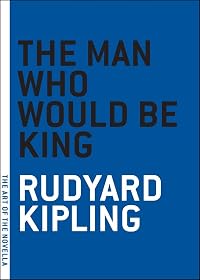
The Man Who Would Be King
by Rudyard Kipling 
On This Page
Description
HTML:Swashbuckling British adventurers find triumph and tragedy in nineteenth-century Afghanistan in this novella J. M. Barrie called "the most audacious thing in fiction." While on tour in India, a British journalist encounters Daniel Dravot and Peachey Carnehan, two foolhardy drifters with a plan. Claiming they've exhausted all the schemes and odd jobs they could find in India, the two are in search of an even greater adventure. They tell the journalist they're venturing to nearby show more Kafiristan—modern-day Afghanistan—to depose a weak ruler and establish themselves as kings. With a cache of the best rifles and knowledge of Masonic rituals that will baffle the native tribesmen, Daniel and Peachey don't see how they can fail. But they may have underestimated the locals . . . Inspired by tales of real-life explorers, Rudyard Kipling wrote The Man Who Would Be King when he was only twenty-two years old. Featuring vivid prose, exotic settings, and unforgettable characters, this dissection of the heroic pretensions of imperialism and colonialism is a swashbuckling tale for the ages, and served as inspiration for the 1975 John Huston film starring Sean Connery and Michael Caine. Classic Literature. Historical Fiction. Fiction. show lessTags
Recommendations






















Member Recommendations


Member Reviews
What happens when you read something in which the form, public, content, style, content, and voice are entirely familiar, to the point where they do not register as objects of thought, but only as tokens of the familiar? That's my experience reading "The Man Who Would Be King." Kipling is an author who does not need to be read to be experienced, because every mannerism, every narrative move, each racist and colonialist cliché, is already lodged in our culture. I'd seen the movie, which is a John Huston epic, and I had thought the book must be long: but on my e-reader it's only 80 pages, and Kipling only needs one-third of that to tell his story. The speed of his narrative might be an indication that even for him, the subjects and show more interests of the story were so familiar they only needed to be telegraphed.
Reading is an empty experience: how can any of the reality effects work? How can any of the bids for drama and affect produce the effects they were apparently intended to have? Nearly everything runs automatically. I am not impatient to know what happens; I am impatient at my own reading speed. Nothing disturbs my racing eye. My thoughts are placid, distracted. Every once in a while, a character says something colorful, and I make a mental note to remember it, but it's so trivial, so uninteresting, that I immediately forget it: I had only noticed it because everything around it was so blank, so free of interest. Kipling has died a cultural death: the work is empty, and there isn't even any reason left to mourn for it.
But then again, this must be the experience of millions of readers who consume murder mysteries, romances, and any other formula fiction.
If I did feel anything reading "The Man Who Would be King," I would have to question how much I had thought about the books I have read, and the movies I've seen, depicting the British colonial experience. I'd have to wonder whether I had ever considered what generates the interest in epic adventures and romantic journeys. I would have to do some serious reconsidering of my own capacity to reflect on what I read. There can't be a thrill here, if everything that presents the thrill is such a frail cliché. If you like Kipling in the twenty-first century, you have to be an unreflective reader. show less
Reading is an empty experience: how can any of the reality effects work? How can any of the bids for drama and affect produce the effects they were apparently intended to have? Nearly everything runs automatically. I am not impatient to know what happens; I am impatient at my own reading speed. Nothing disturbs my racing eye. My thoughts are placid, distracted. Every once in a while, a character says something colorful, and I make a mental note to remember it, but it's so trivial, so uninteresting, that I immediately forget it: I had only noticed it because everything around it was so blank, so free of interest. Kipling has died a cultural death: the work is empty, and there isn't even any reason left to mourn for it.
But then again, this must be the experience of millions of readers who consume murder mysteries, romances, and any other formula fiction.
If I did feel anything reading "The Man Who Would be King," I would have to question how much I had thought about the books I have read, and the movies I've seen, depicting the British colonial experience. I'd have to wonder whether I had ever considered what generates the interest in epic adventures and romantic journeys. I would have to do some serious reconsidering of my own capacity to reflect on what I read. There can't be a thrill here, if everything that presents the thrill is such a frail cliché. If you like Kipling in the twenty-first century, you have to be an unreflective reader. show less
No Kings! Readathon
June 14, 2025
I'm reviewing books about Kings today. How did it turn out for the Kings and the wannabe Kings in classic literature?
Two scruffy English adventurers head to the backwaters of Afghanistan, determined to set themselves up as kings and be showered with power and riches. They succeed, for a time. When the queen-to-be bites the lip of the "king god" and he bleeds, the game is up. The Afghanis have discovered he is,
"Neither God nor Devil but a man!"
Yes, a manipulative, greedy, immoral man.
Like all wicked kings and wannabe kings--then and now--it just doesn't turn out too nice for them, not in literature, not in history.
June 14, 2025
I'm reviewing books about Kings today. How did it turn out for the Kings and the wannabe Kings in classic literature?
Two scruffy English adventurers head to the backwaters of Afghanistan, determined to set themselves up as kings and be showered with power and riches. They succeed, for a time. When the queen-to-be bites the lip of the "king god" and he bleeds, the game is up. The Afghanis have discovered he is,
"Neither God nor Devil but a man!"
Yes, a manipulative, greedy, immoral man.
Like all wicked kings and wannabe kings--then and now--it just doesn't turn out too nice for them, not in literature, not in history.
Pretty good. Two wastrels wander out of British India into Afghanistan and make themselves kings over the inhabitants of a few remote valleys. They bring some guns, some basic soldiering skills, and a whole pile of bravado and use that kill and rule the villagers. The villagers are a faceless bunch who show almost no initiative. Despite being described as the descendants of alexander and “white as Englishmen,” the natives don’t do much to impress.
I found it funny that the two adventurers woo the valley’s chiefs and priests with their knowledge of masonic ritual. I’ve never understood the mystique of masonry. I gather it was pretty exclusive at one time, but in my experience it’s mostly old white guys.
The kingdom falls show more apart over a woman. I’m not sure what Kipling was trying to say. It could be that all women are trouble and men of action should steer clear of them. Or, it could be a commentary on the natives and that ill-befalls any Englishman who mixes with the locals.
It is more than a bit racist, but given the period I suppose it could be worse. show less
I found it funny that the two adventurers woo the valley’s chiefs and priests with their knowledge of masonic ritual. I’ve never understood the mystique of masonry. I gather it was pretty exclusive at one time, but in my experience it’s mostly old white guys.
The kingdom falls show more apart over a woman. I’m not sure what Kipling was trying to say. It could be that all women are trouble and men of action should steer clear of them. Or, it could be a commentary on the natives and that ill-befalls any Englishman who mixes with the locals.
It is more than a bit racist, but given the period I suppose it could be worse. show less
A brief, punchy story that John Huston made into a wonderful film with Sean Connery and Michael Caine. Huston and Gladys Hill kept to the outline of Kipling's story (the story is actually an outline itself), and fleshed out the characters unforgettably. This is really Peachy Carnahan's story, and his telling of his and Daniel Dravot's adventures in Kafiristan (northeast Afghanistan)is heartbreaking, despite the con artists' hubris and stupidity. I suppose this is a microcosm of the British experience in Afghanistan - as well as the Russians'. Whether colonialism writ large, or colonialism writ small, it all seemed doomed from the start.
"Not a devil or a god, but a man"
What defines godhood here? Forsaking lust? Absence of liqour? Nay.
Power in the 'right' sense. As much I (as a libertarian), wish to ignore class politics, I won't and can't. The desire to improve, make something of yourselves. The innermost want which doesn't come after puberty or such but something which has been there far before it. Greatness. This is an inherent part of humans and any system we're a part of, it's the essence of the hero's journey to me as I've seen my mentors, family and friends fulfill it with me doing so too.
I wonder if godhood is worth it though. To me it sure is.
What defines godhood here? Forsaking lust? Absence of liqour? Nay.
Power in the 'right' sense. As much I (as a libertarian), wish to ignore class politics, I won't and can't. The desire to improve, make something of yourselves. The innermost want which doesn't come after puberty or such but something which has been there far before it. Greatness. This is an inherent part of humans and any system we're a part of, it's the essence of the hero's journey to me as I've seen my mentors, family and friends fulfill it with me doing so too.
I wonder if godhood is worth it though. To me it sure is.
This is a short book. I saw the movie years ago, starring Sean Connery and Michael Caine. I thought that the movie was brilliant.
This book, short that it is, packs in a punch.
It is rich in imagery, it is rich in style. Not one word is wasted.
You are left thinking deeply about the imaginary events that would have taken place in the mountains of Afghanistan.
It is a story of megalomania, it is a story of superstition. It is a painting cast in words.
It's a story for a lost time, yet one that is alive today.
This book, short that it is, packs in a punch.
It is rich in imagery, it is rich in style. Not one word is wasted.
You are left thinking deeply about the imaginary events that would have taken place in the mountains of Afghanistan.
It is a story of megalomania, it is a story of superstition. It is a painting cast in words.
It's a story for a lost time, yet one that is alive today.
This story of two English adventurers determined to raise themselves into rulers in trackless Afghanistan is vintage Kipling. It's deadly serious, yet playful and ironic; detailed, yet broad in scope; fanciful, yet strangely plausible. His characters leap off the page, demonstrated vividly here. The Man Who Would Be King is freely available at Project Guttenberg, and is an excellent point of entry for Kipling's work.
Members
- Recently Added By
Lists

Best Adventure Stories
66 works; 15 members

Nobel Price Winners
222 works; 20 members

Books with Noble Titles
179 works; 11 members

Books on my Kindle
162 works; 3 members

Trinity College Booklist (1951): Class Ten, English Literature
358 works; 5 members
Talk Discussions
Past Discussions
OT: The Man Who Would Be King in Fine Press Forum (January 2024)
OT: for those that liked the Caurette Wind in the Willows… in Folio Society Devotees (January 2024)
Author Information

2,470+ Works 91,181 Members
Kipling, who as a novelist dramatized the ambivalence of the British colonial experience, was born of English parents in Bombay and as a child knew Hindustani better than English. He spent an unhappy period of exile from his parents (and the Indian heat) with a harsh aunt in England, followed by the public schooling that inspired his "Stalky" show more stories. He returned to India at 18 to work on the staff of the Lahore Civil and Military Gazette and rapidly became a prolific writer. His mildly satirical work won him a reputation in England, and he returned there in 1889. Shortly after, his first novel, The Light That Failed (1890) was published, but it was not altogether successful. In the early 1890s, Kipling met and married Caroline Balestier and moved with her to her family's estate in Brattleboro, Vermont. While there he wrote Many Inventions (1893), The Jungle Book (1894-95), and Captains Courageous (1897). He became dissatisfied with life in America, however, and moved back to England, returning to America only when his daughter died of pneumonia. Kipling never again returned to the United States, despite his great popularity there. Short stories form the greater portion of Kipling's work and are of several distinct types. Some of his best are stories of the supernatural, the eerie and unearthly, such as "The Phantom Rickshaw," "The Brushwood Boy," and "They." His tales of gruesome horror include "The Mark of the Beast" and "The Return of Imray." "William the Conqueror" and "The Head of the District" are among his political tales of English rule in India. The "Soldiers Three" group deals with Kipling's three musketeers: an Irishman, a Cockney, and a Yorkshireman. The Anglo-Indian Tales, of social life in Simla, make up the larger part of his first four books. Kipling wrote equally well for children and adults. His best-known children's books are Just So Stories (1902), The Jungle Books (1894-95), and Kim (1901). His short stories, although their understanding of the Indian is often moving, became minor hymns to the glory of Queen Victoria's empire and the civil servants and soldiers who staffed her outposts. Kim, an Irish boy in India who becomes the companion of a Tibetan lama, at length joins the British Secret Service, without, says Wilson, any sense of the betrayal of his friend this actually meant. Nevertheless, Kipling has left a vivid panorama of the India of his day. In 1907, Kipling became England's first Nobel Prize winner in literature and the only nineteenth-century English poet to win the Prize. He won not only on the basis of his short stories, which more closely mirror the ambiguities of the declining Edwardian world than has commonly been recognized, but also on the basis of his tremendous ability as a popular poet. His reputation was first made with Barrack Room Ballads (1892), and in "Recessional" he captured a side of Queen Victoria's final jubilee that no one else dared to address. (Bowker Author Biography) show less
Rudyard Kipling has a Legacy Library. Legacy libraries are the personal libraries of famous readers, entered by LibraryThing members from the Legacy Libraries group.
Some Editions
Awards and Honors
Series
Belongs to Publisher Series
Work Relationships
Is contained in
British Mystery Megapack Volume 3: The Mysterious Affair At Styles, The Secret Agent, The Man Who Would Be King, A Christmas Tragedy and The Dead Secret by Agatha Christie
Has the adaptation
Inspired
Has as a student's study guide
Common Knowledge
- Canonical title*
- El hombre que quiso ser rey
- Original title
- The Man Who Would Be King
- Original publication date
- 1888
- People/Characters
- Peachy Taliaferro Carnehan; Daniel Dravot
- Important places
- Marwar Junction, Rajasthan, India; Kafiristan
- Related movies
- The Man Who Would Be King (1975 | IMDb)
- Original language
- English
- Disambiguation notice
- This is not a collection of short stories, but works containing only the title story. Please do not combine it with any collections.
*Some information comes from Common Knowledge in other languages. Click "Edit" for more information.
Classifications
Statistics
- Members
- 923
- Popularity
- 28,972
- Reviews
- 23
- Rating
- (3.48)
- Languages
- 7 — Catalan, English, French, Greek, Italian, Portuguese, Spanish
- Media
- Paper, Audiobook, Ebook
- ISBNs
- 80
- UPCs
- 1
- ASINs
- 42