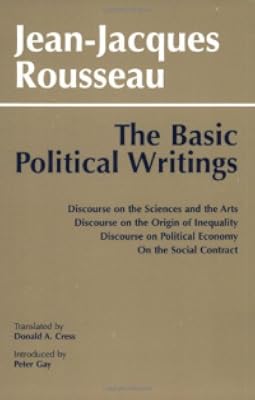
Basic Political Writings
by Jean-Jacques Rousseau
On This Page
Description
This substantially revised new edition of Rousseau: The Basic Political Writings features a brilliant new Introduction by David Wootton, a revision by Donald A. Cress of his own 1987 translation of Rousseau's most important political writings, and the addition of Cress' new translation of Rousseau's State of ?War . New footnotes, headnotes, and a chronology by David Wootton provide expert guidance to first-time readers of the texts.Tags
Recommendations
Member Reviews
Last chapter on civil religion is pure genius. A pleasure to read in general. Regardless of the ambiguities and, sometimes, contradictions, Rousseau put forward his ideas and their structures very clearly. All themes for him seem to revolve around a certain kind of proportion.
Rousseau is interesting, and I'd like to say I understand him thoroughly, but to me there *does* seem to be a contradiction between the love of liberty of "Discourse on the Origin of Inequality" and his view of the ideal government in "The Social Contract". Which latter work is, by the way, quite difficult especially after part two. Despite Wollstonecraft's calling him an optimist, one doesn't quite see that in this book. He seems to think so many things can go wrong in the constitution of a nation. I am left with ambivalent feelings about him, however I like his writing style.
Totally divorced from reality.
Cress, Donald A. (Translator)
Ratings
Members
- Recently Added By
Lists

Works cited in Palimpsest: A History of the Written Word by Matthew Battles
79 works; 2 members

essential pol.phil
17 works; 1 member
Author Information

904+ Works 27,422 Members
Jean Jacques Rousseau was a Swiss philosopher and political theorist who lived much of his life in France. Many reference books describe him as French, but he generally added "Citizen of Geneva" whenever he signed his name. He presented his theory of education in Emile (1762), a novel, the first book to link the educational process to a scientific show more understanding of children; Rousseau is thus regarded as the precursor, if not the founder, of child psychology. "The greatest good is not authority, but liberty," he wrote, and in The Social Contract (1762) Rousseau moved from a study of the individual to an analysis of the relationship of the individual to the state: "The art of politics consists of making each citizen extremely dependent upon the polis in order to free him from dependence upon other citizens." This doctrine of sovereignty, the absolute supremacy of the state over its members, has led many to accuse Rousseau of opening the doors to despotism, collectivism, and totalitarianism. Others say that this is the opposite of Rousseau's intent, that the surrender of rights is only apparent, and that in the end individuals retain the rights that they appear to have given up. In effect, these Rousseau supporters say, the social contract is designed to secure or to restore to individuals in the state of civilization the equivalent of the rights they enjoyed in the state of nature. Rousseau was a passionate man who lived in passionate times, and he still stirs passion in those who write about him today. (Bowker Author Biography) show less
Some Editions
Work Relationships
Classifications
- Genres
- Philosophy, Politics and Government, Nonfiction, General Nonfiction
- DDC/MDS
- 320.01 — Society, government, & culture Political science Types of Government Political Science Philosophy and Theory
- LCC
- JC179 .R7 — Political Science Political theory Political theory. The state. Theories of the state Modern state
- BISAC
Statistics
- Members
- 1,200
- Popularity
- 20,657
- Reviews
- 4
- Rating
- (3.54)
- Languages
- English
- Media
- Paper, Ebook
- ISBNs
- 11
- ASINs
- 3