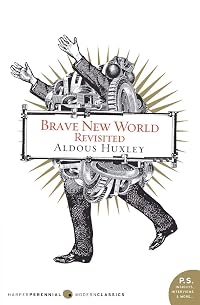
Brave New World Revisited
by Aldous Huxley 
On This Page
Description
In this "brilliantly written" book, the author of Brave New World reflects on his dystopian classic-and its echoes in the real world decades later (Kirkus Reviews). Written almost thirty years after the publication of Aldous Huxley's groundbreaking dystopian novel, Brave New World Revisited compares the "future" of 1958 with his vision of it from the early 1930s. Touching on subjects as diverse as world population, drugs, subliminal suggestion, and totalitarianism, these timeless essays show more provide a fascinating look at ideas of early science fiction in the context of the real world. "It is a frightening experience, indeed, to discover how much of his satirical prediction of a distant future became reality in so short a time. . . . fascinating." -The New York Times Book Review. show lessTags
Recommendations




















Member Reviews
While written long ago, much of this sounds amazingly contemporary. "Propaganda in favor of action dictated by the impulses that are below self-interest offers false, garbled or incomplete evidence, avoids logical argument and seeks to influence its victims by the mere repetition of catchwords, by the furious denunciation of foreign or domestic scapegoats, and by cunningly associating the lowest passions with the highest ideals..." Hmmm, yeah, anyone catch the most recent Republican candidate debate?
Due to the events from last and this year I got hooked on books on sociology and in general mass control. Reason is very simple - when one gets rather disappointed in the people one tries to find out what and when went wrong.
And unfortunately I have to say course of this planet's society was set way way back. Unfortunately.....
What makes this book bleak and truly dystopian is that author writes almost of events not almost 60 years back but like he is listening and following current news. As he says himself he was surprised that future he foreseen with his novel started to realize in only couple of decades.
Let's see....
Crisis and way it can be misused for obtaining power? Check.
Media effect and polarizing effect of it on the masses? show more Check.
Danger of succumbing to emotions instead of reason (aka activism)? Check.
Rise of bureaucrats - gray man with power - and technocrats grabbing ever more power into their hands? Check.
Inability to use technology outside of what the author calls Big Technology and Big Government? Oh yes, check.
Bureaucratic tendency not to let power slip from their hands once it is obtained (aka mini-despots)? Check.
Rise of scientific zealots that aim to make people uniform (divergence cannot be allowed) and expect them to behave as automatons? Gas-lighting, contradicting statements that mess up people? Use of fear and general wearing down and exhausting of populace using constant crisis as a control factor? Check, check .... and check.
Indifference of general populace to keep their freedoms and ensure elites are not absolute rulers but executives given limited power for limited time - what you might call prevalence of immediate satisfaction of ones needs instead of going for long term solutions? Check.
Forcing migrations and "herding" people (aforementioned masses) and in general dehumanization of society - again through that uniformity and seeking optimal instead of human society? Check.
Dangers of personality-cults and the way propaganda works to push public opinion into desired direction? Check.
Dangers of distractions and off-tracking in order to busy people with things that do not have any value or long term effect when it comes to changing the society for the better? Oh, man, big check.
Dumbing down of general populace (zombies constantly staring into bloody phones 24/7) and failure of education that becomes more of an activist playground than actual learning tool (again, distractions)? Oh, yes, check.
I was surprised that even at time when author was writing the book theories that basically annulled the human being's biological individuality and considered it as a result of only strict forms of social influence were accepted by good deal of social scientists. Considering this, it is no wonder we are where we are.
I was truly intrigued by Institute for Propaganda Analysis and its demise after only 4 years. If there was ever an indicator that the world people live in is not what they believe it is. I mean who would dismantle organization that aims to make people think - not activist way of thinking so popular today (all of the radical movements (from left to right) this organization considered completely undemocratic because radicalism breeds authoritarianism and suffocates freedom of speech) but actual thinking?
You are right - not people who have best for humanity in their heart.
This is a highly recommended book for everyone to read. Might be overly romanticized view of the world but as long people try to keep their individuality, freedom of speech and in general freedom there is still hope. And becoming aware of things taking place around us is always the first step in the right direction.
Highly recommended. show less
And unfortunately I have to say course of this planet's society was set way way back. Unfortunately.....
What makes this book bleak and truly dystopian is that author writes almost of events not almost 60 years back but like he is listening and following current news. As he says himself he was surprised that future he foreseen with his novel started to realize in only couple of decades.
Let's see....
Crisis and way it can be misused for obtaining power? Check.
Media effect and polarizing effect of it on the masses? show more Check.
Danger of succumbing to emotions instead of reason (aka activism)? Check.
Rise of bureaucrats - gray man with power - and technocrats grabbing ever more power into their hands? Check.
Inability to use technology outside of what the author calls Big Technology and Big Government? Oh yes, check.
Bureaucratic tendency not to let power slip from their hands once it is obtained (aka mini-despots)? Check.
Rise of scientific zealots that aim to make people uniform (divergence cannot be allowed) and expect them to behave as automatons? Gas-lighting, contradicting statements that mess up people? Use of fear and general wearing down and exhausting of populace using constant crisis as a control factor? Check, check .... and check.
Indifference of general populace to keep their freedoms and ensure elites are not absolute rulers but executives given limited power for limited time - what you might call prevalence of immediate satisfaction of ones needs instead of going for long term solutions? Check.
Forcing migrations and "herding" people (aforementioned masses) and in general dehumanization of society - again through that uniformity and seeking optimal instead of human society? Check.
Dangers of personality-cults and the way propaganda works to push public opinion into desired direction? Check.
Dangers of distractions and off-tracking in order to busy people with things that do not have any value or long term effect when it comes to changing the society for the better? Oh, man, big check.
Dumbing down of general populace (zombies constantly staring into bloody phones 24/7) and failure of education that becomes more of an activist playground than actual learning tool (again, distractions)? Oh, yes, check.
I was surprised that even at time when author was writing the book theories that basically annulled the human being's biological individuality and considered it as a result of only strict forms of social influence were accepted by good deal of social scientists. Considering this, it is no wonder we are where we are.
I was truly intrigued by Institute for Propaganda Analysis and its demise after only 4 years. If there was ever an indicator that the world people live in is not what they believe it is. I mean who would dismantle organization that aims to make people think - not activist way of thinking so popular today (all of the radical movements (from left to right) this organization considered completely undemocratic because radicalism breeds authoritarianism and suffocates freedom of speech) but actual thinking?
You are right - not people who have best for humanity in their heart.
This is a highly recommended book for everyone to read. Might be overly romanticized view of the world but as long people try to keep their individuality, freedom of speech and in general freedom there is still hope. And becoming aware of things taking place around us is always the first step in the right direction.
Highly recommended. show less
I had read this while a teenager. At the time, I didn't understand much of it although I had found it striking enough to promise myself to read it again at some point. Well, there go: I did, and, this time, with one of my sons, himself a teenager (14 at the time of reading, which is roughly the age I was myself when I first read it too).
First of, no surprise: my son found it a tough and challenging read as well. From the perspective of an adult, I can understand why. Aldous Huxley's writing style is rather muddy, interweaving quite clumsily various scenes in the same chapters, rendering the plot quite hard to follow. 'Plot', by the way, is quite a misnomer here, for it's more the outline of a dystopian world and what happen to those show more struggling to fit in than a story being propelled forward. In fact, when it comes to the story line, the whole is bafflingly simplistic: describe features of the World State, send a few characters to a society outside this World State (the so-called 'Savage Reservation'), bring back one of their member to try and fit in 'Brave New World', show such character hating it as much as we would (or would we?), and -END! (Of course, there's more to the ending than that but I don't want to spoil it...).
What's striking for a book first published in 1932 is that, from my vintage point as of now (2022) we are living in Brave New World. We may not make babies in hatcheries and we may not engage in social engineering whereas people are conditioned from infancy to later *love* the jobs and status they are ascribed to. Nevertheless, from the triumph of individualism to the rise of egotism, from the relentless materialism and consumerism walking hand-in-hand with vulgarity (something Huxley predicted after his travels to the USA, an ultra-capitalistic culture he found appalling) to the sexual revolution of the sixties which brought about an openness to sexual promiscuity (no matter your values on the topic -sex is all around) we succeeded in bringing to life such nightmarish state. Brave New World, then, acts like a disturbing mirror, and, I suspect, if eugenics is among the only few features which hasn't made it to us it's merely because the Nazis abused it, and so the topic became taboo. Interestingly, there is actually a controversy according to which Huxley intended this to be an utopia, as he, apparently, supported eugenics by the time he wrote this (I don't know if it's true, but I wouldn't be surprised -eugenics was then embraced across the whole political spectrum, from fascists to liberal progressivists...).
Personally, I was also particularly stuck by the over-use of 'soma', the intoxicating pill every one takes to remain in a state of perpetual 'happiness' (or oblivious imbecility, depending on your view). Emotions can hurt indeed, and so, in Brave New World, emotions are treated as symptomatic of a social sickness preventing people to be 'happy'. Soma solved the problem: just pop a pill and everything will be fine. Working in health and social care I am fully aware of the controversies plaguing my field of work, whereas, maybe, we are now turning every normal emotions and various reactions to social stresses into an 'illness' that requires, well, a pill (as per the biomedical model peddled by modern psychiatry). Just have a look at the DSM 5, this monster-book describing 297 different disorders (297!!) pertaining to everything 'wrong' with human psyche! People aren't over active or busy anymore, they get diagnosed with ADHD, and hop: pills! People aren't anxious or shy anymore, but are labelled as having some forms of anxiety disorders, and hop: pills! People aren't sad or low, but diagnosed as depressed, and hop: pills! I won't tackle such debate here, but you get the picture...
What about my son? He found it 'striking' and 'interesting' too, despite the difficulties in understanding what was going on. Will he read it again? 'Maybe', he said. Maybe indeed, and maybe as an adult too, when God knows how society will look like then! Meanwhile, despite the clumsy writing style, here is definitely one of the best book ever published. It's a nightmarish dystopia, but, in many respect, it is our nightmarish dystopia.
Hug me, honey, snuggly bunny,
Love is as good as soma... show less
First of, no surprise: my son found it a tough and challenging read as well. From the perspective of an adult, I can understand why. Aldous Huxley's writing style is rather muddy, interweaving quite clumsily various scenes in the same chapters, rendering the plot quite hard to follow. 'Plot', by the way, is quite a misnomer here, for it's more the outline of a dystopian world and what happen to those show more struggling to fit in than a story being propelled forward. In fact, when it comes to the story line, the whole is bafflingly simplistic: describe features of the World State, send a few characters to a society outside this World State (the so-called 'Savage Reservation'), bring back one of their member to try and fit in 'Brave New World', show such character hating it as much as we would (or would we?), and -END! (Of course, there's more to the ending than that but I don't want to spoil it...).
What's striking for a book first published in 1932 is that, from my vintage point as of now (2022) we are living in Brave New World. We may not make babies in hatcheries and we may not engage in social engineering whereas people are conditioned from infancy to later *love* the jobs and status they are ascribed to. Nevertheless, from the triumph of individualism to the rise of egotism, from the relentless materialism and consumerism walking hand-in-hand with vulgarity (something Huxley predicted after his travels to the USA, an ultra-capitalistic culture he found appalling) to the sexual revolution of the sixties which brought about an openness to sexual promiscuity (no matter your values on the topic -sex is all around) we succeeded in bringing to life such nightmarish state. Brave New World, then, acts like a disturbing mirror, and, I suspect, if eugenics is among the only few features which hasn't made it to us it's merely because the Nazis abused it, and so the topic became taboo. Interestingly, there is actually a controversy according to which Huxley intended this to be an utopia, as he, apparently, supported eugenics by the time he wrote this (I don't know if it's true, but I wouldn't be surprised -eugenics was then embraced across the whole political spectrum, from fascists to liberal progressivists...).
Personally, I was also particularly stuck by the over-use of 'soma', the intoxicating pill every one takes to remain in a state of perpetual 'happiness' (or oblivious imbecility, depending on your view). Emotions can hurt indeed, and so, in Brave New World, emotions are treated as symptomatic of a social sickness preventing people to be 'happy'. Soma solved the problem: just pop a pill and everything will be fine. Working in health and social care I am fully aware of the controversies plaguing my field of work, whereas, maybe, we are now turning every normal emotions and various reactions to social stresses into an 'illness' that requires, well, a pill (as per the biomedical model peddled by modern psychiatry). Just have a look at the DSM 5, this monster-book describing 297 different disorders (297!!) pertaining to everything 'wrong' with human psyche! People aren't over active or busy anymore, they get diagnosed with ADHD, and hop: pills! People aren't anxious or shy anymore, but are labelled as having some forms of anxiety disorders, and hop: pills! People aren't sad or low, but diagnosed as depressed, and hop: pills! I won't tackle such debate here, but you get the picture...
What about my son? He found it 'striking' and 'interesting' too, despite the difficulties in understanding what was going on. Will he read it again? 'Maybe', he said. Maybe indeed, and maybe as an adult too, when God knows how society will look like then! Meanwhile, despite the clumsy writing style, here is definitely one of the best book ever published. It's a nightmarish dystopia, but, in many respect, it is our nightmarish dystopia.
Hug me, honey, snuggly bunny,
Love is as good as soma... show less
Huxley was in his mid-sixties when he wrote this. It has all the characteristics of a rant by an elderly public intellectual who still had a captive audience. It does not stand up well today if only because the science and technology he depends upon have very much moved on - as have our political concerns.
It is a classical liberal take on society with a nice and simple view of the risks of totalitarian social control and manipulation from a man wanting not only his cake of freedom but to eat it as a member of the Anglo-American intelligentsia with a rather prescriptive mentality.
It is largely of antiquarian interest now. His original 'Brave New World' was a suggestive pioneering work of science fiction but, like 1984 and like most show more literary views of future political realities, it expressed fears of something that might be with little true understanding of what is.
Concerns laid out in literary terms translated less well as non-fiction over a quarter of a century later. We have here an opinion piece as transient as contemporary journalism, feeding into Cold War fears and prejudices, with a dash perhaps of barely suppressed hysteria about the way the world is going.
It is not a stupid book but it has become an irrelevant and dull book. The concerns in it are still those of many well positioned public intellectuals fearful of the ability to sustain their rather cosy world and certainly understandable from that point of view but that is, frankly, no longer good enough. show less
It is a classical liberal take on society with a nice and simple view of the risks of totalitarian social control and manipulation from a man wanting not only his cake of freedom but to eat it as a member of the Anglo-American intelligentsia with a rather prescriptive mentality.
It is largely of antiquarian interest now. His original 'Brave New World' was a suggestive pioneering work of science fiction but, like 1984 and like most show more literary views of future political realities, it expressed fears of something that might be with little true understanding of what is.
Concerns laid out in literary terms translated less well as non-fiction over a quarter of a century later. We have here an opinion piece as transient as contemporary journalism, feeding into Cold War fears and prejudices, with a dash perhaps of barely suppressed hysteria about the way the world is going.
It is not a stupid book but it has become an irrelevant and dull book. The concerns in it are still those of many well positioned public intellectuals fearful of the ability to sustain their rather cosy world and certainly understandable from that point of view but that is, frankly, no longer good enough. show less
16 years after the publication of [b:Brave New World|5129|Brave New World|Aldous Huxley|https://i.gr-assets.com/images/S/compressed.photo.goodreads.com/books/1575509280l/5129._SY75_.jpg|3204877], Huxley revisits his predictions of society as well as comparing the predictions of [b:1984|61439040|1984|George Orwell|https://i.gr-assets.com/images/S/compressed.photo.goodreads.com/books/1657781256l/61439040._SX50_.jpg|153313] by [a:George Orwell|3706|George Orwell|https://images.gr-assets.com/authors/1588856560p2/3706.jpg].
Huxley discusses Overpopulation, Medication, Propaganda and other facets of ruling the masses. He uses the framework of Hitler's Nazi Germany which happened between his fiction work and this nonfiction work.
Huxley's brain show more is brilliant and many of his predictions have in fact come true, if maybe with not the same force or speed as he predicted. I would love to see what Huxley thinks of society today. He definitely would be horrified, but I'm sure his thought would be as insightful as they were in the 30s and 50s. I was reading this saying to myself, this information is available, and warnings have been given, but here we are treading down the same dangerous path. Maybe human nature, both greed and apathy, is too strong to overcome. show less
Huxley discusses Overpopulation, Medication, Propaganda and other facets of ruling the masses. He uses the framework of Hitler's Nazi Germany which happened between his fiction work and this nonfiction work.
Huxley's brain show more is brilliant and many of his predictions have in fact come true, if maybe with not the same force or speed as he predicted. I would love to see what Huxley thinks of society today. He definitely would be horrified, but I'm sure his thought would be as insightful as they were in the 30s and 50s. I was reading this saying to myself, this information is available, and warnings have been given, but here we are treading down the same dangerous path. Maybe human nature, both greed and apathy, is too strong to overcome. show less
Last review of the year!
I admit I expected this to be fiction... a story picking up where Brave New World left off. Shows you how much I know. Actually, this is a series of essays, in which Huxley explains why he wrote some of the things he wrote in BNW. In that sense, the book reads like an interview on one of those shows like Charlie Rose or Inside the Actor's Studio. It's a little bit self-indulgent on Huxley's part, but it's also captivating. This new volume was written in 1958 - twenty-seven years after Brave New World was penned, and Huxley makes some interesting comments on ways that the world has grown to look more like the world of the OneState.
Naturally, Hitler and Stalin are mentioned; both dictators employed propaganda show more techniques described in BNW. Those comparisons were more or less expected. What I found much more absorbing was Huxley's detailed catalogue of all the new pharmaceuticals developed between 1932 and 1958, which in various ways suggest an effort (conscious or not) on the part of pharmaceutical companies to come up with a drug exactly like "Soma". The most interesting part of this book, in fact, is Huxley's refining of how he thinks a dictatorship would medicate its population. It's a little more sophisticated than what he described in Brave New World. Essentially, Huxley makes a case for tranquilizing (or hallucinogenizing) the population during peace, and amphetiminizing it during war.
From the standpoint of 1958, it looked like Huxley's prophecy had been fulfilled... a proliferation of prescription tranquilizers was on the market (as the Rolling Stones sang in 1965: "Mother's Little Helper"), and the country was in a decades-long Cold War, but no hot war. From the standpoint of 2012, things are a little muddier. The number of psychotropic meds available is stunning, and many have a tranquilizing effect, but many of the SSRI meds have a simultaneously uplifting effect. Incidentally, it's also difficult to know whether most citizens would say we're in a state of war or not, given George Bush's advice to go shopping and forget about our foreign military adventures. The world has become very complex.
No matter; this book is not really about Huxley saying "Aha! Prophecy fulfilled!" or not. It's about why he wrote what he wrote, and pretty much why he still in 1958 contends he would have written the same thing. This gets to answering questions I posed in my own review of Brave New World, namely: Did Huxley pen BNW to warn the population of creeping totalitarianism, or to rub our noses in it? With this second book, the answer is straightforwardly clear: to warn us.
For as much as our society's creep towards the Brave New World is engineered (by people he calls the "Power Elite"), Huxley very articulately denounces it. However he also attributes the march to tyrrany partly to unengineered circumstances, such as the world's increasing population, the scarcity of various strategic resources, the advance of technology, the advent of social sciences, and the unintended consequences of a free market economy. I won't say I agree with every last point, but getting inside of his head for a few hours made for good reading, and further enhanced my appreciation for Brave New World.
Most depressing of all, Huxley identifies in our own society a love for gullability and suggestability, which are so easily seized on by those who would control us. Too often, we prize group cohesion over truth; easily-told lies over difficult-to-explain truths, if the latter seem to promote some good; and unthinking slogans which rouse the spirit -so long as the cause is worthy. To illustrate his point, he tells the sad story of the Institute for Propaganga Analysis (IPA). The institute was founded in 1937 in New England, by philanthropist Edward Filene (of "Filene's" department store fame), who was rightly distressed at seeing how effectively Hitler's propaganda was swaying opinions in Europe. The intention of the IPA was to strip the fallacies from Hitler's message, and expose his manipulative trickeries for what they were. At first, the Institute was lauded and supported, but soon the State Department realized they wanted to rouse Americans to war with many of the same techniques. Moreover, certain members of organized religion felt the work of the IAP undermined the spirit and teachings of their various churches. Educators started to voice concern that propaganda analysis would make students too cynical and unruly. Military leaders feared too much critical thinking would make troops unleadable. In short- too many elements within our own "free society" identify with the impulse to control through manipulation- and more importantly, are willing to sacrifice nuanced, critical thinking in exchange for managability of the public to their causes. The IPA was closed six years after it was founded, and its true history is one of the most troublesome anecdotes I've ever heard from a functioning democracy.
At the end of this book, the editors saw fit to include a letter written by Aldous Huxley to George Orwell in 1949, after Huxley first read 1984. In my mind, at least, this is a great moment in literary history: a personal communication between the authors of the two great dystopian novels of the twentieth century. Huxley applauds 1984 for its literary merits, and agrees the mechanisms of oppression described therein certainly exist. Huxley sees 1984-style tyrrany as a possiblility, but disagrees with Orwell that it would be a static endpoint in history.
He argues that in 1984, political stability is achieved at too high a price (e.g. maintaining a large secret police apparatus to oversee the entire population) which would not be sustainable long-term. The Brave New World is a much more efficient tyrrany; by training a public to love their subservience, the oligarchs of the OneState did not require nearly as large a police force. Where 1984 may be a necessary intermediate for would-be oligarchs, Huxley believes Brave New World better approximates the Power Elite's ultimate model society.
Amazing.
I'll leave you with a nice passage from page 120:
That so many of the well fed young television-watchers in the world's most powerful democracy should be so completely indifferent to the idea of self-government, so blankly uninterested in freedom of thought and the right to dissent, is distressing, but not too surprising. "Free as a bird", we say, and envy the winged creatures for their power of unrestricted movement in all the three dimensions. But alas, we forget the dodo. Any bird that has learned how to grub up a good living without being compelled to use its wings will soon renounce the privilege of flight and remain forever grounded.show less
Wow, how does such a slim volume explore so many BIG issues, whilst also telling an interesting story?
Although published nearly 80 years ago (1932), it presciently exposes many issues that are problematic in our time: consumerism; the nature of happiness; what it means to be civilised; cloning and other reproductive technologies; parenting, families, loyalty, promiscuity; recreational drug use; social mobility and equality of opportunity; individualism versus group loyalty; pornography; benevolent dictatorship; censorship; religion; the power of language, and so much more.
Clearly some of the details of a future world are more plausible than others, but that doesn't matter because the book is about ideas and dilemmas, not the specific show more technologies that give rise to them.
Read it once for the plot, and read it again to get full value from the powerful issues within.
NB Review to be updated and lengthened soon. [Oops. Missed that boat!]
See also BNW Revisited:
https://www.goodreads.com/book/show/5481.Brave_New_World_Revisited
Huxley was heavily inspired by Yevgeny Zamyatin’s WE, which I prefer. See my review HERE. show less
Although published nearly 80 years ago (1932), it presciently exposes many issues that are problematic in our time: consumerism; the nature of happiness; what it means to be civilised; cloning and other reproductive technologies; parenting, families, loyalty, promiscuity; recreational drug use; social mobility and equality of opportunity; individualism versus group loyalty; pornography; benevolent dictatorship; censorship; religion; the power of language, and so much more.
Clearly some of the details of a future world are more plausible than others, but that doesn't matter because the book is about ideas and dilemmas, not the specific show more technologies that give rise to them.
Read it once for the plot, and read it again to get full value from the powerful issues within.
NB Review to be updated and lengthened soon. [Oops. Missed that boat!]
See also BNW Revisited:
https://www.goodreads.com/book/show/5481.Brave_New_World_Revisited
Huxley was heavily inspired by Yevgeny Zamyatin’s WE, which I prefer. See my review HERE. show less
Members
- Recently Added By
Lists

Futurism Works
25 works; 6 members

The Works of Aldous Huxley
49 works; 1 member

1964 College Preparatory Reading List
202 works; 8 members

Book wishlist
78 works; 1 member

2023 Reads
26 works; 1 member
Author Information

287+ Works 104,867 Members
Aldous Huxley was born on July 26, 1894, in Surrey, England, into a distinguished scientific and literary family; his grandfather was the noted scientist and writer, T.H. Huxley. Following an eye illness at age 16 that resulted in near-blindness, Huxley abandoned hope of a career in medicine and turned instead to literature, attending Oxford show more University and graduating with honors. While at Oxford, he published two volumes of poetry. Crome Yellow, his first novel, was published in 1927 followed by Antic Hay, Those Barren Leaves, and Point Counter Point. His most famous novel, Brave New World, published in 1932, is a science fiction classic about a futuristic society controlled by technology. In all, Huxley produced 47 works during his long career, In 1947, Huxley moved with his family to southern California. During the 1950s, he experimented with mescaline and LSD. Doors of Perception and Heaven and Hell, both works of nonfiction, were based on his experiences while taking mescaline under supervision. In 1959, Aldous Huxley received the Award of Merit for the Novel from the American Academy of Arts and Letters. He died on November 22, 1963. (Bowker Author Biography) show less
Aldous Huxley has a Legacy Library. Legacy libraries are the personal libraries of famous readers, entered by LibraryThing members from the Legacy Libraries group.
Some Editions
Awards and Honors
Distinctions
Series
Belongs to Publisher Series
Work Relationships
Is contained in
Is a reply to
Common Knowledge
- Canonical title
- Brave New World Revisited
- Original title
- Brave New World Revisited
- Alternate titles
- Tyranny over the Mind (newspaper article series on which the book is based) (newspaper article series on which the book is based)
- Original publication date
- 1958
- First words
- In 1931, when Brave New World was being written, I was convinced that there was still plenty of time.
- Quotations
- But liberty, as we all know, cannot flourish in a country that is permanently on a war footing, or even a near-war footing. Permanent crisis justifies permanent control of everybody and everything by the agencies of the centr... (show all)al government.
Meanwhile we find ourselves confronted by a most disturbing moral problem. We know that the pursuit of good ends does not justify the employment of bad means. But what about those situations, now of such frequent occurrence, ... (show all)in which good means have end results which turn out to be bad? - Last words
- (Click to show. Warning: May contain spoilers.)It is still our duty to do whatever we can to resist them.
- Original language
- English
Classifications
Statistics
- Members
- 3,220
- Popularity
- 5,341
- Reviews
- 37
- Rating
- (3.64)
- Languages
- 16 — Catalan, Chinese, Danish, English, Finnish, French, German, Hungarian, Italian, Norwegian (Bokmål), Polish, Romanian, Spanish, Swedish, Turkish, Portuguese (Portugal)
- Media
- Paper, Audiobook, Ebook
- ISBNs
- 63
- ASINs
- 52