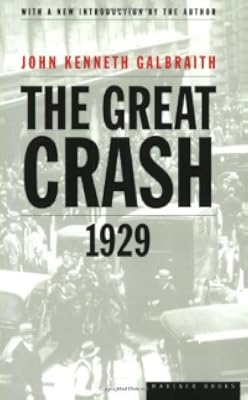
The Great Crash 1929
by John Kenneth Galbraith
On This Page
Description
Of Galbraith's classic examination of the 1929 financial collapse, the Atlantic Monthly said: "Economic writings are seldom notable for their entertainment value, but this book is. Galbraith's prose has grace and wit, and he distills a good deal of sardonic fun from the whopping errors of the nation's oracles and the wondrous antics of the financial community." Now, with the stock market riding historic highs, the celebrated economist returns with new insights on the legacy of our past and show more the consequences of blind optimism and power plays within the financial community. show lessTags
Recommendations








Member Recommendations
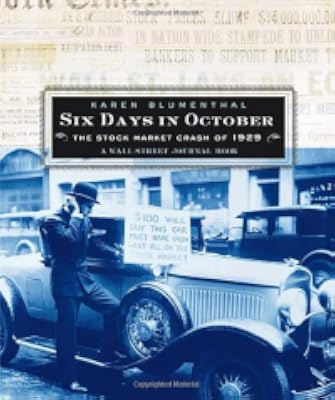
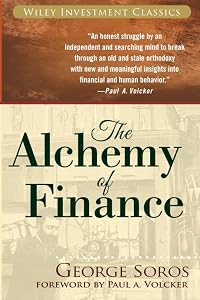
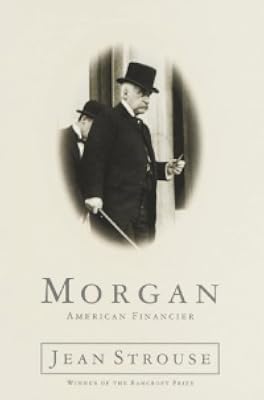
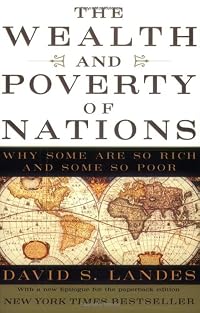
mercure Both books take opposite looks at economic crisis; Galbraith looks at the mechanics, Reinhart and Rogoff take a quantitative approach.
Member Reviews
J. K. Galbraith produced his short book on the Great Stock Market Crash of 1929 in late 1954 in an atmosphere that still recalled recent witch hunts over communism (a fact that will help an early twenty-first century reader with some of the few obscure political references). The current Penguin edition adds the short Foreword to the 1975 edition that urged 'memory' as a necessary corrective to over-enthusiasm within the financial system. One can only guess what this grand old man of liberal economics would have written in 2008.
Galbraith's book is not the last word on the subject of the causes and consequences of 1929 - how could it be: it was written over 50 years ago within only 25 years of the events in question and largely from show more contemporary newspaper reports and available official documentation? But it is succinct on the facts, very witty (albeit in that dry professorial way affected by an older generation of intellectuals) but oddly conservative in its overall message.
Galbraith does not judge capitalism - he could scarcely do so in the middle of the most conservative phase of the Cold War. He is also far more sympathetic to the bankers of the late 1920s than we might feel minded to be of our bankers in 2008/2009. His model is of a crisis in the equity markets built on the greedy and deluded behaviour of a surprisingly small number of Americans, exploited and managed by a yet-smaller group in positions of financial power and influence. A stand-offish government allowed a burst bubble to hit a downturn in the wider business cycle and so triggered something that was much worse than it need have been.
Whether he is right or not is not for me to judge. This book is interesting not because of its ability to tell us the 'truth' but because it helps us to understand our own predicament through contrasts as much as similarities. I do not accept the implicit moralism of either Galbraith or today's commentators - people do bad or silly things but it is our responsibility as much as theirs if we have not constructed the political or regulatory framework that will set limits to political or economic collective hysteria.
His defence of bankers has to be seen in the context of his dislike of William Jennings Bryan's country populism with its roots in creationist Christianity and its ascription of all the nation's ills to East Coast elites. He clearly enjoys pointing out that Bryan was complicit in the promotion of inflated land values in Florida that, in retrospect, should have indicated that American popular interest in a 'fast buck' was getting out of hand. The Florida land speculation of the mid-twenties brought us the original Ponzi scheme.
Perhaps a million or so Americans out of a population many, many times as large were speculators on the stock market - either with enough money to burn or enough credit to burn other people's money. In some ways, the consequent economic crisis is the story of the loss of an upper middle class surplus available to purchases the good and services that would have kept the rest of America working.
And this is where we see the similarities and differences from today. Our crisis also starts in the US but it does not derive from the upper middle classes getting over-excited by speculation in industrial growth. It starts with bankers getting over-excited by what can be done in packaging or securitising massive debt both for wealthier investors and themselves. The collusion between bankers and investors in 'sure thing' economics is what marks out the latest crisis as similar to the collusion between trust promoters and investors in the earlier case.
The first crisis involved a disconnect from the fundamentals of American industrial strength and the international trading economy. Our current crisis derives from a lack of due diligence on the returns that could reasonably be expected from a whole range of instruments. The ultimate recipients and intermediate sponsors understood less about these instruments than Wall Street brokers understood their own investment trusts in 1928/1929.
Similarly, the 1929 crisis was a domestic national crisis which spread around the world because of other instabilities in the trading system. Our crisis is a global one arising to the degree that financial activity is integrated into Wall Street and the City of London. The UK, for example, is being hit as hard and probably harder than the US not because of a collapse of trade (yet) but because its entire polity is based on the privileging of a financial sector that is now going into as sharp a decline as any inter-war steelmaker.
There are coincidences in the tale - some amusing. Goldman Sachs is the broker behind two of the most egregiously speculative (and ultimately failed) investment trusts - Shenandoah Corporation and Blue Ridge. Its humiliation was to turn it into one of the most conservative broking houses by the time Galbraith was putting pen to paper. The rest is history. Lehmann Corporation, meanwhile, gets rare praise as a rarely well managed investment trust appearing in 1929 - another neat little historical irony.
Just as conventional property-based retailing today is the first line of collapse (evidenced by the closure of the British Woolworths) so, in a neat mirroring of history, the belief that industrial expansion would go on forever was based, in part, on vigorous programmes of retail consolidation and expansion that created the Montgomery Ward and Woolworths' chains in the US. Investors could see new stores with lots of stock in most major towns by the late 1920s and wanted a slice of the action.
The similarities do not lie in the causes or incidents of the crisis - although investment trusts built on sand perhaps have their parallel in today's hedge funds and private equity groups - as in the attitudes of those caught up in it. Galbraith has a great deal of fun at the expense of the 'boosters' of the stock market which seemed to have included just about everyone - including the almost comically wrong Harvard Economic Society.
Galbraith was Paul M. Warburg Emeritus Professor of Economics at Harvard but this does not stop him from detailing proof positive that a group of experts engaged in group-think are more than likely to persist in their errors long after the rest of us are staring the facts in the face. The Harvard Economic Society should be remembered whenever any school of public intellectuals and experts purports to tell us what is right and proper in any area of public policy. Those who were seduced by the neo-conservatives before the recent round of incompetent foreign policies, take note.
On the other hand, Galbraith points out that the specialist financial Press saw through the house of cards and warned investors of the risks in 1929. Unfortunately, professional investors on Wall Street who would read this material were making serious money out of the speculation, while the people providing cash on margin were not interested in research and analysis - only in profiting from the 'sure thing'.
This is in marked contrast to the role of the media in the current crisis - see http://asithappens.tppr.info/journal/2008/12/16/the-financial-times-a-slipping-a.... Sadly, the financial press, pace the important reporting of Robert Peston of the BBC and the critiques of a few individuals like Larry Elliott of The Guardian in London, signally failed to advise the public of the trajectory of bank lending and of the 'toxicity' within the financial system. The media in 1929 at least tried to educate the public and policymakers ... the twenty-first century media merely parroted the news releases and briefings of the market players.
The very differences between the two crises show, paradoxically, what is wrong with the system as a whole. The common denominators are weak laissez-faire governments, the fact that the wealthiest are not necessarily the brightest and the existence of a cadre of insiders within the financial system who are expert at relieving the relatively rich of their funds in mutually profitable (in the short to medium term) adventures. If the super-rich and their middle class hangers-on are relieved of their funds by cleverer and more devious professionals, then why should the rest of us worry. But, of course, the nature of capitalism in the 1920s and at the beginning of the Twenty-First Century means that nothing is so simple or so morally satisfying.
The pleasure of watching a Darwinian struggle amongst the top 5% is mitigated by the fact that the capitalist system operates on the assumption that the wealthiest re-invest their funds in productive capacity. If the wealthy are cutting back because their assets have halved in value and continue to fall or they have lost everything to some over-clever fraudster, then innovative businesses or businesses employing thousands do not get the cash they need. The ordinary Joe's money also, aggregated, fails to go back into the system to sustain the wider economy. The whole bloody thing starts to wind down and even go into reverse. Banks and the wealthy have now lost a great deal of money and want to make the rest safe and claw it back.
Galbraith will not criticise the system because he cannot. But there are fundamental questions to ask about how it is that innovation and employment are allowed to depend so much on hysterical decision-making by a tiny minority of the population in a collusive herd relationship with an even smaller group of 'technical experts'. More, how can they be allowed to continue to set the agenda after they have almost brought the system to its knees?
It may be time for Americans to ask a few questions about whether free markets and the American system of capitalism created by the likes of J P Morgan, centred on Wall Street, actually works for America. They won't, of course. Even Prof. Galbraith seemed unable to ask such questions. show less
Galbraith's book is not the last word on the subject of the causes and consequences of 1929 - how could it be: it was written over 50 years ago within only 25 years of the events in question and largely from show more contemporary newspaper reports and available official documentation? But it is succinct on the facts, very witty (albeit in that dry professorial way affected by an older generation of intellectuals) but oddly conservative in its overall message.
Galbraith does not judge capitalism - he could scarcely do so in the middle of the most conservative phase of the Cold War. He is also far more sympathetic to the bankers of the late 1920s than we might feel minded to be of our bankers in 2008/2009. His model is of a crisis in the equity markets built on the greedy and deluded behaviour of a surprisingly small number of Americans, exploited and managed by a yet-smaller group in positions of financial power and influence. A stand-offish government allowed a burst bubble to hit a downturn in the wider business cycle and so triggered something that was much worse than it need have been.
Whether he is right or not is not for me to judge. This book is interesting not because of its ability to tell us the 'truth' but because it helps us to understand our own predicament through contrasts as much as similarities. I do not accept the implicit moralism of either Galbraith or today's commentators - people do bad or silly things but it is our responsibility as much as theirs if we have not constructed the political or regulatory framework that will set limits to political or economic collective hysteria.
His defence of bankers has to be seen in the context of his dislike of William Jennings Bryan's country populism with its roots in creationist Christianity and its ascription of all the nation's ills to East Coast elites. He clearly enjoys pointing out that Bryan was complicit in the promotion of inflated land values in Florida that, in retrospect, should have indicated that American popular interest in a 'fast buck' was getting out of hand. The Florida land speculation of the mid-twenties brought us the original Ponzi scheme.
Perhaps a million or so Americans out of a population many, many times as large were speculators on the stock market - either with enough money to burn or enough credit to burn other people's money. In some ways, the consequent economic crisis is the story of the loss of an upper middle class surplus available to purchases the good and services that would have kept the rest of America working.
And this is where we see the similarities and differences from today. Our crisis also starts in the US but it does not derive from the upper middle classes getting over-excited by speculation in industrial growth. It starts with bankers getting over-excited by what can be done in packaging or securitising massive debt both for wealthier investors and themselves. The collusion between bankers and investors in 'sure thing' economics is what marks out the latest crisis as similar to the collusion between trust promoters and investors in the earlier case.
The first crisis involved a disconnect from the fundamentals of American industrial strength and the international trading economy. Our current crisis derives from a lack of due diligence on the returns that could reasonably be expected from a whole range of instruments. The ultimate recipients and intermediate sponsors understood less about these instruments than Wall Street brokers understood their own investment trusts in 1928/1929.
Similarly, the 1929 crisis was a domestic national crisis which spread around the world because of other instabilities in the trading system. Our crisis is a global one arising to the degree that financial activity is integrated into Wall Street and the City of London. The UK, for example, is being hit as hard and probably harder than the US not because of a collapse of trade (yet) but because its entire polity is based on the privileging of a financial sector that is now going into as sharp a decline as any inter-war steelmaker.
There are coincidences in the tale - some amusing. Goldman Sachs is the broker behind two of the most egregiously speculative (and ultimately failed) investment trusts - Shenandoah Corporation and Blue Ridge. Its humiliation was to turn it into one of the most conservative broking houses by the time Galbraith was putting pen to paper. The rest is history. Lehmann Corporation, meanwhile, gets rare praise as a rarely well managed investment trust appearing in 1929 - another neat little historical irony.
Just as conventional property-based retailing today is the first line of collapse (evidenced by the closure of the British Woolworths) so, in a neat mirroring of history, the belief that industrial expansion would go on forever was based, in part, on vigorous programmes of retail consolidation and expansion that created the Montgomery Ward and Woolworths' chains in the US. Investors could see new stores with lots of stock in most major towns by the late 1920s and wanted a slice of the action.
The similarities do not lie in the causes or incidents of the crisis - although investment trusts built on sand perhaps have their parallel in today's hedge funds and private equity groups - as in the attitudes of those caught up in it. Galbraith has a great deal of fun at the expense of the 'boosters' of the stock market which seemed to have included just about everyone - including the almost comically wrong Harvard Economic Society.
Galbraith was Paul M. Warburg Emeritus Professor of Economics at Harvard but this does not stop him from detailing proof positive that a group of experts engaged in group-think are more than likely to persist in their errors long after the rest of us are staring the facts in the face. The Harvard Economic Society should be remembered whenever any school of public intellectuals and experts purports to tell us what is right and proper in any area of public policy. Those who were seduced by the neo-conservatives before the recent round of incompetent foreign policies, take note.
On the other hand, Galbraith points out that the specialist financial Press saw through the house of cards and warned investors of the risks in 1929. Unfortunately, professional investors on Wall Street who would read this material were making serious money out of the speculation, while the people providing cash on margin were not interested in research and analysis - only in profiting from the 'sure thing'.
This is in marked contrast to the role of the media in the current crisis - see http://asithappens.tppr.info/journal/2008/12/16/the-financial-times-a-slipping-a.... Sadly, the financial press, pace the important reporting of Robert Peston of the BBC and the critiques of a few individuals like Larry Elliott of The Guardian in London, signally failed to advise the public of the trajectory of bank lending and of the 'toxicity' within the financial system. The media in 1929 at least tried to educate the public and policymakers ... the twenty-first century media merely parroted the news releases and briefings of the market players.
The very differences between the two crises show, paradoxically, what is wrong with the system as a whole. The common denominators are weak laissez-faire governments, the fact that the wealthiest are not necessarily the brightest and the existence of a cadre of insiders within the financial system who are expert at relieving the relatively rich of their funds in mutually profitable (in the short to medium term) adventures. If the super-rich and their middle class hangers-on are relieved of their funds by cleverer and more devious professionals, then why should the rest of us worry. But, of course, the nature of capitalism in the 1920s and at the beginning of the Twenty-First Century means that nothing is so simple or so morally satisfying.
The pleasure of watching a Darwinian struggle amongst the top 5% is mitigated by the fact that the capitalist system operates on the assumption that the wealthiest re-invest their funds in productive capacity. If the wealthy are cutting back because their assets have halved in value and continue to fall or they have lost everything to some over-clever fraudster, then innovative businesses or businesses employing thousands do not get the cash they need. The ordinary Joe's money also, aggregated, fails to go back into the system to sustain the wider economy. The whole bloody thing starts to wind down and even go into reverse. Banks and the wealthy have now lost a great deal of money and want to make the rest safe and claw it back.
Galbraith will not criticise the system because he cannot. But there are fundamental questions to ask about how it is that innovation and employment are allowed to depend so much on hysterical decision-making by a tiny minority of the population in a collusive herd relationship with an even smaller group of 'technical experts'. More, how can they be allowed to continue to set the agenda after they have almost brought the system to its knees?
It may be time for Americans to ask a few questions about whether free markets and the American system of capitalism created by the likes of J P Morgan, centred on Wall Street, actually works for America. They won't, of course. Even Prof. Galbraith seemed unable to ask such questions. show less
Short and interesting story, focused on the stock market boom and crash. He tries to understand the reasons for both, but maybe there are not enough comparisons to other speculative booms for his explanations to be fully convincing. Interesting, nonetheless. Galbraith crams in a lot of atmosphere. He is also very opinionated and judgmental, which is fun to read. It is a bit frustrating that he describes stock price movements all in dollars, instead of in percentage point changes—without the denominator, it's hard to know the significance of a change.
A well thought-through explication of some of the causes of the great stock market crash of 1929. Galbraith approaches the subject with wit, and a wry take on the short-term thinking with which humanity will always struggle. Of course, there are interesting parallels to more recent experiences, such as the 2001 and 2008 stock market tumbles: All three were characterized by "irrational exuberance," to quote Greenspan, a self-defeating prophecy that "this time, things are different, this time, investing is a sure bet," "housing always goes up," "the Internet (the radio) is a game-changer": pick your slogan.
One thing I appreciate in Galbraith's book, in addition to his treating the subject with some measure of humor, is his avoidance of show more pat, easy, and overly simplistic answers about what caused the great crash. In the end, he doesn't really know, but says that some measure of each of the following played a part: the monetary imbalance with world economies (with the US being such a huge lender during this period), as well as the sheer intensity of the speculative frenzy, the incredible leverage (90% margins anyone), the lack of a safety net for banking, and the refusal of the government to step in to stabilize markets. show less
One thing I appreciate in Galbraith's book, in addition to his treating the subject with some measure of humor, is his avoidance of show more pat, easy, and overly simplistic answers about what caused the great crash. In the end, he doesn't really know, but says that some measure of each of the following played a part: the monetary imbalance with world economies (with the US being such a huge lender during this period), as well as the sheer intensity of the speculative frenzy, the incredible leverage (90% margins anyone), the lack of a safety net for banking, and the refusal of the government to step in to stabilize markets. show less
As delightful a book as it could be, given the gloomy subject. Galbraith's wry humor sparkles and makes the book a pleasure to read.
Everyone knows the plot, but Galbraith fills in some nice details. The suicide rate in New York increased by the smallest amount - the legendary mass suicides have no real basis in fact. This is a good book from which to learn the elements of finance - Galbraith explains the terms and concepts, like margin and leverage and shorting - and of course the events he describes provide a wealth of examples.
There is a nice discussion of the connection between the stock market crash and the depression that followed. Galbraith doesn't settle on any particular theory, but just sketches out the most likely suspects. show more
It's a quick fun read on an essential subject. show less
Everyone knows the plot, but Galbraith fills in some nice details. The suicide rate in New York increased by the smallest amount - the legendary mass suicides have no real basis in fact. This is a good book from which to learn the elements of finance - Galbraith explains the terms and concepts, like margin and leverage and shorting - and of course the events he describes provide a wealth of examples.
There is a nice discussion of the connection between the stock market crash and the depression that followed. Galbraith doesn't settle on any particular theory, but just sketches out the most likely suspects. show more
It's a quick fun read on an essential subject. show less
This was a re-re-reading of the book. The positives of the book are a cogent analysis (toward the end) of the factors that could have led to the 1929 stock market crash, including problems with supply and demand and the surprisingly fragile nature of business. There's also a good narrative of the actual events of the crash. What can grate on a reader is the smarm that Galbraith trowels on, including a few shots at John Foster Dulles (Secretary of State at the time of writing, a lawyer at the time of the crash), and a not terribly cogent parallel to Alger Hiss, plus a great deal of sneering at those who'd made predictions regarding the market. And how would YOU have fared, Dr. Galbraith? So take the bad with the good. Still a good show more account of the event. show less
Galbraith wrote The Great Crash in 1954 and he notes in his introduction that every time it was about to go out-of-print a new speculative mania would come along and a new printing would issue. One expects that the 2008 version must be in the works.
Galbraith writes for the general audience, which means he not only leaves out most of the arcane details, but he also writes in an engaging style. Galbraith's view is that the great speculative boom that preceded the Great Crash was fueled by not by easy credit, but rather by a mindset that ignored risk and assumed that the market would go ever upwards - in short, a mania. The leverage that helped raise the market to unknown heights, particularly buying on the margin, also built in the means show more for the sudden collapse. Once the market nosed over, margin calls went out, some were met, many were not, and the market tumbled faster and farther. Galbraith demonstrates that many leaders held onto a `boundless optimism' long after any rational support for such a view had disappeared.
Galbraith's main focus is on the market speculation and its collapse, but he also takes the view that the stock market collapse did in fact contribute greatly to the cause of the Great Depression. Galbraith asserts that the economy was not in strong shape before the stock market collapse. He likens the Great Crash to `typhoon which blew out of lower Manhattan'. The crash in the market struck the rich especially hard and because wealth was so concentrated the subsequent shrinkage in spending and investment by the rich caused serious damage to the economy. While we have significant safeguards in place today that did not exist in the 1930's, we also once again have a concentration of income and wealth eerily comparable to the pre-depression era.
Highest recommendation. Well-written, well-argued, and timely (once again). Readers may also appreciate Galbraith's equally readable A Short History of Financial Euphoria (Whittle) show less
Galbraith writes for the general audience, which means he not only leaves out most of the arcane details, but he also writes in an engaging style. Galbraith's view is that the great speculative boom that preceded the Great Crash was fueled by not by easy credit, but rather by a mindset that ignored risk and assumed that the market would go ever upwards - in short, a mania. The leverage that helped raise the market to unknown heights, particularly buying on the margin, also built in the means show more for the sudden collapse. Once the market nosed over, margin calls went out, some were met, many were not, and the market tumbled faster and farther. Galbraith demonstrates that many leaders held onto a `boundless optimism' long after any rational support for such a view had disappeared.
Galbraith's main focus is on the market speculation and its collapse, but he also takes the view that the stock market collapse did in fact contribute greatly to the cause of the Great Depression. Galbraith asserts that the economy was not in strong shape before the stock market collapse. He likens the Great Crash to `typhoon which blew out of lower Manhattan'. The crash in the market struck the rich especially hard and because wealth was so concentrated the subsequent shrinkage in spending and investment by the rich caused serious damage to the economy. While we have significant safeguards in place today that did not exist in the 1930's, we also once again have a concentration of income and wealth eerily comparable to the pre-depression era.
Highest recommendation. Well-written, well-argued, and timely (once again). Readers may also appreciate Galbraith's equally readable A Short History of Financial Euphoria (Whittle) show less
I read this book for a course that I am undertaking. I'm glad that I did.
It is hard to read this work without making comparisons to the present day: Galbraith lists five main causes for the crash and each has eerie echoes reverberating in the present day economic system. It seems that, as a species, we never learn, but are condemned to circle through our errors on a regular basis.
It is hard to read this work without making comparisons to the present day: Galbraith lists five main causes for the crash and each has eerie echoes reverberating in the present day economic system. It seems that, as a species, we never learn, but are condemned to circle through our errors on a regular basis.
Members
- Recently Added By
Published Reviews
ThingScore 100
Almost 80 years ago, a financial crisis led directly to an economic catastrophe. The Great Crash 1929 sets out the five routes by which one became the other. Not all have direct parallels today, but some do. All these years later, Galbraith's book is still essential reading.
added by mikeg2
Lists

Well-Educated Mind
150 works; 3 members

Mustich's 1000 Books to Read Before You Die: A Life Changing List
1,001 works; 20 members

My List
302 works; 1 member

The Well-Educated Mind, Susan Wise Bauer, 2016
179 works; 3 members

Reading LIst
648 works; 1 member
Author Information

77+ Works 11,284 Members
John Kenneth Galbraith is a Canadian-born American economist who is perhaps the most widely read economist in the world. He taught at Harvard from 1934-1939 and then again from 1949-1975. An adviser to President John F. Kennedy, he served from 1961 to 1963 as U.S. ambassador to India. His style and wit in writing and his frequent media appearances show more have contributed greatly to his fame as an economist. Galbraith believes that it is not sufficient for government to manage the level of effective demand; government must manage the market itself. Galbraith stated in American Capitalism (1952) that the market is far from competitive, and governments and labor unions must serve as "countervailing power." He believes that ultimately "producer sovereignty" takes the place of consumer sovereignty and the producer - not the consumer - becomes ruler of the marketplace. (Bowker Author Biography) John Kenneth Galbraith, born in 1908, is the Paul M. Warburg Professor of Economics Emeritus at Harvard University and a past president of both the American Academy of Arts and Letters and the American Economic Association. He is the author of thirty-one books spanning five decades. He has received honorary degrees from, among others, Harvard University, Oxford University, the University of Paris, the University of Toronto, and Moscow State University. He is Commandeur de la Legion d'Honneur in France, and in 1997 he was inducted into the Order of Canada. In 2000, at a White House ceremony, he was given the Presidential Medal of Freedom. He lives in Cambridge, Massachusetts. (Publisher Provided) show less
Some Editions
Awards and Honors
Distinctions
Notable Lists
Series
Belongs to Publisher Series
Work Relationships
Common Knowledge
- Original title
- The Great Crash 1929
- Original publication date
- 1954
- Important places
- Wall Street, New York, New York, USA
- Important events
- Great Depression; Stock Market Crash (1929)
- Related movies
- 1929: The Great Crash (2009 | IMDb)
- Dedication
- To Catherine Atwater Galbraith
- First words
- The reissue of a moderately well-known book provides a temptation which, I have observed, very few authors resist. That is to tell, with that combination of deprecatory modesty and evident self-approval of which Somerset Maug... (show all)ham was perhaps the master, just how this good thing came to be done. And I have noticed that authors who are a trifle ashamed of these exercises in self-appreciation begin them with an apology and then go right ahead anyway. And perhaps we should.
(Introduction to 1961 edition).
Some years, like some poets and politicians and some lovely women, are singled out for fame far beyond the common lot, and 1929 was clearly such a year. - Quotations
- The sense of responsibility in the financial community for the community as a whole is not small. It is nearly nil.
(Introduction to 1961 edition).
In a community where the primary concern is making money, one of the necessary rules is to live and let live. To speak out against madness may be to ruin those who have succumbed to it. So the wise in Wall Street are nearly a... (show all)lways silent. The foolish thus have the field to themselves. None rebukes them. There is always the fear, moreover, that even needful self-criticism may be an excuse for government intervention. That is the ultimate horror.
(Introduction to 1961 edition).
One of the oldest puzzles of politics is who is to regulate the regulators. But an equally baffling problem, which has never received the attention it deserves, is who is to make wise those who are required to have wisdom.
To the economist embezzlement is the most interesting of crimes. Alone among the various forms of larceny it has a time parameter. Weeks, months or years may elapse between the commission of the crime and its discovery. (This... (show all) is a period, incidentally, when the embezzler has his gain and the man who has been embezzled, oddly enough, feels no loss. There is a net increase in psychic wealth.)
Clerks in downtown hotels were said to be asking guests if they wished the room for sleeping or jumping. - Last words
- (Click to show. Warning: May contain spoilers.)It is what causes men who know that things are going quite wrong to say that things are fundamentally sound.
- Blurbers
- Heilbroner, R.L.
Classifications
Statistics
- Members
- 1,993
- Popularity
- 10,602
- Reviews
- 32
- Rating
- (4.01)
- Languages
- 12 — Danish, Dutch, English, French, German, Italian, Japanese, Norwegian (Bokmål), Portuguese, Russian, Spanish, Swedish
- Media
- Paper, Audiobook, Ebook
- ISBNs
- 54
- UPCs
- 1
- ASINs
- 38