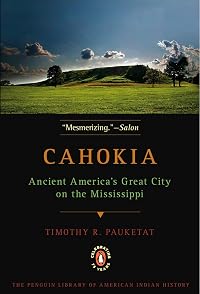
Cahokia: Ancient America's Great City on the Mississippi
by Timothy R. Pauketat
Penguin Library of American Indian History
On This Page
Description
Almost a thousand years ago, a Native American city flourished along the Mississippi River near what is now St. Louis. Cahokia was a thriving metropolis at its height, with a population of 20,000, a sprawling central plaza, and scores of spectacular earthen mounds. The city gave rise to a new culture that spread across the plains; yet by 1400 it had been abandoned, leaving only the giant mounds as monuments, and traces of its influence in tribes we know today. Here, anthropologist Timothy R. show more Pauketat reveals the story of the city and its people as uncovered by American archaeologists. Their excavations have revealed evidence of a powerful society, including complex celestial timepieces, the remains of feasts big enough to feed thousands, and disturbing signs of large-scale human sacrifice. Pauketat provides a comprehensive picture of what's been discovered about Cahokia, and how these findings have challenged our perceptions of Native Americans.--From publisher description. show lessTags
Recommendations






Member Reviews
The Book Report: Where today sits St. Louis, Missouri, there once sat a huge Native American city we call Cahokia, absent any other name for it, relating it to a creek that flows through the five-square-mile extent of the known city and suburbs. There are Indian mounds galore here, and there even is a state park over on the Illinois side of the river. Serious archaeology has been done mostly in front of the bulldozers and the plows of farmers, developers, and the highway builders. Pauketat is one of the region's many dirt archaeologists, the guys who go out and trench interesting sites and keep uber-meticulous notes and drawings and samples of stuff. (GOD doesn't that sound like a painful bore?) Thanks to him and his colleagues, we now show more know that some sort of major urbanization kick hit the area in 1054 and ended in tears about 1250. Why? (On both counts.) Who? What the hell? Those are the questions raised by the archeology, and treated in concise chapters in this book.
My Review: I am not joking when I say concise. This entire book comes in at 170pp of author's text, plus 15pp of notes and an index. Not a challenging read, right? Wrong. The information conveyed in these pages, with about the expected level of grace from an academic writing about his pernickety, obsessive specialty, is rich and deep. I found myself taking week-long pauses at times, not "oh god what a slog" pauses but "...wait...what...no...wait..." pauses while my inner Bill and Ted tried to work out the IMMENSE and IMPORTANT implications of what I was learning.
Immense indeed. Native Americans are all-too-frequently hagiogrpahized as natural-world-lovin' harmony seekers. Oh really? Explain then, if you please, the six separate sites with as many as seventy sacrificed women buried in the trenches in front of which they were clubbed to death in this MATRILINEAL society? In ranks, meaning the next row stood there while the first row was clubbed to death. Why did the different-genetic-stock neighborhoods outlying Cahokia show the signs of poor diet and overwork that one expects to see in the lower classes, and that are absent from the downtowners? Why is there evidence from as far away as Wisconsin that the Cahokian religion was being proselytized and effectively forced down the throats of the locals via economic might?
Why are these Living Saints, as many counterculture woo-woos have it, suddenly shopping for shoes in the feet of clay department?
I confess that I am uber-gleeful about this. I do not subscribe to a worldview that, once upon a time, before icky-ptoo-ptoo Men got hold of things, there was a beautiful wonderful peaceful womanly world, and matrilineality is the last teensy vestige of that demi-Paradise. Ha! All these sacrifices, hugely overwhelmingly female, in a matrilineal society? Oh dear, got some blood on those girly-hands, don't we?
I also don't for a second buy the "living-in-harmony-with-Mother-Earth" story either. These folks stripped the local landscape bare and planted what supported their chosen life-style. No European involvement possible. When it all came to a halt, the violence of the Plains eternal wars began, and never ended. Massacres (google "Crow Creek" just for giggles), colonization, oh the fun that people have when the lid of powerful neighbors is lifted...all here, present and accounted for in the archeaological record!
So should you read this book? Not unless you're already interested in archeology. If you're a leftover hippie, it's likely to hurt too much. If you're wanting an overview, this ain't it. Definitely for the serious-minded reader. show less
My Review: I am not joking when I say concise. This entire book comes in at 170pp of author's text, plus 15pp of notes and an index. Not a challenging read, right? Wrong. The information conveyed in these pages, with about the expected level of grace from an academic writing about his pernickety, obsessive specialty, is rich and deep. I found myself taking week-long pauses at times, not "oh god what a slog" pauses but "...wait...what...no...wait..." pauses while my inner Bill and Ted tried to work out the IMMENSE and IMPORTANT implications of what I was learning.
Immense indeed. Native Americans are all-too-frequently hagiogrpahized as natural-world-lovin' harmony seekers. Oh really? Explain then, if you please, the six separate sites with as many as seventy sacrificed women buried in the trenches in front of which they were clubbed to death in this MATRILINEAL society? In ranks, meaning the next row stood there while the first row was clubbed to death. Why did the different-genetic-stock neighborhoods outlying Cahokia show the signs of poor diet and overwork that one expects to see in the lower classes, and that are absent from the downtowners? Why is there evidence from as far away as Wisconsin that the Cahokian religion was being proselytized and effectively forced down the throats of the locals via economic might?
Why are these Living Saints, as many counterculture woo-woos have it, suddenly shopping for shoes in the feet of clay department?
I confess that I am uber-gleeful about this. I do not subscribe to a worldview that, once upon a time, before icky-ptoo-ptoo Men got hold of things, there was a beautiful wonderful peaceful womanly world, and matrilineality is the last teensy vestige of that demi-Paradise. Ha! All these sacrifices, hugely overwhelmingly female, in a matrilineal society? Oh dear, got some blood on those girly-hands, don't we?
I also don't for a second buy the "living-in-harmony-with-Mother-Earth" story either. These folks stripped the local landscape bare and planted what supported their chosen life-style. No European involvement possible. When it all came to a halt, the violence of the Plains eternal wars began, and never ended. Massacres (google "Crow Creek" just for giggles), colonization, oh the fun that people have when the lid of powerful neighbors is lifted...all here, present and accounted for in the archeaological record!
So should you read this book? Not unless you're already interested in archeology. If you're a leftover hippie, it's likely to hurt too much. If you're wanting an overview, this ain't it. Definitely for the serious-minded reader. show less
Author Timothy Pauketat is an anthropologist at the University of Illinois; his description of the Cahokia site is fascinating but tragic. The tragic part comes in two stages; the inhabitants of Cahokia were capable of magnificent engineering and administrative works – but were also capable of gruesome human sacrifices. (Many of the victims were young women, and a significant number were pregnant women). The modern part of the tragedy comes with the destruction of much of the site by development, until the State of Illinois protected it in the 1980s. The Cahokians left no written records, so what’s known comes from careful archaeological work and inferences from surviving native cultures. Pauketat does an terrific job of explaining show more how the site was handled over the years and what evidence was used to try and deduce how the Cahokians lived. Recommended.
I have to confess I find the topic of human sacrifices of macabre interest. As far as I can tell, every culture has done this sort of thing at some time in their history – Egyptians, Mesopotamians, Cathaginians, Europeans, Chinese, Africans, Aztecs, Mayans, Incas, Polynesians. It’s still done; Google “muti murders”. But don’t ask for images.
A good map of the site, not much in the way of other illustrations. No bibliography but references in the endnotes. show less
I have to confess I find the topic of human sacrifices of macabre interest. As far as I can tell, every culture has done this sort of thing at some time in their history – Egyptians, Mesopotamians, Cathaginians, Europeans, Chinese, Africans, Aztecs, Mayans, Incas, Polynesians. It’s still done; Google “muti murders”. But don’t ask for images.
A good map of the site, not much in the way of other illustrations. No bibliography but references in the endnotes. show less
I will always remember my Time-Life Mysteries of the Ancient World book, which featured a misty picture of the Cahokia mounds and informed us that no one knows who built these mysterious mounds, or why, (oooOOOoooOOOOooo) before moving on to Easter Island. Either the Time-Life people were slacking off, or more discoveries have been made, because there's enough interesting information about the Cahokians to fill a (small) book.
There's still a lot of "maybe ... or then again, maybe not" going on, there is a lot of speculation, but the book contains plenty of satisfying urban planning, human sacrifice (I made notes in case the 2nd Avenue subway construction drags on too long) and iconography. As a bonus, the author deadpans his way through show more the recounting of the most entertaining Native American myth I have ever come across. show less
There's still a lot of "maybe ... or then again, maybe not" going on, there is a lot of speculation, but the book contains plenty of satisfying urban planning, human sacrifice (I made notes in case the 2nd Avenue subway construction drags on too long) and iconography. As a bonus, the author deadpans his way through show more the recounting of the most entertaining Native American myth I have ever come across. show less
I've long been fascinated by Cahokia, the name give to a series of mounds constructed by prehistoric indigenous people in the vicinity of modern day St. Louis, Missouri and East St. Louis, Illinois. Archaeologists have determined that culture thrived at Cahokia circa 1050–1350 CE with 120 earthworks constructed within a 6 square mile area. Between 15,000 and 20,000 people inhabited Cahokia.
The unfortunate part of the Cahokia story is that it's been overlooked due prejudice and stereotypes of indigenous North Americans. Even more positive traits such as the assumption that indigenous people were stewards of the environment and peaceful people so that researchers assumed they would never build a large city. As a result many of the show more mounds were destroyed for highway building and other developments.
Pauketat, a former Illinois State Archaeologist, spent much of his career researching Cahokia. Early in this work he creates a narrative of what it may have been like to walk through Cahokia at its peak. Much of the rest of the work is the history of archaeological research at the site going back to 19th century settlers. From the archaeological work at Cahokia, researchers have learned not only about the activities at the site but also Cahokia's cultural influence elsewhere in North America and modern descendants of the Cahokians show less
The unfortunate part of the Cahokia story is that it's been overlooked due prejudice and stereotypes of indigenous North Americans. Even more positive traits such as the assumption that indigenous people were stewards of the environment and peaceful people so that researchers assumed they would never build a large city. As a result many of the show more mounds were destroyed for highway building and other developments.
Pauketat, a former Illinois State Archaeologist, spent much of his career researching Cahokia. Early in this work he creates a narrative of what it may have been like to walk through Cahokia at its peak. Much of the rest of the work is the history of archaeological research at the site going back to 19th century settlers. From the archaeological work at Cahokia, researchers have learned not only about the activities at the site but also Cahokia's cultural influence elsewhere in North America and modern descendants of the Cahokians show less
For a couple of hundred years between the 10th and 12th centuries a large city, planned city with monumental raised flat-topped mounds, built and inhabited by thousands, flourished along the eastern shore of the Mississippi - ancillary groupings were also scattered about in St. Louis and E. St. Louis (pretty much all destroyed). William Clark, George Catlin and other early visitors wrote of and sketched some of what they saw, but the entrenched belief of the times was that there could never have been such a thing as a 'real' city in North America, with an organized (albeit brutal in the meso-american vein) culture.
Pauketat has organized his information reasonably well, but alas, some editor has, in the new style of 'popular' show more anthropology, advised him to imagine scenarios, withhold tidbits to make the narrative more exciting etcetera, with the result, that it isn't until the end that he lays out neatly the points he should have made from the start. Here's why I like my information up front in a book like this..... it takes me awhile to sort out and absorb what I'm being told. I want that. I know I'm not reading a detective novel. The real 'story' here is about us and how our attitudes shape what we see and what we decide is the meaning of what we see. That tale - mostly sorry with a few bright spots - overshadowed the fact that Cahokia is astonishing to read about. Something that Pauketat calls 'the big bang' (do I sense another editor whispering in his ear?) happened around 1050 A.D. - no one knows what and we can't ever know - to draw people from all around the vicinity - to help build, to farm, and even to being within range to be chosen as a sacrificial victim for one of the Cahokian spectacles...... What is clear is that there was a craze for a game - 'Chunkey' of which, I somehow had never heard or absorbed. A game a bit like hoop and stick only you throw the hoop (a round stone with notches or a hole in it) and then you throw notched sticks (finely made, of course) after it and the scoring is done according to what matches up with what. As I read (and I'm committing the sin of imagining) it did press on my mind that most likely a truly charismatic person or family combined with the allure of this game plus the novelty of living in this new way, close together, the higher caste being supported by a peasant caste, but the peasants, perhaps, feeling they benefitted by proximity to the game, the person, the glory of it all...... Fascinating, unsettling. Even more interesting to think about is how and why it all went to pieces and where everyone went afterward, and how it changed them. If you like delving into American pre-history, this is a must-read. I can't give it more stars because the writing didn't grab me at all. Don't be put off by the lack of a zillion stars. Another reviewer notes the dearth of maps and photographs. I second that. show less
Pauketat has organized his information reasonably well, but alas, some editor has, in the new style of 'popular' show more anthropology, advised him to imagine scenarios, withhold tidbits to make the narrative more exciting etcetera, with the result, that it isn't until the end that he lays out neatly the points he should have made from the start. Here's why I like my information up front in a book like this..... it takes me awhile to sort out and absorb what I'm being told. I want that. I know I'm not reading a detective novel. The real 'story' here is about us and how our attitudes shape what we see and what we decide is the meaning of what we see. That tale - mostly sorry with a few bright spots - overshadowed the fact that Cahokia is astonishing to read about. Something that Pauketat calls 'the big bang' (do I sense another editor whispering in his ear?) happened around 1050 A.D. - no one knows what and we can't ever know - to draw people from all around the vicinity - to help build, to farm, and even to being within range to be chosen as a sacrificial victim for one of the Cahokian spectacles...... What is clear is that there was a craze for a game - 'Chunkey' of which, I somehow had never heard or absorbed. A game a bit like hoop and stick only you throw the hoop (a round stone with notches or a hole in it) and then you throw notched sticks (finely made, of course) after it and the scoring is done according to what matches up with what. As I read (and I'm committing the sin of imagining) it did press on my mind that most likely a truly charismatic person or family combined with the allure of this game plus the novelty of living in this new way, close together, the higher caste being supported by a peasant caste, but the peasants, perhaps, feeling they benefitted by proximity to the game, the person, the glory of it all...... Fascinating, unsettling. Even more interesting to think about is how and why it all went to pieces and where everyone went afterward, and how it changed them. If you like delving into American pre-history, this is a must-read. I can't give it more stars because the writing didn't grab me at all. Don't be put off by the lack of a zillion stars. Another reviewer notes the dearth of maps and photographs. I second that. show less
Writing style isn't like the DaVinci Code, but maybe that's a good thing. It does a good, clear job of explaining the whole history of Cahokia that we know of, cutting back and forth from the present to the past. The history of the archeological excavations, with some sites lost to "progress" but the key site (apparently) preserved, is itself fairly dramatic.
This book caught my attention at a Little Free Library. The hypotheses presented by Pauketat are plausible and fascinating. He presents evidence and explanations of a massive civilization that existed in current Illinois east of St. Louis and the possible connections with Mesoamerican and influence with other Native American populations.
Members
- Recently Added By
Published Reviews
ThingScore 50
added by smasler
Lists

Mississippi River in Books
20 works; 3 members

Books in the Bibliography of The Dawn of Everything by Graeber & Wengrow
478 works; 2 members
Author Information

20+ Works 794 Members
Timothy R. Pauketat is Professor of Anthropology at the University of Illinois at Urbana-Champaign and a Survey Affiliate of the Illinois State Archaeological Survey, USA.
Series

Common Knowledge
- Canonical title
- Cahokia: Ancient America's Great City on the Mississippi
- Alternate titles
- Cahokia
- Original publication date
- 2009
- Important places
- Cahokia Mounds State Historic Site, Illinois, USA; Mississippi Valley, USA; St. Louis, Missouri, USA; East St. Louis, Illinois, USA; Mound 72, Cahokia Mounds, Illinois, USA; Monks Mound, Cahokia Mounds, Illinois, USA (show all 8); Spiro Mounds, Oklahoma, USA; Cahokia Mounds, Illinois, USA
- Dedication
- In memory
of Mike, Preston, Harriet, Warren,
Al, and Chuck - First words
- In the early hours before sunrise, for part of each year, the planet Venus shines as a "morning star."
- Last words
- (Click to show. Warning: May contain spoilers.)At night, the sky fills with reminders of the past until the rising sun dissolves the darkness, balancing all.
- Publisher's editor
- Colin Calloway
Classifications
- Genres
- Anthropology, History, Nonfiction, General Nonfiction
- DDC/MDS
- 977.386 — History & geography History of North America North central United States Illinois Southwest counties Madison; Alton
- LCC
- E99 .M6815 .P375 — History of the United States America Indians of North America Indian tribes and cultures
- BISAC
Statistics
- Members
- 485
- Popularity
- 62,636
- Reviews
- 15
- Rating
- (3.68)
- Languages
- English
- Media
- Paper, Audiobook, Ebook
- ISBNs
- 11
- ASINs
- 5