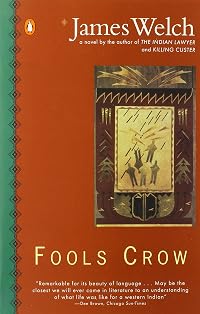
Fools Crow
by James Welch
On This Page
Description
Fiction. Literature. Western. HTML:The year is 1870, and Fool's Crow, so called after he killed the chief of the Crows during a raid, has a vision at the annual Sun Dance ceremony. The young warrior sees the end of the Indian way of life and the choice that must be made: resistance or humiliating accommodation."A major contibution to Native American literature." —Wallace Stegner.
Cover image courtesy of Walter McClintock Papers. Western Americana Collection, Beinecke Rare Book and show more Manuscript Library, Yale University.
. show less
Tags
Recommendations









Member Reviews
This leisurely-paced and character-driven novel tells the story of a young Blackfeet man coming of age at the time when his tribe’s way of life is slipping away from them as white settlers steadily encroach on their Montana homelands. Though Welch does not take the timeline as far as the Little Big Horn battle, it looms on the horizon.
Although to overall sweep of the novel is tinged with the foreshadowing of the end of the great tribal plains society, the individual scenes are often sweet, quiet, domestic ones. Violence is also there, as matter-of-fact as the rising and setting of the sun. His characters follow the traditional ways, or depart from them to their grief, and each one works out his own destiny inside the circle of show more seasons.
Overall, it's a somewhat melancholy read, but well worth the journey. show less
Although to overall sweep of the novel is tinged with the foreshadowing of the end of the great tribal plains society, the individual scenes are often sweet, quiet, domestic ones. Violence is also there, as matter-of-fact as the rising and setting of the sun. His characters follow the traditional ways, or depart from them to their grief, and each one works out his own destiny inside the circle of show more seasons.
Overall, it's a somewhat melancholy read, but well worth the journey. show less
James Welch has given us a wonderful account of Native American life in the late 1800s. Things are changing in northern Montana as more settlers discover the area, infringing on the hunting grounds of the natives. Fools Crow is a young brave in the Pikunis branch of the Blackfeet Indians. Specifically, he is part of the Lone Eaters, a close-knit band deeply rooted in the earth. The members "help each other, depend on each other…fight and die beside each other." (187) Welch gives the reader an in-depth look at the daily lives of these people and makes us privy to the dreams that guide them on their hunts and determine their personalities. We tend to lump people we don't understand into a group, forgetting that they have their strengths show more and weaknesses as we all do.
As their hunting grounds shrink and the white settlers bring disease west with them, a hard life becomes a fight for survival. The smallpox epidemics shrink their numbers and sap their strength. Fools Crow has seen a vision of what will become of his people and he is helpless to stop it. Honor and the blackhorns (buffalo) make his people what they are, and both are slipping away. It's a story we know well, but Welch makes it seem personal to me. show less
As their hunting grounds shrink and the white settlers bring disease west with them, a hard life becomes a fight for survival. The smallpox epidemics shrink their numbers and sap their strength. Fools Crow has seen a vision of what will become of his people and he is helpless to stop it. Honor and the blackhorns (buffalo) make his people what they are, and both are slipping away. It's a story we know well, but Welch makes it seem personal to me. show less
An amazing coming of age tale set against the backdrop of a civilizational clash. "Fools Crow" follows the tale of White Man's dog (later Fools Crow after blooding himself in a raid), a young Blackfeet Indian charged with great mystic powers and his struggle to preserve his people in the face of manifest destiny.
Welch creates a surreal world in which the past and the present, myth and reality amalgamate to weave a mystical tapestry in which humanity confronts itself. Fools Crow and his tribe of Lone Eaters are the Earth's children, humble in sophistication but intelligent in their living. The juxtaposed whites meanwhile are afflicted by hubris and possessed of the belief that the end of the Indian is neigh.
The distinctiveness of Welch's show more work can be gauged from the fact that his Indians are not the stereotypic monochromatic naturists of the Occidental purview. They are progressive in their own right, have property rights and are astute statesmen among themselves. They are able to discern the true intent behind the settler's design for them, but are not possessed of a keen insight into the white psyche to adjudge their next course of action.
While their fellow Indians take to their weapons to confront the whites, Fools Crow and the Lone Eaters emphasize co-existence. The novel ends with two poignant events. The 1870 massacre of unarmed friendly Blackfeet by the US 2nd Cavalry, and Fools Crow's resolve that the Blackfeet will preserve their culture while living in the White Man's world.
"Fools Crow" is a warrior's story, a tale of necessary sacrifices for a better future and the pursuit of justice in a changing world. show less
Welch creates a surreal world in which the past and the present, myth and reality amalgamate to weave a mystical tapestry in which humanity confronts itself. Fools Crow and his tribe of Lone Eaters are the Earth's children, humble in sophistication but intelligent in their living. The juxtaposed whites meanwhile are afflicted by hubris and possessed of the belief that the end of the Indian is neigh.
The distinctiveness of Welch's show more work can be gauged from the fact that his Indians are not the stereotypic monochromatic naturists of the Occidental purview. They are progressive in their own right, have property rights and are astute statesmen among themselves. They are able to discern the true intent behind the settler's design for them, but are not possessed of a keen insight into the white psyche to adjudge their next course of action.
While their fellow Indians take to their weapons to confront the whites, Fools Crow and the Lone Eaters emphasize co-existence. The novel ends with two poignant events. The 1870 massacre of unarmed friendly Blackfeet by the US 2nd Cavalry, and Fools Crow's resolve that the Blackfeet will preserve their culture while living in the White Man's world.
"Fools Crow" is a warrior's story, a tale of necessary sacrifices for a better future and the pursuit of justice in a changing world. show less
As a rule, I prefer non-fiction over historical fiction because I frequently find that historical fiction tends to romanticize its subjects. I do, however feel that there are certain subtle understandings about the characters and unspoken inner worlds of human beings that can be expressed in a uniquely personal way quite well through the medium of the historical novel. In his novel Fools Crow, author James Welch has traveled with a sure step and a deft hand the thin line that all historical writers walk between truth and fabrication. I think he has offered his readers an honest, revealing and intimate look into the lives, personalities, traditions and inner worlds of the Pikuni Blackfeet people of the mid 1800s. His fictional approach show more to teaching allows for a singularly personal understanding of such intangibles in Indian life and psychology as dreaming, communicating with otherworldly beings and the effects of their honor and bravery traditions. By offering his readers the insights into the feelings and motivations of created characters we are shown multidimensional portraits that are vivid and evocative and to which we, as fellow human beings, can relate. When we pair these personal insights with the factual evidence of the history of those times in which these characters lived we end up with a well rounded understanding that non-fictional accounts frequently lack.
James Welch (1940-2003)authored several novels and volumes of poetry concerning the life of western plains Indians. Born of a Blackfeet father and a Gros Ventre mother and raised primarily on Montana's Fort Belknap Reservation Welch had ample experience and access to the stories, spirituality and traditions of the Blackfeet tribe throughout his life. His style of writing is frank, thoughtful and detailed. Dee Brown, author of Bury My Heart at Wounded Knee had this to say about Fools Crow, "Remarkable for its beauty of language...May be the closest we will ever come in literature to an understanding of what life was like for a western Indian." While I do not think I can be as effusive as Mr. Brown in my assessment of this book I most heartily concur with his viewpoint as to the style and beauty of the writing. When Welch is in his omniscient perspective he communicates in modern English but when seeing through the eyes of a particular character he manages to convey in English the Indian way of sentence structure and idiom without making it sound like pidgin English. The results whether internal or external add a valuable layer of characterization that is revealed through the very structure of the thoughts, emotions and dialog of characters.
Fools Crow is a novel whose main character, White Man's Dog eventually earns the name of Fools Crow for his bravery in a raid upon a Crow village. The Fools Crow of this novel should not be confused in any way with the contemporary real life person of Fools Crow, a respected Ceremonial Chief of the Oglala Sioux.
The novel tells the story of the latter days of the Pikuni (aka Piegan) people, one of three branches of the Blackfeet Nation. The life of its central character, Fools Crow is traced from the young adult days of an untried hunter and warrior up through his growth as a healer, visionary, husband and father, and respected warrior of his people at the time of the disastrous Marias River Massacre in which over 200 unarmed, sleeping women, children and elderly people were slaughtered and the few survivors left to freeze and starve by the terrorist American Calvary in January of 1870.
Fools Crow is like so many other books about Indians of this time period in that it traces their frustration, confusion, fear and anger due to the incursions into their territory by white settlers, prospectors and military. It relates the same frightful racist tactics of greed and hatred that are part and parcel to any book of historical insights from this period. Open any book of this genre and you will learn the same essential facts no matter if it concerns the Blackfeet, the Lakota, the Nez Perce, the Cherokee or any other First Nation tribe. It is easy to find books that talk about Indian life with its myriad variations tribe to tribe of social traditions, spiritual and religious expression, and traditions surrounding the hunt and warfare. I've read a good many and I do appreciate any opportunity to further pierce the veil with which the years and the whitewashing of facts by white historians and educators has obscured the truth. This novel has done just that by its perceptive sensitivity of characterization.
In Fools Crow we will not find the circumstances any different than those that we have come to know about the injustice, the murder and pillage, the breaking of promises and treaty agreements, the white man disease epidemics, the wanton waste of the buffalo herds, the encroachment upon homelands, the dehumanization and racism, the forced relocations and poverty, starvation and disease of the reservation life and all the other atrocities heaped upon the First Nation people by the United States government and its people. What I found unique about this book and why it was most certainly worth my while to read it was the perspective it gave of the personalities (and I mean the use of that word in its most literal sense) of Blackfeet people of that time. Welch is the grandson of a woman who survived the tragic Marias River Massacre. He has obviously been exposed to deep personal insights into the feelings and thoughts of real people from that time.
The character Fools Crow gives us through his inner dialog of thoughts and feelings and his outer dialog of conversation with his family, friends and enemies another layer of understanding. We are given the opportunity to feel the inner person's wash of emotions as we learn the facts of acquiring skills, hunting, fighting, protecting the women, children and old ones, healing the sick, listening to the wisdom as it comes from tribal mentors and from the deities and the voices of the animals who share the world. Instead of only fact we get a multidimensional experience.
The novel examines several interpersonal relationships that Fools Crow has and it traces the events that led up to the historical Marias River Massacre. We learn many details and facts about camp life, life as it was lived on a day to day basis with its courtships, marriages, births and deaths, sickness and healing, traditions and taboos. We are treated to several Pikuni legends and spiritual stories that are offered up in a unique way that illustrates the very real impact they had on individual people. Crow and Wolverine speak with and relate to Fools Crow and others of the Pikuni in a very real, first person manner. Their wisdom is related personally in the otherworld consciousness that for the Pikuni and many First Nations tribes is very real. Usually when in the past I have read Indian legends and teaching stories they seemed like rather one dimensional tales...symbolic and contrived for a purpose. In this book the legends are conveyed in the way that a person actually would have perceived them. We see how real and how important they were to every day life and to the direction of that life. We see how much respect for the deities of the seasons, the sun and moon and stars and their fellow creatures the Blackfeet people had. When an eclipse occurs just prior to an important raid upon the Crows we see how each man takes its import very seriously indeed. Signs and portents are everywhere and are looked upon with great seriousness. We are made to understand how very connected the Blackfeet people were to their world, how every bit of it was alive and capable of speech and wisdom.
The plot or action of this book makes it a page turner but its action is not what makes it so remarkable. It is the inner worlds of its characters that offer us so much. As with all books from this time period we already know when we start reading it that it isn't going to have a "happy ending." Still, we go along with the characters and we experience life through their eyes. This drives home the depth of the tragedy of white incursion in a personal way because we see people just trying to be people, just living life, all the while knowing full well what they are up against even when they themselves do not.
Many books about Indians have a tendency to group braves, warriors, hunters in one stereotypical group, leaders, chiefs, old men in another, women in another and children in yet another. We are used to the stereotypical stoicism, bravery, physical endurance of the braves, the selfless wisdom of the chiefs, the demure, submissive role of the women. This book does a brilliant job of filling in the blanks in those stereotypes and illuminating the essential truths of them while expanding upon the psychology behind those roles with the more personal variances of individual personalities. At a time in history when the Indians were often violently punished by the United States government with bloody actions that claimed hundreds of innocent lives it is very interesting to understand the motivations and understandings and also the confusion of the Indians as they faced an atmosphere of living that was utterly foreign to their way of thinking. In a novel, more so than a work of non-fiction we have the powerful opportunity of absorbing the emotional content that most certainly would have accompanied the facts that history has taught us. We get an inside seat to the events and we gain an appreciation for the nuances of personality and situation that a backward look at history cannot provide.
For the most part, I enjoyed this book very much. I did take issue with what I perceived to be the author's own perspective on females and gender relations in general which I felt cast a somewhat misogynous and more overtly chauvinistic attitude of the Pikuni men toward women than was actually present in the factual lives of the people. It's no secret that interpersonal relations between men and women were different among Indian people of the 1800s than they are today. It is a complex subject the scope of which this review cannot contain. It is known that women most definitely had a "place" and were expected to know that place and to keep in it. The same is true for men. Social structure and taboos defined these places and behaviors and gender relationships. They can appear to be chauvinistic and misogynous on the surface when viewed in a strictly linear way but can be seen to be practical and orderly if seen in another light. My problem with Welch's portrayal of men's actions and responses to women in this book is that in his desire to be frank and honest about the sexual feelings and appetites of men he has a tendency in this book to stereotype and often makes the men seem like inappropriate sexually primitive beings. He tends to describe men's reactions to female presence in a primarily sexual way. He suggests that certain sexual responses that are completely abnormal occur to totally normal men. For example he describes the rape of a sick and feverish young woman who is happened upon by an honorable warrior in the midst of a raid gone wrong while trying to hide from his enemies. The rape happens not as an act of violence or hatred toward an enemy woman but rather as a side effect of the warrior hiding in her robes and becoming aroused when discovering her naked body to be hot and wet from her fever. I found it to be quite preposterous. He describes the erections of various men at times when they for example see a woman bathing in the river or hard at work scraping a buffalo hide. I am not saying that sexual arousal is not a part of everyday life but in this book it seems that many times Welch seems to be describing his own sexual feelings and agenda as regards women rather than relating anything meaningful about social/sexual relationships. Welch makes it seem like Indian men are horny dogs as a first response to women in general. Since I know this is not the actual case it leads me to suspect that it is actually Welch who is the horny dog in this case and not his characters.
I really loved the way this book ended because even though Fools Crow has stood in the destroyed and burned out rubble of the winter camp of Heavy Runner's people on the Marias River and witnessed the murderous mayhem and even though he has received a powerful medicine vision that has revealed the dismal and desperate future of his people and knows what is ahead, the final pages show him continuing on with his life, anticipating the coming spring hunt, the raising of his infant son, and the continuation of his people's way of life. It is a hopeful and brave heart that he maintains even in the face of such depredation. It is a well grounded urge to continue, to survive and to live a brave life, a good life. Knowing what we the readers do know about the fate of the Blackfeet people of that time we can not help but be moved by Welch's ending because we know the insurmountable wave of destruction that raced toward the shore even as Fools Crow so valiantly picks up the pieces and continues living. For me the ending spoke very poignantly and illustrated one of the most important reasons why the First Nation people and their ways are still alive today despite the holocaust they endured.
All in all, despite my objection to the sexual stereotyping I found this book to be very informative, moving and just a downright interesting read. I can easily recommend it. I don't know of a better inside look at the perceptions of the Indians of the 1800s as regards their interrelationships on a personal level with the natural world in which they lived. Their relationship to their world was so much more layered than our own and they approached it with such elevated sensitivity. This is a very hard thing to convey in writing. James Welch managed it with a high degree of artistry. I can recommend this book for the clarity and authenticity of its view into history, for its depiction of the events leading up to the Marias River Massacre and its insights into Blackfeet culture and most importantly to me, its insights into the inner world of First Nation people of that astonishingly volatile period. show less
James Welch (1940-2003)authored several novels and volumes of poetry concerning the life of western plains Indians. Born of a Blackfeet father and a Gros Ventre mother and raised primarily on Montana's Fort Belknap Reservation Welch had ample experience and access to the stories, spirituality and traditions of the Blackfeet tribe throughout his life. His style of writing is frank, thoughtful and detailed. Dee Brown, author of Bury My Heart at Wounded Knee had this to say about Fools Crow, "Remarkable for its beauty of language...May be the closest we will ever come in literature to an understanding of what life was like for a western Indian." While I do not think I can be as effusive as Mr. Brown in my assessment of this book I most heartily concur with his viewpoint as to the style and beauty of the writing. When Welch is in his omniscient perspective he communicates in modern English but when seeing through the eyes of a particular character he manages to convey in English the Indian way of sentence structure and idiom without making it sound like pidgin English. The results whether internal or external add a valuable layer of characterization that is revealed through the very structure of the thoughts, emotions and dialog of characters.
Fools Crow is a novel whose main character, White Man's Dog eventually earns the name of Fools Crow for his bravery in a raid upon a Crow village. The Fools Crow of this novel should not be confused in any way with the contemporary real life person of Fools Crow, a respected Ceremonial Chief of the Oglala Sioux.
The novel tells the story of the latter days of the Pikuni (aka Piegan) people, one of three branches of the Blackfeet Nation. The life of its central character, Fools Crow is traced from the young adult days of an untried hunter and warrior up through his growth as a healer, visionary, husband and father, and respected warrior of his people at the time of the disastrous Marias River Massacre in which over 200 unarmed, sleeping women, children and elderly people were slaughtered and the few survivors left to freeze and starve by the terrorist American Calvary in January of 1870.
Fools Crow is like so many other books about Indians of this time period in that it traces their frustration, confusion, fear and anger due to the incursions into their territory by white settlers, prospectors and military. It relates the same frightful racist tactics of greed and hatred that are part and parcel to any book of historical insights from this period. Open any book of this genre and you will learn the same essential facts no matter if it concerns the Blackfeet, the Lakota, the Nez Perce, the Cherokee or any other First Nation tribe. It is easy to find books that talk about Indian life with its myriad variations tribe to tribe of social traditions, spiritual and religious expression, and traditions surrounding the hunt and warfare. I've read a good many and I do appreciate any opportunity to further pierce the veil with which the years and the whitewashing of facts by white historians and educators has obscured the truth. This novel has done just that by its perceptive sensitivity of characterization.
In Fools Crow we will not find the circumstances any different than those that we have come to know about the injustice, the murder and pillage, the breaking of promises and treaty agreements, the white man disease epidemics, the wanton waste of the buffalo herds, the encroachment upon homelands, the dehumanization and racism, the forced relocations and poverty, starvation and disease of the reservation life and all the other atrocities heaped upon the First Nation people by the United States government and its people. What I found unique about this book and why it was most certainly worth my while to read it was the perspective it gave of the personalities (and I mean the use of that word in its most literal sense) of Blackfeet people of that time. Welch is the grandson of a woman who survived the tragic Marias River Massacre. He has obviously been exposed to deep personal insights into the feelings and thoughts of real people from that time.
The character Fools Crow gives us through his inner dialog of thoughts and feelings and his outer dialog of conversation with his family, friends and enemies another layer of understanding. We are given the opportunity to feel the inner person's wash of emotions as we learn the facts of acquiring skills, hunting, fighting, protecting the women, children and old ones, healing the sick, listening to the wisdom as it comes from tribal mentors and from the deities and the voices of the animals who share the world. Instead of only fact we get a multidimensional experience.
The novel examines several interpersonal relationships that Fools Crow has and it traces the events that led up to the historical Marias River Massacre. We learn many details and facts about camp life, life as it was lived on a day to day basis with its courtships, marriages, births and deaths, sickness and healing, traditions and taboos. We are treated to several Pikuni legends and spiritual stories that are offered up in a unique way that illustrates the very real impact they had on individual people. Crow and Wolverine speak with and relate to Fools Crow and others of the Pikuni in a very real, first person manner. Their wisdom is related personally in the otherworld consciousness that for the Pikuni and many First Nations tribes is very real. Usually when in the past I have read Indian legends and teaching stories they seemed like rather one dimensional tales...symbolic and contrived for a purpose. In this book the legends are conveyed in the way that a person actually would have perceived them. We see how real and how important they were to every day life and to the direction of that life. We see how much respect for the deities of the seasons, the sun and moon and stars and their fellow creatures the Blackfeet people had. When an eclipse occurs just prior to an important raid upon the Crows we see how each man takes its import very seriously indeed. Signs and portents are everywhere and are looked upon with great seriousness. We are made to understand how very connected the Blackfeet people were to their world, how every bit of it was alive and capable of speech and wisdom.
The plot or action of this book makes it a page turner but its action is not what makes it so remarkable. It is the inner worlds of its characters that offer us so much. As with all books from this time period we already know when we start reading it that it isn't going to have a "happy ending." Still, we go along with the characters and we experience life through their eyes. This drives home the depth of the tragedy of white incursion in a personal way because we see people just trying to be people, just living life, all the while knowing full well what they are up against even when they themselves do not.
Many books about Indians have a tendency to group braves, warriors, hunters in one stereotypical group, leaders, chiefs, old men in another, women in another and children in yet another. We are used to the stereotypical stoicism, bravery, physical endurance of the braves, the selfless wisdom of the chiefs, the demure, submissive role of the women. This book does a brilliant job of filling in the blanks in those stereotypes and illuminating the essential truths of them while expanding upon the psychology behind those roles with the more personal variances of individual personalities. At a time in history when the Indians were often violently punished by the United States government with bloody actions that claimed hundreds of innocent lives it is very interesting to understand the motivations and understandings and also the confusion of the Indians as they faced an atmosphere of living that was utterly foreign to their way of thinking. In a novel, more so than a work of non-fiction we have the powerful opportunity of absorbing the emotional content that most certainly would have accompanied the facts that history has taught us. We get an inside seat to the events and we gain an appreciation for the nuances of personality and situation that a backward look at history cannot provide.
For the most part, I enjoyed this book very much. I did take issue with what I perceived to be the author's own perspective on females and gender relations in general which I felt cast a somewhat misogynous and more overtly chauvinistic attitude of the Pikuni men toward women than was actually present in the factual lives of the people. It's no secret that interpersonal relations between men and women were different among Indian people of the 1800s than they are today. It is a complex subject the scope of which this review cannot contain. It is known that women most definitely had a "place" and were expected to know that place and to keep in it. The same is true for men. Social structure and taboos defined these places and behaviors and gender relationships. They can appear to be chauvinistic and misogynous on the surface when viewed in a strictly linear way but can be seen to be practical and orderly if seen in another light. My problem with Welch's portrayal of men's actions and responses to women in this book is that in his desire to be frank and honest about the sexual feelings and appetites of men he has a tendency in this book to stereotype and often makes the men seem like inappropriate sexually primitive beings. He tends to describe men's reactions to female presence in a primarily sexual way. He suggests that certain sexual responses that are completely abnormal occur to totally normal men. For example he describes the rape of a sick and feverish young woman who is happened upon by an honorable warrior in the midst of a raid gone wrong while trying to hide from his enemies. The rape happens not as an act of violence or hatred toward an enemy woman but rather as a side effect of the warrior hiding in her robes and becoming aroused when discovering her naked body to be hot and wet from her fever. I found it to be quite preposterous. He describes the erections of various men at times when they for example see a woman bathing in the river or hard at work scraping a buffalo hide. I am not saying that sexual arousal is not a part of everyday life but in this book it seems that many times Welch seems to be describing his own sexual feelings and agenda as regards women rather than relating anything meaningful about social/sexual relationships. Welch makes it seem like Indian men are horny dogs as a first response to women in general. Since I know this is not the actual case it leads me to suspect that it is actually Welch who is the horny dog in this case and not his characters.
I really loved the way this book ended because even though Fools Crow has stood in the destroyed and burned out rubble of the winter camp of Heavy Runner's people on the Marias River and witnessed the murderous mayhem and even though he has received a powerful medicine vision that has revealed the dismal and desperate future of his people and knows what is ahead, the final pages show him continuing on with his life, anticipating the coming spring hunt, the raising of his infant son, and the continuation of his people's way of life. It is a hopeful and brave heart that he maintains even in the face of such depredation. It is a well grounded urge to continue, to survive and to live a brave life, a good life. Knowing what we the readers do know about the fate of the Blackfeet people of that time we can not help but be moved by Welch's ending because we know the insurmountable wave of destruction that raced toward the shore even as Fools Crow so valiantly picks up the pieces and continues living. For me the ending spoke very poignantly and illustrated one of the most important reasons why the First Nation people and their ways are still alive today despite the holocaust they endured.
All in all, despite my objection to the sexual stereotyping I found this book to be very informative, moving and just a downright interesting read. I can easily recommend it. I don't know of a better inside look at the perceptions of the Indians of the 1800s as regards their interrelationships on a personal level with the natural world in which they lived. Their relationship to their world was so much more layered than our own and they approached it with such elevated sensitivity. This is a very hard thing to convey in writing. James Welch managed it with a high degree of artistry. I can recommend this book for the clarity and authenticity of its view into history, for its depiction of the events leading up to the Marias River Massacre and its insights into Blackfeet culture and most importantly to me, its insights into the inner world of First Nation people of that astonishingly volatile period. show less
"We will go on, he thought; as long as Mother Earth smiles on her children, we will continue to be a people. We will live and die and live on."
Fools Crows is the story of the Pikuni (Blackfeet) tribe in the Montana territory shortly after the Civil War. As the white man is encroaching more and more on their land, the tribe is faced with the choice of whether to stand their ground and fight or surrender and sacrifice their resources, land and way of life.
The story is almost entirely from the male perspective, primarily the main character named White Man's Dog, who is later re-named Fools Crow (a common tribal tradition). He begins the story as a boy struggling to find his place and become a man and ends it as one of the leaders and show more medicine men of his band, known as the Lone Eaters.
Although there were some women characters, the author definitely doesn't have the gift of a connection with the feminine soul like some other male authors I've read, so unfortunately they were flat and unemotional.
For me, this was an educational book that taught me some important things about one of the most awful aspects of my country's history. What it did not do was have a lasting emotional impact on me, so it's not likely to live long in my memory. Regardless, it made me better, so for that I am grateful. show less
Fools Crows is the story of the Pikuni (Blackfeet) tribe in the Montana territory shortly after the Civil War. As the white man is encroaching more and more on their land, the tribe is faced with the choice of whether to stand their ground and fight or surrender and sacrifice their resources, land and way of life.
The story is almost entirely from the male perspective, primarily the main character named White Man's Dog, who is later re-named Fools Crow (a common tribal tradition). He begins the story as a boy struggling to find his place and become a man and ends it as one of the leaders and show more medicine men of his band, known as the Lone Eaters.
Although there were some women characters, the author definitely doesn't have the gift of a connection with the feminine soul like some other male authors I've read, so unfortunately they were flat and unemotional.
For me, this was an educational book that taught me some important things about one of the most awful aspects of my country's history. What it did not do was have a lasting emotional impact on me, so it's not likely to live long in my memory. Regardless, it made me better, so for that I am grateful. show less
Fools Crow is a truly excellent novel. Although it took me a few chapters to really get into the rhythm of the novel, Welsh maintains a distinct tone throughout the narrative that is distinct and feels like a first-hand account of the events. The pacing was excellent and the end of the book encapsulates the sorrow at the changing future and the hope and resilience of this tribe of Blackfeet.
James Welch’s book Fools Crow is a novel that follows the life of the Pukuni band of Blackfeet Indians that lived in the area that is present-day Montana. Welch introduces the reader to White Man’s Dog, the main protagonist of the story, and tells of his journey from a boy subjected to ridicule and teasing by his peers, to a man given great respect by his fellow people. Welch provides in-depth insight into the life and experiences of the Pukuni people in the post Civil War West. He discusses the struggles faced by the Blackfeet in order survive the often brutal environment of the High Plains. He illustrates the great lengths White Man’s Dog’s people go to in order to hunt the black horn (buffalo) and provide food and clothing show more for their families. Yet, perhaps Welch’s greatest achievement is his presentation of Indian-White (Napikwans) relations during this time period. He goes to great pains to explain the plethora of effects the Napikwans had on the Pukunis. Welch’s writing illustrates beautifully the family dynamics, customs and the religious beliefs and practices of the Blackfeet people. As a Indian himself, and as a direct descendant of a survivor of the Marias River Massacre of 1870, Welch brings a unique and uncompromised perspective through his fiction, describing the struggles and atrocities undergone by the people to which he belongs.
Welch does not shy away from describing aspects of Blackfeet life and culture in the nineteenth century that could be considered taboo today. He describes the ambush and murder of both Indians from enemy tribes as well as the killing of white men and the rape of white women. He mentions accounts of slavery or indentured servitude within the tribes as well as the common practice of polygamy. Yet he also describes in great detail the social structure of the tribes. Welch gives examples of the unity and bonding that these people possess, the affinity they have for one another and the great lengths they go to in order to insure stability within their community. He provides the reader with accounts of disease that infect the Blackfeet, and their attempts to heal their people through medicine and religious ritual. The reader is given a look inside the political procedures of the tribes, by reading scenes that take places in the chief’s lodge with all the other men of influence. Welch gives examples of how the Blackfeet may have thought about the influence of the Whites and how they would maintain their lives and practices in an ever shrinking world. In addition to social and political action Welch gives the reader insight into romantic life as well as interpersonal relationships between parents and children, siblings and young members of the tribe and their relationships with the elders of the community. In the end, Welch creates a detailed description of the life of the Blackfeet Indians on the high plains of North American toward the end of their isolation and freedom from the White influence. He does an excellent job of giving an account of their effort to preserve their culture while at the same time realizing that their way of life was quickly coming to an end.
The story begins when White Man’s Dog is an adolescent and is invited by Yellow Kidney, a respected man among the Pikuni, to accompany him and a group of others on a horse raid against the enemy Crow. White Man’s Dog accepts this invitation and successfully steals many of the Crow horses while also obtaining his first kill of an enemy. Yet the attack was not a complete success because of White Man’s Dog’s childhood friend Fast Horse. During the covert raid Fast Horse entered the sleeping Crow camp with Yellow Kidney and other experienced warriors and was overcome by the moment. Fast Horse’s sudden outburst of brevity alerts the sleeping Crow and Yellow Kidney is captured as a result. White Man’s Dog and the others return to their camp with many of the Crow horses unaware of the fate of Yellow Kidney. After much time passes, Yellow Kidney returns to the Lone Eaters’ camp mutilated and barely alive. He tells of Fast Horse’s out cry and his subsequent capture and torture (the Crow, under the command of their chief Bull Shield, cut the fingers off of both of Yellow Kidney’s hands). Fast Horse is banished from the Lone Eaters and joins a renegade band of Pikuni, lead by Owl Child, which raid and kill Napikwans in the area. As a result of Yellow Kidneys mutilation, White Man’s Dog begins to hunt and provide for his family. Through doing so White Man’s Dog meets Red Paint, Yellow Kidney’s daughter, whom he will eventually marry and have a child with.
While looking after Yellow Kidney’s family White Man’s Dog begins to spend time with Mik-Api, the local medicine man. Through his apprenticeship and the many sweats to two men participate in together White Man’s Dog receives his spirit animal, the wolverine. The Lone Eaters begin to plan an attack on the Crow and Bull Shield in order to avenge Yellow Kidney’s capture and torture. White Man’s Dog is to be a major figure in the war party, accompanied by his father Rides-at-the-Door and his brother Running Fisher. During the attack White Man’s Dog locates Bull Shield’s lodge and attempts to steal his horse (a large, strong, black buffalo runner). During this attempt, White Man’s Dog is wounded and falls to the ground, Bull Shield, believing White Man’s Dog is dead ignores him, giving the young brave the opportunity to mortally wound the great chief. White Man’s Dog returns to the Lone Eaters’ camp with the scalp of Bull Shield and is given the name Fools Crow for his bravery and trickery during the battle.
Fools Crow had earned the respect of the tribe and was thus given a special mission by Boss Ribs, father of Fast Horse. Fools Crow accepted the mission to track down and bring Fast Horse back to the Pikunis. This is the first of many journeys Fools Crow set out on. While he failed to bring Fast Horse back to his family and people, he was successful in fulfilling the request of yet another spirit animal, the crow, which came to him in a dream. He travels, with his wife Red Paint, far up into the Backbone of the World (the Rocky Mountains) and shots Napikwan that had been killing animals only for sport. Fools Crow and Red Paint return from their time away in the Backbone of the World, only to feel the pressure and panic of their people worried by the ever-advancing Napikwans of the U. S. Army (whom the Pikunis refer to as seizers).
As Welch draws his novel to a close, Fools Crow goes on one final journey, this time alone. He travels for several days without stopping to sleep or eat. Finally he arrives in a place where it is always summer, and meets a woman that he comes to find is Feather Woman, daughter of Morning Star and Sun. Feather Woman had been cast out of the family in the Sky for digging a magic turnip and was exiled to spend eternity begging Morning Star and Sun to forgive her and accept her back into their family. In the days that he spent with Feather Woman, he would sit in her lodge and watch her paint on yellow hides, yet Fools Crow could never see her paintings. It was as if the pigment had disappeared, until one day Fools Crow was able to recognize the painting. As he studied Feather Woman’s drawing, the figures in it came to life, and Fools Crow was able to see what was to come of his people. He sees his people being cut down and burned by the seizers, children attending Napikwan schools with their hair cut short and he sees the effect of smallpox on the Lone Eaters.
Fools Crow returns to his camp to see that Feather Woman’s painting was true. He worked diligently alongside Mik-Api to use their medicine to heal those that suffered with the bad spirit of the white-scab sickness. Their medicine was useless. Fools Crow knew the fate of his people, many would parish form this terrible disease. After many days of working with medicine and performing many sweats, Fools Crow went out with a small group of young hunters in orders to gather some meat for his ailing people. While traveling to the place where the black horns could be found the hunters came upon a group of exhausted and injured Pikunis from a neighboring band. These people tell Fools Crow and the hunting group that they are survivors of an attack on their camp by the seizers who ambushed them early in the morning killing almost everyone and burning everything in site. This was the site of the Marias Massacre. Fools Crow travels to the camp and sees the destruction, just as he saw it in the painting of Feather Woman. Welch ends his book with Fools Crow and Red Paint and their new son, Butterfly, performing a rain dance for Thunder Chief, at an early spring celebration with the surviving members of the Pikuni people.
Welch presents many themes in his novel. Perhaps a better word to describe the themes he presents is perspectives. Welch presents many different perspectives held by the characters of his story and describes their feelings and thoughts in regards to the expansion of the Whites. He presents the reader with characters like Mountain Chief who would rather fight to the death then deal with the Napikwans. Others, like Heavy Runner, maintain a type of trust for the Napikwans arguing that the Pikunis needed to submit to the demands of the Napikwans in order to receive some type a conciliation; conciliation that many thought would never come. There were those characters like Owl Child that took things into their own hands and attacked and killed the Whites. Welch also presented the reader with characters whose attitudes were more contemplative such as Rides-at-the-Door and Mik-Api. These men were torn between the emotional and the rational. Their hearts told them to fight and defend their people and homeland, while their heads told them they stood no chance against the Napikwan’s numbers and weapons.
Welch offers the reader insight into the complexity not only of the situation that that Indians all other North America were forced to deal with, but the inner struggle with which they battled. He not only put a face and a name to individuals who have for too long been faceless and nameless, dehumanized by the lustful desire for land and money; but also gives them a voice and a spirit. Through the genre of fiction, Welch is allowed the capability to develop these individuals in a personal and intimate fashion. He is not restricted by the cold hard guidelines and rules of academia. He is permitted the freedom to express his ideas and understandings of the struggle and the torment his people faced, and are still faced in many ways today. James Welch’s Fools Crow is beautifully written and an excellent insight into the Native American psyche, exposing the reader to new ways of thinking, living and being. show less
Welch does not shy away from describing aspects of Blackfeet life and culture in the nineteenth century that could be considered taboo today. He describes the ambush and murder of both Indians from enemy tribes as well as the killing of white men and the rape of white women. He mentions accounts of slavery or indentured servitude within the tribes as well as the common practice of polygamy. Yet he also describes in great detail the social structure of the tribes. Welch gives examples of the unity and bonding that these people possess, the affinity they have for one another and the great lengths they go to in order to insure stability within their community. He provides the reader with accounts of disease that infect the Blackfeet, and their attempts to heal their people through medicine and religious ritual. The reader is given a look inside the political procedures of the tribes, by reading scenes that take places in the chief’s lodge with all the other men of influence. Welch gives examples of how the Blackfeet may have thought about the influence of the Whites and how they would maintain their lives and practices in an ever shrinking world. In addition to social and political action Welch gives the reader insight into romantic life as well as interpersonal relationships between parents and children, siblings and young members of the tribe and their relationships with the elders of the community. In the end, Welch creates a detailed description of the life of the Blackfeet Indians on the high plains of North American toward the end of their isolation and freedom from the White influence. He does an excellent job of giving an account of their effort to preserve their culture while at the same time realizing that their way of life was quickly coming to an end.
The story begins when White Man’s Dog is an adolescent and is invited by Yellow Kidney, a respected man among the Pikuni, to accompany him and a group of others on a horse raid against the enemy Crow. White Man’s Dog accepts this invitation and successfully steals many of the Crow horses while also obtaining his first kill of an enemy. Yet the attack was not a complete success because of White Man’s Dog’s childhood friend Fast Horse. During the covert raid Fast Horse entered the sleeping Crow camp with Yellow Kidney and other experienced warriors and was overcome by the moment. Fast Horse’s sudden outburst of brevity alerts the sleeping Crow and Yellow Kidney is captured as a result. White Man’s Dog and the others return to their camp with many of the Crow horses unaware of the fate of Yellow Kidney. After much time passes, Yellow Kidney returns to the Lone Eaters’ camp mutilated and barely alive. He tells of Fast Horse’s out cry and his subsequent capture and torture (the Crow, under the command of their chief Bull Shield, cut the fingers off of both of Yellow Kidney’s hands). Fast Horse is banished from the Lone Eaters and joins a renegade band of Pikuni, lead by Owl Child, which raid and kill Napikwans in the area. As a result of Yellow Kidneys mutilation, White Man’s Dog begins to hunt and provide for his family. Through doing so White Man’s Dog meets Red Paint, Yellow Kidney’s daughter, whom he will eventually marry and have a child with.
While looking after Yellow Kidney’s family White Man’s Dog begins to spend time with Mik-Api, the local medicine man. Through his apprenticeship and the many sweats to two men participate in together White Man’s Dog receives his spirit animal, the wolverine. The Lone Eaters begin to plan an attack on the Crow and Bull Shield in order to avenge Yellow Kidney’s capture and torture. White Man’s Dog is to be a major figure in the war party, accompanied by his father Rides-at-the-Door and his brother Running Fisher. During the attack White Man’s Dog locates Bull Shield’s lodge and attempts to steal his horse (a large, strong, black buffalo runner). During this attempt, White Man’s Dog is wounded and falls to the ground, Bull Shield, believing White Man’s Dog is dead ignores him, giving the young brave the opportunity to mortally wound the great chief. White Man’s Dog returns to the Lone Eaters’ camp with the scalp of Bull Shield and is given the name Fools Crow for his bravery and trickery during the battle.
Fools Crow had earned the respect of the tribe and was thus given a special mission by Boss Ribs, father of Fast Horse. Fools Crow accepted the mission to track down and bring Fast Horse back to the Pikunis. This is the first of many journeys Fools Crow set out on. While he failed to bring Fast Horse back to his family and people, he was successful in fulfilling the request of yet another spirit animal, the crow, which came to him in a dream. He travels, with his wife Red Paint, far up into the Backbone of the World (the Rocky Mountains) and shots Napikwan that had been killing animals only for sport. Fools Crow and Red Paint return from their time away in the Backbone of the World, only to feel the pressure and panic of their people worried by the ever-advancing Napikwans of the U. S. Army (whom the Pikunis refer to as seizers).
As Welch draws his novel to a close, Fools Crow goes on one final journey, this time alone. He travels for several days without stopping to sleep or eat. Finally he arrives in a place where it is always summer, and meets a woman that he comes to find is Feather Woman, daughter of Morning Star and Sun. Feather Woman had been cast out of the family in the Sky for digging a magic turnip and was exiled to spend eternity begging Morning Star and Sun to forgive her and accept her back into their family. In the days that he spent with Feather Woman, he would sit in her lodge and watch her paint on yellow hides, yet Fools Crow could never see her paintings. It was as if the pigment had disappeared, until one day Fools Crow was able to recognize the painting. As he studied Feather Woman’s drawing, the figures in it came to life, and Fools Crow was able to see what was to come of his people. He sees his people being cut down and burned by the seizers, children attending Napikwan schools with their hair cut short and he sees the effect of smallpox on the Lone Eaters.
Fools Crow returns to his camp to see that Feather Woman’s painting was true. He worked diligently alongside Mik-Api to use their medicine to heal those that suffered with the bad spirit of the white-scab sickness. Their medicine was useless. Fools Crow knew the fate of his people, many would parish form this terrible disease. After many days of working with medicine and performing many sweats, Fools Crow went out with a small group of young hunters in orders to gather some meat for his ailing people. While traveling to the place where the black horns could be found the hunters came upon a group of exhausted and injured Pikunis from a neighboring band. These people tell Fools Crow and the hunting group that they are survivors of an attack on their camp by the seizers who ambushed them early in the morning killing almost everyone and burning everything in site. This was the site of the Marias Massacre. Fools Crow travels to the camp and sees the destruction, just as he saw it in the painting of Feather Woman. Welch ends his book with Fools Crow and Red Paint and their new son, Butterfly, performing a rain dance for Thunder Chief, at an early spring celebration with the surviving members of the Pikuni people.
Welch presents many themes in his novel. Perhaps a better word to describe the themes he presents is perspectives. Welch presents many different perspectives held by the characters of his story and describes their feelings and thoughts in regards to the expansion of the Whites. He presents the reader with characters like Mountain Chief who would rather fight to the death then deal with the Napikwans. Others, like Heavy Runner, maintain a type of trust for the Napikwans arguing that the Pikunis needed to submit to the demands of the Napikwans in order to receive some type a conciliation; conciliation that many thought would never come. There were those characters like Owl Child that took things into their own hands and attacked and killed the Whites. Welch also presented the reader with characters whose attitudes were more contemplative such as Rides-at-the-Door and Mik-Api. These men were torn between the emotional and the rational. Their hearts told them to fight and defend their people and homeland, while their heads told them they stood no chance against the Napikwan’s numbers and weapons.
Welch offers the reader insight into the complexity not only of the situation that that Indians all other North America were forced to deal with, but the inner struggle with which they battled. He not only put a face and a name to individuals who have for too long been faceless and nameless, dehumanized by the lustful desire for land and money; but also gives them a voice and a spirit. Through the genre of fiction, Welch is allowed the capability to develop these individuals in a personal and intimate fashion. He is not restricted by the cold hard guidelines and rules of academia. He is permitted the freedom to express his ideas and understandings of the struggle and the torment his people faced, and are still faced in many ways today. James Welch’s Fools Crow is beautifully written and an excellent insight into the Native American psyche, exposing the reader to new ways of thinking, living and being. show less
Members
- Recently Added By
Published Reviews
On the most immediate level, Mr. Welch, himself part Blackfoot, details the intricacies of coming of age in a time and society that are long gone. To a rather loose and, some might argue, episodic plot involving Fools Crow's comings and goings on buffalo hunts and so forth, Mr. Welch fastens more compelling aspects of the culture - the prayers, ghosts, dreams and waking visions that make up a show more warrior's spiritual life. In their fascination with exotic religions, outsiders tend to separate them from everyday life. As Mr. Welch shows to the contrary, Native Americans didn't hike up to mountaintops on empty bellies simply to have the pleasure of chromatic hallucinations.... show less
added by climbingtree
Lists

Top 100 books by Indigenous Masters
134 works; 7 members

Animals in the Title
498 works; 11 members

Leah Eady's Book Mentions
18 works; 2 members

Indigenous America Reader
145 works; 12 members
Author Information

Some Editions
Awards and Honors
Awards
Series
Belongs to Publisher Series
Work Relationships
Has as a commentary on the text
Common Knowledge
- Canonical title
- Fools Crow
- Original title
- Fools Crow
- Original publication date
- 1986
- Original language
- English
Classifications
Statistics
- Members
- 1,033
- Popularity
- 25,068
- Reviews
- 17
- Rating
- (4.05)
- Languages
- 6 — English, Finnish, French, German, Italian, Swedish
- Media
- Paper, Audiobook, Ebook
- ISBNs
- 21
- ASINs
- 15