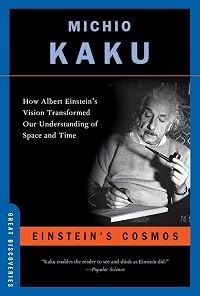
Einstein's Cosmos: How Albert Einstein's Vision Transformed Our Understanding of Space and Time
by Michio Kaku
On This Page
Description
A physicist demonstrates how Albert Einstein used simple, picture-based imagery to convey his theories about relativity and subsequently changed the way people thought about the world.Tags
Recommendations




Member Reviews
Summary: This book was a mixture between an abbreviated biography of Albert Einstein and a discussion of how he came up with his theories. It is pretty good at explaining any physics that it included in the book, and was not at all difficult to understand for a complete layperson on the subject.
My Thoughts: I enjoyed this book quite a bit. It’s my second book by Kaku, and I plan on reading more of his work. His science is quite approachable and he keeps to interesting topics.
My Thoughts: I enjoyed this book quite a bit. It’s my second book by Kaku, and I plan on reading more of his work. His science is quite approachable and he keeps to interesting topics.
Einstein’s Cosmos, How Albert Einstein’s Vision Transformed Our Understanding of Space and Time, by Micho Kaku (pp 233). Professor Einstein once wrote “All physical theories, their mathematical expression notwithstanding, ought to lend themselves to so simple a description that even a child could understand.” While I’m no longer a child, I’d like to think I can understand much that children understand, but apparently I can’t. In reading about Einstein’s theories in this and other books, the various word pictures he used to describe his instructions gets did give me insight into some of his theories, but try as I might, any glimpses I gained as a result never got me past the most rudimentary elements of his thinking. This show more book, despite the author’s valiant attempt to make this subject matter comprehensible, was part wonderful biography and story telling, and part scientific mumbo jumbo (to me). Obviously, my understanding of science is at its most basic level: water is wet if it’s not a solid or a gas, air is what we breathe and is made up of oxygen, nitrogen, and carbon dioxide (mostly), fire is often hot, and other basics. What I think I know of physics, notwithstanding a class in high school, comes from episodes of The Big Bang Theory television show. In imminently readable prose, the author walks readers through Einstein’s life, and the extraordinary breakthroughs in theoretical physics he made while working as an unheralded patent clerk. His breathtakingly new theories, then and in later years, overturned much of the world’s understanding of physics and spawned new fields of study and direct and indirect collaborators throughout his life and to the present day. Given my extreme ignorance, I will not feign understanding of his breakthroughs by quoting from the book, but even with my pitiable lack of knowledge, even I could grasp at least a tiny bit of the magnitude of his achievements, at least in the abstract. Micho Kaku walks the reader through Einstein’s work, compares it to his predecessors include Newton and Maxwell, and throws in fellow physicists whose names many of your will know: Planck, Schrodinger (of cat fame), Heisenberg (uncertainty principle), Fermi, Oppenheimer, Bohr, Hubble, Higgs, and more. Despite the many passages that defied my brain cells’ ability to comprehend, this was a fascinating book and was well worth my time. show less
Written in three parts, this biography focuses on Einstein's best ideas, but also includes details from his life and how he was perceived both during his lifetime and now. I began the book with not much hope for understanding, but Michio Kaku has a gift for making these extremely difficult concepts approachable by the "everyman." I won't pretend that I understood any of it completely, but like a work of great art shown by an excellent docent, Kaku was able to give me an appreciation of the beauty, joy and workmanship of those who are working so hard to understand our universe and make it understandable. I might even say that he brought excitement to a subject which has heretofore been off my radar as unintelligible.
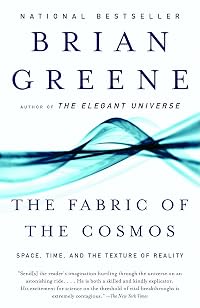
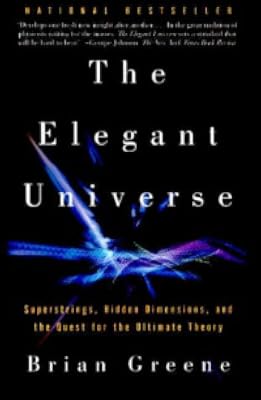
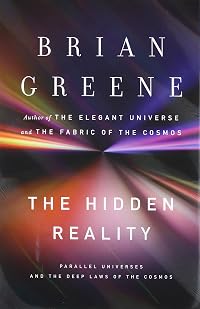
This is a great book for getting acquainted with the nature of the space-time continuum, a phrase that has entered the common parlance, but that few *really* understand. Kaku is the perfect guide into the complexities of the Einsteinian universe (and the post-Einsteinian universe), and does not rely as heavily on metaphor and image as does, say, [author: Brian Greene] does in his books "[book: The Elegant Universe]" and "[book: The Fabric of the Cosmos]". An elegant and understated book, it definitely belongs on the bookshelf of any armchair physicist.
Biographies usually bore me. But Michio manages to avoid the dry academic prose and the romantic idolatry of the subject. He even manages to give a layman reader like myself a beginner’s grasp of Einstein’s theory of relativity!
The book gives me a respect for the physicists and mathematicians of the world. I was already fascinated with Einstein and was overjoyed to get a peek at his life and mind.
The book gives me a respect for the physicists and mathematicians of the world. I was already fascinated with Einstein and was overjoyed to get a peek at his life and mind.
"If you can't explain it to a six year old, you don't understand it yourself."
Einstein came up with his theories of special and general relativity based on 2 pictures. For special relativity it was picturing himself running alongside a light beam. For general relativity it was falling off a chair. He spent the rest of his career trying to find the 'theory of everything', but was unsuccessful; perhaps because he couldn't come up with a simple picture to describe it.
Kaku does an excellent job of mixing biographical information along with some physics; and making it all understandable. But don't let the inclusion of a little physics deter you; it's all very simple and there are no crazy equations. This book is more about Einstein's life show more and how it led him to discover his relativity theories. It's a relatively short read at 233 pages, so if you're looking for a simple yet informative book on Einstein's life, give this a try. show less
Einstein came up with his theories of special and general relativity based on 2 pictures. For special relativity it was picturing himself running alongside a light beam. For general relativity it was falling off a chair. He spent the rest of his career trying to find the 'theory of everything', but was unsuccessful; perhaps because he couldn't come up with a simple picture to describe it.
Kaku does an excellent job of mixing biographical information along with some physics; and making it all understandable. But don't let the inclusion of a little physics deter you; it's all very simple and there are no crazy equations. This book is more about Einstein's life show more and how it led him to discover his relativity theories. It's a relatively short read at 233 pages, so if you're looking for a simple yet informative book on Einstein's life, give this a try. show less
Einstein was probably the greatest mind of the twentieth century, revolutionized physics, and his work is still producing new breakthroughs today. Michio Kaku recounts both his scientific contributions and something of his personal life in a completely engaging, entertaining way.
While Einstein was late in starting to talk, it's not true that he was a poor student in school. What he was, was a stubborn student. He had no interest in rote learning, which was the accepted pedagogic technique in Germany at the time. He would read, and think, and ask questions--and that mainly in the subjects he cared about.
Einstein's work on special relativity and general relativity changed our understanding of the universe and how it works. His struggles show more with quantum mechanics and his unsuccessful effort to create a unified field theory, a "theory of everything," have led some to say it would have been better for his reputation if he had not practiced physics for his last thirty years. Yet now, in the first decades of the twenty-first century, with advances in the technology available to study and test ideas, Einstein's work in the hands of a new generation of physicists and mathematicians is bearing new scientific fruit.
This is a fun, enjoyable read or listen, as well as educational.
Recommended.
I received a free copy of this audiobook from Audible in exchange for an honest review. show less
While Einstein was late in starting to talk, it's not true that he was a poor student in school. What he was, was a stubborn student. He had no interest in rote learning, which was the accepted pedagogic technique in Germany at the time. He would read, and think, and ask questions--and that mainly in the subjects he cared about.
Einstein's work on special relativity and general relativity changed our understanding of the universe and how it works. His struggles show more with quantum mechanics and his unsuccessful effort to create a unified field theory, a "theory of everything," have led some to say it would have been better for his reputation if he had not practiced physics for his last thirty years. Yet now, in the first decades of the twenty-first century, with advances in the technology available to study and test ideas, Einstein's work in the hands of a new generation of physicists and mathematicians is bearing new scientific fruit.
This is a fun, enjoyable read or listen, as well as educational.
Recommended.
I received a free copy of this audiobook from Audible in exchange for an honest review. show less
Members
- Recently Added By
Lists

My Wishlist
40 works; 1 member

al.vick-wishlist-science and nature
83 works; 1 member
Author Information

39+ Works 15,151 Members
Michio Kaku was born January 24, 1947 in San Jose California. Kaku attended Cubberley High School in Palo Alto in the early 1960s and played first board on their chess team. At the National Science Fair in Albuquerque, New Mexico, he attracted the attention of physicist Edward Teller, who took Kaku as a protégé, awarding him the Hertz show more Engineering Scholarship. Kaku graduated summa cum laude from Harvard University with a B.S. degree in 1968 and was first in his physics class. He attended the Berkeley Radiation Laboratory at the University of California, Berkeley and received a Ph.D. in 1972 and held a lectureship at Princeton University in 1973. During the Vietnam War, Kaku completed his U.S. Army basic training at Fort Benning, Georgia and his advanced infantry training at Fort Lewis, Washington. Kaku currently holds the Henry Semat Chair and Professorship in theoretical physics and a joint appointment at City College of New York, and the Graduate Center of the City University of New York, where he has lectured for more than 30 years. He is engaged in defining the "Theory of Everything", which seeks to unify the four fundamental forces of the universe: the strong nuclear force, the weak nuclear force, gravity and electromagnetism. He was a visiting professor at the Institute for Advanced Study in Princeton, and New York University. He is a Fellow of the American Physical Society. He is listed in Who's Who in Science and Engineering, and American Men and Women of Science. He has published research articles on string theory from 1969 to 2000. In 1974, along with Prof. K. Kikkawa, he wrote the first paper on string field theory, now a major branch of string theory, which summarizes each of the five string theories into a single equation. In addition to his work on string field theory, he also authored some of the first papers on multi-loop amplitudes in string theory. Kaku is the author of several doctoral textbooks on string theory and quantum field theory and has published 170 articles in journals covering topics such as superstring theory, supergravity, supersymmetry, and hadronic physics. He is also author of the popular science books: Visions, Hyperspace, Einstein's Cosmos, Parallel Worlds, The Future of the Mind, and The Future of Humanity: Terraforming Mars, Interstellar Travel, Immortality, and Our Destiny Beyond. (Bowker Author Biography) show less
All Editions
Some Editions
Awards and Honors
Notable Lists
Series
Belongs to Publisher Series
Common Knowledge
- Canonical title
- Einstein's Cosmos: How Albert Einstein's Vision Transformed Our Understanding of Space and Time
- Original title
- Einstein's Cosmos: How Albert Einstein's Vision Transformed Our Understanding of Space and Time
- Original publication date
- 2004
- People/Characters
- Albert Einstein
- Dedication
- This book is dedicated to Michelle and Alyson
- First words
- Genius. [Preface]
A journalist once asked Albert Einstein, the greatest scientific genius since Isaac Newton, to explain his formula for success. - Last words
- (Click to show. Warning: May contain spoilers.)Einstein was the founder of the first, was the godfather of the second, and paved the way for the possible unification of both.
- Publisher's editor*
- Rapajka, Gabriella
- Blurbers
- Greene, Brian; Tyson, Neil deGrasse; Croswell, Ken; Goldsmith, Donald
- Original language
- English
*Some information comes from Common Knowledge in other languages. Click "Edit" for more information.
Classifications
Statistics
- Members
- 534
- Popularity
- 56,011
- Reviews
- 17
- Rating
- (4.11)
- Languages
- 10 — Czech, English, German, Hungarian, Italian, Japanese, Polish, Portuguese, Spanish, Turkish
- Media
- Paper, Audiobook, Ebook
- ISBNs
- 21
- ASINs
- 3