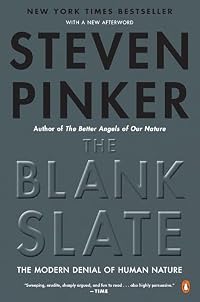
The Blank Slate: The Modern Denial of Human Nature
by Steven Pinker
On This Page
Description
In "The Blank Slate", Steven Pinker, one of the world's leading experts on language and the mind, explores the idea of human nature and it's moral, emotional, and political colorings. With characteristic wit, lucidity, and insight, Pinker argues that the dogma that the mind has no innate traits, a doctrine held by many intellectuals during the past century, denies our common humanity and our individual perferences, replaces objective analyses of social problems with feel-good slogans, and show more distorts our understanding of politics, violence, parenting, and the arts. show lessTags
Recommendations


















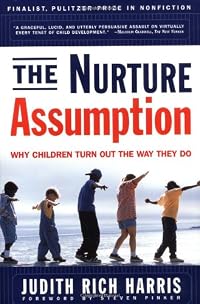
Member Recommendations


by anonymous user
Member Reviews
Pinker deftly blends a deep understanding of philosophy and a thorough review of scientific literature to critic the dearly-held 19070’s intellectual doctrines of the blank slate, the noble savage and the ghost of the machine. Like Better Angles of our Nature, the book is expansive, thorough and convincing - liberally citing from the literature to make his points with data.
Whether we like it or not, we have a common human nature and it’s imparted by our genes. While this does not mean our destiny is predetermined, it does shape our lives and our society. To ignore it, or worse, actively deny it exists, is folly.
What was particularly striking was how recognizable the debunked arguments still are in today’s intellectual debates. As show more explored in the book, many intellectuals espouse theories they want to be true, largely because they fit with their ideology, even if they have no basis in fact. After reading this book, you’ll see these arguments frequently in debates of many of societies most passionate disagreements.
A quote I think succinctly summarizes Pinker’s argument:
“Acknowledging human nature does not mean overturning our personal world views, and I would have nothing to suggest as a replacement if it did. It means only taking intellectual life out of its parallel universe and reuniting it with science and, when it is borne out by science, with common sense. The alternative is to make intellectual life increasingly irrelevant to human affairs, to turn intellectuals into hypocrites, and to turn everyone else into anti-intellectuals.” show less
Whether we like it or not, we have a common human nature and it’s imparted by our genes. While this does not mean our destiny is predetermined, it does shape our lives and our society. To ignore it, or worse, actively deny it exists, is folly.
What was particularly striking was how recognizable the debunked arguments still are in today’s intellectual debates. As show more explored in the book, many intellectuals espouse theories they want to be true, largely because they fit with their ideology, even if they have no basis in fact. After reading this book, you’ll see these arguments frequently in debates of many of societies most passionate disagreements.
A quote I think succinctly summarizes Pinker’s argument:
“Acknowledging human nature does not mean overturning our personal world views, and I would have nothing to suggest as a replacement if it did. It means only taking intellectual life out of its parallel universe and reuniting it with science and, when it is borne out by science, with common sense. The alternative is to make intellectual life increasingly irrelevant to human affairs, to turn intellectuals into hypocrites, and to turn everyone else into anti-intellectuals.” show less
Steven Pinker explores what was the latest research in evolutionary psychology and human nature in 2002 and how it puts to rest what he portrays as three hoary myths of the Blank Slate, the Noble Savage, and the Ghost in the Machine.
I don't have the background and technical knowledge to assess whether Pinker is right about what advances in the scientific study of human pyschology are showing us, but it sounds plausible. Certainly, his accounts of the pitchfork-and-torch waving mob reaction to those whose research and conclusions are deemed to transgress against what some want to be true of human psychology on ideological grounds ring even more true in the days of increased social media.
I don't have the background and technical knowledge to assess whether Pinker is right about what advances in the scientific study of human pyschology are showing us, but it sounds plausible. Certainly, his accounts of the pitchfork-and-torch waving mob reaction to those whose research and conclusions are deemed to transgress against what some want to be true of human psychology on ideological grounds ring even more true in the days of increased social media.
Equality is not the empirical claim that all groups of humans are interchangeable; it is the moral principle that individuals should not be judged or constrained by the average properties of their group.
I must confess that I'm broadly sympathetic to almost every point made by Steven Pinker in The Blank Slate. For the most part, he lays out the case against social constructivism clearly and convincingly. There are a few areas where he seems out of his depth of expertise, but it is refreshing to see such a work of wide scope attempted by someone so insightful. In fact, I would argue that The Blank Slate is one of the most significant works produced by any public intellectual this century. Whether one agrees with the thesis or not, show more Pinker's arguments are put forward so thoroughly and powerfully that any counterargument must contend with them. show less
I must confess that I'm broadly sympathetic to almost every point made by Steven Pinker in The Blank Slate. For the most part, he lays out the case against social constructivism clearly and convincingly. There are a few areas where he seems out of his depth of expertise, but it is refreshing to see such a work of wide scope attempted by someone so insightful. In fact, I would argue that The Blank Slate is one of the most significant works produced by any public intellectual this century. Whether one agrees with the thesis or not, show more Pinker's arguments are put forward so thoroughly and powerfully that any counterargument must contend with them. show less
So it turns out this book looks more credible than it actually is. Pinker does a poor job of actually defining what he means by "human nature" and capitalizes on the ambiguity by never planting a flag on the sort and extent of influence heredity and environment play on said human nature. His opponents on the other hand are inevitably presented as holding the most implausible and rigid stance in the nurture camp. It's not immediately suspicious when looking at the historical debate, but is very much so if one plans to refute 'the modern denial of human nature'.
Ultimately Pinker fails to properly address the modern voices of science and psychology. He practically admits this when he mentions that when explaining his book to colleagues show more the usual reaction is skepticism of the relevancy of a book refuting a belief no one holds. But he dismisses that. Instead of venturing into the disputed territory of the how both hereditary and environmental factors come together Pinker intentionally takes an unspecified position somewhere on the side of nature and nurture so he may benefit from portraying his opponents' cartoonishly defined positions as two-dimensionally as possible. Here there be straw men.
It simply isn't very scientific. When studies are mentioned they are often poorly explained if at all which does fuck all to support his argument beyond some childish appeal to the authority. Data is only as good as its source and rigor and the nearest Pinker comes to defining studies is to occassionally tell us if there were twins involved. Yes, I understand twins are great to have in genetic studies, but I'd also like to know what was being tested and how it was evaluated and if that thing the study puts a number is actually the sort of data that can quantified. But no.
Ultimately Pinker isn't debating a scientific point, but a political one. A dumb political one. And while it's certainly no surprise that fake science and poor philosophy are often shitty bedfellows when it comes to politics the arguments against them ought to stand on the rigors of science and logic, not petulent rhetoric. I probably agree with at least 80% of Pinker's actual postion on the matter, but none of that came of any argument Pinker brought to the table. No, the only reasonable arguments Pinker trots out were some elementary ethics and common sense. And frankly, I don't need anyone to explain that just because something may be true doesn't make it right any more than I need Pinker to explain that, actually, rape is sexual. No shit Sherlock. show less
Ultimately Pinker fails to properly address the modern voices of science and psychology. He practically admits this when he mentions that when explaining his book to colleagues show more the usual reaction is skepticism of the relevancy of a book refuting a belief no one holds. But he dismisses that. Instead of venturing into the disputed territory of the how both hereditary and environmental factors come together Pinker intentionally takes an unspecified position somewhere on the side of nature and nurture so he may benefit from portraying his opponents' cartoonishly defined positions as two-dimensionally as possible. Here there be straw men.
It simply isn't very scientific. When studies are mentioned they are often poorly explained if at all which does fuck all to support his argument beyond some childish appeal to the authority. Data is only as good as its source and rigor and the nearest Pinker comes to defining studies is to occassionally tell us if there were twins involved. Yes, I understand twins are great to have in genetic studies, but I'd also like to know what was being tested and how it was evaluated and if that thing the study puts a number is actually the sort of data that can quantified. But no.
Ultimately Pinker isn't debating a scientific point, but a political one. A dumb political one. And while it's certainly no surprise that fake science and poor philosophy are often shitty bedfellows when it comes to politics the arguments against them ought to stand on the rigors of science and logic, not petulent rhetoric. I probably agree with at least 80% of Pinker's actual postion on the matter, but none of that came of any argument Pinker brought to the table. No, the only reasonable arguments Pinker trots out were some elementary ethics and common sense. And frankly, I don't need anyone to explain that just because something may be true doesn't make it right any more than I need Pinker to explain that, actually, rape is sexual. No shit Sherlock. show less
If you want a depressing look back at the state of the current culture wars look no further than this (now) 22 year book featuring many of the same controversies, sometimes wholesale, sometimes slightly modified. That research has gone on to cement strong evidence for genetic determinism has done little to sway the influence of attitudes surrounding everything from politics and education to social topics, even as the replication crisis reverberates.
Pinker's rebuttal to the blank slate and the philosophical underpinning of the noble savage has aged pretty well, with a few exceptions. His neoliberal policy prescriptions (more notable in later books) can be quibbled with. But that the overall debate has stayed almost static for a quarter show more of a century isn't a good thing, and if anything the current state of the debate is worse than what Pinker offers here; with a reasonably wide net thrown across multiple disciplines and with a look back at the philosophers and academics that influenced the climate he thinks was intolerable way back when. show less
Pinker's rebuttal to the blank slate and the philosophical underpinning of the noble savage has aged pretty well, with a few exceptions. His neoliberal policy prescriptions (more notable in later books) can be quibbled with. But that the overall debate has stayed almost static for a quarter show more of a century isn't a good thing, and if anything the current state of the debate is worse than what Pinker offers here; with a reasonably wide net thrown across multiple disciplines and with a look back at the philosophers and academics that influenced the climate he thinks was intolerable way back when. show less
I was really disappointed by this book. I expected more focus on cognitive science and got an overwrought polemic against views no one actually holds in mainstream science. I think by now we've all agreed that in the "nature vs nurture" debate, no side is totally correct. He spends half the book quoting the likes of Locke and Descartes, debunking ideas like "the noble savage" and "the ghost in the machine". None of which has been seriously defended in the past few decades, so I fail to see how they are "modern" denials of human nature. He spends a good chunk of the first part of the book essentially defending the need for this such a work, which others have done it more effectively and certainly in a far more nuanced manner.
He also has show more the annoying habit of presenting ridiculous caricatures of those who disagree with his position, even in the slightest. Depicting contrary views as if there can only be one true victor in the nature vs nurture debate, often exaggerating and taking his sources out of context.
Add to that his willfully ignorant diatribe on rape and I was pretty much done with the book. Pinker disagrees with the notion that “rape isn’t about sex, it’s about power,” which on the surface is certainly a claim that needs more nuance. The problem is that just because sexual desire is a biological imperative, the violent disregard for a woman’s bodily autonomy is not. Pinker ignores the role that misogyny and the patriarchy play in our cultural understanding of rape in his excitement to defend its biological roots. He even displays his own ignorance and misogyny when he compares a woman dressing provocatively or drinking at a frat party to leaving the keys on the dashboard of your unlocked car. It reiterates the nonsense idea that women should fear the stranger in the bushes, and that it is up to the woman to protect herself by not wearing revealing clothes or going out at night. He continually calls rapists “losers” and “nobodies” as though rape is a crime only committed by those in the fringes of society, and not powerful, successful people. He apparently ignores the fact that most rape is NOT committed by a stranger, but one the victim knows and trusts.
I was frankly so disgusted by this particular section of the book, I found it hard to finish. Maybe another day. show less
He also has show more the annoying habit of presenting ridiculous caricatures of those who disagree with his position, even in the slightest. Depicting contrary views as if there can only be one true victor in the nature vs nurture debate, often exaggerating and taking his sources out of context.
Add to that his willfully ignorant diatribe on rape and I was pretty much done with the book. Pinker disagrees with the notion that “rape isn’t about sex, it’s about power,” which on the surface is certainly a claim that needs more nuance. The problem is that just because sexual desire is a biological imperative, the violent disregard for a woman’s bodily autonomy is not. Pinker ignores the role that misogyny and the patriarchy play in our cultural understanding of rape in his excitement to defend its biological roots. He even displays his own ignorance and misogyny when he compares a woman dressing provocatively or drinking at a frat party to leaving the keys on the dashboard of your unlocked car. It reiterates the nonsense idea that women should fear the stranger in the bushes, and that it is up to the woman to protect herself by not wearing revealing clothes or going out at night. He continually calls rapists “losers” and “nobodies” as though rape is a crime only committed by those in the fringes of society, and not powerful, successful people. He apparently ignores the fact that most rape is NOT committed by a stranger, but one the victim knows and trusts.
I was frankly so disgusted by this particular section of the book, I found it hard to finish. Maybe another day. show less
Warning: I haven't actually read all of this book.
I have tried, though, and I think I got a clear enough picture of it. I tried to read it because I had enjoyed other books by Pinker: although I disagreed with a lot of what he said I found them interesting, and they contained a lot of fascinating facts.
I gave this one up after reading the Introduction and a few samples around the book because I think Pinker here has gone intellectually bankrupt. This book is simply a rant against a couple of theories, starting with "the blank slate" -- or rather, what makes it unreadable to me, a rant against a strawman version of that theory. I hold a fairly strong version of it myself, which is why I feel confident to say that nobody holds the show more position that Pinker so vehemently attacks, never mind it being the "current orthodoxy" as he claims. A much weaker version is indeed the current orthodoxy.
There are 2 other theories he rants against, The Noble Savage and The Ghost in the Machine -- once again, they're nowhere near "the orthodoxy", especially not in the strawman versions he uses.
This is intellectually dishonest. Not only intellectual dishonesty really repels me, but it also makes it impossible to trust any of what the author says: how can I take his word on anything, when I've caught him lying on the basic point of the whole book?
Life is too short, and there are too many other books to read. Including, quite possibly, older books by Pinker -- but I'm not going to waste more of my time on this one. show less
I have tried, though, and I think I got a clear enough picture of it. I tried to read it because I had enjoyed other books by Pinker: although I disagreed with a lot of what he said I found them interesting, and they contained a lot of fascinating facts.
I gave this one up after reading the Introduction and a few samples around the book because I think Pinker here has gone intellectually bankrupt. This book is simply a rant against a couple of theories, starting with "the blank slate" -- or rather, what makes it unreadable to me, a rant against a strawman version of that theory. I hold a fairly strong version of it myself, which is why I feel confident to say that nobody holds the show more position that Pinker so vehemently attacks, never mind it being the "current orthodoxy" as he claims. A much weaker version is indeed the current orthodoxy.
There are 2 other theories he rants against, The Noble Savage and The Ghost in the Machine -- once again, they're nowhere near "the orthodoxy", especially not in the strawman versions he uses.
This is intellectually dishonest. Not only intellectual dishonesty really repels me, but it also makes it impossible to trust any of what the author says: how can I take his word on anything, when I've caught him lying on the basic point of the whole book?
Life is too short, and there are too many other books to read. Including, quite possibly, older books by Pinker -- but I'm not going to waste more of my time on this one. show less
Members
- Recently Added By
Lists

Books That Changed Me
156 works; 47 members

Non-Fiction Worth Reading
1,015 works; 260 members

Falling for Science
56 works; 3 members

Guttabois
27 works; 1 member

Fake Top 100 Nonfiction
79 works; 3 members

Psicología - Clásicos
165 works; 2 members

Política - Clásicos
164 works; 2 members

Books Read in 2015
3,298 works; 129 members

The Joe Rogan Experience Library
254 works; 3 members

Mind Expanding Books by hackerkid
581 works; 8 members

Shaykh Hamza's Book Recommendations
439 works; 3 members

My List
302 works; 1 member

Biblioteca de não ficção
41 works; 1 member

Books Cited in Blueprint by Nicholas Christakis
261 works; 1 member
Author Information

41+ Works 31,725 Members
Steven Pinker is an authority on language and the mind. He is Peter de Florez professor of psychology in the department of brain and cognitive sciences at the Massachusetts Institute of Technology. He lives in Cambridge, Massachusetts. Steven Arthur Pinker was born on September 18, 1954 in Canada. He is an experimental psychologist, cognitive show more scientist, linguist, and author. He is a psychology professor at Harvard University. He is the author of several non-fiction books including The Language Instinct, How the Mind Works, Words and Rules, The Blank Slate, The Stuff of Thought, and The Sense of Style: The Thinking Person's Guide to Writing in the 21st Century. His research in cognitive psychology has won the Early Career Award in 1984 and Boyd McCandless Award in 1986 from the American Psychological Association, the Troland Research Award in 1993 from the National Academy of Sciences, the Henry Dale Prize in 2004 from the Royal Institution of Great Britain, and the George Miller Prize in 2010 from the Cognitive Neuroscience Society. He was twice a finalist for the Pulitzer Prize, in 1998 and in 2003. In 2006, he received the American Humanist Association's Humanist of the Year award for his contributions to public understanding of human evolution. (Bowker Author Biography) show less
Awards and Honors
Awards
Distinctions
Notable Lists
Series
Belongs to Publisher Series
Work Relationships
Contains
Is a reply to
Was inspired by
Inspired
Common Knowledge
- Canonical title*
- Das unbeschriebene Blatt
- Original title
- The Blank Slate: The Modern Denial of Human Nature
- Original publication date
- 2002; 2016
- People/Characters
- Noam Chomsky; Martin Daly; Charles Darwin [Charles Robert: 1809-1882]; Stephen Jay Gould; Judith Rich Harris; Thomas Hobbes (show all 12); Richard Lewontin; Karl Marx; Steven Rose; Robert Trivers; E. O. Wilson; Margo Wilson
- Dedication
- To Don, Judy, Leda, and John
- Last words
- (Click to show. Warning: May contain spoilers.)It is a scene that has the voice of the species in it: that infuriating, endearing, mysterious, predictable, and eternally fascinating thing we call human nature.
- Original language
- English
- Canonical DDC/MDS
- BF341
- Canonical LCC
- WM193.5.D3
*Some information comes from Common Knowledge in other languages. Click "Edit" for more information.
Classifications
- Genres
- Science & Nature, Anthropology, General Nonfiction, Philosophy, Nonfiction
- DDC/MDS
- 155.234 — Philosophy and Psychology Psychology Differential and developmental psychology Individual Psychology Traits Determinants of Traits
- LCC
- BF341 .P47 — Philosophy, Psychology and Religion Psychology Psychology Consciousness. Cognition
- BISAC
Statistics
- Members
- 4,930
- Popularity
- 2,826
- Reviews
- 61
- Rating
- (4.08)
- Languages
- 11 — Chinese, Dutch, English, French, German, Italian, Polish, Portuguese, Spanish, Swedish, Turkish
- Media
- Paper, Audiobook, Ebook
- ISBNs
- 38
- ASINs
- 18