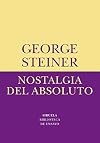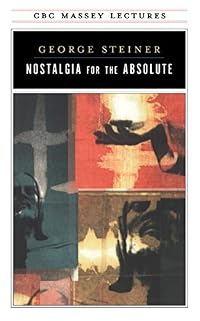
Nostalgia for the Absolute
by George Steiner
On This Page
Description
Writer and scholar George Steiner's Massey Lectures are just as cogent today as when he delivered them in 1974 -- perhaps even more so. He argues that Western culture's moral and emotional emptiness stems from the decay of formal religion. He examines the alternate mythologies (Marxism, etc.) and fads of irrationality (astrology, the occult). Steiner argues that this decay and the failure of the mythologies have created a nostalgia for the absolute that is growing and leading us to a massive show more clash between truth and human survival. Ultimately he suggests that we can only reduce the impact of this collision course if we continue, as disinterestedly as possible, to ask questions and seek answers in the face of our increasingly complex world. show lessTags
Recommendations





























Member Reviews
In these lectures, Steiner argues that in the cultural vacuum left by the decay of religion, the religious urge, a "nostalgia for the absolute" continue to fuel our zest for what amount to modern mythologies (Freud, Marx, and--strangely--Levi-Strauss' structural anthropology) along with new age fads. Given the format, it's hard to fault him too much for some lax argumentation and sensationalist conclusions. Yet despite some interesting observations and rhetorically persuasive narratives about how all these things fit together, the thesis suffers from too many hasty generalizations and simplistic analogies.
The analysis of Marx is rather superficial and makes no effort to distinguish between Marx and Marxism; the chapter on Freud involves show more some rather weak arguments concerning the role played by mythology in the genesis and support of Freud's ideas; and the chapter on Levi-Strauss is both bewildering for its inclusion at all, and also doesn't even remotely establish Steiner's claim that structural anthropology constitutes a total mythology (in the sense in which he proposes this thesis). show less
The analysis of Marx is rather superficial and makes no effort to distinguish between Marx and Marxism; the chapter on Freud involves show more some rather weak arguments concerning the role played by mythology in the genesis and support of Freud's ideas; and the chapter on Levi-Strauss is both bewildering for its inclusion at all, and also doesn't even remotely establish Steiner's claim that structural anthropology constitutes a total mythology (in the sense in which he proposes this thesis). show less
Interesante obra post-religiosa que curiosamente vuelve a caer en los errores que denuncia, no restándole esto razón a su crítica.
Ratings
Members
- Recently Added By
Author Information

82+ Works 7,411 Members
George Steiner was born in 1929 in Paris, but also lived in Vienna and New York. Steiner was a critic, novelist, philosopher, translator, and educator. Currently, he is a professor at Cambridge University and the University of Geneva. He has written for the New Yorker for over thirty years and has published the books No Passion Spent, Errata: An show more Examined Life, and Martin Heidegger: With a New Introduction. George Steiner died in Cambridge, England on February 3, 2020, at the age of 90. (Bowker Author Biography) show less
Series
Belongs to Publisher Series
CBC Massey Lectures (1974)
Common Knowledge
- Canonical title
- Nostalgia for the Absolute
- Original title
- Nostalgia for the Absolute
- Original publication date
- 1974
Classifications
Statistics
- Members
- 199
- Popularity
- 163,596
- Reviews
- 2
- Rating
- (3.72)
- Languages
- 7 — English, French, Greek, Italian, Portuguese, Romanian, Spanish
- Media
- Paper, Ebook
- ISBNs
- 13
- ASINs
- 3