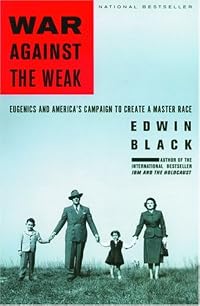
War Against the Weak: Eugenics and America's Campaign to Create a Master Race
by Edwin Black
On This Page
Description
Publisher's description: History has recorded the horrors of ethnic cleansing, but until now, America's own efforts to create a master race have been largely overlooked. In War Against the Weak, investigative journalist and author of the New York Times bestseller IBM and the Holocaust Edwin Black reveals that eugenics-sham science made up to justify ethnic cleansing-had an incredible foothold in America in the early twentieth century, and was in fact championed and funded by America's show more social, political, and academic elite. Even more shocking, Black traces the flow of ideas, research, and money from Cold Spring Harbor (Long Island) to Germany, in the process proving that it was America's eugenics program that gave Hitler the scientific justification to escalate his virulent anti-Semitism into all-out genocide. Black's team of dozens of researchers scoured scores of archives in four countries, unearthing some 50,000 documents, which collectively prove that the eugenics agenda was funded by esteemed philanthropies such as the Rockefeller Foundation and the Carnegie Institution; taught at Yale, Harvard, and Princeton; lauded by leading progressive thinkers such as Margaret Sanger, Oliver Wendell Holmes, and Woodrow Wilson; and even sanctioned by the U.S. Supreme Court. With this kind of backing, American eugenics was quickly able to move beyond the theoretical in its quest to eliminate social "undesirables," getting cruel and racist laws enacted in 27 U.S. states. Ultimately, more than 60,000 Americans were sterilized against their will, and tens of thousands of others were institutionalized and/or denied the right to marry whom they chose. In the last year or so, governors from five states-Virginia, Oregon, California, North Carolina, and South Carolina-have apologized for their states' official efforts to wipe out their unwanted citizens. Surprisingly, the victims of eugenics weren't limited to the groups that have regularly suffered from prejudice in the U.S.; they were also the poor, epileptics, alcoholics, people who wore glasses, petty criminals, the mentally ill, and those deemed "shiftless." War Against the Weak details how those at the forefront of the movement worked tirelessly to establish the biological rationales for persecution, with the goal of continuously eradicating the "lower tenth" until only a pure Nordic super race remained. To achieve that end, eugenics contaminated many otherwise worthy causes, from the birth control movement to the development of psychology and IQ testing, and beyond. After Nuremberg declared eugenics to be genocide and a crime against humanity, the American eugenics movement did not disappear; it simply went underground, changed its name, and reappeared as "human genetics." War Against the Weak closes by bringing its analysis into the present day, pointing out that our increasing knowledge in the realm of genetic selection and gene-mapping is rife with opportunity for misuse. show lessTags
Recommendations
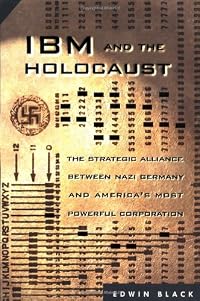
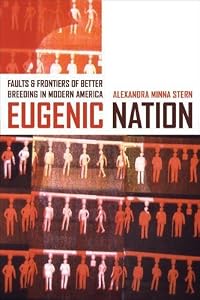



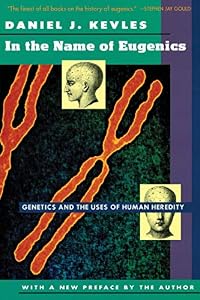

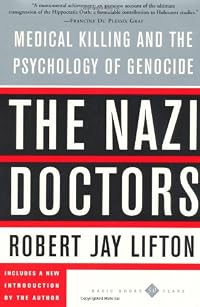
















Member Recommendations
Member Reviews
It's no secret: although eugenics triumphed in its most despicable and murderous form in Nazi Germany, the Nazis were just carrying on to the next extreme what had been thought and done in the USA during the previous decades. In fact, the Nuremberg Laws and even the sterilization laws that had preceded them were just, at their core, just a copy of the same type of legislation then defining about 27 states in the US. Sadly, though, if the victims of the Nazis regime had been liberated when the gas chambers closed down after the Third Reich's collapse, victims of American eugenics were not that lucky -its practice went well into the 1970s, if not beyond. It's an horrific story, with gruesome parallels, but which deserves to be known.
Edwin show more Black delivers here a masterpiece and must-read on the topic. His book is magistral, dense, well-researched and meticulous. It also is, despite its challenging length (more than 600 pages!) a very engaging expose of how what happened in Nazi Germany was nothing but the brainchild of a twisted intellectual movement born in the USA. War Against the Weak is highly instructive. It also stands as a powerful warning.
Indeed, the striking and sad thing is, eugenics claimed to be rooted in science and genetics, yet, serious biologists and geneticists even back then knew perfectly well it was everything but. There was nothing in the theory of evolution as outlined by Darwin which justified it; and, more to the point, a basic understanding of Mendelian genetics was amply enough to debunk it outright. In fact, even the man who had coined the word, Francis Galton, had refused until his death in 1911 to align himself with such burgeoning socio-political agenda -he was too clever to rely even on his own assumptions, and, anyway, his was a matter of 'positive eugenics' (encouraging the supposedly fit to procreate) away from the 'negative eugenics' (the getting-rid of the supposedly unfit, through forced sterilizations if necessary) that would ultimately swamp America, and take upon its own genocidal course under Nazism. Not that it mattered, but the impact would be hugely different.
How come, then, such a pseudo-science, such intellectual fraud, came to be so popular? How come major political figures would take it up and enshrine its tenets into laws? Edwin Black here strikes right at the heart of it all: the so-called American 'melting pot', and money.
Racism, of course, always had been pernicious in America. But, if it's obvious and easy to think White vs Black, in a country that were deeply impacted by slavery, a Civil War motivated in part by White Supremacy, and which was then subjected to Jim Crow laws, the author rightly reminds that American racism was also White vs White. There was no such thing as an admirable 'melting-pot' indeed (well, think of the Native-Americans or even the Mexicans...) and Ellis Island was as much a beckon of hope for many fleeing all corners of the world as it was a center to sort out the undesirable -for being of the wrong creed, the wrong colour, including the wrong white. The perceived threat of 'race suicide' terrified many.
'By no mean did the eugenics movement limit its animus to non-English speaking immigrants. It was a movement against non-Nordics regardless of their skin color, language or national origin.'
Where the book truly rings alarm bells and pop red flags, though, is when Edwin Black discusses the crucial influence of powerful business barons and their fortunes. Eugenics surely was nothing but a scientific sham adhered to by looneys, but these looneys, in America, were backed by millions of dollars and, oh boy! They didn't waste it! The Carnegie Institution, the Rockefeller Foundation, Mary Harriman (the widow of a railroad magnate, filthy rich), even IBM... They would all happily fork in to make sure their social prejudices were lobbied as they should -for social prejudices it was too. Being the instrument of the wealthy, eugenics was not only an attack upon the 'inferior races', but, an attack on the poor as well. But here was a complex and wide-ranging program, which would target from the disabled to the criminals, and the poor to the foreigners.
'Eugenics was nothing less than corporate philanthropy gone wild.'
'Big money made all the differences for eugenics. Indeed, biological supremacy, raceology and coercive eugenics battle plan were all just talk until those ideas married into American affluence. With that affluence came the means and the connections to make eugenics theory an administrative reality.'
What about the Nazis, then? Well, I personally knew about the 'intellectual' influence of American eugenicists upon Nazis thinkers. I also knew about American legislations inspiring Hitler (e.g. Carrie Buck vs Bell, or, the Virginia Integrity Act to prevent so-called 'mongrelization' truly were landmark cases indeed...). The author, of course, details it all brilliantly. What I didn't know was, how deeper and closer both side of the Atlantic were intertwined, beyond just mere ideals echoing each other. Richard Davenport was an unrepentant Nazis apologetic until his death in 1944. Harry Laughlin was offered a Honorary Degree from the University of Heidelberg for his influence on 'racial hygiene'. The Kaiser Wilhelm Institutes, where such 'sciences' were performed, had been financed by the Rockefeller Foundation (until the break out of the war, but, still, their money had made some of such institutions possible in the first place). In fact, the sickening collaboration will even have weird consequences: Dr Katzen-Ellenbogen, one of the doctors at Buchenwald, had been Chief Eugenicist in New Jersey (interestingly enough, when Woodrow Wilson was then its Governor...) before emigrating to Europe; while a Otto Hoffman, SS in charge of the Race and Settlement Office, would cite American policies and legislations as his defense during his trial -he couldn't understand how the USA could accuse him of crime against humanity, they who had brainstormed the same kind of policies in the name of the same views! He could be excused; when the Nazis were getting tougher with their eugenics policies:
'While much of the world recoiled in revulsion, American eugenicists covered eugenic developments in Germany with pride and excitement...'
This is not an indictment, though. In fact, Edwin Black is remarkably fair in his account. Yes, he debunks mercilessly the racism and social prejudices of cranks, whose success was owed to unscrupulous financiers fueled by their own agendas. But he also reminds us that, eugenics was also perceived as a charitable movement, its practical use a form of philanthropic endeavour. Case in point: Margaret Sanger. She still is very controversial in America, and so should she! Her views were typical of this grey area illustrating that, well, the road to hell can be paved with good intent indeed... As the author stresses, she was:
'...a powerful example of American eugenics' ability to pervade, infect and distort the most dedicated causes and the most visionary reformers. None was untouchables.'
Here's a massive opus, yet engaging and truly leaving the reader with food for thought. Of course, here's an history of American eugenics per se, and how it ideologically impacted the Nazi regime. But, it also is more than that. By reminding us that such pseudo-science would have never triumphed as it did without the powerful backing-up of successful capitalists (in the USA in any case) it serves as a warning too. In the age of genetic engineering and other wonders, is it that a good idea to entrust into the hands of private entrepreneurs and other venture corporates the potential offered by our cracking of the structure of DNA? Money talks; but what it has to say is not always wise... Striking. Brilliant. Important. show less
Edwin show more Black delivers here a masterpiece and must-read on the topic. His book is magistral, dense, well-researched and meticulous. It also is, despite its challenging length (more than 600 pages!) a very engaging expose of how what happened in Nazi Germany was nothing but the brainchild of a twisted intellectual movement born in the USA. War Against the Weak is highly instructive. It also stands as a powerful warning.
Indeed, the striking and sad thing is, eugenics claimed to be rooted in science and genetics, yet, serious biologists and geneticists even back then knew perfectly well it was everything but. There was nothing in the theory of evolution as outlined by Darwin which justified it; and, more to the point, a basic understanding of Mendelian genetics was amply enough to debunk it outright. In fact, even the man who had coined the word, Francis Galton, had refused until his death in 1911 to align himself with such burgeoning socio-political agenda -he was too clever to rely even on his own assumptions, and, anyway, his was a matter of 'positive eugenics' (encouraging the supposedly fit to procreate) away from the 'negative eugenics' (the getting-rid of the supposedly unfit, through forced sterilizations if necessary) that would ultimately swamp America, and take upon its own genocidal course under Nazism. Not that it mattered, but the impact would be hugely different.
How come, then, such a pseudo-science, such intellectual fraud, came to be so popular? How come major political figures would take it up and enshrine its tenets into laws? Edwin Black here strikes right at the heart of it all: the so-called American 'melting pot', and money.
Racism, of course, always had been pernicious in America. But, if it's obvious and easy to think White vs Black, in a country that were deeply impacted by slavery, a Civil War motivated in part by White Supremacy, and which was then subjected to Jim Crow laws, the author rightly reminds that American racism was also White vs White. There was no such thing as an admirable 'melting-pot' indeed (well, think of the Native-Americans or even the Mexicans...) and Ellis Island was as much a beckon of hope for many fleeing all corners of the world as it was a center to sort out the undesirable -for being of the wrong creed, the wrong colour, including the wrong white. The perceived threat of 'race suicide' terrified many.
'By no mean did the eugenics movement limit its animus to non-English speaking immigrants. It was a movement against non-Nordics regardless of their skin color, language or national origin.'
Where the book truly rings alarm bells and pop red flags, though, is when Edwin Black discusses the crucial influence of powerful business barons and their fortunes. Eugenics surely was nothing but a scientific sham adhered to by looneys, but these looneys, in America, were backed by millions of dollars and, oh boy! They didn't waste it! The Carnegie Institution, the Rockefeller Foundation, Mary Harriman (the widow of a railroad magnate, filthy rich), even IBM... They would all happily fork in to make sure their social prejudices were lobbied as they should -for social prejudices it was too. Being the instrument of the wealthy, eugenics was not only an attack upon the 'inferior races', but, an attack on the poor as well. But here was a complex and wide-ranging program, which would target from the disabled to the criminals, and the poor to the foreigners.
'Eugenics was nothing less than corporate philanthropy gone wild.'
'Big money made all the differences for eugenics. Indeed, biological supremacy, raceology and coercive eugenics battle plan were all just talk until those ideas married into American affluence. With that affluence came the means and the connections to make eugenics theory an administrative reality.'
What about the Nazis, then? Well, I personally knew about the 'intellectual' influence of American eugenicists upon Nazis thinkers. I also knew about American legislations inspiring Hitler (e.g. Carrie Buck vs Bell, or, the Virginia Integrity Act to prevent so-called 'mongrelization' truly were landmark cases indeed...). The author, of course, details it all brilliantly. What I didn't know was, how deeper and closer both side of the Atlantic were intertwined, beyond just mere ideals echoing each other. Richard Davenport was an unrepentant Nazis apologetic until his death in 1944. Harry Laughlin was offered a Honorary Degree from the University of Heidelberg for his influence on 'racial hygiene'. The Kaiser Wilhelm Institutes, where such 'sciences' were performed, had been financed by the Rockefeller Foundation (until the break out of the war, but, still, their money had made some of such institutions possible in the first place). In fact, the sickening collaboration will even have weird consequences: Dr Katzen-Ellenbogen, one of the doctors at Buchenwald, had been Chief Eugenicist in New Jersey (interestingly enough, when Woodrow Wilson was then its Governor...) before emigrating to Europe; while a Otto Hoffman, SS in charge of the Race and Settlement Office, would cite American policies and legislations as his defense during his trial -he couldn't understand how the USA could accuse him of crime against humanity, they who had brainstormed the same kind of policies in the name of the same views! He could be excused; when the Nazis were getting tougher with their eugenics policies:
'While much of the world recoiled in revulsion, American eugenicists covered eugenic developments in Germany with pride and excitement...'
This is not an indictment, though. In fact, Edwin Black is remarkably fair in his account. Yes, he debunks mercilessly the racism and social prejudices of cranks, whose success was owed to unscrupulous financiers fueled by their own agendas. But he also reminds us that, eugenics was also perceived as a charitable movement, its practical use a form of philanthropic endeavour. Case in point: Margaret Sanger. She still is very controversial in America, and so should she! Her views were typical of this grey area illustrating that, well, the road to hell can be paved with good intent indeed... As the author stresses, she was:
'...a powerful example of American eugenics' ability to pervade, infect and distort the most dedicated causes and the most visionary reformers. None was untouchables.'
Here's a massive opus, yet engaging and truly leaving the reader with food for thought. Of course, here's an history of American eugenics per se, and how it ideologically impacted the Nazi regime. But, it also is more than that. By reminding us that such pseudo-science would have never triumphed as it did without the powerful backing-up of successful capitalists (in the USA in any case) it serves as a warning too. In the age of genetic engineering and other wonders, is it that a good idea to entrust into the hands of private entrepreneurs and other venture corporates the potential offered by our cracking of the structure of DNA? Money talks; but what it has to say is not always wise... Striking. Brilliant. Important. show less
This is one of the saddest books you'll ever read. To give you a taste, "The laws of nature require the obliteration of the unfit and human life is valuable only when it is of use to the community or race" (259).
Charity is declared evil, since "it was better that the cold and hungry be left without help, so that the eugenically superior strains could multiple without competition from 'the unfit'" (127). And "referred to the lower classes and the unfit as 'human waste' not worthy of assistance, and proudly quoted the extreme eugenic view that human 'weeds' should be 'exterminated'" (127). The first president of Stanford University argued that the poor should be sterilized. I agree with the other reviewer that it should be mandatory show more reading, perhaps in around 7th grade. I need to think more to do this review.
I was shocked by the names that occur in here, such as Kellogg, Alexander Graham Bell, Carnegie Hall, the Rockefeller Foundation, Margaret Sanger, H.G. Wells, Irving Fischer, and so on. Modern framing of debate can be understood as descending in significant part from the eugenics movement. Immigration rhetoric, school performance testing, testing and standardized norms as gatekeepers to social resources such as universities, war rhetoric, and political division over redistribution of resources all can been seen in a new perspective after reading this book.
If you've ever found the genocide and monstrocities commited during WW2 to be unfathomable, this book makes WW2 genocide fathomable. It shows how deviance was defined and redefined. This book doesn't hold back either. You get taken all the way from the pearly pampered gates of acadamia spewing hatred down down down into the eugenic death doctors of WW2 concentration camps, and through grisly human medical experimentation. There is a shot of the face of Josef Mengele. One of the saddest books you'll ever read. show less
Charity is declared evil, since "it was better that the cold and hungry be left without help, so that the eugenically superior strains could multiple without competition from 'the unfit'" (127). And "referred to the lower classes and the unfit as 'human waste' not worthy of assistance, and proudly quoted the extreme eugenic view that human 'weeds' should be 'exterminated'" (127). The first president of Stanford University argued that the poor should be sterilized. I agree with the other reviewer that it should be mandatory show more reading, perhaps in around 7th grade. I need to think more to do this review.
I was shocked by the names that occur in here, such as Kellogg, Alexander Graham Bell, Carnegie Hall, the Rockefeller Foundation, Margaret Sanger, H.G. Wells, Irving Fischer, and so on. Modern framing of debate can be understood as descending in significant part from the eugenics movement. Immigration rhetoric, school performance testing, testing and standardized norms as gatekeepers to social resources such as universities, war rhetoric, and political division over redistribution of resources all can been seen in a new perspective after reading this book.
If you've ever found the genocide and monstrocities commited during WW2 to be unfathomable, this book makes WW2 genocide fathomable. It shows how deviance was defined and redefined. This book doesn't hold back either. You get taken all the way from the pearly pampered gates of acadamia spewing hatred down down down into the eugenic death doctors of WW2 concentration camps, and through grisly human medical experimentation. There is a shot of the face of Josef Mengele. One of the saddest books you'll ever read. show less
I came to this book not entirely ignorant of America's shameful role in eugenics, but before reading this book, I was unaware of the extent of that role. Essentially, the U.S. provided Hitler the blueprints for the final solution.
Here in the U.S., thousands of Americans were sterilized against their will. No less a jurist that Oliver Wendell Holmes ruled that involuntary sterilization was a proper remedy to preventing these so-called inferiors from contaminating the gene stock. He famously wrote that "three generations of imbeciles are enough” in Buck v. Bell, a 1927 Supreme court case upholding a Virginia law that authorized the state to surgically sterilize certain “mental defectives” without their consent.
The people identified show more as defective were invariably poor and usually of color or of immigrant stock. My own forebears who lived in the Blue Ridge Mountains of West Virginia would have been prime candidates, being poor and uneducated.
I do have one criticism in that Black should have maintained a bit more emotional distance to his subject, though I understand his deep anger and outrage over these injustices.
After reading this book, I wonder what it was about America that provided such a fertile breeding ground for hate? show less
Here in the U.S., thousands of Americans were sterilized against their will. No less a jurist that Oliver Wendell Holmes ruled that involuntary sterilization was a proper remedy to preventing these so-called inferiors from contaminating the gene stock. He famously wrote that "three generations of imbeciles are enough” in Buck v. Bell, a 1927 Supreme court case upholding a Virginia law that authorized the state to surgically sterilize certain “mental defectives” without their consent.
The people identified show more as defective were invariably poor and usually of color or of immigrant stock. My own forebears who lived in the Blue Ridge Mountains of West Virginia would have been prime candidates, being poor and uneducated.
I do have one criticism in that Black should have maintained a bit more emotional distance to his subject, though I understand his deep anger and outrage over these injustices.
After reading this book, I wonder what it was about America that provided such a fertile breeding ground for hate? show less
A difficult book to read. Not because it is poorly written. But because it is so disappointing to read about the American history of oppressing the weak.
The pseudo-science of eugenics is the application of evolutionistic natural selection to humankind. If humans are descended from animals and still evolving then some portion of humankind could conceivably be further ahead than others. And if this is true, should not the human race be bettered by encouraging the propagation of this portion of our race and discouraging the continued breeding of those that may be further down the evolutionary ladder? Especially those that carry hereditary diseases, deformities, a high probability of mental defect, or propensity to engage in criminal show more misconduct. Or so eugenic theory would have you believe.
Some of the research backing this idea followed families through multiple generations and tracked the fact that most member's of this family were criminals. If these people were sterilized so they could not continue to have children the state and society would be safer and see a significant savings in the criminal justice arena. The same argument was presented for families with a history of expensive medical issues.
This "reasonable" view of evolution and society was cloaked in the blessing of science and used to create sterilization laws and laws prohibiting interracial marriages. These views and the corresponding laws were not the result of a groundswell of public sentiment calling for sterilizations to be accomplished on those found unfit or laws prohibiting interracial marriages. Rather, these laws were promulgated, lobbied for, and supported by a highly educated portion of the American scientific community funded by major philanthropic monies.
Part of the basis of this philanthropy was the idea of some that charity rewards people for failure and that human kind should mirror nature in letting the weak die off and the strong continue. Charity was viewed as unnatural meddling in the natural way of life. Eugenics was viewed as a way of restoring balance. Margaret Sanger, founder of planned parenthood believed in this view of charity as well as well as the importance of eugenics.
There were several doctors that performed uncalled for sterilizations on people they thought were unfit prior to laws being passed allowing the procedure. Indiana was the first state to legalize sterilization of the unfit. At least 29 other states followed that lead. California by far completed the most recorded sterilizations. And the funding to start the process was provided by New Englands wealthy. A victory showing what a small group of educated people with a vision and funding can accomplish while the majority of people are not really paying attention.
What did this movement cost America? The idea as a science and the word "eugenics" was British in origin (invented by Sir Francis Galton). However, it was in American where this idea became popular and applied in an active way. In the 20s and 30s these ideas accepted in America were globalized. American model legislation for sterilization was sent to many European countries and enacted there creating sterilization programs in Switzerland, Denmark, Norway, and Germany. German efforts to cleanse their race of those deemed unfit were highly admired in America. And it was because of successful eugenic efforts to restrict immigration into America of the unfit that many Jews were unable to escape Europe and holocaust to come.
American philanthropic efforts were not confined to the United States. Rockefeller and other wealthy New Englanders funded most of the eugenic scientist in Germany after WWI. The research and books that guided Hitler to understanding how the unfit made the German people weak were funded with American monies. Hitler even wrote an admiring thank you letter to one of the leading eugenics proponents in the United States.
We tend many time to tie up our righteous anger for the holocaust to the leader of the German people that led them into murdering millions and the SS who carried out his vision. We like to say Adolph Hitler was a racist, and that is true fact. But his racism was not merely some backwoods silly hatred based on people being different than he was. Rather, his hatred was based on the science of eugenics.
We should not forget that when Jews and other people that were considered unfit (not always based on race) got off the train at Auschwitz and other death camps it was not Hitler personally that decided who would be treated in what ways. Nor was it always the SS trooper. Rather usually there was someone there with medical credentials and eugenics training in their background making this decision. The SS were the trigger man. Hitler was the government leader that made the horrors of the holocaust possible politically. But it was the scientists and doctors, funded by American money that created the basis for all these horrors. How could ordinary people do such terrible things to other people in death camps and elsewhere? First, they were taught eugenics and that not all people are equal, and the unfit drag the rest of society down. Before they tried to kill off entire races they worked hard to cleanse their own race; sterilizing or killing the weaker parts of their society in nursing homes and insane asylums. It is clear that we cannot trust science alone to create a moral compass for society.
Much as I hate to admit it, America carries some moral responsibility for what happened in Europe with the holocaust. Because of the outrage and condemnation of the holocaust and Germany's eugenic actions the American eugenic community melted away into the background. Usually changing their names from eugenics to something with genetics. It still took many years to change all the laws that the American eugenic movement put into the books in the United States. It was not until the 1960s that laws against interracial marriages were set aside and people were being sterilized without their consent into the 1970s. Several states till have laws on the books for sterilization. But they have not been utilized for years.
This book is well written and researched. If anything there is probably much left unexamined for the sake of preserving a comprehensible narrative and story of a reasonable length. Clocking in at over 500 pages it's not a swift read. show less
The pseudo-science of eugenics is the application of evolutionistic natural selection to humankind. If humans are descended from animals and still evolving then some portion of humankind could conceivably be further ahead than others. And if this is true, should not the human race be bettered by encouraging the propagation of this portion of our race and discouraging the continued breeding of those that may be further down the evolutionary ladder? Especially those that carry hereditary diseases, deformities, a high probability of mental defect, or propensity to engage in criminal show more misconduct. Or so eugenic theory would have you believe.
Some of the research backing this idea followed families through multiple generations and tracked the fact that most member's of this family were criminals. If these people were sterilized so they could not continue to have children the state and society would be safer and see a significant savings in the criminal justice arena. The same argument was presented for families with a history of expensive medical issues.
This "reasonable" view of evolution and society was cloaked in the blessing of science and used to create sterilization laws and laws prohibiting interracial marriages. These views and the corresponding laws were not the result of a groundswell of public sentiment calling for sterilizations to be accomplished on those found unfit or laws prohibiting interracial marriages. Rather, these laws were promulgated, lobbied for, and supported by a highly educated portion of the American scientific community funded by major philanthropic monies.
Part of the basis of this philanthropy was the idea of some that charity rewards people for failure and that human kind should mirror nature in letting the weak die off and the strong continue. Charity was viewed as unnatural meddling in the natural way of life. Eugenics was viewed as a way of restoring balance. Margaret Sanger, founder of planned parenthood believed in this view of charity as well as well as the importance of eugenics.
There were several doctors that performed uncalled for sterilizations on people they thought were unfit prior to laws being passed allowing the procedure. Indiana was the first state to legalize sterilization of the unfit. At least 29 other states followed that lead. California by far completed the most recorded sterilizations. And the funding to start the process was provided by New Englands wealthy. A victory showing what a small group of educated people with a vision and funding can accomplish while the majority of people are not really paying attention.
What did this movement cost America? The idea as a science and the word "eugenics" was British in origin (invented by Sir Francis Galton). However, it was in American where this idea became popular and applied in an active way. In the 20s and 30s these ideas accepted in America were globalized. American model legislation for sterilization was sent to many European countries and enacted there creating sterilization programs in Switzerland, Denmark, Norway, and Germany. German efforts to cleanse their race of those deemed unfit were highly admired in America. And it was because of successful eugenic efforts to restrict immigration into America of the unfit that many Jews were unable to escape Europe and holocaust to come.
American philanthropic efforts were not confined to the United States. Rockefeller and other wealthy New Englanders funded most of the eugenic scientist in Germany after WWI. The research and books that guided Hitler to understanding how the unfit made the German people weak were funded with American monies. Hitler even wrote an admiring thank you letter to one of the leading eugenics proponents in the United States.
We tend many time to tie up our righteous anger for the holocaust to the leader of the German people that led them into murdering millions and the SS who carried out his vision. We like to say Adolph Hitler was a racist, and that is true fact. But his racism was not merely some backwoods silly hatred based on people being different than he was. Rather, his hatred was based on the science of eugenics.
We should not forget that when Jews and other people that were considered unfit (not always based on race) got off the train at Auschwitz and other death camps it was not Hitler personally that decided who would be treated in what ways. Nor was it always the SS trooper. Rather usually there was someone there with medical credentials and eugenics training in their background making this decision. The SS were the trigger man. Hitler was the government leader that made the horrors of the holocaust possible politically. But it was the scientists and doctors, funded by American money that created the basis for all these horrors. How could ordinary people do such terrible things to other people in death camps and elsewhere? First, they were taught eugenics and that not all people are equal, and the unfit drag the rest of society down. Before they tried to kill off entire races they worked hard to cleanse their own race; sterilizing or killing the weaker parts of their society in nursing homes and insane asylums. It is clear that we cannot trust science alone to create a moral compass for society.
Much as I hate to admit it, America carries some moral responsibility for what happened in Europe with the holocaust. Because of the outrage and condemnation of the holocaust and Germany's eugenic actions the American eugenic community melted away into the background. Usually changing their names from eugenics to something with genetics. It still took many years to change all the laws that the American eugenic movement put into the books in the United States. It was not until the 1960s that laws against interracial marriages were set aside and people were being sterilized without their consent into the 1970s. Several states till have laws on the books for sterilization. But they have not been utilized for years.
This book is well written and researched. If anything there is probably much left unexamined for the sake of preserving a comprehensible narrative and story of a reasonable length. Clocking in at over 500 pages it's not a swift read. show less
To be honest, I read about half of the book thoroughly and then skipped around a bit in the last half. I really enjoyed this book, but with school coming up soon I couldn't take the time to seriously delve into the last half of the book with primarily deals with the rise of Hitler and "Eugenicide", something that most of us are familiar with.
I found this book to be absolutely fascinating and eye-opening. The author is clearly on top of his research and goes into massive amounts of detail (too much, in my opinion) about the rise of eugenics in America and Europe. The writing is fairly concise but seems to spend inordinate amounts of time on certain people rather then moving forward with the theme of the book, which is America's attempt show more to create a master race by getting rid of those deemed "inferior".
This was a great read and very educational. show less
I found this book to be absolutely fascinating and eye-opening. The author is clearly on top of his research and goes into massive amounts of detail (too much, in my opinion) about the rise of eugenics in America and Europe. The writing is fairly concise but seems to spend inordinate amounts of time on certain people rather then moving forward with the theme of the book, which is America's attempt show more to create a master race by getting rid of those deemed "inferior".
This was a great read and very educational. show less
This was an interesting book. I must admit that while I was reading it I kept wanting to label it as extreme so that I could dismiss it as a bunch of nonsense. However, after I read some biographies of people from this time period, I realized that the author was not taking an extremist position.
There is lots of good information here, but I had a bit of a problem with the execution. The history of the American eugenics movement is plenty dark without the author's use of words like "disgusting" and "abhorrent." Black has done a lot of good research, but his book is most effective when he shares that information without commentary.
Members
- Recently Added By
Author Information

10+ Works 2,217 Members
Edwin Black is the award-winning, New York Times bestselling and international investigative author of 80 editions in 14 languages in 61 countries, as well as scores of newspaper and magazine articles in the leading publications of the United States, Europe, and Israel. With more than a million books in print, his work focuses on genocide and show more hate, corporate criminality and corruption, governmental misconduct, academic fraud, philanthropy abuse, oil addiction, alternative energy, and historical investigation. Editors have submitted Black's work ten times for Pulitzer Prize nomination, and in recent years, he has been the recipient of a series of top editorial awards. IBM and the Holocaust won two top honors from the American Society of Journalists and Authors: Best Non-Fiction Book of the Year and Best Investigation of the Year. show less
Common Knowledge
- Dedication
- To my mother who at present is unable to read this book, but whostill remembers when American principles of eugenics came to Nazi-occupied Poland.
Classifications
- Genres
- Nonfiction, Sociology, History, General Nonfiction, Science & Nature
- DDC/MDS
- 363.97 — Society, Government, and Culture Social problems and social services Public Safety - Police, Crime Investigation Population problems
- LCC
- HQ755.5 .U5 .B53 — Social sciences The family. Marriage, Women and Sexuality The Family. Marriage. Women The family. Marriage. Home Eugenics
- BISAC
Statistics
- Members
- 558
- Popularity
- 52,790
- Reviews
- 10
- Rating
- (4.13)
- Languages
- English, Portuguese
- Media
- Paper, Ebook
- ISBNs
- 9
- ASINs
- 4