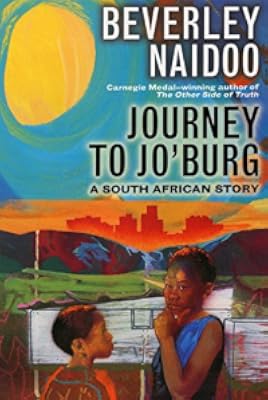
On This Page
Description
Separated from their mother by the harsh social and economic conditions prevalent among blacks in South Africa, thirteen-year-old Naledi and her younger brother make a journey of over 300 kilometers to find her in Johannesburg.Tags
Recommendations











Member Reviews
I liked this book because of its plot, and that it pushes readers to broaden their perspectives. The book tells the story of siblings Naledi and Tiro and how they make their way to Johannesburg from their village. When they first realized that their baby sister was ill, Naledi and Tiro went against their grandmother’s rules and decided to travel to Johannesburg by foot, to inform their Mma of their younger sister’s illness. Since they live in a village far away from the city, the siblings are unaware of what is happening during this time of the Apartheid. As they find their mother, who works as a servant for a white family, they begin to understand what is really happening in their country. Black people are not being given the same show more rights as white people. For example, Black children only go to school to learn how to become servants, instead of learning about math or history. Eventually the children and their Mma are reunited and are able to get their baby sister to the hospital. The trip left Naledi with many thoughts as to what she can do to change the outcome of her life, and her people. For instance, she thought that she had every right to become a doctor and help cure sick people. I feel that this book can push readers to think about tough issues because the Apartheid was a very scary time in South Africa, and life was extremely hard for Black people. Even though the story does not talk about the detailed events of the Apartheid, such as murders and wars, readers can still think about what was happening during this time period, and may want to learn more about it.
I feel that the main idea of this story is to remind readers how important family is. Naledi and Tiro took many risks just to be able to save their baby sister. For example, the children could have easily been taken by police, since they were not supposed to be traveling alone and in certain parts of the city. I think this story can help readers understand the perspectives of Black people living during the Apartheid and what they had to go through just to help feed and care for their family members. show less
I feel that the main idea of this story is to remind readers how important family is. Naledi and Tiro took many risks just to be able to save their baby sister. For example, the children could have easily been taken by police, since they were not supposed to be traveling alone and in certain parts of the city. I think this story can help readers understand the perspectives of Black people living during the Apartheid and what they had to go through just to help feed and care for their family members. show less
When their baby sister falls seriously ill, two young South African siblings set out from home to make the 200+ mile journey to Johannesburg to find their mother, who works as a housekeeper for a rich, white family.
This middle grade book has some issues, I think. It seems clear that the point of the novel is to point up some of the major problems with apartheid, but at the same time it seems to downplay those problems too much. The dangers and massive injustices inherent in that system are mentioned and then, weirdly, glossed over quickly, and the ending is a little too pat and trite.
It's possible I'm overreading these elements, because I was aware going into it that the book was written by a white woman from South Africa. Naidoo has a show more history of standing up for equal rights and speaking out against apartheid, and that's wonderful, of course, but I still don't know how I feel about white people writing stories for PoC. Maybe, at the time, it was an important step toward handing that authority over? So maybe it was a good first step in children's, but I do know for certain that there are now, happily, more and better versions of this kind of story out there by #ownvoices authors. show less
This middle grade book has some issues, I think. It seems clear that the point of the novel is to point up some of the major problems with apartheid, but at the same time it seems to downplay those problems too much. The dangers and massive injustices inherent in that system are mentioned and then, weirdly, glossed over quickly, and the ending is a little too pat and trite.
It's possible I'm overreading these elements, because I was aware going into it that the book was written by a white woman from South Africa. Naidoo has a show more history of standing up for equal rights and speaking out against apartheid, and that's wonderful, of course, but I still don't know how I feel about white people writing stories for PoC. Maybe, at the time, it was an important step toward handing that authority over? So maybe it was a good first step in children's, but I do know for certain that there are now, happily, more and better versions of this kind of story out there by #ownvoices authors. show less
This one is an incomplete book! It's one of my daughter's school books, written and set in the mid-1980s, when apartheid still infected the country of South Africa. It concerns the story of two children, who run away from their village to the city of Johannesburg in order to find their mother. It's a quick travelogue of some of the abuses black people were suffering at that time. Why I call it incomplete is that the ending is less than happy. There's no freedom won for the family or the nation, only the hope that the children might join in the fight against the unjust system and that one day that dream may be realized. Well, now it's 20 years later and we know that things are better. I would love to read a sequel to see what happened to show more the family. Anyway, while this book is dated, the evil of discrimination is not. This journey is still worth checking out.
--J. show less
--J. show less
A children's book about Apartheit.
Originally written in 1985, this book was not historical fiction but a description of life as it was in South Africa at the time. The author wanted to teach young children about the unacceptable policy of Apartheit that separated Africans from Caucasians purely by colour.
The wealth was all in the hands of the 'Whites', while the labour was done by the 'Blacks' who worked long hours for little pay and lived under apalling conditions.
Naledi and her brother Tiro are just 13 and 9 when their baby sister Dineo falls seriously sick with fever and malnutrition. Their mother is working hundreds of miles away in Johannesbug but this does not deter these brave young children from deciding to make the journey to show more bring their mother back to save Dineo.
On the way they experience many of the realities of Apartheit that they had been shielded from in their small isolated village - the segregation by colour, the Pass Card that must be carried at all times and the poverty in the face of so much wealth. This is where the strength of this book lies; as a learning tool for today's children.
Probably best suited for 9 to 10 yr olds it provides plenty of opportunity for learning about this era in history and perhaps ensuring that such inhumanities are not repeated. show less
Originally written in 1985, this book was not historical fiction but a description of life as it was in South Africa at the time. The author wanted to teach young children about the unacceptable policy of Apartheit that separated Africans from Caucasians purely by colour.
The wealth was all in the hands of the 'Whites', while the labour was done by the 'Blacks' who worked long hours for little pay and lived under apalling conditions.
Naledi and her brother Tiro are just 13 and 9 when their baby sister Dineo falls seriously sick with fever and malnutrition. Their mother is working hundreds of miles away in Johannesbug but this does not deter these brave young children from deciding to make the journey to show more bring their mother back to save Dineo.
On the way they experience many of the realities of Apartheit that they had been shielded from in their small isolated village - the segregation by colour, the Pass Card that must be carried at all times and the poverty in the face of so much wealth. This is where the strength of this book lies; as a learning tool for today's children.
Probably best suited for 9 to 10 yr olds it provides plenty of opportunity for learning about this era in history and perhaps ensuring that such inhumanities are not repeated. show less
Most of the civil rights problems and civil wars students learn about seem like ancient history. Journey to Jo'burg takes place in the 1970s, which was just 30 years ago. This tale of struggle, hardship, and determination brings major political issues into a current-day light.
I liked this chapter book for many different reasons. I liked how this book included many aspects of the South African Culture. For example, the author used names that girls and boys would have in South Africa, Tiro and Nadeli. The author also uses language from South Africa. For example, the author wrote, “”Sala sentle,” said the boy as he slipped away in the dark. “Tsamaya sentle,” came the reply from the shed.” This book is also written in simple language for a child that is around 9-12 years. The plot of this book also tells the many struggles that men and women faced being a different race. I liked that this chapter book incorporated illustrations throughout this story. This is a good text feature that gives readers a show more visualization of what is happening in the story. This is a Contemporary Realistic Fiction book and it can be related to student’s lives because many lessons can be taught about multiculturalism. The events are also believable because many people faced these struggles throughout history. This book was very entertaining and would make a good chapter book for students read and learn. The big idea or message of this story is overcoming struggles that many cultures endured because people believed they did not “belong”. show less
SUMMARY: Naledi, a thirteen year old girl, is the main character. She lives in South Africa. She goes on a journey to Johannesburg to get their mother, since her youngest sister is very sick. On their journey, they learn that police can be corrupt, that there are white-only buses, and that students are taught in school to be servants. In the end, they are able to take Dineo, the little sister to a hospital to be cared for. Naledi realizes that she wants to be more than a servant, she wants to be a doctor!
Review: I thought this book was a good read. It takes the reader on an emotional journey with Naledi and her brother. The author did a great job at making the reader have a visual along with the text. For example, "People were show more screaming, bleeding, falling... A little girl, about eight years old, standing near Grace raised her fist, and next thing she was lying dead." The central message was focusing on the struggle and fear and the lives of African village people . show less
Review: I thought this book was a good read. It takes the reader on an emotional journey with Naledi and her brother. The author did a great job at making the reader have a visual along with the text. For example, "People were show more screaming, bleeding, falling... A little girl, about eight years old, standing near Grace raised her fist, and next thing she was lying dead." The central message was focusing on the struggle and fear and the lives of African village people . show less
Members
- Recently Added By
Lists

1001 Children's Books You Must Read Before You Grow Up
774 works; 100 members

A Child's Book Tour of South Africa ::: Botswana, Mozambique, Zimbabwe
33 works; 3 members

Sonlight Books
1,487 works; 25 members

4th Grade Books
312 works; 5 members

Historical Fiction
889 works; 91 members

Build Your Library Level 4
23 works; 1 member

The Story of the World: Activity Book Four: The Modern Age
333 works; 2 members
Talk Discussions
Past Discussions
Found: Two Children Search for Their Mother in Name that Book (February 2025)
Author Information

33+ Works 3,645 Members
In 1965 as a young student, Beverley Naidoo was forced into exile from South Africa, where she had been imprisoned for her involvement in resistance to apartheid. She moved to England at the age of twenty-two
Some Editions
Awards and Honors
Awards
Series

Common Knowledge
- Canonical title
- Journey to Jo'burg
- Original publication date
- 1985
- People/Characters
- Naledi; Tiro
- Important places
- Johannesburg, South Africa; South Africa
Classifications
- Genres
- Kids, Fiction and Literature, Children's Books
- DDC/MDS
- 823.914 — Literature & rhetoric English & Old English literatures English fiction 1900- 1901-1999 1945-1999
- LCC
- PZ7 .N1384 .J — Language and Literature Fiction and juvenile belles lettres Fiction and juvenile belles lettres Juvenile belles lettres
- BISAC
Statistics
- Members
- 1,820
- Popularity
- 11,996
- Reviews
- 34
- Rating
- (3.68)
- Languages
- Dutch, English, Norwegian (Bokmål), Norwegian
- Media
- Paper, Audiobook, Ebook
- ISBNs
- 41
- ASINs
- 12