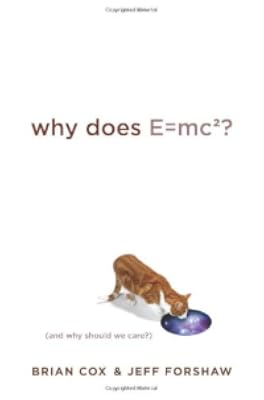
Why Does E=mc²?: (And Why Should We Care?)
by Brian Cox, Jeff Forshaw
On This Page
Description
In one of the most exciting and accessible explanations of The Theory of Relativity in recent years, Professors Brian Cox and Jeff Forshaw go on a journey to the frontier of 21st century science to consider the real meaning behind the iconic sequence of symbols that make up Einstein's most famous equation, exploring the principles of physics through everyday life.Tags
Recommendations









Member Recommendations
Member Reviews
As a layman who is interested in Physics and finds some books too technical and many others lack of precision and depth, I found this book brilliant and very helpful. It is an easy-to-follow popular science book, yet more profound than that.
Most of all, it isn't a book that just throws out "facts", results and theories towards you. It gives the readers an opportunity to looke into minds of the great, to think like a physicist and to understand how theories of Relativity and some other scientific ideas came into being.
Finally, aided by this book, I came to understand Einstein's theories of Special Relativity in detail. It really has given me more insights into this subject than any other book I've read on the same topic.
The only thing show more that left me somehow unsatisfied, is its brevity on theories of General Relativity, of which, the book only explains its concept. Although the mathematics should be difficult, I'd really like to learn more, by following a similar way that this wondeful book has guided us through previously. show less
Most of all, it isn't a book that just throws out "facts", results and theories towards you. It gives the readers an opportunity to looke into minds of the great, to think like a physicist and to understand how theories of Relativity and some other scientific ideas came into being.
Finally, aided by this book, I came to understand Einstein's theories of Special Relativity in detail. It really has given me more insights into this subject than any other book I've read on the same topic.
The only thing show more that left me somehow unsatisfied, is its brevity on theories of General Relativity, of which, the book only explains its concept. Although the mathematics should be difficult, I'd really like to learn more, by following a similar way that this wondeful book has guided us through previously. show less
Einstein’s theory of special relativity for dummies. Which, in this case, is probably most of us.
It will be hard for someone to come up with a simpler way to explain Einstein’s work - if you’re well versed on maths or physics, you will probably find this annoying or maybe too dumbed down. But this isn’t for you - it’s for all people that are curious about Einstein and our universe, can follow a logical discussion, but are not technical enough to follow a more detailed explanation. Not that this isn’t detailed, but Cox and Forshaw go to great lengths to hold your hand along the way and explain it all, using analogies and not a lot of maths to make their point.
And it works. You might feel a bit lost at times, but things will show more fall into place. And hopefully you will also be able to appreciate the beauty of Einstein’s ideas. show less
It will be hard for someone to come up with a simpler way to explain Einstein’s work - if you’re well versed on maths or physics, you will probably find this annoying or maybe too dumbed down. But this isn’t for you - it’s for all people that are curious about Einstein and our universe, can follow a logical discussion, but are not technical enough to follow a more detailed explanation. Not that this isn’t detailed, but Cox and Forshaw go to great lengths to hold your hand along the way and explain it all, using analogies and not a lot of maths to make their point.
And it works. You might feel a bit lost at times, but things will show more fall into place. And hopefully you will also be able to appreciate the beauty of Einstein’s ideas. show less
Have you ever wondered WHY e=mc^2? I suppose that the answer to that question (depending on your religious predilections) is something like: (1) Duh. That’s the way the universe came out; (2) That’s the way god made it, and she’s sticking with it; or (3) Some variant or combination of (1) and (2). And so I must say that a beautiful little volume, entitled Why does e=mc^2?, subtitled (and why should we care?) doesn’t really answer that question. But it does answer the question, HOW do we know e=mc^2, and can I prove it to a moderately math-competent layman?
This book is yet another popularized explanation of Einstein’s theory or (as the authors explain) theories of relativity. It is also one of the best available. Its special show more merit lies in the fact that it actually uses equations.
The so-called “special” theory of relativity defines how observers moving at constant velocity relative to one another observe the same events. The theory begins with the assumption that the speed of light is a constant, no matter what the velocity of the light source. That assumption was originally derived from Maxwell’s equations of electricity and magnetism and subsequently verified experimentally by the famous Michelson-Morley experiment. From this assumption, the theory concludes that for different observers moving relative to one another, measuring rods shrink, clocks slow down, and the mass of all object increases as their velocity increases. Moreover, these conclusions can be derived with mathematics no more complicated than college algebra and the Pythagorean Theorem.
Einstein was troubled by these conclusions. He wanted to know what laws of physics were truly invariant, no matter how different observers moved relative to one another. In fact, he thought the theory of invariance was a better name for his conclusions than the theory of relativity. To make sense of these calculations, which have been verified numerous times by experiment, we must assume that space and time are not separate entities, as we formerly thought, but are inextricably meshed together in a single entity now called space-time. The authors then demonstrate the consequences of the law of the conservation of momentum, expressed in space-time. Remarkably, by teasing the relativity equations regarding length, mass, and time in light of the conservation of momentum, the famous E=mc² pops out almost like magic! The conclusion that energy and mass are equivalent and related to one another in a very precise ratio is completely unexpected and profound. To the authors’ credit, they do not insulate the reader from the relatively simple math used to derive the theory. The reader’s appreciation of the profundity of the theory is greatly enhanced by following its mathematical derivation.
You have to start with two assumptions. (1) Physical laws should be invariant, that is, they should predict the same result whether the events analyzed are measured from an observer at rest, in a speeding train, or in an elevator. (2) The universe contains a maximum speed limit (which turns out to be the speed of light, but that’s another story, treated late in the book). Einstein figured out that if (2) were true, then a lot of physics would have to be recast in order for (1) to be true as well.
The special theory of relativity showed that to observers moving at high relative speeds, time would slow down and distances would shrink. Consequently, Newton’s concept of absolute space had to be amended. If observers moving at high relative speeds (actually, at any speed) could not agree on length or time, what, if anything, was invariant? The answer was an amalgam of time and space that Einstein called space-time.
Call the space-time distance ’s.’ Call distance measured by an observer at rest ‘x.’ Call the duration of time ’t.’ Call the maximum speed limit ‘c.’ It turns out that all observers, no matter how fast they are traveling relative to one another will measure s^2 to equal (c times t)^2 - x^2. Or, s = the square root of [(c times t)^2 - x^2]. ’S’, the measure of space-time, is invariant even though ’t’ and ‘x’ will be measured differently by different observers.
When it comes to the general theory of relativity, which deals with systems accelerating relative to one another and explains the phenomenon of gravity as the localized curvature of Minkowski space-time, the math becomes much more difficult—it took Einstein ten years of intense effort to figure it out. I’ve seen the math in technical journals, and it is far too daunting for the average reader such as me. The authors mercifully omit that math, but point out that the theory ultimately was derived from the observation that objects fall at the same speed (unless differentially affected by air friction).
The book also includes a chapter on the origin of mass, which takes us away from relativity theory into the realm of quantum mechanics. The math here is very difficult, but the authors simplify matters as much a possible by using Feynman diagrams.
This is a well-written book for the curious layman with a mathematical bent who wants to explore modern physics.
(JAB) show less
This book is yet another popularized explanation of Einstein’s theory or (as the authors explain) theories of relativity. It is also one of the best available. Its special show more merit lies in the fact that it actually uses equations.
The so-called “special” theory of relativity defines how observers moving at constant velocity relative to one another observe the same events. The theory begins with the assumption that the speed of light is a constant, no matter what the velocity of the light source. That assumption was originally derived from Maxwell’s equations of electricity and magnetism and subsequently verified experimentally by the famous Michelson-Morley experiment. From this assumption, the theory concludes that for different observers moving relative to one another, measuring rods shrink, clocks slow down, and the mass of all object increases as their velocity increases. Moreover, these conclusions can be derived with mathematics no more complicated than college algebra and the Pythagorean Theorem.
Einstein was troubled by these conclusions. He wanted to know what laws of physics were truly invariant, no matter how different observers moved relative to one another. In fact, he thought the theory of invariance was a better name for his conclusions than the theory of relativity. To make sense of these calculations, which have been verified numerous times by experiment, we must assume that space and time are not separate entities, as we formerly thought, but are inextricably meshed together in a single entity now called space-time. The authors then demonstrate the consequences of the law of the conservation of momentum, expressed in space-time. Remarkably, by teasing the relativity equations regarding length, mass, and time in light of the conservation of momentum, the famous E=mc² pops out almost like magic! The conclusion that energy and mass are equivalent and related to one another in a very precise ratio is completely unexpected and profound. To the authors’ credit, they do not insulate the reader from the relatively simple math used to derive the theory. The reader’s appreciation of the profundity of the theory is greatly enhanced by following its mathematical derivation.
You have to start with two assumptions. (1) Physical laws should be invariant, that is, they should predict the same result whether the events analyzed are measured from an observer at rest, in a speeding train, or in an elevator. (2) The universe contains a maximum speed limit (which turns out to be the speed of light, but that’s another story, treated late in the book). Einstein figured out that if (2) were true, then a lot of physics would have to be recast in order for (1) to be true as well.
The special theory of relativity showed that to observers moving at high relative speeds, time would slow down and distances would shrink. Consequently, Newton’s concept of absolute space had to be amended. If observers moving at high relative speeds (actually, at any speed) could not agree on length or time, what, if anything, was invariant? The answer was an amalgam of time and space that Einstein called space-time.
Call the space-time distance ’s.’ Call distance measured by an observer at rest ‘x.’ Call the duration of time ’t.’ Call the maximum speed limit ‘c.’ It turns out that all observers, no matter how fast they are traveling relative to one another will measure s^2 to equal (c times t)^2 - x^2. Or, s = the square root of [(c times t)^2 - x^2]. ’S’, the measure of space-time, is invariant even though ’t’ and ‘x’ will be measured differently by different observers.
When it comes to the general theory of relativity, which deals with systems accelerating relative to one another and explains the phenomenon of gravity as the localized curvature of Minkowski space-time, the math becomes much more difficult—it took Einstein ten years of intense effort to figure it out. I’ve seen the math in technical journals, and it is far too daunting for the average reader such as me. The authors mercifully omit that math, but point out that the theory ultimately was derived from the observation that objects fall at the same speed (unless differentially affected by air friction).
The book also includes a chapter on the origin of mass, which takes us away from relativity theory into the realm of quantum mechanics. The math here is very difficult, but the authors simplify matters as much a possible by using Feynman diagrams.
This is a well-written book for the curious layman with a mathematical bent who wants to explore modern physics.
(JAB) show less
This book attempts to take us through special relativity, explaining how space and time aren't independent, but part of a larger spacetime, why e=mc squared falls out of these concepts, and then onto general relativity and even the standard model in its entirety. There are lots of passages that are brilliantly and very clearly explained, and this is definitely one of the stronger, more accessible popular physics books out there.
However, I was somewhat frustrated by how uneven it was at times. There are some extremely basic mathematical operations that the book takes pains to explain, which I don't mind, but then also some rather complex mathematics and degree level concepts combined with the mathematics that were far from clear. I'm a show more scientist myself with a reasonable amount of maths in my research and some of the descriptions walking through the mathematical and theoretical steps just seemed rushed, missing steps and explanation, which seemed a shame. Had the book been longer, taking greater care to explain the critical stages, I think it would have been so much better.
For a book that covers so much ground, I did still learn a lot, but would strongly recommend Oerter's The Theory of Almost Everything over this. show less
However, I was somewhat frustrated by how uneven it was at times. There are some extremely basic mathematical operations that the book takes pains to explain, which I don't mind, but then also some rather complex mathematics and degree level concepts combined with the mathematics that were far from clear. I'm a show more scientist myself with a reasonable amount of maths in my research and some of the descriptions walking through the mathematical and theoretical steps just seemed rushed, missing steps and explanation, which seemed a shame. Had the book been longer, taking greater care to explain the critical stages, I think it would have been so much better.
For a book that covers so much ground, I did still learn a lot, but would strongly recommend Oerter's The Theory of Almost Everything over this. show less
It took me a while to get my hands on this book, and yet the wait was worth it. For those who have always wondered since school days, about the most famous equation of the last century and its relevance, this book clears the air.
The authors have explained special and general relativity in a way that non-phycists/mathematicians like me can understand (though with a few re-reads of certain sections).
I can finally say that if someone asked me to explain special and general relativity, I could manage my way to attempt it now. Thanks to this wonderfully simple book.
The authors have explained special and general relativity in a way that non-phycists/mathematicians like me can understand (though with a few re-reads of certain sections).
I can finally say that if someone asked me to explain special and general relativity, I could manage my way to attempt it now. Thanks to this wonderfully simple book.
I want to love a book like this, a book that guides the reader or listener to amazing scientific insights. Unfortunately I did not because the book's general attitude rubbed me the wrong way. Don't ask me why.
A few tangible things:
* The book (at least the edition I consumed) is dated. For instance, the Higgs boson was found by the Large Hadron Collider a couple of years after this book was written.
* It explicitly avoids even letting the user get a glimpse of any complicated math. Just to be able to pretend everything is very simple. A lot is very simple. All is not very simple.
* It avoids mentioning things that complicates the current picture, except when saying over and over again that some day we might figure out even better theories show more and models. For instance, if time is like any other dimension in spacetime, why can't it move backwards?
All in all it dumbs down things a bit too much. I'm probably just not in the book's target audience, so what book should I read instead? show less
A few tangible things:
* The book (at least the edition I consumed) is dated. For instance, the Higgs boson was found by the Large Hadron Collider a couple of years after this book was written.
* It explicitly avoids even letting the user get a glimpse of any complicated math. Just to be able to pretend everything is very simple. A lot is very simple. All is not very simple.
* It avoids mentioning things that complicates the current picture, except when saying over and over again that some day we might figure out even better theories show more and models. For instance, if time is like any other dimension in spacetime, why can't it move backwards?
All in all it dumbs down things a bit too much. I'm probably just not in the book's target audience, so what book should I read instead? show less
I have very mixed feelings in regards to this book. On one hand, it introduced me to lots of fascinating concepts I had only heard of but never truly understood, but on the other hand, I don't feel I understand them now either. The writing ranged from condescendingly simple to very confusing - confusing, for example, in that it transformed relatively simple mathematical proofs into jumbles of narration that were very difficult for me to follow, although I was well acquainted with the actual maths. (Just write the vector in vector notation, please!) I don't feel like someone who had never encountered the maths before would have understood it, and the way it was presented made it unnecessarily hard even for those who have some knowledge show more to grasp it. Mathematical notation exists for the sake of clarity and simplicity, after all!
I also feel like the author would describe a simple, intuitive concept for (p)ages, but gloss over more boggling and counter-intuitive ideas, so I felt I had to go back and re-read certain passages several times. Although certain things were very well explained, like the mass-energy conversion that is at the heart of the most simple energy-releasing processes, i.e. burning. The motorcyclist analogy I did not understand, but the nice geometrical proof of why things cannot go above the speed of light was really good. The last few chapters were also fine (except the last, about general relativity - I felt like I wanted a much more in-depth explanation), but I just felt the quality of the explanations really fluctuated and the whole thing lacked a bit flow; there were some rather abrupt changes of topic and too many "we'll explain it later"s .
For all that criticism, it was an overall enjoyable read, and it has spurred me into researching relativity and the like a bit more, and I certainly learned something new and exciting about the universe. So, a solid 3-star! show less
I also feel like the author would describe a simple, intuitive concept for (p)ages, but gloss over more boggling and counter-intuitive ideas, so I felt I had to go back and re-read certain passages several times. Although certain things were very well explained, like the mass-energy conversion that is at the heart of the most simple energy-releasing processes, i.e. burning. The motorcyclist analogy I did not understand, but the nice geometrical proof of why things cannot go above the speed of light was really good. The last few chapters were also fine (except the last, about general relativity - I felt like I wanted a much more in-depth explanation), but I just felt the quality of the explanations really fluctuated and the whole thing lacked a bit flow; there were some rather abrupt changes of topic and too many "we'll explain it later"s .
For all that criticism, it was an overall enjoyable read, and it has spurred me into researching relativity and the like a bit more, and I certainly learned something new and exciting about the universe. So, a solid 3-star! show less
Members
- Recently Added By
Lists

Books Read in 2018
4,360 works; 110 members

In Our Time books
4,934 works; 2 members
Author Information

29+ Works 3,378 Members
4 Works 2,306 Members
Awards and Honors
Awards
Notable Lists
Work Relationships
Common Knowledge
- Canonical title
- Why Does E=mc²?: (And Why Should We Care?) (And Why Should We Care?)
- Original publication date
- 2009-07-02
- People/Characters
- Michael Faraday; Albert Einstein; Humphry Davy; Thomas Edison; Richard Feynman; Nostradamus (show all 7); James Joyce
- Dedication
- To our families, especially Gia, Mo, George, Dabid, Barbara, Sandra, Naomi, Isabel, Sylvia, Thomas, and Michael
- First words
- What do the words "space" and "time" mean to you?
- Last words
- (Click to show. Warning: May contain spoilers.)Albert Einstein will be remembered for as long as there are humans in the universe both as an inspiration and an example to all those who are captivated by a natural curiosity to understand the world around them.
Classifications
Statistics
- Members
- 1,168
- Popularity
- 21,452
- Reviews
- 27
- Rating
- (3.79)
- Languages
- 8 — Czech, English, French, German, Italian, Polish, Serbian, Spanish
- Media
- Paper, Audiobook, Ebook
- ISBNs
- 25
- ASINs
- 15
