On This Page
Description
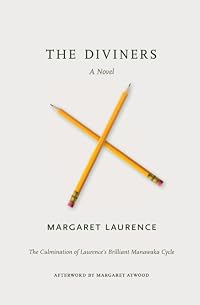
Morag Gunn, now in her mid-forties, lives in a riverside farmhouse in Eastern Ontario. Through a series of flashbacks she reviews the painful and exhilarating moments of her earlier life: her childhood on the social margins of the small prairie town of Manawaka; her escape from a demeaning marriage into writing fiction; and her travels to England, Scotland and finally back to Canada where she faces a different challenge - the necessity to understand, and let go of, the daughter she loves. A show more feminist saga as inspirational as when it was first published in 1974, The Diviners is an evocative exploration of one woman's search for her identity. show lessTags
Recommendations














Member Recommendations
librorumamans Both books, written four decades apart, look at the gulf that divides aboriginal peoples from the Europeans who supplanted them.
Member Reviews
It caused a fair amount of controversy upon its initial release due to language and frank depictions of a woman actually enjoying sex, but Margaret Laurence's novel stands as one of modern Canadian literature's seminal works. Author Morag Gunn looks back on her life thus far and in so doing Laurence explores the ways we recall, and occaionally twist, our past; the myriad ways the new generation follows in the footsteps of the old (Gunn's daughter truly is a chip of the old block); and the evolution of the artist through adversity. She also touches on issues of racism, classism, and the small town "values" which stifle more than liberate. Laurence takes Thomas Wolfe's epitaph, "You can't go home again" and gives it new meaning for as her show more protagonist ruminates on the past you realize that she has in fact been taking her home with her wherever she goes. show less
The Diviners is the last novel in Margaret Laurence’s Manawaka cycle, set in and around a fictional Canadian town. All four novels feature strong, smart female protagonists, chafing under the constraints society places on them (circa 1970 and earlier). In this novel, Morag Gunn is a 47-year-old writer with a young adult daughter, Pique, who recently set off to make her way across Canada on her own. While Morag frets about Pique’s welfare while trying to get work done, she also reflects on her past through a series of “snapshot” and “memorybank movie” flashbacks.
Morag’s parents died when she was very young, and she was taken in by Christie Logan and his wife, Prin. They treated Morag as their own child; it was a loving show more home environment if a somewhat impoverished one. Christie was the town scavenger / garbage collector, and the family’s socioeconomic status led to Morag being somewhat of an outsider among her classmates. Morag befriended Jules Tonnerre, who was also an outcast due to his Métis heritage (a mix of indigenous people and European settlers). Eventually Morag, suffocating in the small town environment, left for university, married, and published her first novel, but the bond between Morag and Jules remained strong. The plot threads come together beautifully as the narrative of the past catches up to the present.
I loved everything about this novel. The characters are beautifully drawn; I felt I knew Morag and was moved by her relationships with Pique, Jules, and Christie, especially during pivotal events in their lives. Laurence connects this novel to the previous books in the Manawaka cycle through references to characters or events, and while it’s not essential to read the earlier novels first, doing so enhances the reading experience. Near the end of The Diviners, Laurence makes a powerful emotional connection back to The Stone Angel’s Hagar Shipley that was absolutely perfect, and that’s when I knew for sure I was reading a 5-star book.
Margaret Laurence’s Manawaka novels are true classics -- highly recommended. show less
Morag’s parents died when she was very young, and she was taken in by Christie Logan and his wife, Prin. They treated Morag as their own child; it was a loving show more home environment if a somewhat impoverished one. Christie was the town scavenger / garbage collector, and the family’s socioeconomic status led to Morag being somewhat of an outsider among her classmates. Morag befriended Jules Tonnerre, who was also an outcast due to his Métis heritage (a mix of indigenous people and European settlers). Eventually Morag, suffocating in the small town environment, left for university, married, and published her first novel, but the bond between Morag and Jules remained strong. The plot threads come together beautifully as the narrative of the past catches up to the present.
I loved everything about this novel. The characters are beautifully drawn; I felt I knew Morag and was moved by her relationships with Pique, Jules, and Christie, especially during pivotal events in their lives. Laurence connects this novel to the previous books in the Manawaka cycle through references to characters or events, and while it’s not essential to read the earlier novels first, doing so enhances the reading experience. Near the end of The Diviners, Laurence makes a powerful emotional connection back to The Stone Angel’s Hagar Shipley that was absolutely perfect, and that’s when I knew for sure I was reading a 5-star book.
Margaret Laurence’s Manawaka novels are true classics -- highly recommended. show less
[The Diviners] is the story of Margaret Gunn who grows up in a small town on the Canada prairie, raised by friends of her father after her parents die when she is five. The people who raise her are Christie and Prin. Christie is the town scavenger, i.e. garbage man, and is looked down upon. He is also deeply scarred from his WWI experience. Prin is eating herself into an early grave. The town in small in thinking and backwards until you get to know the characters. Morag, though, must escape and finds her way through the world as a writer. Before she leaves, she meets Jules Tonnerre, a mixed race boy, who she falls in love with. He will come and go in her life throughout the novel. Morag later has a child, Pique, and their travels and show more relationship form another portion of the book.
This book isn't linear. It's told through a series of brief flashbacks labeled "memorybank movies" in the text. It's an exploration of memory as well as life through Morag's experience. Somehow it all flows together perfectly, though, and you barely realize the different shifts in time - they just work. I really, really loved this book. The characters were so alive to me and I did not want the book to end. I read another of Laurence's books, [The Stone Angel], recently and it was also excellent. This, though, was more complex and I felt a bit more maturely written. I highly recommend reading some [[Margaret Laurence]]. show less
This book isn't linear. It's told through a series of brief flashbacks labeled "memorybank movies" in the text. It's an exploration of memory as well as life through Morag's experience. Somehow it all flows together perfectly, though, and you barely realize the different shifts in time - they just work. I really, really loved this book. The characters were so alive to me and I did not want the book to end. I read another of Laurence's books, [The Stone Angel], recently and it was also excellent. This, though, was more complex and I felt a bit more maturely written. I highly recommend reading some [[Margaret Laurence]]. show less
In Margaret Laurence’s final novel most of her characters are searching; searchers for home, family or creativity, water or scavenging in town dumps. The Diviners; the final novel in Laurence’s Manawaka sequence (though I still have to read number three and the collection of stories) is though a novel of outsiders.
At about 400 pages, I thought twice about reading this, as I am trying not to pick anything too big as I race toward the end of my A Century of Books. I had wanted to read this so long, I decided it didn’t really matter – I should read what I wanted to. So very glad I did, I loved every bit of this novel, not a fast read, but a thoroughly absorbing one, beautifully written it proved a real treat spending time with this show more book. An epic novel, which is already considered a classic of Canadian literature. Strangely, the novel has also been banned several times by school boards for blasphemy. I find that absurd.
Manawaka is the fictional prairie town that first appeared in Margaret Laurence’s The Stone Angel. The Diviners is the story of Morag Gunn, a fiercely independent writer, her difficult relationships with her Métis lover Jules Tonnerre, and her daughter Pique. As we first meet Morag, she is a forty-seven-year old woman, living near a river. Her eighteen-year-old daughter has gone away for a while and she is worrying about her, watching the river – trying to get her mind back to her work. Here, Morag is alone but has friends close by – neighbours who pop in frequently. Old Royland, the water diviner is one.
“No boats today. Yes, one. Royland was out, fishing for muskie, seventy-four years old this year, Royland. Eyesight terrible, but he was too stubborn to wear glasses. A marvel that he could go on working. Of course, his work did not depend upon eyesight. Some other kind of sight. A water diviner. Morag always felt she was about to learn something of great significance from him, something which would explain everything. But things remained mysterious, his work, her own, the generations, the river.”
The story moves back and forth between Morag’s present – where she struggles with her work and her relationship with her daughter, and the past as she grows up more and more desperate to escape the town of Manawaka.
Morag Gunn wasn’t born in Manawaka – her parents died when she was just five years old – and she goes to live in Manawaka with an army friend of her father’s and his wife – who agree to take the orphaned child in. Christy Logan and his wife Prin (short for Princess) are an odd choice as guardians for such a young child. Morag has never lived in town before – it all seems very strange – and she has never met Christy and Prin before she is taken there by a neighbour. Christy is the town scavenger – he spends his days at the nuisance grounds (the town tip) he gets rid of the things people don’t want – a keeper of secrets, and a finder of things. His wife Prin is an enormously large woman, who stays mainly in the house.
“‘She’ll be alright Christie,’ the Big Fat Woman says. ‘She gotta get used to us. Leave her be, now’
‘I was only trying, for God’s sake, woman,’ sounding mad.
‘You want to see your room, Morag?’ the woman says.
She nods. They mount the stairs, the woman going very slow because fat. The room is hers, this one? A thin bed, a green dresser, a window with a (oh – ripped, shame on them) lace curtain. A little room. You might be safe in a place like that, if it was really yours. If they meant it.”
Christy and Prin are kind people – and though Morag is often slightly ashamed of them – in the way children are when their adults are so obviously different to other children’s – she becomes used to them. Christy is a good teller of tales – stories that Morag carries with her – she is both fascinated and repelled by his life at the nuisance grounds (I shall forever now, think of a rubbish dump as the nuisance grounds). However, as Morag grows up – she becomes more and more dissatisfied with life in Manawaka, knowing that when the time is right, she will break away.
Morag is made tough by this strange life in the prairie town. It is here in Manawaka though as a teenager that Morag first meets Jules Tonnerre, (nickname Skinner), Jules and his family are outsiders, Métis living on the outskirts of town, they are subject to all the usual prejudices. While Jules is away at the war, Morag a junior reporter on the town newspaper is sent to report on the fire at the Tonnerre home, where Jules’ sister and her children are killed. It is a scene that will haunt them both over the coming years.
Morag does leave Manakawa – she goes to college where she meets new friends and lovers, marries the wrong man and longs for a child. One day, she meets up with Jules again, though their relationship is never destined to be conventional, she takes the chance to break away one more time.
Laurence’s characters are wonderfully memorable – her storytelling is rich and poignantly written. My first novel of the month will be one that is hard to beat. I don’t think it matters that I am reading these books slightly out of order, but I am looking forward to reading The Fire Dwellers even more now. show less
At about 400 pages, I thought twice about reading this, as I am trying not to pick anything too big as I race toward the end of my A Century of Books. I had wanted to read this so long, I decided it didn’t really matter – I should read what I wanted to. So very glad I did, I loved every bit of this novel, not a fast read, but a thoroughly absorbing one, beautifully written it proved a real treat spending time with this show more book. An epic novel, which is already considered a classic of Canadian literature. Strangely, the novel has also been banned several times by school boards for blasphemy. I find that absurd.
Manawaka is the fictional prairie town that first appeared in Margaret Laurence’s The Stone Angel. The Diviners is the story of Morag Gunn, a fiercely independent writer, her difficult relationships with her Métis lover Jules Tonnerre, and her daughter Pique. As we first meet Morag, she is a forty-seven-year old woman, living near a river. Her eighteen-year-old daughter has gone away for a while and she is worrying about her, watching the river – trying to get her mind back to her work. Here, Morag is alone but has friends close by – neighbours who pop in frequently. Old Royland, the water diviner is one.
“No boats today. Yes, one. Royland was out, fishing for muskie, seventy-four years old this year, Royland. Eyesight terrible, but he was too stubborn to wear glasses. A marvel that he could go on working. Of course, his work did not depend upon eyesight. Some other kind of sight. A water diviner. Morag always felt she was about to learn something of great significance from him, something which would explain everything. But things remained mysterious, his work, her own, the generations, the river.”
The story moves back and forth between Morag’s present – where she struggles with her work and her relationship with her daughter, and the past as she grows up more and more desperate to escape the town of Manawaka.
Morag Gunn wasn’t born in Manawaka – her parents died when she was just five years old – and she goes to live in Manawaka with an army friend of her father’s and his wife – who agree to take the orphaned child in. Christy Logan and his wife Prin (short for Princess) are an odd choice as guardians for such a young child. Morag has never lived in town before – it all seems very strange – and she has never met Christy and Prin before she is taken there by a neighbour. Christy is the town scavenger – he spends his days at the nuisance grounds (the town tip) he gets rid of the things people don’t want – a keeper of secrets, and a finder of things. His wife Prin is an enormously large woman, who stays mainly in the house.
“‘She’ll be alright Christie,’ the Big Fat Woman says. ‘She gotta get used to us. Leave her be, now’
‘I was only trying, for God’s sake, woman,’ sounding mad.
‘You want to see your room, Morag?’ the woman says.
She nods. They mount the stairs, the woman going very slow because fat. The room is hers, this one? A thin bed, a green dresser, a window with a (oh – ripped, shame on them) lace curtain. A little room. You might be safe in a place like that, if it was really yours. If they meant it.”
Christy and Prin are kind people – and though Morag is often slightly ashamed of them – in the way children are when their adults are so obviously different to other children’s – she becomes used to them. Christy is a good teller of tales – stories that Morag carries with her – she is both fascinated and repelled by his life at the nuisance grounds (I shall forever now, think of a rubbish dump as the nuisance grounds). However, as Morag grows up – she becomes more and more dissatisfied with life in Manawaka, knowing that when the time is right, she will break away.
Morag is made tough by this strange life in the prairie town. It is here in Manawaka though as a teenager that Morag first meets Jules Tonnerre, (nickname Skinner), Jules and his family are outsiders, Métis living on the outskirts of town, they are subject to all the usual prejudices. While Jules is away at the war, Morag a junior reporter on the town newspaper is sent to report on the fire at the Tonnerre home, where Jules’ sister and her children are killed. It is a scene that will haunt them both over the coming years.
Morag does leave Manakawa – she goes to college where she meets new friends and lovers, marries the wrong man and longs for a child. One day, she meets up with Jules again, though their relationship is never destined to be conventional, she takes the chance to break away one more time.
Laurence’s characters are wonderfully memorable – her storytelling is rich and poignantly written. My first novel of the month will be one that is hard to beat. I don’t think it matters that I am reading these books slightly out of order, but I am looking forward to reading The Fire Dwellers even more now. show less
THE DIVINERS, Margaret Laurence’s sequel to her Manawaka novels, is a raw Canadian journey into the feminist movement of the seventies. Morag Gunn is an independent, powerful character who refuses to be dictated to by the rigid, and often cruel expectations of her times. Told through the eyes of a middle-aged writer trying to come to terms with her teenaged daughter, the younger, orphaned Morag is revealed through a slideshow of memory blurbs that bring the character alive—almost like leafing through a photo album of the character’s life. She is a woman that has never tolerated being told what to do, and must fight her motherly instinct of trying to protect her daughter from the pain that is an essential part of growth. Love plays show more a powerful role in this honest story of the loneliness that comes with stepping out of the box and following your dream. show less
What I liked about this book: the way Laurence wove in Morag’s memories as mini-movies, as well as stories told by Christie, songs by Jules and Pique, and even interludes from Catherine Parr Traill. I liked too that Morag was a strong and determined character who made her own way as best she could.
What I didn’t like in this book: the relationship between Morag and Brooke. The student/teacher relationship was skeevy because of the power imbalance inherent in the relationship, and Brooke himself was repulsive in how he tried to get Morag to behave in a “ladylike” way and at the same time infantilized her. Also the sex scenes.
What was OK about this book: I liked the idea of including songs by Jules and Pique, but the songs show more themselves sounded a bit too much like they were written by the same person, which they probably were. show less
What I didn’t like in this book: the relationship between Morag and Brooke. The student/teacher relationship was skeevy because of the power imbalance inherent in the relationship, and Brooke himself was repulsive in how he tried to get Morag to behave in a “ladylike” way and at the same time infantilized her. Also the sex scenes.
What was OK about this book: I liked the idea of including songs by Jules and Pique, but the songs show more themselves sounded a bit too much like they were written by the same person, which they probably were. show less
The Diviners by Margaret Laurence is considered a classic of Canadian Literature, winning the Governor General’s Award for fiction in 1974. The main character of the story is Morag Gunn, an independent novelist and single mother who grew up in the small town of Manawaka, Manitoba. She has a difficult relationship with her daughter Pique and the father of Pique, a Metis named Jules Tonnerre and is struggling with her writing as well.
The novel opens with Morag finding that her eighteen year old daughter has left home then while brooding over that she thinks back over her own life, her traumatic childhood, her difficult relationships and her struggles to assert herself. This self-reflective portrait not only portrayed Morag’s life but show more also with it’s exploration of several generations, races and classes painted a vivid picture of the Canadian immigrant experience.
When originally published The Diviners was considered quite controversial with it’s depiction of a woman who chose to leave her marriage and conceive a child out of wedlock. Also the interracial relationship between Morag and Jules caused more than a few raised eyebrows. I believe the author was striving to show how mixed culturally and racially Canadian heritage can be.
I surprised myself by how much I enjoyed this book. Although published in the 1970s, its feminist themes still ring true today. I will long remember Morag Gunn, the flawed, conflicted yet strong main character who takes the reader on such an emotional journey. The author’s writing totally engaged me with it’s honest and intimate manner of delivering such a complex story. show less
The novel opens with Morag finding that her eighteen year old daughter has left home then while brooding over that she thinks back over her own life, her traumatic childhood, her difficult relationships and her struggles to assert herself. This self-reflective portrait not only portrayed Morag’s life but show more also with it’s exploration of several generations, races and classes painted a vivid picture of the Canadian immigrant experience.
When originally published The Diviners was considered quite controversial with it’s depiction of a woman who chose to leave her marriage and conceive a child out of wedlock. Also the interracial relationship between Morag and Jules caused more than a few raised eyebrows. I believe the author was striving to show how mixed culturally and racially Canadian heritage can be.
I surprised myself by how much I enjoyed this book. Although published in the 1970s, its feminist themes still ring true today. I will long remember Morag Gunn, the flawed, conflicted yet strong main character who takes the reader on such an emotional journey. The author’s writing totally engaged me with it’s honest and intimate manner of delivering such a complex story. show less
Members
- Recently Added By
Lists

1001 Books You Must Read Before You Die
1,448 works; 1,137 members

Classics you know you should have read but probably haven't
421 works; 409 members
501 Must-Read Books
529 works; 72 members

The Best of Canadian Literature
235 works; 33 members

Female Author
1,234 works; 66 members
CBC Books - Canada's 100 (+ bonus 10): Which have you read?
110 works; 23 members

20th Century Literature
1,161 works; 55 members
Female Protagonist
1,056 works; 57 members

Books Set in Canada
80 works; 16 members

Favourite Virago Modern Classics
183 works; 38 members

Top Five Books of 2020
982 works; 350 members

Women's Stories
88 works; 13 members

1970s
657 works; 23 members

Governor General of Canada's English Fiction Awards
89 works; 3 members

Top Five Books of 2014
1,064 works; 398 members

New Canadian Library
191 works; 7 members

Top Five Books of 2019
387 works; 107 members
Writers as Characters in Fiction
120 works; 19 members

A Novel Cure
742 works; 23 members

Literature About Women and Girls
426 works; 41 members
Small Town Fiction
66 works; 13 members

CBC's Great Canadian Reading List
149 works; 5 members

Five star books
1,767 works; 110 members

Books Set in Canada
57 works; 10 members

Allie's Favourite 150 Books
145 works; 3 members

Best Books set in Manitoba
85 works; 2 members

Books Read in 2007
326 works; 8 members
Best Books of the 20th Century
193 works; 5 members

University literature
145 works; 5 members

Books You Read For University
184 works; 3 members
Canadian Historical Fiction 🇨🇦
157 works; 8 members

Women Writers
16 works; 2 members

Canada
42 works; 3 members

Swinging Seventies
255 works; 18 members

Literary Works Read in College
316 works; 15 members

Books Read in 1996
30 works; 1 member
Talk Discussions
Past Discussions
Group Read, January 2020: The Diviners in 1001 Books to read before you die (February 2020)
Author Information

Canadian author Margaret Laurence was born Jean Margaret Wemyss in Neepawa, Manitoba, Canada, on July 18, 1926. She attended United College (now the University of Winnipeg), receiving her B.A. in 1947. Shortly after graduation, she married Jack Laurence, a hydraulic engineer whose job would often take them overseas; the Laurences lived in England show more for a year, moved to British Somaliland in 1950, and then to Ghana in 1952. It was in Africa that Laurence wrote her first book, A Tree for Poverty, which was a translation of Somali poetry and stories. She also wrote about her experiences in Somaliland in a travel memoir, The Prophet's Camel Bell, and used Africa as a setting for her first fictional work, a novel called This Side Jordan, and a collection of short stories, The Tomorrow Tamers. This Side Jordan received the 1961 Beta Sigma Phi Award for the best first novel by a Canadian. Laurence is best known, however, for her Manawaka books, which are set in Canada. They include The Stone Angel, The Fire Dwellers House, A Bird in the House, A Jest of God, and The Diviners. The latter two books both received the Governor General's Award, in 1967 and 1975, respectively. After living in Africa, England, and several other countries for many years, Laurence returned to Canada in 1974, settling in Lakefield, Ontario, where she remained until her death in 1987. The Energy Probe Research Foundation, an environmental organization for which she served as one of the directors, now sponsors the Margaret Laurence Fund for projects related to the environment and peace, areas in which Laurence was very active during the last decade of her life. (Bowker Author Biography) show less
Some Editions
Awards and Honors
Awards
Series

Belongs to Publisher Series
New Canadian Library (146)
Virago Modern Classics (323)
Work Relationships
Has as a student's study guide
Common Knowledge
- Canonical title
- The Diviners
- Original title
- The Diviners
- Alternate titles*
- I rabdomanti
- Original publication date
- 1974
- People/Characters
- Morag Gunn; Pique Tonnerre Gunn; Jules "Skinner" Tonnerre; Christie Logan; Prin Logan
- Important places
- Manawaka (fictionalised name | Laurence actually grew up in Neepawa, MB); Manitoba, Canada; Canada
- Related movies
- The Diviners (1993 | IMDb)
- Epigraph
- but they had their being once / and left a place to stand on --Al Purdy (Roblin Mills Circa 1842)
- Dedication
- For the Elmcot people past present and future and for the house itself with love and gratitude.
- First words
- The river flowed both ways.
- Last words
- (Click to show. Warning: May contain spoilers.)Morag returned to the house, to write the remaining private and fictional words, and to set down her title.
*Some information comes from Common Knowledge in other languages. Click "Edit" for more information.
Classifications
Statistics
- Members
- 1,295
- Popularity
- 18,886
- Reviews
- 22
- Rating
- (4.12)
- Languages
- 5 — Dutch, English, French, German, Italian
- Media
- Paper, Audiobook, Ebook
- ISBNs
- 33
- ASINs
- 19