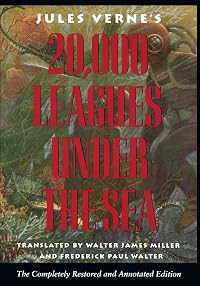
The Annotated Jules Verne: Twenty Thousand Leagues under the Sea
by Jules Verne
On This Page
Description
Retells the adventures of a French professor and his two companions as they sail above and below the world's oceans as prisoners on the fabulous electric submarine of the deranged Captain Nemo.Tags
Recommendations






































Member Reviews
Strangely, I never read much Jules Verne as a child; Around the World in Eighty Days and Journey to the Center of the Earth were it. So, it was nice to get to experience this, one of the foundational texts of science fiction. Twenty Thousand Leagues under the Sea can get a little bit long-winded at times, what with the long descriptions of underwater life, and the plot is kind of free of incident, but it's pretty interesting all the same, mostly thanks to the marvelous figure of Captain Nemo himself. Through his submarine, and through practices like his scientific classification, Nemo places himself in dominion over the seas, but the novel tries to establish Nemo as a benevolent monarch, not a crass imperialist exploiter. I found the show more segment where Nemo refuses to harm the islanders who try to board the Nautilus absolutely fascinating; it's a huge contrast to Verne's contemporaries (especially edisonades, like the ones about Frank Reade, Jr.); he just wants to see them go free, unharmed, and there's no ethnic slurs or wanton cruelty.
Nemo, and Professor Aronnax's growing obsession with him, drive the novel through its weaker moments. The contrast between the two men is interesting; both are scientists, but while Aronnax seems to live for nothing but his books and his oceans, Nemo is a man driven by passions as deep as the ocean itself, and Aronnax can never fully understand the strange captain. The other characters are fun, too-- Aronnax's servant Conseil gets in some nice lines, but Ned the Canadian harpooner steals the show with his bluster. (Not to mention that he gets my favorite line: "Complaining doesn't have to do good, it feels good.") And though the endless cataloging gets dull (even the characters complain about it), there are some great segments: walking in the underwater forest, raiding shipwrecks, and especially the escape from the polar regions.
It's hard to find good translations of Verne-- most of the 19th-century translations were rush jobs, and few of his novels have been retranslated since-- so I was grateful for the thoroughness of Walter James Miller and Frederick Paul Walter (the two Walters?) in my Naval Institute Press edition. Nothing was cut, and though I think they have some questionable textual practices in correcting errors in Verne's original, they always clearly indicate what they've done with a footnote. Their introduction is a little goofy; it's too fannish, such as when they assert that Verne's relevance is shown in that he once mentioned asteroids in a novel, and asteroids were in the news recently. Well, he also wrote about oceans, and they were in the news recently, too. And their comment about female sf writers was just bizarre. But on the whole, I applaud them for retranslating a work that has been mangled time and again since the 19th century, and doing it properly. Even now that academia has registered this deficit, there still haven't been new translations for most of Verne's oeuvre. show less
Nemo, and Professor Aronnax's growing obsession with him, drive the novel through its weaker moments. The contrast between the two men is interesting; both are scientists, but while Aronnax seems to live for nothing but his books and his oceans, Nemo is a man driven by passions as deep as the ocean itself, and Aronnax can never fully understand the strange captain. The other characters are fun, too-- Aronnax's servant Conseil gets in some nice lines, but Ned the Canadian harpooner steals the show with his bluster. (Not to mention that he gets my favorite line: "Complaining doesn't have to do good, it feels good.") And though the endless cataloging gets dull (even the characters complain about it), there are some great segments: walking in the underwater forest, raiding shipwrecks, and especially the escape from the polar regions.
It's hard to find good translations of Verne-- most of the 19th-century translations were rush jobs, and few of his novels have been retranslated since-- so I was grateful for the thoroughness of Walter James Miller and Frederick Paul Walter (the two Walters?) in my Naval Institute Press edition. Nothing was cut, and though I think they have some questionable textual practices in correcting errors in Verne's original, they always clearly indicate what they've done with a footnote. Their introduction is a little goofy; it's too fannish, such as when they assert that Verne's relevance is shown in that he once mentioned asteroids in a novel, and asteroids were in the news recently. Well, he also wrote about oceans, and they were in the news recently, too. And their comment about female sf writers was just bizarre. But on the whole, I applaud them for retranslating a work that has been mangled time and again since the 19th century, and doing it properly. Even now that academia has registered this deficit, there still haven't been new translations for most of Verne's oeuvre. show less
The Miller/Walter translation is excellent; Conseil seems wittier, and the submarine engineering more believable, than the last time I read 20,000 Leagues. I'm of divided mind about the footnotes, though. Some are historically and scientifically helpful, by filling in allusions understood by the contemporary audience or guessing the identity of an organism under discussion. The "psychohistory" ends up sounding like 7th grade humor (Ned Land has no "targets" for his "cannon", p. 24). And some notes are bafflingly unscientific; p. 347 cites a novel by the author of JAWS and Reader's Digest as proof of the existence of giant squid.
I really like the laundry lists of fish swimming by the ship, but I also read through a reference work on show more marine animals cover to cover in the 7th grade. Humann's ID books would have come in useful for the last part of the journey in the Atlantic, but I think it would have taken me several more months to look up every fish and mollusk mentioned. show less
I really like the laundry lists of fish swimming by the ship, but I also read through a reference work on show more marine animals cover to cover in the 7th grade. Humann's ID books would have come in useful for the last part of the journey in the Atlantic, but I think it would have taken me several more months to look up every fish and mollusk mentioned. show less
It's a pity that many of the LibraryThing reviews shown here seem to be for the standard English translations of the work, most, if not all, of which derive from the Mercier Lewis tranlsation of the 1870s.
Let me be quite clear, this translation is a travesty of the French original. My review is of the Annotated Edition of the Verne story, lovingly annotated by Walter James Miller, and restored to its full length. Miller shows us the butchery done by Mercier Lewis, and reveals the subtleties and science of Verne's original. It's a revelation.
http://gcoupe.wordpress.com/2011/07/18/the-annotated-jules-verne/
Let me be quite clear, this translation is a travesty of the French original. My review is of the Annotated Edition of the Verne story, lovingly annotated by Walter James Miller, and restored to its full length. Miller shows us the butchery done by Mercier Lewis, and reveals the subtleties and science of Verne's original. It's a revelation.
http://gcoupe.wordpress.com/2011/07/18/the-annotated-jules-verne/
I remember encountering Captain Nemo and his crew when I was still in high school. The book begins with reports of mysterious sightings of a "sea monster". Professor Aronnax, his faithful servant, Conseil, and the Canadian harpooner, Ned Land, begin an extremely hazardous voyage to rid the seas of a this little-known and terrifying sea monster. However, the "monster" turns out to be a giant submarine, commanded by Captain Nemo. It is only then that the true adventures begin and they are compelling with both exotic sights and edge of your seat suspense. The book has continued to be one of my favorites.
In France this book is considered Classic literature, but in English speaking countries, it is only considered an adolescent boy's book. Turns out the English translation we are used to reading has many omissions and mistranslations. This new 1993 Naval Institute Press edition is a new translation that corrects the many mistranslations and includes all the anti-English remarks that are in the original French version. A delight to read just for the annotations.
You MUST read Miller's translation to have a chance to appreciate Verne's works. The early English translations are slightly more than worthless; they make Verne look like a mediocre writer of juvenile adventure novels. You probably would have to enjoy and appreciate the technical aspects of his work as well to rate this as high as I have.
This is the new translation which adds 25% missing from the original translation. It is well annotated with historic references and updated scientific information. Differences between published versions are given for Verne scholars but they don't interfere with the general narrative. Also, this edition's large size is good for showing the original woodcut graphics. I kept waiting for a boring stretch of reading, like I've experienced in other Verne books, but it never happened. I'm sure the annotations helped. Put your preconceptions behind and get this edition published in 1993 by the Naval Institute Press in Annapolis. It is marvelous book.
Members
- Recently Added By
Author Information

2,850+ Works 112,797 Members
Jules Verne was born on February 8, 1828 in Nantes, France. He wrote for the theater and worked briefly as a stockbroker. He is considered by many to be the father of science fiction. His most popular novels included Journey to the Center of the Earth, Twenty Thousand Leagues Under the Sea, and Around the World in Eighty Days. Several of his works show more have been adapted into movies and TV mini-series. In 1892, he was made a Chevalier of the Legion of Honor in France. He died on March 24, 1905 at the age of 77. (Bowker Author Biography) Jules Verne (1828-1905) is the author of numerous adventure stories grounded in popularizations of science. (Publisher Provided) show less
All Editions
Some Editions
Series
Belongs to Publisher Series
Common Knowledge
- Canonical title
- The Annotated Jules Verne: Twenty Thousand Leagues under the Sea
- Original title
- Vingt mille lieues sous les mers
- Original publication date
- 1869-1870 (serialised) (serialised); 1870 (book) (book)
- People/Characters
- Captain Nemo
- Important places
- The Nautalus; The Coral Kingdom; Indian Ocean; The Red Sea; The Grecian Archipelago; Vigo Bay, Galicia, Spain (show all 8); The Sargasso Sea; The South Pole
- Blurbers
- Asimov, Isaac; Vonnegut, Kurt
- Disambiguation notice
- This is the annotated edition by Walter James Miller of 20000 Leagues Under the Sea. It should not be combined with the original book.
Classifications
Statistics
- Members
- 330
- Popularity
- 96,534
- Reviews
- 15
- Rating
- (4.11)
- Languages
- English, French
- Media
- Paper
- ISBNs
- 5
- ASINs
- 5