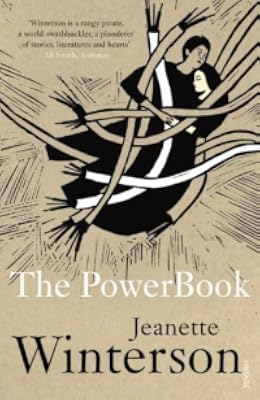
The PowerBook
by Jeanette Winterson
On This Page
Description
Fiction. Literature. LGBTQIA+ (Fiction.) HTML:Winterson enfolds her seventh novel within the world of computers, and transforms the signal development of our time into a wholly human medium. The story is simple: an e-mail writer called Ali will compose anything you like, on order, provided you're prepared to enter the story as yourself and risk leaving it as someone else. You can be the hero of your own life. You can have freedom just for one night. But there is a price, and Ali discovers show more that she, too, will have to pay it.The PowerBook reinvents itself as it travels from London to Paris, Capri, and Cyberspace, using fairy tales, contemporary myths, and popular culture to weave a story of failed but requited love. show less
Tags
Recommendations





Member Recommendations

Member Reviews
The lush sensual prose, and the themes of abandonment, adoption, fluid gender and sexuality, time, transformation and disguise, religious imagery, mythology, dreams, storytelling, and liturgical repetition are the familiar Winterson I love. The cover is sinuously sensual too, with a naked woman lying back, as if in ecstasy, on a carpet of tulips that look like vulvas.
But as a novel, this didn’t work, I didn’t enjoy it, and I’m sad to write those words.
It’s trying to be too many different things: Alix’s story and stories, philosophical essays, short stories based on well-known ones, imagined and reimagined biographies, passages that could be lifted from a tourist guidebook, all wrapped up as something quirky and show more tech-savvy.
Like every novel I’ve read by AS Byatt (see my reviews HERE), the best aspects were brilliant, but there were many frustrations to counter them. One minute I was annoyed, and then I was seduced by prose like this:
“I was the place where you anchored. I was the deep water where you could be weightless. I was the surface where you saw your own reflection. You scooped me up in your hands.”
Image: Woman’s hands scooping water from a lake (Source)
Let’s pretend
“Freedom for a night… the freedom to be someone else.”
This was published - on paper - in 2000, and playfully imagines interactive ways of digital storytelling. The framing story is Alix, an orphan and adoptee, who now lives above a shop in Spitalfields, London, as Winterson did. Winterson’s shop sold… oranges, but they were not the only fruit. Alix’s shop hires out costumes, and she also writes stories for people who want a different form of escape.
“This is a virtual world. This is a world inventing itself. Daily, new landmasses form and then submerge. New continents of thought break off from the mainland… Others are like Atlantis - fabulous, talked about, but never found.”
Tulips to Amsterdam
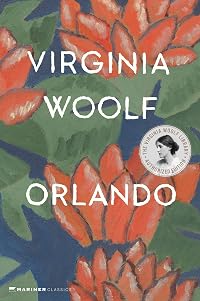
From the start, this feels like a clear homage to Virginia Woolf’s Orlando, which I reviewed HERE. The first significant narrative is especially so: an exotic, erotic, and comic caper in which the narrator smuggles the first tulips to Holland, the bulbs being an integral and intimate part of her disguise. But Woolf did it better.
Image: Pink Tulip, by Georgia O’Keeffe (Source)
“I warned you the story might change under my hands. I forgot that the storyteller changes too.”
Other stories are woven around Lancelot and Guinevere, Emperor Tiberius on Capri, Francesca de Rimini, George Mallory on Everest, Giovani da Castro, and finally, Orlando is named.
“He slipped between the gaps in history, as easily as a coin rolls between the floorboards.”
This section also brought to mind Jeffrey Eugenides’ Middlesex (see my review HERE) and the tulips in Margaret Attwood’s Handmaid’s Tale (see my review HERE).
How does it end?
“I can’t untangle my whole life… I can’t be an exile from my own past… I can’t start again at year zero.”
Winterson often says there are three types of ending: revenge, tragedy and forgiveness. She says it here, and in The Gap of Time (see my review HERE) and Why be Happy? (see my review HERE), and probably elsewhere. But this doesn’t really end. And that felt right.
“I was typing on my laptop, trying to move this story on, trying to avoid endings, trying to collide the real and the imaginary worlds, trying to be sure which is which.”
Image: “Flora”, Rembrandt’s portrait of his wife, Saskia, mentioned in the book because of the broken tulip in her hair and how she’s holding the staff (Source)
Quotes
• “The evening was stretching itself. The day’s muscle had begun to relax.”
• “Strangers often like to hear how writers write their books. It saves the bother of reading them.”
• “There was a woman near me, eating an ice cream with the intensity of a sacrament.”
• “There is no secret about eating [globe] artichoke or what the act resembles. Nothing else gives itself up so satisfyingly towards its centre. Nothing else promises and rewards. The tiny hairs are part of the pleasure.”
• “What a strange world it is where you can have as much sex as you like but love is taboo.”
• “I’m looking for something, it’s true. I’m looking for the meaning inside the data. That’s why I trawl my screen like a beachcomber - looking for you, looking for me, trying to see through the disguise.”
• “I wonder, maybe, if time stacks vertically, and there is no past, present, future, only simultaneous layers of reality.”
• “History is a collection of found objects washed up through time… We cannot rely on the facts. Time, which returns everything, changes everything.”
• “Beyond time, beyond death, love is.” show less
But as a novel, this didn’t work, I didn’t enjoy it, and I’m sad to write those words.
It’s trying to be too many different things: Alix’s story and stories, philosophical essays, short stories based on well-known ones, imagined and reimagined biographies, passages that could be lifted from a tourist guidebook, all wrapped up as something quirky and show more tech-savvy.
Like every novel I’ve read by AS Byatt (see my reviews HERE), the best aspects were brilliant, but there were many frustrations to counter them. One minute I was annoyed, and then I was seduced by prose like this:
“I was the place where you anchored. I was the deep water where you could be weightless. I was the surface where you saw your own reflection. You scooped me up in your hands.”
Image: Woman’s hands scooping water from a lake (Source)
Let’s pretend
“Freedom for a night… the freedom to be someone else.”
This was published - on paper - in 2000, and playfully imagines interactive ways of digital storytelling. The framing story is Alix, an orphan and adoptee, who now lives above a shop in Spitalfields, London, as Winterson did. Winterson’s shop sold… oranges, but they were not the only fruit. Alix’s shop hires out costumes, and she also writes stories for people who want a different form of escape.
“This is a virtual world. This is a world inventing itself. Daily, new landmasses form and then submerge. New continents of thought break off from the mainland… Others are like Atlantis - fabulous, talked about, but never found.”
Tulips to Amsterdam
From the start, this feels like a clear homage to Virginia Woolf’s Orlando, which I reviewed HERE. The first significant narrative is especially so: an exotic, erotic, and comic caper in which the narrator smuggles the first tulips to Holland, the bulbs being an integral and intimate part of her disguise. But Woolf did it better.
Image: Pink Tulip, by Georgia O’Keeffe (Source)
“I warned you the story might change under my hands. I forgot that the storyteller changes too.”
Other stories are woven around Lancelot and Guinevere, Emperor Tiberius on Capri, Francesca de Rimini, George Mallory on Everest, Giovani da Castro, and finally, Orlando is named.
“He slipped between the gaps in history, as easily as a coin rolls between the floorboards.”
This section also brought to mind Jeffrey Eugenides’ Middlesex (see my review HERE) and the tulips in Margaret Attwood’s Handmaid’s Tale (see my review HERE).
How does it end?
“I can’t untangle my whole life… I can’t be an exile from my own past… I can’t start again at year zero.”
Winterson often says there are three types of ending: revenge, tragedy and forgiveness. She says it here, and in The Gap of Time (see my review HERE) and Why be Happy? (see my review HERE), and probably elsewhere. But this doesn’t really end. And that felt right.
“I was typing on my laptop, trying to move this story on, trying to avoid endings, trying to collide the real and the imaginary worlds, trying to be sure which is which.”
Image: “Flora”, Rembrandt’s portrait of his wife, Saskia, mentioned in the book because of the broken tulip in her hair and how she’s holding the staff (Source)
Quotes
• “The evening was stretching itself. The day’s muscle had begun to relax.”
• “Strangers often like to hear how writers write their books. It saves the bother of reading them.”
• “There was a woman near me, eating an ice cream with the intensity of a sacrament.”
• “There is no secret about eating [globe] artichoke or what the act resembles. Nothing else gives itself up so satisfyingly towards its centre. Nothing else promises and rewards. The tiny hairs are part of the pleasure.”
• “What a strange world it is where you can have as much sex as you like but love is taboo.”
• “I’m looking for something, it’s true. I’m looking for the meaning inside the data. That’s why I trawl my screen like a beachcomber - looking for you, looking for me, trying to see through the disguise.”
• “I wonder, maybe, if time stacks vertically, and there is no past, present, future, only simultaneous layers of reality.”
• “History is a collection of found objects washed up through time… We cannot rely on the facts. Time, which returns everything, changes everything.”
• “Beyond time, beyond death, love is.” show less
We are our own oral history. A living memoir of time.
Alix writes stories for other people, interacting with them online to construct the story and write them into it. This is how she makes her living. The book was published in 2000, which is problematic from the technological standpoint (Netscape Navigator rears its wooly, archaic head). At the time, people were batshit crazy over the concept of "online life" and its myriad possibilities. Nowadays, of course, it has become the background (or foreground, for some) of most of our lives. So the urgency, the novelty, that pokes through here and there with regard to the Internet, seems overblown. Thankfully, however, I found it easy enough to ignore (some critics have not).
At its heart, this show more novel is about stories. Of course this attracted me. I found the book on my friend's bookshelf while completing my "depressive-in-residency" program here in the Dirty South (today's my last day). I'd been wanting to read Winterson, and didn't particularly want to start with this book, but I didn't think I could finish Written on the Body (also on her shelf), before I had to leave.
I can't take my body through space and time, but I can send my mind, and use the stories, written and unwritten, to tumble me out in a place not yet existing—my future.
Alix, or Ali, finds herself drawn into one particular story she is writing for a married woman. Woven into this story are many other tiny stories, usually retellings of known myths or legends. Other reviewers have complained about various issues, that there are too many aphoristic bits and pieces of little meaning, or that have been cribbed from elsewhere and/or are trite and overly "romantic." Yeah, well, everything comes from somewhere else and, okay, some of these bits and pieces aren't exactly soaked in insight, but why not just quit your crying and bask in the poetry. For Winterson writes in a poetic way, and I like that. She takes familiar concepts down unfamiliar paths. I think it is a strength of the novel. I also think that for some people who are obsessed with novels and don't read or enjoy poetry much, this is probably a weakness. Fair enough, but let's keep in mind that it's a subjective critique of the book, and try instead to enjoy images like this:
The evening was stretching itself. The day's muscle had begun to relax.
From reading about her other writing, I know that Winterson has her familiar concerns she returns to in her books. These include gender, time, personal history, shifting change, longing. Important things, all of which I am also interested in. So, the book feels like a lot all at once. She has said she tried to do a lot in the book. There is some autobiographical componentry, as well, which I'm not going to talk about here, but that I know of from reading interviews.
The fabric of the book is stretched on love's fragile frame. Some of her aphorisms surrounding love are bleak:
You keep the form and habit of what you have, but gradually you empty it of meaning.
The pain of dying love. One can tell that Winterson knows of what she speaks. And I am really only interested in reading about love if it is from someone who has charted much of the territory herself.
What to say? That the end of love is a haunting. A haunting of dreams. A haunting of silence. Haunted by ghosts it is easy to become a ghost. Life ebbs. The pulse is too faint. Nothing stirs you. Some people approve of this and call it healing. It is not healing. A dead body feels no pain.
In a discussion with her new potential lover, the idea of pain surfaces. Ali wonders if this woman "thinks that pain is the only way I can feel." But it is not stopping her from loving. In her words, "the pain is not feeling, but it has become an instrument of feeling." This idea of pain as an instrument through which to feel intrigues me. It was one of the more compelling concepts to rise up from these pages. How does the pain instrument alter the feelings and what happens if or when the pain fades away. How do the remaining feelings react when the pain leaves, do they alter, do they grow. How sensitive an instrument is it, does it dull the feelings, distort them, enhance them...
Winterson talks a lot in the book about layering. The idea of time and stories stacking up. And maps.
In these wild places I become part of the map, part of the story, adding my version to the versions there. This Talmudic layering of story on story, map on map, multiplies possibilities but also warns me of the weight of accumulation.
So, there is this yearning to experience everything and maybe the way to cheat time is to layer, but then you end up with too much. And then there are other people and their effects on you: "How do you seem to write me to myself? I am a message. You change the meaning. I am a map that you redraw." So then others are redrawing your maps as they are layering and perhaps there is the danger of losing yourself in there, the tension between sharing a life with another and still retaining your own individuality. The sweet-and-sour unrequited taste at solitude's hard candy center.
I like being on my own better than I like anything else, but I can't give up on love. Maybe it's the tension between longing and aloneness that I need. My own funincular railway, holding in balance the two things most likely to destroy me.
She explores the idea of other worlds in parallel with our own. And this can be partly read as the "gee whiz, it's the Internet Age" aspect of the book. I watched a clip where she talks about this. The inventing of oneself online, and the idea that you can be anyone you want with another person because you cannot see them and they can't see you. I wasn't interested in that slant of this concept so much; certainly, anonymity still titillates some, but I think now just as many (or more) of us are looking for authentic online interactions. Wrapped into this concept of other worlds or at least what exists outside our immediate spheres are ideas like this:
All the separations and divisions and blind alleys and impossibilities that seem so central to life are happening at its outer edges.
And the mirror concept: "The world is a mirror of the mind's abundance." The idea that everything in our heads can be found in the world around us, that we don't just need to live in our minds, despite the temptation. Parallel to this is the storytelling Ali orchestrates, where as she writes the story for another, she herself is written into the story. And the stories become mirrors for her life, as her lover's body is a mirror held up to her own.
She returns again later to the time layering...
I wonder, maybe, if time stacks vertically, and there is no past, present, future, only simultaneous layers of reality. We experience our own reality at ground level. At a different level, time would be elsewhere. We would be elsewhere in time.
I am reminded again of some other reviews I read and how surprised I was at how dismissive they were. Then again, this seems like one of those divisive books that people either love or strongly dislike. There is so much here, so many ways to read the text, so much to glean from it. I copied down so much for such a short book.
She talks about "tameness" of love and how the tamer it gets, the farther away it is from real love. "In fierceness, in heat, in longing, in risk, I find something of love's nature." And Ali in reply to her lover: "So when you ask me why I cannot love you more calmly, I answer that to love you calmly is not to love you at all." This reflects her wider view on living life:
I don't want to eke out my life like a resource in short supply. The only selfish life is a timid one. To hold back, to withdraw, to keep the best in reserve, both overvalues the self, and undervalues what the self is.
The other lives, other worlds idea is kind of nebulous to me. Setting aside the "online world" as mentioned earlier, I'm not quite sure what she is getting at, but it makes for some beautiful prose:
This life, the one we know, stands in the sun. It is our daytime and the stars and planets that surround it cannot be seen. The sense of other lives, still our own, its clearer to us in the darkness of night or in our dreams. Sometimes a total eclipse shows us in the day what we cannot usually see for ourselves. As our sun darkens, other brilliances appear. And there is the strange illusion of looking over our shoulder and seeing the sun racing towards us at two thousand miles an hour.
Certainly I understand other lives, still our own, at night in dreams. And how night can make everything feel different, especially late night, how new possibilities open up, our mind yawning to the darkness, sheltered from everyday reality's blinding sun. And how she writes, "These lives of ours that press in on us must be heard." Yes! For while it is so easy to ignore the other worlds, to not stride forward to the outer edges and peer around at what it just outside our narrow view, she is telling us that "what I carry back from those worlds to my world is another chance."
I feel like I am only clawing indistinct marks on the surface of the book. And she gets kind of mired in ambiguity at the end, but then again, what she is meeting head-on is the shape-shifterish nature of everything: love, life, time, gender.
Perhaps this is how it is—life flowing smoothly over memory and history, the past returning or not, depending on the tide. History is a collection of found objects washed up through time. Goods, ideas, personalities, surface toward us, then sink away. Some we hook out, others we ignore, as the pattern changes, so does the meaning. We cannot rely on the facts. Time, which returns everything, changes everything.
And even what strands I pull from this text are representative of my own concerns, merely what I as one single reader choose to "hook out," they are familiar and new lines to write into my own story.
I dipped my hands in the water. Liquid time.
And I thought, 'Go home and write the story again. Keep writing it because one day she will read it.'
You can change the story. You are the story. show less
Alix writes stories for other people, interacting with them online to construct the story and write them into it. This is how she makes her living. The book was published in 2000, which is problematic from the technological standpoint (Netscape Navigator rears its wooly, archaic head). At the time, people were batshit crazy over the concept of "online life" and its myriad possibilities. Nowadays, of course, it has become the background (or foreground, for some) of most of our lives. So the urgency, the novelty, that pokes through here and there with regard to the Internet, seems overblown. Thankfully, however, I found it easy enough to ignore (some critics have not).
At its heart, this show more novel is about stories. Of course this attracted me. I found the book on my friend's bookshelf while completing my "depressive-in-residency" program here in the Dirty South (today's my last day). I'd been wanting to read Winterson, and didn't particularly want to start with this book, but I didn't think I could finish Written on the Body (also on her shelf), before I had to leave.
I can't take my body through space and time, but I can send my mind, and use the stories, written and unwritten, to tumble me out in a place not yet existing—my future.
Alix, or Ali, finds herself drawn into one particular story she is writing for a married woman. Woven into this story are many other tiny stories, usually retellings of known myths or legends. Other reviewers have complained about various issues, that there are too many aphoristic bits and pieces of little meaning, or that have been cribbed from elsewhere and/or are trite and overly "romantic." Yeah, well, everything comes from somewhere else and, okay, some of these bits and pieces aren't exactly soaked in insight, but why not just quit your crying and bask in the poetry. For Winterson writes in a poetic way, and I like that. She takes familiar concepts down unfamiliar paths. I think it is a strength of the novel. I also think that for some people who are obsessed with novels and don't read or enjoy poetry much, this is probably a weakness. Fair enough, but let's keep in mind that it's a subjective critique of the book, and try instead to enjoy images like this:
The evening was stretching itself. The day's muscle had begun to relax.
From reading about her other writing, I know that Winterson has her familiar concerns she returns to in her books. These include gender, time, personal history, shifting change, longing. Important things, all of which I am also interested in. So, the book feels like a lot all at once. She has said she tried to do a lot in the book. There is some autobiographical componentry, as well, which I'm not going to talk about here, but that I know of from reading interviews.
The fabric of the book is stretched on love's fragile frame. Some of her aphorisms surrounding love are bleak:
You keep the form and habit of what you have, but gradually you empty it of meaning.
The pain of dying love. One can tell that Winterson knows of what she speaks. And I am really only interested in reading about love if it is from someone who has charted much of the territory herself.
What to say? That the end of love is a haunting. A haunting of dreams. A haunting of silence. Haunted by ghosts it is easy to become a ghost. Life ebbs. The pulse is too faint. Nothing stirs you. Some people approve of this and call it healing. It is not healing. A dead body feels no pain.
In a discussion with her new potential lover, the idea of pain surfaces. Ali wonders if this woman "thinks that pain is the only way I can feel." But it is not stopping her from loving. In her words, "the pain is not feeling, but it has become an instrument of feeling." This idea of pain as an instrument through which to feel intrigues me. It was one of the more compelling concepts to rise up from these pages. How does the pain instrument alter the feelings and what happens if or when the pain fades away. How do the remaining feelings react when the pain leaves, do they alter, do they grow. How sensitive an instrument is it, does it dull the feelings, distort them, enhance them...
Winterson talks a lot in the book about layering. The idea of time and stories stacking up. And maps.
In these wild places I become part of the map, part of the story, adding my version to the versions there. This Talmudic layering of story on story, map on map, multiplies possibilities but also warns me of the weight of accumulation.
So, there is this yearning to experience everything and maybe the way to cheat time is to layer, but then you end up with too much. And then there are other people and their effects on you: "How do you seem to write me to myself? I am a message. You change the meaning. I am a map that you redraw." So then others are redrawing your maps as they are layering and perhaps there is the danger of losing yourself in there, the tension between sharing a life with another and still retaining your own individuality. The sweet-and-sour unrequited taste at solitude's hard candy center.
I like being on my own better than I like anything else, but I can't give up on love. Maybe it's the tension between longing and aloneness that I need. My own funincular railway, holding in balance the two things most likely to destroy me.
She explores the idea of other worlds in parallel with our own. And this can be partly read as the "gee whiz, it's the Internet Age" aspect of the book. I watched a clip where she talks about this. The inventing of oneself online, and the idea that you can be anyone you want with another person because you cannot see them and they can't see you. I wasn't interested in that slant of this concept so much; certainly, anonymity still titillates some, but I think now just as many (or more) of us are looking for authentic online interactions. Wrapped into this concept of other worlds or at least what exists outside our immediate spheres are ideas like this:
All the separations and divisions and blind alleys and impossibilities that seem so central to life are happening at its outer edges.
And the mirror concept: "The world is a mirror of the mind's abundance." The idea that everything in our heads can be found in the world around us, that we don't just need to live in our minds, despite the temptation. Parallel to this is the storytelling Ali orchestrates, where as she writes the story for another, she herself is written into the story. And the stories become mirrors for her life, as her lover's body is a mirror held up to her own.
She returns again later to the time layering...
I wonder, maybe, if time stacks vertically, and there is no past, present, future, only simultaneous layers of reality. We experience our own reality at ground level. At a different level, time would be elsewhere. We would be elsewhere in time.
I am reminded again of some other reviews I read and how surprised I was at how dismissive they were. Then again, this seems like one of those divisive books that people either love or strongly dislike. There is so much here, so many ways to read the text, so much to glean from it. I copied down so much for such a short book.
She talks about "tameness" of love and how the tamer it gets, the farther away it is from real love. "In fierceness, in heat, in longing, in risk, I find something of love's nature." And Ali in reply to her lover: "So when you ask me why I cannot love you more calmly, I answer that to love you calmly is not to love you at all." This reflects her wider view on living life:
I don't want to eke out my life like a resource in short supply. The only selfish life is a timid one. To hold back, to withdraw, to keep the best in reserve, both overvalues the self, and undervalues what the self is.
The other lives, other worlds idea is kind of nebulous to me. Setting aside the "online world" as mentioned earlier, I'm not quite sure what she is getting at, but it makes for some beautiful prose:
This life, the one we know, stands in the sun. It is our daytime and the stars and planets that surround it cannot be seen. The sense of other lives, still our own, its clearer to us in the darkness of night or in our dreams. Sometimes a total eclipse shows us in the day what we cannot usually see for ourselves. As our sun darkens, other brilliances appear. And there is the strange illusion of looking over our shoulder and seeing the sun racing towards us at two thousand miles an hour.
Certainly I understand other lives, still our own, at night in dreams. And how night can make everything feel different, especially late night, how new possibilities open up, our mind yawning to the darkness, sheltered from everyday reality's blinding sun. And how she writes, "These lives of ours that press in on us must be heard." Yes! For while it is so easy to ignore the other worlds, to not stride forward to the outer edges and peer around at what it just outside our narrow view, she is telling us that "what I carry back from those worlds to my world is another chance."
I feel like I am only clawing indistinct marks on the surface of the book. And she gets kind of mired in ambiguity at the end, but then again, what she is meeting head-on is the shape-shifterish nature of everything: love, life, time, gender.
Perhaps this is how it is—life flowing smoothly over memory and history, the past returning or not, depending on the tide. History is a collection of found objects washed up through time. Goods, ideas, personalities, surface toward us, then sink away. Some we hook out, others we ignore, as the pattern changes, so does the meaning. We cannot rely on the facts. Time, which returns everything, changes everything.
And even what strands I pull from this text are representative of my own concerns, merely what I as one single reader choose to "hook out," they are familiar and new lines to write into my own story.
I dipped my hands in the water. Liquid time.
And I thought, 'Go home and write the story again. Keep writing it because one day she will read it.'
You can change the story. You are the story. show less
A novel written in short stories, a collection of short stories that make up a novel... it's Jeanette Winterson, so who can even tell for sure. This is a meditation on love, a relationship in metaphor, an exploration of sexuality and sensuality. Maybe not her best book, though I suspect I'd have gotten more out of it were I better versed in Virgina Woolf (particularly Orlando).
A clever conceit in its time that has aged poorly, our hero exists in a world of their own making telling stories by email to strangers. Thankfully the stories come from Winterson, so they sparkle with surprising turns. Magical realism for the digital age.
I'm at a bit of a loss at how to describe this book. It's most definitely not conventional. It's confusing but at the same time, strangely clear. It's without a doubt one of the most beautifully written books I've ever read. It's a love story that ends in both a heartbreaking and yet a hopeful manner. It shows the power of stories. It evokes so many different emotions. It's about ambiguous identity and erasing the binary opposition between males and females.
Honestly, the first scene is very...strange. But I hope is doesn't deter anyone from reading this book. I really enjoyed this book and it's going on to my list of memorable reads. It's one of those books that just begs to be reread over and over. I wish I could write a better review show more for this book but I'm tired so this will have to do for now. I hope I've encouraged someone to try this book out though :) show less
Honestly, the first scene is very...strange. But I hope is doesn't deter anyone from reading this book. I really enjoyed this book and it's going on to my list of memorable reads. It's one of those books that just begs to be reread over and over. I wish I could write a better review show more for this book but I'm tired so this will have to do for now. I hope I've encouraged someone to try this book out though :) show less
There were many aspects of this book that I found intriguing and engaging. Perhaps one that is worth mentioning is how the story keeps shifting. First we read about the storyteller, then we see it as the character of a story being written, then as the person whom the story is directed to. Again and again we are given different perspectives to ponder, different characters to emphatize with, different roles to play. We are constantly transported to different worlds and realms, moving back and forth between reality and virtuality.
The beauty of it all is that none of this leaves us readers out in the dark. We know what they know. We feel what they feel. We are, in a sense, the characters in the book, and the characters within the stories in show more the book. We are one with them, and yet, we transform and merge into other characters with such ease, it is quite quite exhilarating.
This book was beautifully written. show less
The beauty of it all is that none of this leaves us readers out in the dark. We know what they know. We feel what they feel. We are, in a sense, the characters in the book, and the characters within the stories in show more the book. We are one with them, and yet, we transform and merge into other characters with such ease, it is quite quite exhilarating.
This book was beautifully written. show less
Classic Winterson. Twenty years ago, I would have given it a couple more stars, I suspect. As the narrator divulges near the beginning, it's always about boundaries and desire. Best are the petite tales within the Tale.
Members
- Recently Added By
Lists

Female Protagonist
1,056 works; 57 members

Best Lesbian Fiction (And Narrative Non-Fiction)
155 works; 36 members

Books Read in 2003
261 works; 7 members

Epistolary Books
105 works; 25 members

Biggest Disappointments
606 works; 168 members

Queer Fiction (Owned TBR)
142 works; 1 member
Author Information

55+ Works 37,161 Members
Jeanette Winterson was born in Manchester, England in 1959 and graduated from St. Catherine's College, Oxford. Her book, Oranges Are Not the Only Fruit, is a semi-autobiographical account of her life as a child preacher (she wrote and gave sermons by the time she was eight years old). The book was the winner of the Whitbread Prize for best first show more fiction and was made into an award-winning TV movie. The Passion won the John Llewelyn Rhys Memorial Prize for best writer under thirty-five, and Sexing the Cherry won the American Academy of Arts and Letters' E. M. Forster Award. (Bowker Author Biography) Jeanette Winterson lives in London & the Cotswolds. (Publisher Provided) show less
Some Editions
Awards and Honors
Awards
Series
Belongs to Publisher Series
Work Relationships
Inspired
Common Knowledge
- Canonical title*
- Powerbook
- Original title
- Powerbook
- Original publication date
- 2000
- People/Characters
- Ali/x; George Mallory
- Important places
- Paris, France; London, England, UK; Capri, Campania, Italy
- Dedication
- To Peggy Reynolds with love
- First words
- To avoid discovery I stay on the run.
- Quotations
- Well, where would you store a priceless pair of bulbs?
That gave me the idea.
In the same place as a priceless pair of balls.
There is no greater grief than to find no happiness but happiness in what is past.
Perhaps this is how it is - life flowing smoothly over memory and history, the past returning or not, depending on the tide. History is a collection of found objects washed up through time. Goods, ideas, personalities sur... (show all)face towards us, then sink away. Some we hook out, others we ignore, and as the pattern changes, so does the meaning. We cannot rely on the facts. Time, which returns everything, changes everything. - Last words
- (Click to show. Warning: May contain spoilers.)Your body is my Book of Hours.
Open it. read it.
This is the true history of the world. - Original language
- English
- Canonical DDC/MDS
- 813
- Canonical LCC
- PR6073.I558
*Some information comes from Common Knowledge in other languages. Click "Edit" for more information.
Classifications
Statistics
- Members
- 1,349
- Popularity
- 17,782
- Reviews
- 18
- Rating
- (3.54)
- Languages
- 8 — Danish, Dutch, English, French, German, Italian, Spanish, Swedish
- Media
- Paper, Ebook
- ISBNs
- 22
- ASINs
- 6