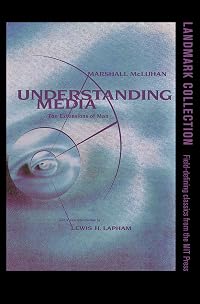
Understanding Media: The Extensions of Man
by Marshall McLuhan
On This Page
Description
When first published, Marshall McLuhan's Understanding Media made history with its radical view of the effects of electronic communications upon man and life in the twentieth century. This edition of McLuhan's best-known book both enhances its accessibility to a general audience and provides the full critical apparatus necessary for scholars. In Terrence Gordon's own words, "McLuhan is in full flight already in the introduction, challenging us to plunge with him into what he calls 'the show more creative process of knowing. '" Much to the chagrin of his contemporary critics McLuhan's preference was for a prose style that explored rather than explained. Probes, or aphorisms, were an indispensable tool with which he sought to prompt and prod the reader into an "understanding of how media operate" and to provoke reflection. In the 1960s McLuhan's theories aroused both wrath and admiration. It is intriguing to speculate what he might have to say 40 years later on subjects to which he devoted whole chapters such as Television, The Telephone, Weapons, Housing and Money. Today few would dispute that mass media have indeed decentralized modern living and turned the world into a global village. This critical edition features an appendix that makes available for the first time the core of the research project that spawned the book and individual chapter notes are supported by a glossary of terms, indices of subjects, names, and works cited. There is also a complete bibliography of McLuhan's published works. W. Terrence Gordon is Associate General Editor of the Gingko Press McLuhan publishing program, author of the biography Marshall McLuhan: Escape into Understanding and McLuhan for Beginners. show lessTags
Recommendations














Member Reviews
This was a frustrating read. Lots of intriguing ideas, but presented with vague language and very little supporting evidence. Sometimes while reading it I was unsure if I was reading the profound thoughts of a genius that was above my comprehension, the ramblings of a mad man, or just the drivel of a hack who thought he was a lot more clever than he actually was.
The scholarship in this book is embarrassingly sloppy. At times he makes big claims with absolutely no evidence to support them. When he does offer evidence it is often anecdotal, with no reference to anything concrete. He'll write something like "a study was conducted in Canada a few years back in which X happened," and then use that as solid proof that X is universal. Come one show more man! Where's the citation? You expect me to believe the outrageous claims you're making with no proof? I felt like I was reading cult literature at times. What's more, some of his claims, without a good understanding of the context, can be taken as quite racist.
I read one defense of his lack of evidence which argued that he came from the humanist tradition (he was an English professor) which does not rely on the scientific methods of hypothesis and experimentation, etc. That's a terrible excuse. If you're going to start spouting off about cognitive science and social psychology you better bring some hard evidence to support your claims or no one will take you seriously.
I really want to give this book a higher rating, because some of his ideas are very interesting and sound plausible and I do think I have learned to look at media and world history in a new way. But I could not in good faith recommend this book to a friend unless they were hardcore about media studies. I could possibly forgive the lack of evidence and recommend it to someone with a caveat regarding such, but his terrible prose is perhaps an even bigger hurdle to get over than his credibility. He presents his ideas in metaphors, but, because of the nature of his topics, sometimes it's difficult to be sure if he is being literal or metaphorical. This may be cute to some, but it is embarrassingly bad for a scientific text. Furthermore, many of his theories are contradictory, which makes it even more difficult to understand or take seriously.
I wish someone would go through this book, pluck the interesting and plausible ideas from it and present them in a clear way that exposes the contradictions and areas that require more research for support, because there is a lot of good food for thought in the pages of this book. Unfortunately, I don't think those morsels are worth the effort of reading this book. show less
The scholarship in this book is embarrassingly sloppy. At times he makes big claims with absolutely no evidence to support them. When he does offer evidence it is often anecdotal, with no reference to anything concrete. He'll write something like "a study was conducted in Canada a few years back in which X happened," and then use that as solid proof that X is universal. Come one show more man! Where's the citation? You expect me to believe the outrageous claims you're making with no proof? I felt like I was reading cult literature at times. What's more, some of his claims, without a good understanding of the context, can be taken as quite racist.
I read one defense of his lack of evidence which argued that he came from the humanist tradition (he was an English professor) which does not rely on the scientific methods of hypothesis and experimentation, etc. That's a terrible excuse. If you're going to start spouting off about cognitive science and social psychology you better bring some hard evidence to support your claims or no one will take you seriously.
I really want to give this book a higher rating, because some of his ideas are very interesting and sound plausible and I do think I have learned to look at media and world history in a new way. But I could not in good faith recommend this book to a friend unless they were hardcore about media studies. I could possibly forgive the lack of evidence and recommend it to someone with a caveat regarding such, but his terrible prose is perhaps an even bigger hurdle to get over than his credibility. He presents his ideas in metaphors, but, because of the nature of his topics, sometimes it's difficult to be sure if he is being literal or metaphorical. This may be cute to some, but it is embarrassingly bad for a scientific text. Furthermore, many of his theories are contradictory, which makes it even more difficult to understand or take seriously.
I wish someone would go through this book, pluck the interesting and plausible ideas from it and present them in a clear way that exposes the contradictions and areas that require more research for support, because there is a lot of good food for thought in the pages of this book. Unfortunately, I don't think those morsels are worth the effort of reading this book. show less
Hard to read, yet visionary and enlightening.
Gosh, how do I even begin talking about this one. It took me almost 4 years to finish it; I had to take breaks from our from time to time. It's one of those books that seem to be written for a different kind of focus, and so densely packed with information and connections that you start feeling overwhelmed in no time.
He has a way to just dump information. In the same sentence he links Einstein's Theory of Relativity to MAD Magazine ("relative" understanding opened the door to cartoons and MAD's cynicism); in another wheels and Krazy Kat (wheels extend men's reach; bricks extend Krazy Kat's).
Still, he has a way to see and explain patterns others have ignored; it's no surprise many of the show more lessons from this book are still repeated to this day, and many future predictions turned out to be accurate (if painfully described).
Reads like the extensive ramblings of a madman that was correct more often than not. show less
Gosh, how do I even begin talking about this one. It took me almost 4 years to finish it; I had to take breaks from our from time to time. It's one of those books that seem to be written for a different kind of focus, and so densely packed with information and connections that you start feeling overwhelmed in no time.
He has a way to just dump information. In the same sentence he links Einstein's Theory of Relativity to MAD Magazine ("relative" understanding opened the door to cartoons and MAD's cynicism); in another wheels and Krazy Kat (wheels extend men's reach; bricks extend Krazy Kat's).
Still, he has a way to see and explain patterns others have ignored; it's no surprise many of the show more lessons from this book are still repeated to this day, and many future predictions turned out to be accurate (if painfully described).
Reads like the extensive ramblings of a madman that was correct more often than not. show less
This was partially a frustrating read. Lots of ideas, but vague language and little supporting evidence. The scholarship is sloppy. This is a good, not great summary of analytical claims by the media-studies pioneer. Not hard to read, but not so much visionary or enlightening. He has a way to just dump information. In the same sentence he links Einstein's Theory of Relativity to MAD Magazine ; in another sentence wheels and Krazy Kat (wheels extend men's reach; bricks extend Krazy Kat's). Reads like the extensive ramblings of a madman that was correct more often than not.
Dr. McLuhan gave us a group of insights into the transition from getting our information primarily from the print mediums to the screen exposed information bath of today. The epigrams are on the money, and so is the overall message. How we get our information has a serious effect on the way our brains process and retain the information. Into the bargain the medium necessarily transforms the information it tries to transmit. This book is still worth reading, and paying attention to the point of view, as well as the portrait of the pre-internet age , will be helpful for the ages to come.
Yes Marshall, we are entering a new tribalism, of course we are, where "hot" media that allow of less participation because they make more of the connections for you are being supplanted by "cool" media that allow of more engagement/immersion. Are these the most useful possible terms? Especially when you find that print is "hot" and TV is "cool", but movies are "hot", along with radio and photographs, and in contrast to cool comics. The internet? Unanticipated. And what does it mean that the less engaging media are the ones that, we are to understand, allow for more interpretative space? How is that hot?
There is scads to discuss here but half of it is just disagreeing with his terminology and the other half is trying to bend it till it show more works. But that doesn't matter, because in the future we'll all have personal robots beaming up cool images that will obviate the individual mind in some unspecified way, and we'll all work together and be like the "savages" again. Or at least, we'll all have tenure.
I feel like this review had potential, much like McLuhan's book, but started too illconceived and got too tangled to be worth sorting out--also, all too often, much like McLuhan's book. show less
There is scads to discuss here but half of it is just disagreeing with his terminology and the other half is trying to bend it till it show more works. But that doesn't matter, because in the future we'll all have personal robots beaming up cool images that will obviate the individual mind in some unspecified way, and we'll all work together and be like the "savages" again. Or at least, we'll all have tenure.
I feel like this review had potential, much like McLuhan's book, but started too illconceived and got too tangled to be worth sorting out--also, all too often, much like McLuhan's book. show less
McLuhan raises a lot of interesting ideas about the relationship of media to culture, but is frustratingly haphazard about following through on any of them. I can deal with him making oracular pronouncements with zero evidence to back them up, but it would be nice if he at least carried his ideas a little further, examined culture a little more closely... But I don't know, maybe it's not fair to blame a man for not being Foucault.
(Sep 2006) I was led to look up McLuhan through a number of online sources and reading Neil Postman's Amusing Ourselves to Death, in which he credits McLuhan as a major influence.
Reading Understanding Media is drinking from the firehose. McLuhan bursts with ideas, essentially reinterpreting human history through the lens of communication technology and its broader influence on culture. He famously says, "The medium is the message," i.e. content has less impact than form.
I would very much like to find more recent research that takes up McLuhan's program and attempts to sort the wheat from the chaff. McLuhan's extraordinary claims require extraordinary evidence, of which there is little in this volume. The modern field of media studies show more seems to have veered in a different direction... but perhaps I haven't found the right books yet. show less
Reading Understanding Media is drinking from the firehose. McLuhan bursts with ideas, essentially reinterpreting human history through the lens of communication technology and its broader influence on culture. He famously says, "The medium is the message," i.e. content has less impact than form.
I would very much like to find more recent research that takes up McLuhan's program and attempts to sort the wheat from the chaff. McLuhan's extraordinary claims require extraordinary evidence, of which there is little in this volume. The modern field of media studies show more seems to have veered in a different direction... but perhaps I haven't found the right books yet. show less
Members
- Recently Added By
Lists

Alan Kay's Reading List
103 works; 3 members

culture
320 works; 1 member

One Book, Many Authors
441 works; 40 members

Books That Changed Our Perspective
423 works; 168 members

Books in the Bibliography of The Alchemy of Us by Ainissa Ramirez
181 works; 1 member
Author Information

59+ Works 8,747 Members
A poetry professor turned media theorist---or media guru, as some in the press called him at the time---Marshall McLuhan startled television watchers during the 1960's with the notion that the medium they were enthralled by was doing more than transmitting messages---it was the message: Its rapid-fire format, mixing programs and advertisements, show more conveyed as much as---or more than---any single broadcast element. McLuhan grew up in the prairie country of the Canadian West and studied English at the University of Manitoba and Cambridge University. As television entered a period of huge growth during the 1950's, McLuhan, then a college professor, became interested in advertising. He thought of it as something to be taken seriously as a new culture form, beyond its obvious capability of selling products. That interest led to his increasing speculation about what media did to audiences. In his unpredictable modern poetry classes at the University of Toronto, he spoke more and more of media. The students he taught were the television generation, the first to grow up with the medium. Many were fascinated by McLuhan's provocative observations that a medium of communication radically alters the experience being communicated. A society, he said, is shaped more by the style than by the content of its media. Thus, the linear, sequential style of printing established a linear, sequential style of thinking, in which one thing is considered after another in orderly fashion: it shaped a culture in which (objective) reason predominated and experience was isolated, compartmentalized, and repeatable. In contrast, the low-density images of television, composed of a mosaic of light and dark dots, established a style of response in which it is necessary to unconsciously reconfigure the dots immediately in order to derive meaning from them. It has shaped a culture in which (subjective) emotion predominates and experience is holistic and unrepeatable. Since television (and the other electronic media) transcends space and time, the world is becoming a global village---a community in which distance and isolation are overcome. McLuhan was crisp and assured in his pronouncements and impatient with those who failed to grasp their import. McLuhan's most famous saying, "the medium is the message," was explicated in the first chapter of his most successful book, "Understanding Media," published in 1966 and still in print. It sold very well for a rather abstruse book and brought McLuhan widespread attention in intellectual circles. The media industry responded by seeking his advice and enthusiastically disseminating his ideas in magazines and on television. These ideas caused people to perceive their environment, particularly their media environment, in radically new ways. It was an unsettling experience for some, liberating for others. Though McLuhan produced some useful insights, he was given to wild generalizations and flagrant exaggerations. Some thought him a charlatan, and he always felt himself an outcast at the university, at least partly because of his disdain for print culture and opposition to academic conventions. He never seemed quite as energetic after an operation in 1967 to remove a huge brain tumor, but he continued to work and teach until he suffered a stroke in 1979. He died a year later. Though today his writings are not discussed as much by the general public, his thesis is still considered valid and his ideas have become widely accepted. (Bowker Author Biography) show less
Some Editions
Awards and Honors
Series
Belongs to Publisher Series
Work Relationships
Contains
Common Knowledge
- Canonical title
- Understanding Media: The Extensions of Man
- Original title
- Understanding Media
- Alternate titles
- Understanding Media: The Extensions of Man
- Original publication date
- 1964
- First words
- In a culture like ours, long accustomed to splitting and dividing all things as a means of control, it is sometimes a bit of a shock to be reminded that, in operational and practical fact, the medium is the message.
- Last words
- (Click to show. Warning: May contain spoilers.)Panic about automation as a threat of uniformity on a world scale is the projection into the future of mechanical standardization and specialism, which are now past.
Classifications
- Genres
- Sociology, Nonfiction, General Nonfiction, Technology, Philosophy
- DDC/MDS
- 302.23 — Society, government, & culture Social sciences, sociology & anthropology Mass Communication & Media Communication Media (Means of communication)
- LCC
- P90 .M26 — Language and Literature Philology. Linguistics Communication. Mass media
- BISAC
Statistics
- Members
- 3,198
- Popularity
- 5,413
- Reviews
- 26
- Rating
- (3.86)
- Languages
- 16 — Chinese, Czech, Dutch, English, Finnish, French, German, Italian, Lithuanian, Norwegian (Bokmål), Polish, Portuguese, Russian, Spanish, Swedish, Turkish
- Media
- Paper, Ebook
- ISBNs
- 68
- UPCs
- 2
- ASINs
- 44