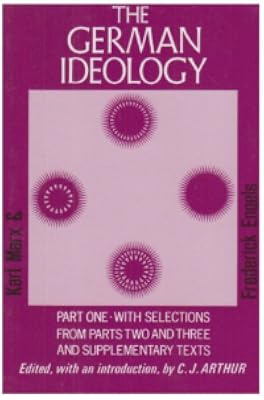
The German Ideology: Part One
by Karl Marx
On This Page
Description
A critical analysis of German philosophical idealism and a one of the earliest accounts of materialism, revolution, and communism.Tags
Recommendations













Member Reviews
Whilst allegedly being accessible, for the common farty 18th century philosophy is very tricky. I think one the key issues with Marx is that the general meaning of words has changed a bit since his time, and thus it can make it hard to understand. So this was hard work because its unannotated and so I had to keep stopping and working out what he meant! In the end there wasn't a lot in here that I didn't already know or understand, so reading it wasn't a journey to enlightenment. But it helped me understand both Marxism and Hegelism better, and I enjoyed Marx's mockery of Stirner throughout. It is a useful reminder that in the days before memes and tweets commentators were being rude to each other. Saint Sancho indeed!
Worth reading for those with an interest in the history of philosophy (particularly German idealism and communism), and also to gain some context on some oft-quoted philosophical aphorisms, most notably the last thesis of the "theses on Feuerbach": "Philosophers have hitherto only interpreted the world in various ways; the point is to change it."
Beyond that, Part 1 is interesting though generally lacking in argumentative rigour, and I found the selections from parts 2 and 3 to be too disjointed to be worth reading in their entirety.
Beyond that, Part 1 is interesting though generally lacking in argumentative rigour, and I found the selections from parts 2 and 3 to be too disjointed to be worth reading in their entirety.
Extremely interesting book. It contains the most basic and essential parts of Marx and Engels thoughts. Reading through this has allowed me to better understand communism and especially that of which Marx had dreamed of, not the perversion that spawned from Lenin and Stalin.
A critical analysis of German philosophical idealism and a one of the earliest accounts of materialism, revolution, and communism.
Ratings
Members
- Recently Added By
Author Information

1,864+ Works 54,892 Members
Karl Heinrich Marx, one of the fathers of communism, was born on May 5, 1818 in Trier, Germany. He was educated at a variety of German colleges, including the University of Jena. He was an editor of socialist periodicals and a key figure in the Working Man's Association. Marx co-wrote his best-known work, "The Communist Manifesto" (1848), with his show more friend, Friedrich Engels. Marx's most important work, however, may be "Das Kapital" (1867), an analysis of the economics of capitalism. He died on March 14, 1883 in London, England. (Bowker Author Biography) show less
Common Knowledge
- Canonical title
- The German Ideology: Part One
- Alternate titles
- The German Ideology: Part One with selections from Parts Two and Three, together with Marx's "Introduction to a Critique of Political Economy"
- Disambiguation notice
- This edition contains only Part One of The German Ideology in whole, plus selections from Parts Two and Three. It also contains These on Feuerbach and Introduction to a Critique of Political Economy. Please help by combinin... (show all)g or seperating texts as appropriate!
Classifications
- Genres
- Philosophy, Nonfiction, Economics, General Nonfiction, Politics and Government
- DDC/MDS
- 335.411 — Society, government, & culture Economics Socialism and related systems Marxian systems Philosophic foundations, economic concepts, aims Philosophic foundations
- LCC
- HX276 .M2782 — Social sciences Socialism. Communism. Anarchism Socialism. Communism. Anarchism
Statistics
- Members
- 495
- Popularity
- 61,132
- Reviews
- 4
- Rating
- (4.09)
- Languages
- English, French, Portuguese, Spanish
- Media
- Paper, Ebook
- ISBNs
- 8
- ASINs
- 7