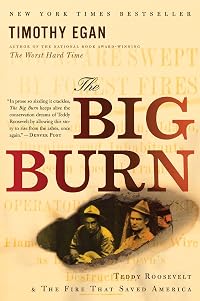
The Big Burn: Teddy Roosevelt and the Fire that Saved America
by Timothy Egan
On This Page
Description
Narrates the struggles of the overmatched rangers against the implacable fire of August, 1910, and Teddy Roosevelt's pioneering conservation efforts that helped turn public opinion permanently in favor of the forests, though it changed the mission of the forest service with consequences felt in the fires of today.Tags
Recommendations
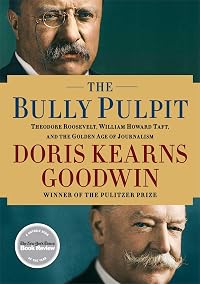
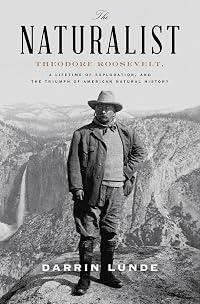
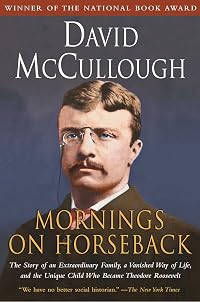
Member Recommendations
Member Reviews
Timothy Egan writes short books of history that we never learned in school. His "The Worst Hard Time", about the tragic collision of the Dustbowl and the Great Depression, was a fine read, and "The Big Burn" comes close to matching it. The beginnings of the National Forest Service and its mentors, Teddy Roosevelt, John Muir, and especially Gifford Pinchot, a true woodsman and also eventually governor of PA, is told with great political insight. Egan's strength is in the personal stories. Teddy and Gifford were "bros" of the time, boxing, wrestling, mountain climbing, and setting policy to keep unspoiled land safe from the mining, railroad, and logging interests. Unfortunately, as the Koch brothers and Repugs of today, there was plenty show more of congressional opposition and support for oligarchs. The Big Burn in Montana and Washington State was the largest forest fire of its time, killing 125, including young, inexperienced firefighters, and town drunks who chose to keep the saloons roaring. There are photographs and personal stories that make this a fast retelling of a forgotten time in isolated places. show less
The kind of history you can't believe could be forgotten -- but it routinely is. Timothy Egan's journalistic researching serves him in good stead here, allowing him to paint a detailed picture of the fire and the individuals' stories. The structure, starting at the fire then jumping back to give lots of background, is somewhat teasing, but the background does eventually pay off as the events and their political aftermath unfold.
I got quite attached to the dedicated foresters and plucky citizens of the tale, and even found myself engaged by the portraits of Teddy Roosevelt and Gifford Pinchot, which I did not expect. Come for the amazing stories of survival and inferno, stay for the perspective on the history of the American West, the show more Forest Service and conservationism! show less
I got quite attached to the dedicated foresters and plucky citizens of the tale, and even found myself engaged by the portraits of Teddy Roosevelt and Gifford Pinchot, which I did not expect. Come for the amazing stories of survival and inferno, stay for the perspective on the history of the American West, the show more Forest Service and conservationism! show less
The Big Burn about the Great Fire of 1910 should have new relevance today with the plethora of wildfires in the American West.
On August 20, 1910, in the middle of a drought, electrical storms, and high winds, fire spread throughout the forests of Washington, Idaho, and Montana. Some ten thousand volunteers were assembled to help fight the fire but they were overmatched against the fire. Ultimately 85 people died, a number much smaller than it should have been, and which was actually a tribute to the perseverance and bravery of those who battled the flames.
Egan interweaves the story of the fire with background about Teddy Roosevelt and his chief forester, Gifford Pinchot. He also educates readers about the influence on forests and fire show more management by big monied interests in the country. A prime example was William Clark, a Montana Senator called the “Copper King” who was worth at least $200 million, an astounding amount at the time. He had no patience for the “moralists” of the Roosevelt administration. As Egan writes, to Clark, the West served no greater purpose than in helping him become the world’s richest man. His attitude was shared by the Harrimans, Morgans, Guggenheims, Weyerhaeusers, etc. who were opposed to forest conservation; they saw it as an obstacle to big-business control of the land. All contributed to the effort by Congress to starve the Forest Service of money, and when the Great Fire came, the country was ill-equipped to fight it.
Egan’s well-researched history, at times reading like a disaster/thriller, is a story of greed versus nature. Unfortunately, greed was only vanquished temporarily. show less
On August 20, 1910, in the middle of a drought, electrical storms, and high winds, fire spread throughout the forests of Washington, Idaho, and Montana. Some ten thousand volunteers were assembled to help fight the fire but they were overmatched against the fire. Ultimately 85 people died, a number much smaller than it should have been, and which was actually a tribute to the perseverance and bravery of those who battled the flames.
Egan interweaves the story of the fire with background about Teddy Roosevelt and his chief forester, Gifford Pinchot. He also educates readers about the influence on forests and fire show more management by big monied interests in the country. A prime example was William Clark, a Montana Senator called the “Copper King” who was worth at least $200 million, an astounding amount at the time. He had no patience for the “moralists” of the Roosevelt administration. As Egan writes, to Clark, the West served no greater purpose than in helping him become the world’s richest man. His attitude was shared by the Harrimans, Morgans, Guggenheims, Weyerhaeusers, etc. who were opposed to forest conservation; they saw it as an obstacle to big-business control of the land. All contributed to the effort by Congress to starve the Forest Service of money, and when the Great Fire came, the country was ill-equipped to fight it.
Egan’s well-researched history, at times reading like a disaster/thriller, is a story of greed versus nature. Unfortunately, greed was only vanquished temporarily. show less
The Big Burn by Timothy Egan focuses on the summer of 1910 when the largest wildfires ever known swept through the West taking forests and towns and animals and people with them. The fledgling Forest Service tried to battle the blazes but ultimately failed with people escaping via train or riding out the fires in tunnels and mines.
Egan tells the story of the fires in the larges context of the time, beginning with the close relationship of a young Teddy Roosevelt and Gifford Pinchot. These two, along with early conservationists like John Muir, led the fight to create wilderness spaces that would be untouched by man. It was a radical idea that flew in the face of rampant capitalism and development and would not really be implemented until show more the economics of logging the deep wilderness led to its end.
Egan is a natural storyteller who uses real people and events to tell his story. We follow them through the disaster, living with them as they make crucial decisions. We get glimpses of the wild West that lived on in the mining towns, full of saloons and brothels and violence. And, we see how government and business worked together to impose their will on both workers and wilderness, often without any plans beyond getting as much as they could as fast they could.
A good read that used one event to touch on a variety of topics, many of which are still important today. show less
Egan tells the story of the fires in the larges context of the time, beginning with the close relationship of a young Teddy Roosevelt and Gifford Pinchot. These two, along with early conservationists like John Muir, led the fight to create wilderness spaces that would be untouched by man. It was a radical idea that flew in the face of rampant capitalism and development and would not really be implemented until show more the economics of logging the deep wilderness led to its end.
Egan is a natural storyteller who uses real people and events to tell his story. We follow them through the disaster, living with them as they make crucial decisions. We get glimpses of the wild West that lived on in the mining towns, full of saloons and brothels and violence. And, we see how government and business worked together to impose their will on both workers and wilderness, often without any plans beyond getting as much as they could as fast they could.
A good read that used one event to touch on a variety of topics, many of which are still important today. show less
The Big Burn by Timothy Egan is a gripping and enlightening journey into a pivotal moment in American history that shaped the very foundation of our National Park system. This book does more than recount the tale of a massive wildfire; it offers a profound introspective look into the personalities, struggles, and battles that helped preserve the wild places we cherish today.
Egan masterfully brings to life the notable figures of the time, such as Theodore Roosevelt and Gifford Pinchot, whose determination and vision were instrumental in the creation of the National Parks. These men, alongside other influential figures, fought not just fires in the literal sense, but against the political and corporate interests that sought to exploit the show more land for profit. As I read, I could almost smell the smoke in the air, feel the grit of the old western towns, and picture myself standing alongside them, witnessing the rawness of the battle for America's wilderness. It was like stepping back in time, seeing the landscape scorched by flames, and feeling the weight of the moment in history where a turning point for conservation occurred.
Egan's storytelling places you squarely in that world—the dusty streets, the crumbling towns, the sweat and struggle of those who fought to preserve something greater than themselves. The Wild West was gritty, unforgiving, and harsh, and these men and women fought to protect what was pure and untouched. And just as this historical struggle unfolded, we are reminded of the continued battle today.
The contrast between the political struggles then and now is stark. In the past, land barons and corrupt politicians tried to undermine the efforts to create national parks, wanting to profit off the land’s resources. Today, we face a similar threat from political figures and corporate interests that see these protected habitats as a means to line their pockets. The specter of corporate greed looms large again, as mining operations, luxury resorts, and even personal land holdings for the wealthy threaten to carve up these sacred spaces. It's a striking reminder that the fight for our parks is ongoing.
Ultimately, The Big Burn is more than just a history of a natural disaster. It’s a reflection on the perseverance and sacrifice it took to preserve our natural heritage—and a call to remain vigilant as we face new challenges. The book left me with a deep sense of gratitude for the individuals who fought to create and protect the National Parks, as well as a renewed awareness of the importance of standing up against those who seek to exploit these wild places for profit. The story of The Big Burn is a powerful reminder that our parks are not only beautiful places but also battlegrounds for the soul of our nation. show less
Egan masterfully brings to life the notable figures of the time, such as Theodore Roosevelt and Gifford Pinchot, whose determination and vision were instrumental in the creation of the National Parks. These men, alongside other influential figures, fought not just fires in the literal sense, but against the political and corporate interests that sought to exploit the show more land for profit. As I read, I could almost smell the smoke in the air, feel the grit of the old western towns, and picture myself standing alongside them, witnessing the rawness of the battle for America's wilderness. It was like stepping back in time, seeing the landscape scorched by flames, and feeling the weight of the moment in history where a turning point for conservation occurred.
Egan's storytelling places you squarely in that world—the dusty streets, the crumbling towns, the sweat and struggle of those who fought to preserve something greater than themselves. The Wild West was gritty, unforgiving, and harsh, and these men and women fought to protect what was pure and untouched. And just as this historical struggle unfolded, we are reminded of the continued battle today.
The contrast between the political struggles then and now is stark. In the past, land barons and corrupt politicians tried to undermine the efforts to create national parks, wanting to profit off the land’s resources. Today, we face a similar threat from political figures and corporate interests that see these protected habitats as a means to line their pockets. The specter of corporate greed looms large again, as mining operations, luxury resorts, and even personal land holdings for the wealthy threaten to carve up these sacred spaces. It's a striking reminder that the fight for our parks is ongoing.
Ultimately, The Big Burn is more than just a history of a natural disaster. It’s a reflection on the perseverance and sacrifice it took to preserve our natural heritage—and a call to remain vigilant as we face new challenges. The book left me with a deep sense of gratitude for the individuals who fought to create and protect the National Parks, as well as a renewed awareness of the importance of standing up against those who seek to exploit these wild places for profit. The story of The Big Burn is a powerful reminder that our parks are not only beautiful places but also battlegrounds for the soul of our nation. show less
Death by forest fire is not pretty. Timothy Egan, author of The Big Burn, relates, “When he started to burn, his hair and clothes aflame, his voice turned into a murderous cant, the sound of life at its end…when, days later, the man’s body was found, it was mistaken for a burned-out log.”
The behavior of people facing forest fires was not always pretty either. When the “Big Burn” threatened Wallace, Idaho in 1910, a brave cast of volunteers did everything they could to save the town, but many men the mayor had known since he was a kid, “bankers and business owners, insurance brokers and builders, families who had names on sides of buildings,” did not. They “elbowed, shoved, and bullied their way onto the exit show more trains…almost taunting” the mayor to try making them behave like honorable men. One wonders what lies these heels told later to impress their sycophants.
By contrast, “Buffalo Soldiers” (Negro troops) earned much praise after saving the town of Avery, though peculiarly expressed praise it was. One citizen said, “They were black, but I never knew a whiter set of men to breathe. Not a man in the lot knew what a yellow streak was . . . They never complained. They were never afraid. They worked, worked, worked, like Trojans, and they worked every minute…my attitude toward the black race has undergone a wonderful change since I knew those twelve heroes.”
The Big Burn’s accounts of the fires raging in the northern Rockies read as breezily as an action novel yet carry the gravitas of terrible fatality. The fury of the firestorm is brilliantly detailed. We learn (yet again) that the American West operated differently than did a lot of other places. For example, Taft, Montana had an estimated 500 prostitutes among its 2,500 citizens—clearly a busy citizenry and one taking care to be adequately provisioned. Egan examines the politics of natural resources and free enterprise, and attends to the ethnic bias directed at anyone not of northern European descent. The burgeoning conservation movement is central to the story, with Gifford Pinchot (who had an exceedingly odd relationship with a former love) and Theodore Roosevelt figuring prominently in that effort. show less
The behavior of people facing forest fires was not always pretty either. When the “Big Burn” threatened Wallace, Idaho in 1910, a brave cast of volunteers did everything they could to save the town, but many men the mayor had known since he was a kid, “bankers and business owners, insurance brokers and builders, families who had names on sides of buildings,” did not. They “elbowed, shoved, and bullied their way onto the exit show more trains…almost taunting” the mayor to try making them behave like honorable men. One wonders what lies these heels told later to impress their sycophants.
By contrast, “Buffalo Soldiers” (Negro troops) earned much praise after saving the town of Avery, though peculiarly expressed praise it was. One citizen said, “They were black, but I never knew a whiter set of men to breathe. Not a man in the lot knew what a yellow streak was . . . They never complained. They were never afraid. They worked, worked, worked, like Trojans, and they worked every minute…my attitude toward the black race has undergone a wonderful change since I knew those twelve heroes.”
The Big Burn’s accounts of the fires raging in the northern Rockies read as breezily as an action novel yet carry the gravitas of terrible fatality. The fury of the firestorm is brilliantly detailed. We learn (yet again) that the American West operated differently than did a lot of other places. For example, Taft, Montana had an estimated 500 prostitutes among its 2,500 citizens—clearly a busy citizenry and one taking care to be adequately provisioned. Egan examines the politics of natural resources and free enterprise, and attends to the ethnic bias directed at anyone not of northern European descent. The burgeoning conservation movement is central to the story, with Gifford Pinchot (who had an exceedingly odd relationship with a former love) and Theodore Roosevelt figuring prominently in that effort. show less
“At the peak of its power, it found the Coeur d’Alene forest, leading with a punch of wind that knocked down thousands of trees before the flames took out the rest of the woods. By now, the conscripted air was no longer a Palouser but a firestorm of hurricane-force winds, in excess of eighty miles an hour. What had been nearly three thousand small fires throughout a three-state region of the northern Rockies had grown to a single large burn.”
This 1910 fire burned three million acres over in Idaho, Montana, and Washington, destroying seven towns and killing eighty-seven people. It served as the impetus for increased protection of America’s forests. In addition to a detailed account of the disastrous “Big Burn,” this book show more provides minibiographies of early conservationists, particularly Theodore Roosevelt and Gifford Pinchot, and a history of the US Forest Service. It speaks of the heroism of Ed Pulaski, the Buffalo Soldiers, and others, who fought the fire and saved lives.
It starts with an episode during the fire, then backtracks to provide history and set it into the context of its time. Egan highlights the key players, providing an extensive analysis of the politics involved and the struggles of the early foresters. I appreciated Egan’s inclusion of first-hand accounts and photos that vividly convey the devastation.
I live in an area impacted each year by wildfires, so I am particularly drawn to the topic. This book will appeal to those interested in the history of forestry and conservation. It is a well-written and compelling narrative history. show less
This 1910 fire burned three million acres over in Idaho, Montana, and Washington, destroying seven towns and killing eighty-seven people. It served as the impetus for increased protection of America’s forests. In addition to a detailed account of the disastrous “Big Burn,” this book show more provides minibiographies of early conservationists, particularly Theodore Roosevelt and Gifford Pinchot, and a history of the US Forest Service. It speaks of the heroism of Ed Pulaski, the Buffalo Soldiers, and others, who fought the fire and saved lives.
It starts with an episode during the fire, then backtracks to provide history and set it into the context of its time. Egan highlights the key players, providing an extensive analysis of the politics involved and the struggles of the early foresters. I appreciated Egan’s inclusion of first-hand accounts and photos that vividly convey the devastation.
I live in an area impacted each year by wildfires, so I am particularly drawn to the topic. This book will appeal to those interested in the history of forestry and conservation. It is a well-written and compelling narrative history. show less
Members
- Recently Added By
Published Reviews
ThingScore 88
Egan's impressive account makes clear that Pinchot and Roosevelt cared deeply for the land—a concern they shared with the rangers who heroically faced down towering walls of flame.
added by Shortride
Egan has already proved himself to be a masterly collector of memorable stories.
His new book, “The Big Burn,” continues in the same tradition. It is also a clarion call for the conservation philosophies of John Muir and others as Egan details the saga of “the largest wildfire in American history”...
A masterwork in every sense
His new book, “The Big Burn,” continues in the same tradition. It is also a clarion call for the conservation philosophies of John Muir and others as Egan details the saga of “the largest wildfire in American history”...
A masterwork in every sense
added by Shortride
Lists

Disaster Books
74 works; 19 members

Non-Fiction Worth Reading
1,016 works; 257 members

Accidents, Disasters, and Tragedies
175 works; 7 members

Set in the Pacific Northwest
136 works; 7 members

Pierce County READS
17 works; 1 member

The Joe Rogan Experience Library
254 works; 3 members

Book Review Roundup
254 works; 2 members
Author Information

18+ Works 10,966 Members
Timothy Egan is a Pulitzer Prize-winning reporter, a New York Times columnist, a winner of the Andrew Carnegie Medal for excellence in nonfiction, and the author of seven books, including Short Nights of the Shadow Catcher, The Worst Hard Time, which won a National Book Award, and the national bestseller The Big Burn.
Some Editions
Awards and Honors
Awards
Distinctions
Common Knowledge
- Original publication date
- 2009
- People/Characters
- Walter Hanson (Mayor of Wallace, Idaho); Ed Pulaski (Ranger, US Forest Service); Emma Pulaski (Ed Pulaski's wife); William Howard Taft; Gifford Pinchot (Chief, US Forest Service); Theodore Roosevelt (show all 20); John Muir, naturalist; William A. Clark (Copper King and Montana Senator); Weldon Heyburn (Idaho Senator, ally of William A Clark); James J. Hill (The Empire Builder, railroad baron); Frederick Weyerhaeuser (timber baron); J. Pierpont Morgan; William Rockefeller (financier, owner of Anaconda Copper and the Milwaukee Road railroad); Elers Koch (Ranger, US Forest Service); Bill Greeley (Ranger, US Forest Service); William Weigle (Ranger, US Forest Service); Laura Houghteling (Pinchot's fiancee and ghost lover); Joe Halm (Ranger, US Forest Service); Ione "Pinky" Adair (homesteader); Richard Ballinger (former Mayor of Seattle | Secretary of the Interior under Taft)
- Important places
- Wallace, Idaho, USA; Avery, Idaho, USA; Grand Forks, Idaho, USA; Taft, Montana, USA; Saltese, Montana, USA; De Borgia, Montana, USA (show all 9); Idaho, USA; Montana, USA; Washington, USA
- Important events
- The Big Burn (August 1910)
- Epigraph
- If now the dead of this fire should awaken and I should be stopped beside a cross, I would no longer be nervous if asked the first and last question of life. How did it happen?
- Norman MacLean, Young Men and Fire - Dedication
- To Sam Howe Verhovek Friend, editor, writer, and adopted son of the Pacific Northwest, no bow-tied bum-kisser he
- First words
- Here now came the fire down from the Bitterroot Mountains and showered embers and forest shrapnel onto the town that was supposed to be protected by all those men with far-away accents and empty stomachs.
- Last words
- (Click to show. Warning: May contain spoilers.)The most remote pocket of the Coeur d'Alene is just as Pulaski had experienced it on those Sunday picnics with Emma, just as Roosevelt envisioned it, just as Piinchot remembered seeing it it for the first time, taking his breath away - there for fresh eyes, for people yet to be born, there to be discovered anew.
- Publisher's editor
- Mueller, Anton; Schulz, Andrea
Classifications
- Genres
- History, General Nonfiction, Science & Nature, Nonfiction, Biography & Memoir, Sports and Leisure
- DDC/MDS
- 973.911 — History & geography History of North America United States 1901- World Wars and Depression Era (1901-1953) Theodore Roosevelt (1901-1909) Panama Canal Construction, Pure Food and Drug Act
- LCC
- E757 .E325 — History of the United States United States Twentieth century Theodore Roosevelt's administrations,
- BISAC
Statistics
- Members
- 1,643
- Popularity
- 13,738
- Reviews
- 77
- Rating
- (3.97)
- Languages
- English
- Media
- Paper, Audiobook, Ebook
- ISBNs
- 20
- ASINs
- 16