Cthulhu’s Reign
by Darrell Schweitzer (Editor)
On This Page
Description
All original stories about the return of Cthulhu and the Old Ones to Earth. Some of the darkest hints in all of H.P. Lovecraft's Cthulhu Mythos relate to what will happen after the Old Ones return and take over the earth. What happens when Cthulhu is unleashed upon the world? What happens when the other Old Ones, long since banished from our universe, break through and descend from the stars? What would the reign of Cthulhu be like on a totally transformed planet where mankind is no longer show more the master? Find out in these exciting, brand-new stories. show lessTags
Recommendations











Member Reviews
This new anthology of original work has a simple postulate - that Cthulhu and his monstrously indifferent hordes have arrived and that humanity has to die or survive in their midst.
After that, the writers have been left to their imaginations and, as you might expect, the results are highly variable, crossing genres and even the two traditions of the mythos (orthodox Lovecraftian and heterodox, and tainted to us purists, Derlethian).
The best are short and keep to the essence of Lovecraft - a sense of unease or cosmic horror at the world turned upside down and a hint of psychological states that are mad in form but real in content. There is a fair anount of the visceral but none of the writers over-indulge and the one that is most brutal show more in this respect (Ian Watson's) is fully justified by the story line.
Watson's has a pure Lovecraftian title, 'The Walker in the Cemetery' and others of this quality include contributions by Mike Allen with his psychological nightmare 'Her Acres of Pastoral Playground' as well as a tale of true spiritual horror that will unnerve anyone with faith in religion in Will Murray's 'What Brings The Void'.
There is a bleak but thought-provoking tale of mutating human resistance in the cracks of the new world from Jay Lake in 'Such Bright and Risen Madness in Our Names' and a work of true imaginative cosmic horror in 'The Holocaust of Ecstasy' from that old master Brian Stableford.
Indeed, only Stableford thinks his way with any depth into the Mythos, creating an extension of it that is a cogent update of Lovecraft's own vision, not dwelling on the horror of pain and suffering caused by the monsters but, like Will Murray, on the utter cold indifference of Lovecaft's creations to what we aspire to or want.
The underlying horror of the Mythos is that forces out there are not our enemy, we are just in the way. It is our projection of what we do to flies, wasps, slugs and cockroaches. 'As flies to wanton boys are we to the gods, they kill us for their sport' (King Lear).
Others are good enough anthology material - solid work by Don Webb that echoes Stephen King (a good mix of the two masters' styles in 'Sanctuary'), Matt Cardin's noble attempt to get inside the skin of a theologian of the new regime, a traditional tale that slips over the edge into acceptability from John R. Fultz and a jolly bit of adventure with no side to it from Gregory Frost.
Laird Barron's ambitious but ultimately over-written 'Vastation' gets an honourable mention for effort - this could be a seriously good book with some discipline but cannot be contained within a short story.
As a footnote, in a book with remarkably little contemporary commentary and thankfully no obvious fashionable eco-think, Don Webb neatly manages to bring the current and recent scandal of priestly paedophilia into play but the instinct of the writers is to make the stories highly personal and familial or get lost in Golden Age tropes or accept that the new world of Cthulhu can have little concern with the old and will present us with existential challenges that place our current concerns as trivial.
The interesting psychological aspect of the anthology is that, faced with radical cosmic horror, the story tellers tend to let the destruction of humanity be pictured like a Hollywood disaster movie and then move on, consciously or subconsciously, quickly and far away from the social towards family, buddy and individual responses.
The irony, of course, is that Cthulhu's indifference results in a form of Stirnerism in which individuals shrink back into their existential selves with concern only for the remnants immediately around them. Is this what would happen if Professor Hawking is right and the aliens that we may attract one day are powerful and malign? Are we not, after all, more like rats than ants?
On the other hand, a few writers (who I will have the good manners not to name) are prolix and obscure in that way that only some self-consciously literary Americans can be or are just plain lazy, predictable, obvious and dull while the closing 'hopeful' Derlethian space opera (well hopeful, if the billions that currently make up the human race survives as a boy, an autistic girl, a tired mum and a dog, all of course from an American professorial family), which I hope was written in ironically pedestrian style with a deliberate lack of imagination, should not be in there at all. The least interesting always seem to be the longest tales.
In other words, like all new and original anthologies, it is a mix of talent with diamonds amongst the rough. Recommended for hard line Cthulhu addicts but the rest of humanity may be puzzled by the in-references or depressed by the sheer hopelessness of much of the best content. show less
After that, the writers have been left to their imaginations and, as you might expect, the results are highly variable, crossing genres and even the two traditions of the mythos (orthodox Lovecraftian and heterodox, and tainted to us purists, Derlethian).
The best are short and keep to the essence of Lovecraft - a sense of unease or cosmic horror at the world turned upside down and a hint of psychological states that are mad in form but real in content. There is a fair anount of the visceral but none of the writers over-indulge and the one that is most brutal show more in this respect (Ian Watson's) is fully justified by the story line.
Watson's has a pure Lovecraftian title, 'The Walker in the Cemetery' and others of this quality include contributions by Mike Allen with his psychological nightmare 'Her Acres of Pastoral Playground' as well as a tale of true spiritual horror that will unnerve anyone with faith in religion in Will Murray's 'What Brings The Void'.
There is a bleak but thought-provoking tale of mutating human resistance in the cracks of the new world from Jay Lake in 'Such Bright and Risen Madness in Our Names' and a work of true imaginative cosmic horror in 'The Holocaust of Ecstasy' from that old master Brian Stableford.
Indeed, only Stableford thinks his way with any depth into the Mythos, creating an extension of it that is a cogent update of Lovecraft's own vision, not dwelling on the horror of pain and suffering caused by the monsters but, like Will Murray, on the utter cold indifference of Lovecaft's creations to what we aspire to or want.
The underlying horror of the Mythos is that forces out there are not our enemy, we are just in the way. It is our projection of what we do to flies, wasps, slugs and cockroaches. 'As flies to wanton boys are we to the gods, they kill us for their sport' (King Lear).
Others are good enough anthology material - solid work by Don Webb that echoes Stephen King (a good mix of the two masters' styles in 'Sanctuary'), Matt Cardin's noble attempt to get inside the skin of a theologian of the new regime, a traditional tale that slips over the edge into acceptability from John R. Fultz and a jolly bit of adventure with no side to it from Gregory Frost.
Laird Barron's ambitious but ultimately over-written 'Vastation' gets an honourable mention for effort - this could be a seriously good book with some discipline but cannot be contained within a short story.
As a footnote, in a book with remarkably little contemporary commentary and thankfully no obvious fashionable eco-think, Don Webb neatly manages to bring the current and recent scandal of priestly paedophilia into play but the instinct of the writers is to make the stories highly personal and familial or get lost in Golden Age tropes or accept that the new world of Cthulhu can have little concern with the old and will present us with existential challenges that place our current concerns as trivial.
The interesting psychological aspect of the anthology is that, faced with radical cosmic horror, the story tellers tend to let the destruction of humanity be pictured like a Hollywood disaster movie and then move on, consciously or subconsciously, quickly and far away from the social towards family, buddy and individual responses.
The irony, of course, is that Cthulhu's indifference results in a form of Stirnerism in which individuals shrink back into their existential selves with concern only for the remnants immediately around them. Is this what would happen if Professor Hawking is right and the aliens that we may attract one day are powerful and malign? Are we not, after all, more like rats than ants?
On the other hand, a few writers (who I will have the good manners not to name) are prolix and obscure in that way that only some self-consciously literary Americans can be or are just plain lazy, predictable, obvious and dull while the closing 'hopeful' Derlethian space opera (well hopeful, if the billions that currently make up the human race survives as a boy, an autistic girl, a tired mum and a dog, all of course from an American professorial family), which I hope was written in ironically pedestrian style with a deliberate lack of imagination, should not be in there at all. The least interesting always seem to be the longest tales.
In other words, like all new and original anthologies, it is a mix of talent with diamonds amongst the rough. Recommended for hard line Cthulhu addicts but the rest of humanity may be puzzled by the in-references or depressed by the sheer hopelessness of much of the best content. show less
As one among innumerable collections of Lovecraftian short fiction, a couple of features distinguish the recent Cthulhu's Reign. First, all of the stories are new, evidently commissioned for this volume, with none garnered from zines and prior anthologies. Second, the unusual theme that they share is that of the Cthulhoid eschaton accomplished: the stars have been right, and humanity's domination of Earth is over and done with.
There are a total of fifteen stories, each by a different author. Most of them don't venture too far beyond the return of our alien landlords; only in a couple instances does the narrative comprehend events that follow the end of our history by more than a single generation of dispossessed humans. In at least a show more few cases, the packaging seems to work against the content--that is to say, the story might have had more dramatic force if the reader hadn't come to it already informed that the setting was "an Earth ruled by Cthulhu, or his minions (or even his enemies)" (per Schweitzer's introduction, 6). All of them show a distinct level of creativity beyond the ordinary Lovecraft pastiche. After all, while the wholesale return of the Old Ones is an invariable element of the mythos, HPL only actualized it in narrative once, in the brief, dream-inspired "Nyarlathotep" (1920).
The stories that do go further into the future than the immediate aftermath of the Old Ones' return are certainly the most exotic. I liked the surreal solipsism of Laird Barron's "Vastation," and Brian Stableford offers piquant food for thought (or is it thought for food?) in "The Holocaust of Ecstasy." In other standouts among the generally high-quality selections, I appreciated the well-informed Central Texas setting of "Sanctuary," as well as its wry blasphemous features that were surely imperative in a story written by Don Webb and dedicated to Robert Price. The most overtly theological entry is "The New Pauline Corpus" by Matt Cardin, which demonstrates even better than Webb's story how adaptable the human religious attitude really is. More pedestrian Cthulhu cultists feature in "Ghost Dancing" by the volume's editor, and in "The Seals of New R'lyeh" by Gregory Frost. The last couple of stories, "Nothing Personal" by Richard A. Lupoff and "Remnants" by Fred Chappell, both expand the context to an interplanetary scale, and tip the genre strongly toward science fiction.
The experience of reading these tales over the course of a week or so brought into relief for me the background sense of recent cataclysm that seems to be part of early 21st-century life, whether it's the 9-11-2001 events, hurricane Katrina, the Deepwater Horizon catastrophe, or the flood of Pakistan, it seems like the world has always just gone to hell. At one point, someone mentioned Houston in conversation, and I found myself mentally groping for the horrible event that had just befallen that city, before realizing with some relief that it was merely a passage from Cthulhu's Reign that I had mentally misfiled too closely to "fact." show less
There are a total of fifteen stories, each by a different author. Most of them don't venture too far beyond the return of our alien landlords; only in a couple instances does the narrative comprehend events that follow the end of our history by more than a single generation of dispossessed humans. In at least a show more few cases, the packaging seems to work against the content--that is to say, the story might have had more dramatic force if the reader hadn't come to it already informed that the setting was "an Earth ruled by Cthulhu, or his minions (or even his enemies)" (per Schweitzer's introduction, 6). All of them show a distinct level of creativity beyond the ordinary Lovecraft pastiche. After all, while the wholesale return of the Old Ones is an invariable element of the mythos, HPL only actualized it in narrative once, in the brief, dream-inspired "Nyarlathotep" (1920).
The stories that do go further into the future than the immediate aftermath of the Old Ones' return are certainly the most exotic. I liked the surreal solipsism of Laird Barron's "Vastation," and Brian Stableford offers piquant food for thought (or is it thought for food?) in "The Holocaust of Ecstasy." In other standouts among the generally high-quality selections, I appreciated the well-informed Central Texas setting of "Sanctuary," as well as its wry blasphemous features that were surely imperative in a story written by Don Webb and dedicated to Robert Price. The most overtly theological entry is "The New Pauline Corpus" by Matt Cardin, which demonstrates even better than Webb's story how adaptable the human religious attitude really is. More pedestrian Cthulhu cultists feature in "Ghost Dancing" by the volume's editor, and in "The Seals of New R'lyeh" by Gregory Frost. The last couple of stories, "Nothing Personal" by Richard A. Lupoff and "Remnants" by Fred Chappell, both expand the context to an interplanetary scale, and tip the genre strongly toward science fiction.
The experience of reading these tales over the course of a week or so brought into relief for me the background sense of recent cataclysm that seems to be part of early 21st-century life, whether it's the 9-11-2001 events, hurricane Katrina, the Deepwater Horizon catastrophe, or the flood of Pakistan, it seems like the world has always just gone to hell. At one point, someone mentioned Houston in conversation, and I found myself mentally groping for the horrible event that had just befallen that city, before realizing with some relief that it was merely a passage from Cthulhu's Reign that I had mentally misfiled too closely to "fact." show less
This collection's theme is grim and simple. As predicted -- and prevented in many of H. P. Lovecraft's Cthulhu Mythos stories, Cthulhu and the Old Ones once again dominate Earth.
Rape, transformation, and religion are themes that show up in several stories.
On a metaphorical level, a sort of intellectual rape - the forcible introduction of unwelcome, devastating knowledge into the mind - occurs in many a Mythos story. But, in two stories, Cthulhu commits a literal rape. A group of survivors find themselves trapped and experimentally winnowed down in an Italian necropolis after Cthulhu's return in Ian Watson's chilling, first person narrated "The Walker in the Cemetery". In John R. Fultz's "This Is How the World Ends", an Iraqi War veteran show more finds himself holed up in a mine as a horrible transformation is wrecked on the world outside.
Not exactly rape, but a gathering of horrible knowledge anyway, is the theme in Brian Stableford's "The Holocaust of Ecstasy". In this story, full of imagery that owes more to Clark Ashton Smith than Lovecraft, a biology professor from Miskatonic University, finds himself reincarnated into an alien ecosystem. Of course, Cthulhu's return is a time of transformation, and many stories take up that theme. In Jay Lake's "Such Bright and Risen Madness", a resistance movement secretly meets on a blighted, chilling Earth to hear of a new weapon which may free them from their masters, the Old Ones. Slowly transforming from "Innsmouth Syndrome", the narrator feels the almost forgotten stirrings of sexual desire when he meets the plan's architect. But he also encounters a figure from his past in a brilliant tale of despair and resolve. The hero of Mike Allen's "Her Acres of Pastoral Playground" inhabits a zone relatively safe from the Cthulhian horrors outside, but cosmic chaos still intrudes in unwelcome changes to his wife's body.
Of course cults and magical rites were frequently a feature of Lovecraft's own Mythos stories, but several authors here ambitiously take that religious element even further. The most stunning here is by a onetime religious scholar, Matt Cardin. "The New Pauline Corpus" logically, horrifyingly, weaves an account of the sights of a Cthulhu dominated Earth with the writings of a Protestant theologian to produce a melange of Christ and Cthulhu, Jerusalem and R'lyeh, a new, "less agreeable" Revelation. Don Webb's "Sanctuary" has a man sent on a mission, by a Catholic priest, to retrieve a special bible three years after Cthulhu has risen in the Pacific. The priest has some disturbing ideas about what man's new purpose on Earth is. Will Murray's "What Brings the Void" (sort of a sequel to his "The Sothis Radiant" in Miskatonic University) reinterprets the pantheon of the Mythos. A remote viewer from the National Reconnaissance Office is sent on a mission to see, in the normal way, what's going on in the zones of America controlled by the Old Ones and finds a another Catholic priest, but this one is preaching a strange new gospel of death. While the title of Darrell Schweitzer's "Ghost Dancing" alludes to a famous end-of-the-world cult, its hero is offered, by an old acquaintance, a chance to make himself useful to Earth's new masters.
Several stories are sort of off by themselves. Since it mentions Yuggoth and is written by Richard A. Lupoff, who used that same planet of Lovecraft in his brilliant "Discovery of the Ghooric Zone -- March 15, 2337", it's sort of a surprise that "Nothing Personal" is a rather standard tale of how an alien-human war breaks out and its resolution. Not a bad story but it doesn't have much of a Mythos feel to it. Fred Chappell's long "Remnants" also often seems, in its story of members of the Peaslee family pathetically living in caves to escape the Old Ones and their shoggoths, rather more like regular science fiction than a Mythos story. But there are elements of cosmic horror as the family decides to heed the telepathic message received by its autistic member.
A couple of stories are as blackly light hearted as the collection's theme will allow. Ken Asamatsu's "Spherical Trigonometry" has a wealthy Japanese businessman, his wife, and the narrator and his wife retreating to a safe house with no angles. In there, they hope to ride out the "Change". "The Seals of New R'lyeh" by Gregory Frost is sort of a cross between a hardboiled crime story and a Mythos story as two thieves look for a seal to magically expel Cthulhu from Earth in the ruins of New York City.
Two outliers of stories stand alone in their style and ambition. "The Shallows" by John Langan combines a family drama with imagery from Lovecraft and Clark Ashton Smith and never explicitly mentions any of the standard Cthulhu props of blasphemous books and malevolent alien entities. Laird Barron's "The Vastation" is, I think, a solipistic tale of a time traveling religious leader who may just be the last real human on an Earth populated by androids in the wake of an alien invasion, massive genetic engineering, and racial purges. You may find yourself concluding, like me, that these stories don't quite work even after a second reading but still applaud the authors' imagination and ambition to combine cosmic horror and the trappings of the literary puzzle story.
This anthology is so good that I think even those unfamiliar with Lovecraft may like it even if oblivious to some of the nuances. It's getting a four instead of the perfect five because not every story was great but many were. show less
Rape, transformation, and religion are themes that show up in several stories.
On a metaphorical level, a sort of intellectual rape - the forcible introduction of unwelcome, devastating knowledge into the mind - occurs in many a Mythos story. But, in two stories, Cthulhu commits a literal rape. A group of survivors find themselves trapped and experimentally winnowed down in an Italian necropolis after Cthulhu's return in Ian Watson's chilling, first person narrated "The Walker in the Cemetery". In John R. Fultz's "This Is How the World Ends", an Iraqi War veteran show more finds himself holed up in a mine as a horrible transformation is wrecked on the world outside.
Not exactly rape, but a gathering of horrible knowledge anyway, is the theme in Brian Stableford's "The Holocaust of Ecstasy". In this story, full of imagery that owes more to Clark Ashton Smith than Lovecraft, a biology professor from Miskatonic University, finds himself reincarnated into an alien ecosystem. Of course, Cthulhu's return is a time of transformation, and many stories take up that theme. In Jay Lake's "Such Bright and Risen Madness", a resistance movement secretly meets on a blighted, chilling Earth to hear of a new weapon which may free them from their masters, the Old Ones. Slowly transforming from "Innsmouth Syndrome", the narrator feels the almost forgotten stirrings of sexual desire when he meets the plan's architect. But he also encounters a figure from his past in a brilliant tale of despair and resolve. The hero of Mike Allen's "Her Acres of Pastoral Playground" inhabits a zone relatively safe from the Cthulhian horrors outside, but cosmic chaos still intrudes in unwelcome changes to his wife's body.
Of course cults and magical rites were frequently a feature of Lovecraft's own Mythos stories, but several authors here ambitiously take that religious element even further. The most stunning here is by a onetime religious scholar, Matt Cardin. "The New Pauline Corpus" logically, horrifyingly, weaves an account of the sights of a Cthulhu dominated Earth with the writings of a Protestant theologian to produce a melange of Christ and Cthulhu, Jerusalem and R'lyeh, a new, "less agreeable" Revelation. Don Webb's "Sanctuary" has a man sent on a mission, by a Catholic priest, to retrieve a special bible three years after Cthulhu has risen in the Pacific. The priest has some disturbing ideas about what man's new purpose on Earth is. Will Murray's "What Brings the Void" (sort of a sequel to his "The Sothis Radiant" in Miskatonic University) reinterprets the pantheon of the Mythos. A remote viewer from the National Reconnaissance Office is sent on a mission to see, in the normal way, what's going on in the zones of America controlled by the Old Ones and finds a another Catholic priest, but this one is preaching a strange new gospel of death. While the title of Darrell Schweitzer's "Ghost Dancing" alludes to a famous end-of-the-world cult, its hero is offered, by an old acquaintance, a chance to make himself useful to Earth's new masters.
Several stories are sort of off by themselves. Since it mentions Yuggoth and is written by Richard A. Lupoff, who used that same planet of Lovecraft in his brilliant "Discovery of the Ghooric Zone -- March 15, 2337", it's sort of a surprise that "Nothing Personal" is a rather standard tale of how an alien-human war breaks out and its resolution. Not a bad story but it doesn't have much of a Mythos feel to it. Fred Chappell's long "Remnants" also often seems, in its story of members of the Peaslee family pathetically living in caves to escape the Old Ones and their shoggoths, rather more like regular science fiction than a Mythos story. But there are elements of cosmic horror as the family decides to heed the telepathic message received by its autistic member.
A couple of stories are as blackly light hearted as the collection's theme will allow. Ken Asamatsu's "Spherical Trigonometry" has a wealthy Japanese businessman, his wife, and the narrator and his wife retreating to a safe house with no angles. In there, they hope to ride out the "Change". "The Seals of New R'lyeh" by Gregory Frost is sort of a cross between a hardboiled crime story and a Mythos story as two thieves look for a seal to magically expel Cthulhu from Earth in the ruins of New York City.
Two outliers of stories stand alone in their style and ambition. "The Shallows" by John Langan combines a family drama with imagery from Lovecraft and Clark Ashton Smith and never explicitly mentions any of the standard Cthulhu props of blasphemous books and malevolent alien entities. Laird Barron's "The Vastation" is, I think, a solipistic tale of a time traveling religious leader who may just be the last real human on an Earth populated by androids in the wake of an alien invasion, massive genetic engineering, and racial purges. You may find yourself concluding, like me, that these stories don't quite work even after a second reading but still applaud the authors' imagination and ambition to combine cosmic horror and the trappings of the literary puzzle story.
This anthology is so good that I think even those unfamiliar with Lovecraft may like it even if oblivious to some of the nuances. It's getting a four instead of the perfect five because not every story was great but many were. show less
This is a collection of Horror Shorts by different authors-- and not the usual Lovecraft adherents like Lumley.
More to the Point, these stories all have the following rules:
They take place NOW.
They all presume the basic setting: The Stars are Right and Cthulhu and the Dark Gods Return
The Return is Triumphant: Mankind Loses.
So What happens now?
I forewarn other readers. These stories are Bleak. There may be a glimmer of hope, but that spark is very feeble, a veritable flickering of a single wooden match sputtering on the damp earth.
To pose a comparison-- when you read the other Lovecraft stories or Lumley or the others, the encounters between Man and the Dark ones always happens off the beaten path, deep in a dark untracked forest-- and show more while the endings are pitiless, the reader is subliminally reassured: The rest of Man's civilizations goes on untouched-- so there is still a chance because Cthulhu is still Trapped outside of Reality.
But in these stories, Cthulhu and his minions explode on the world like a hundred hydrogen bombs strewn from pole to pole and the future ceases to be. Because not only is Cthulhu and his ilk alien, they are transcendentally and evilly powerful. And worse, they are INSANITY given the power of Gods.
So how does Man survive?
For myself, usually, I've read a Lovecraft tome or a Lumley book from cover to cover in one night. With this book, I had to put it down and go watch something light and entertaining, and leave the next story for another night. show less
More to the Point, these stories all have the following rules:
They take place NOW.
They all presume the basic setting: The Stars are Right and Cthulhu and the Dark Gods Return
The Return is Triumphant: Mankind Loses.
So What happens now?
I forewarn other readers. These stories are Bleak. There may be a glimmer of hope, but that spark is very feeble, a veritable flickering of a single wooden match sputtering on the damp earth.
To pose a comparison-- when you read the other Lovecraft stories or Lumley or the others, the encounters between Man and the Dark ones always happens off the beaten path, deep in a dark untracked forest-- and show more while the endings are pitiless, the reader is subliminally reassured: The rest of Man's civilizations goes on untouched-- so there is still a chance because Cthulhu is still Trapped outside of Reality.
But in these stories, Cthulhu and his minions explode on the world like a hundred hydrogen bombs strewn from pole to pole and the future ceases to be. Because not only is Cthulhu and his ilk alien, they are transcendentally and evilly powerful. And worse, they are INSANITY given the power of Gods.
So how does Man survive?
For myself, usually, I've read a Lovecraft tome or a Lumley book from cover to cover in one night. With this book, I had to put it down and go watch something light and entertaining, and leave the next story for another night. show less
A lot of Lovecraftian pastiches deal, like HPL's stories themselves, with the discovery of a dreadful thing that is about to happen, or is narrowly averted, or with a terrible fate that overtakes the solitary narrator.
What if the dreadful thing has already happened? What if the terrible fate has overtaken the world. That's the approach of this collection of stories, which offer fifteen views of life after the stars have gotten right, Cthulhu has risen, and the coming of the Old Ones has changed everything. Not, I need hardly say, for the better.
A few of the stories here are standouts for originality of vision, great writing, or both. I particularly like Ian Watson's "The Walker in the Cemetery," Gregory Frost's "The Seals of New show more R'lyeh," and Laird Barron's "Vastation." show less
What if the dreadful thing has already happened? What if the terrible fate has overtaken the world. That's the approach of this collection of stories, which offer fifteen views of life after the stars have gotten right, Cthulhu has risen, and the coming of the Old Ones has changed everything. Not, I need hardly say, for the better.
A few of the stories here are standouts for originality of vision, great writing, or both. I particularly like Ian Watson's "The Walker in the Cemetery," Gregory Frost's "The Seals of New show more R'lyeh," and Laird Barron's "Vastation." show less
As one reviewer noted basic of all Lovecraft's stories was about horros beyond the dark, lurking madness from dimensions that can never be understood by humans, so incomprehensible that it drives people utterly mad. It is always a spooky story, shadows moving in the night, crazy cultists walking in the pitch black while attending their ceremonies. Or dreams and nightmares. It is not hack and slash horror, but again what can humankind expect from these dark invaders if they materialized all of a sudden?
This is question book tries to answer - what if great horrors woke up and took over earth? What would happen with all these monstrosities moving around and mutating and/or mutilating and torturing humankind and all other Earthly species? show more
As expected majority of stories are rather depressing (in lack of better word) because no matter what humans do they get thwarted in the most hideous ways. Only at the end some light shines through that gives at least some hope. i mean who can read stories without any hope? Otherwise depression would set in and make stories a little bit unbearable (imagine reading whole anthology of depressive thoughts.... No thanks).
Quality varies but overall I think that stories are good. Some are outright weird (Japanese one with spherical geometry was.... very weird), some are very mythological (discussion about nature of dark invaders) and some read like space opera (fantastic story Remnants).
If you like dark fantasy, spooky stories or mix of SF and fantasy give it ago.
Recommended. show less
This is question book tries to answer - what if great horrors woke up and took over earth? What would happen with all these monstrosities moving around and mutating and/or mutilating and torturing humankind and all other Earthly species? show more
As expected majority of stories are rather depressing (in lack of better word) because no matter what humans do they get thwarted in the most hideous ways. Only at the end some light shines through that gives at least some hope. i mean who can read stories without any hope? Otherwise depression would set in and make stories a little bit unbearable (imagine reading whole anthology of depressive thoughts.... No thanks).
Quality varies but overall I think that stories are good. Some are outright weird (Japanese one with spherical geometry was.... very weird), some are very mythological (discussion about nature of dark invaders) and some read like space opera (fantastic story Remnants).
If you like dark fantasy, spooky stories or mix of SF and fantasy give it ago.
Recommended. show less
The premise of Cthulhu's Reign is simple. What happens to humanity after the rising of R'lyeh? Most Cthulhu mythos fiction is concerned with discovering the existence of humanity's true place in the order of things or about cultists trying to bring back Cthulhu. Cthulhu's Reign takes a different perspective.
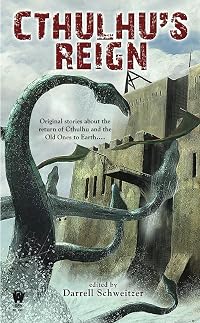
The book is a very nice mass market paperback with 309 pages, including a 7 page introduction, and a few pages of authors' biographies. All stores were newly published for this book; I did not see any major typographical errors. The attractive cover art shows immense tentacles rearing up out of the sea but I am not sure who created it, even after going over the book carefully. I was familiar with about half the authors in this show more volume. I was captivated by the uniformly high quality of the writing; there was not one story that I did not enjoy immensely. I have some beefs of course that I suppose I need to get out of the way. First, as a bibliophile I would have loved a limited edition hardcover, with interior illustrations. In fact, the last mythos anthology I can think of offhand that was published directly as a mmpb was Miskatonic University in 1996! Most such books at least start life as a trade paperback. Perhaps DAW only markets mmpbs? Perhaps it says something about the increasing popularity of fiction inspired by HPL's creations? My second issue is that the title is not listed as volume 1 in DAW's new series of Lovecraftian fiction. Oh, well, I can dream. The introduction by Darrell Schweitzer is, frankly, brilliant. It tells you just about everything you need to know to appreciate where these stories are coming from, and shows off his scholarly credentials to boot. If you never read anything by HPL, he suggests you read The Dunwich Horror, The Call of Cthulhu and The Shadow Over Innsmouth to get the gist. You can find the text of these stories free on line, if you are not a Lovecraftian and want to approach this book with proper frame of reference. The stories in Cthulhu's Reign are quite thematically similar but they are not really monster stories at all, like so many mythos stories are. This is more a series of meditations of human nature at the end of things, a sort of subset of post apocalyptic fiction, this time with tentacles. That makes the anthology all the more fascinating and, I think, broadens its appeal. Having a boat load of talented authors to call upon helped too!
Here are the contents:
The Walker in the Cemetery by Ian Watson - Ian Watson is new to me. Of all the contents, I found the prose here to be the most awkward. At first I was hesitant but I became an enthusiastic fan as Cthulhu spawn traps some surviviors of R'lyeh's rising and a game of cat and mouse ensues.
Sanctuary by Don Webb - Mr. Webb has a collection with many stories of interest to Lovecraftians, When They Came. A small village in south Texas has so far been overlooked, mostly, by the earth's new masters. This was absolutely wonderful. I hope Mr. Webb writes more mythos soon.
Her Acres of Pastoral Playground by Mike Allen - Another new author to me, Mr. Allen gives us a wrenching picture of a man struggling to hold his family together in the face of hopelessness.
Spherical Trigonometry by Ken Asamatsu - Asamatsu san edited the landmark series of Japanese mythos stories, Lairs of the Hidden Gods, published in 4 volumes by Kurodahan Press. His presence adds an international feel to the anthology. Everyone knows the Hounds of Tindalos cannot move through curved space. So what to do about that?
What Brings the Void by Will Murray - Will Murray has written a number of Cthulhu mythos stories, notably To Clear the Earth from The Shub Niggurath Cycle; I hope we see more from his pen soon. A NRO operative tries to use his psychic abilities to get intel on the invaders in this engaging story.
The New Pauline Corpus by Matt Cardin - Mr. Cardin has a collection, Dark Awakenings coming out from Mythos Books. It will contain his previously hard to get novella, The God of Foulness. Wow, what a magnificent story! A theologian tries to reconcile what has happened with what he spent his life studying.
Ghost Dancing by Darrell Schweitzer - The estimable editor of Chtulhu's Reign is a Lovecraftian scholar who wrote the biographical Discovering HP Lovecraft. He also wrote one of my favorite mythos stories, Why We Do It, found in Dead But Dreaming. What can you salvage at the end of all things? The allusion to the Ghost Dancing movement was acute.
This is How the World Ends by John R. Fultz - Mr. Fultz wrote a short novel online, The Wizards of Hyperborea, perhaps more in the vein of Clark Ashton Smith. Alas I don't know if the work is still available; I have not seen it in print. When R'lyeh rises will you fall, fight or be assimilated? Like many other stories here, the protagonist is moved to cling to his humanity.
The Shallows by John Langan - I am unfamiliar with the work or Mr. Langan but I have to remedy that! The Shallows is another brilliant story, as moving for what is says as much as what it doesn't, as a man steadfastly follows his daily routine.
Such Bright and Risen Madness in Our Names by Jay Lake - Another new author for me. A man, or what was once a man, joins with others to resist what has happened. The prose and plotting were top notch.
The Seals of New R'lyeh by Gregory Frost - Apparently Mr. Frost will be appearing at the 2010 Odyssey Writing Workshop; he is new to me. OK, we would like to think we will all behave nobly when the worst comes. Why then did I chortle so much while reading about these two petty crooks who keep trying to get aleg up, with mixed results.
Holocaust of Ecstasy by Brian Stableford - Mr. Stabelford has a short mythos novel coming out soon from Perilous Press, The Womb of Time. The title of this story comes from a line by HPL. What exactly he meant is open to speculation, so Mr. Stableford gives us his meditation on what the future holds.
Vastation by Laird Barron - I loved Mr. Barron's collection The Imago Sequence with the incredible story Old Virginia; his new collection Occultation will be out soon from Nightshade Books and I hope it has some Lovecraftian stories. Vastation was fascinating and complex, with layered prose and was also wonderful.
Nothing Personal by Richard Lupoff - Mr. Lupoff is well known to mythos fans for his collections Terrors and Visions. A first alien encounter doesn't exactly go as planned in this gripping story.
Remnants by Fred Chappell - I confess I could not stand Mr. Chappell's novel, Dagon, but I like his short fiction. Remnants may actually have been the most upbeat of all the stories here.
I think this book is a triumph. Although a Cthulhu mythos anthology, it focuses on the human response to the unthinkable. I really liked all of the stories and some were flat out brilliant, where usually in this type of book there are more than a few dogs; I credit Mr. Schweitzer's selection of talented writers for this. Furthermore Cthulhu's Reign is an inexpensive mass market paperback, making it a bargain. I only hope Mr. Schweitzer and DAW have more such books in the planning stages.
PS: The editor is not the only one who can use Cthulhu in a limerick:
A tentacled Old One named Cthulhu
In space devoured Captain Sulu
The Enterprise tasted
Not so bad when well basted
With the crewmen all crying, boo hulhu show less
The book is a very nice mass market paperback with 309 pages, including a 7 page introduction, and a few pages of authors' biographies. All stores were newly published for this book; I did not see any major typographical errors. The attractive cover art shows immense tentacles rearing up out of the sea but I am not sure who created it, even after going over the book carefully. I was familiar with about half the authors in this show more volume. I was captivated by the uniformly high quality of the writing; there was not one story that I did not enjoy immensely. I have some beefs of course that I suppose I need to get out of the way. First, as a bibliophile I would have loved a limited edition hardcover, with interior illustrations. In fact, the last mythos anthology I can think of offhand that was published directly as a mmpb was Miskatonic University in 1996! Most such books at least start life as a trade paperback. Perhaps DAW only markets mmpbs? Perhaps it says something about the increasing popularity of fiction inspired by HPL's creations? My second issue is that the title is not listed as volume 1 in DAW's new series of Lovecraftian fiction. Oh, well, I can dream. The introduction by Darrell Schweitzer is, frankly, brilliant. It tells you just about everything you need to know to appreciate where these stories are coming from, and shows off his scholarly credentials to boot. If you never read anything by HPL, he suggests you read The Dunwich Horror, The Call of Cthulhu and The Shadow Over Innsmouth to get the gist. You can find the text of these stories free on line, if you are not a Lovecraftian and want to approach this book with proper frame of reference. The stories in Cthulhu's Reign are quite thematically similar but they are not really monster stories at all, like so many mythos stories are. This is more a series of meditations of human nature at the end of things, a sort of subset of post apocalyptic fiction, this time with tentacles. That makes the anthology all the more fascinating and, I think, broadens its appeal. Having a boat load of talented authors to call upon helped too!
Here are the contents:
The Walker in the Cemetery by Ian Watson - Ian Watson is new to me. Of all the contents, I found the prose here to be the most awkward. At first I was hesitant but I became an enthusiastic fan as Cthulhu spawn traps some surviviors of R'lyeh's rising and a game of cat and mouse ensues.
Sanctuary by Don Webb - Mr. Webb has a collection with many stories of interest to Lovecraftians, When They Came. A small village in south Texas has so far been overlooked, mostly, by the earth's new masters. This was absolutely wonderful. I hope Mr. Webb writes more mythos soon.
Her Acres of Pastoral Playground by Mike Allen - Another new author to me, Mr. Allen gives us a wrenching picture of a man struggling to hold his family together in the face of hopelessness.
Spherical Trigonometry by Ken Asamatsu - Asamatsu san edited the landmark series of Japanese mythos stories, Lairs of the Hidden Gods, published in 4 volumes by Kurodahan Press. His presence adds an international feel to the anthology. Everyone knows the Hounds of Tindalos cannot move through curved space. So what to do about that?
What Brings the Void by Will Murray - Will Murray has written a number of Cthulhu mythos stories, notably To Clear the Earth from The Shub Niggurath Cycle; I hope we see more from his pen soon. A NRO operative tries to use his psychic abilities to get intel on the invaders in this engaging story.
The New Pauline Corpus by Matt Cardin - Mr. Cardin has a collection, Dark Awakenings coming out from Mythos Books. It will contain his previously hard to get novella, The God of Foulness. Wow, what a magnificent story! A theologian tries to reconcile what has happened with what he spent his life studying.
Ghost Dancing by Darrell Schweitzer - The estimable editor of Chtulhu's Reign is a Lovecraftian scholar who wrote the biographical Discovering HP Lovecraft. He also wrote one of my favorite mythos stories, Why We Do It, found in Dead But Dreaming. What can you salvage at the end of all things? The allusion to the Ghost Dancing movement was acute.
This is How the World Ends by John R. Fultz - Mr. Fultz wrote a short novel online, The Wizards of Hyperborea, perhaps more in the vein of Clark Ashton Smith. Alas I don't know if the work is still available; I have not seen it in print. When R'lyeh rises will you fall, fight or be assimilated? Like many other stories here, the protagonist is moved to cling to his humanity.
The Shallows by John Langan - I am unfamiliar with the work or Mr. Langan but I have to remedy that! The Shallows is another brilliant story, as moving for what is says as much as what it doesn't, as a man steadfastly follows his daily routine.
Such Bright and Risen Madness in Our Names by Jay Lake - Another new author for me. A man, or what was once a man, joins with others to resist what has happened. The prose and plotting were top notch.
The Seals of New R'lyeh by Gregory Frost - Apparently Mr. Frost will be appearing at the 2010 Odyssey Writing Workshop; he is new to me. OK, we would like to think we will all behave nobly when the worst comes. Why then did I chortle so much while reading about these two petty crooks who keep trying to get aleg up, with mixed results.
Holocaust of Ecstasy by Brian Stableford - Mr. Stabelford has a short mythos novel coming out soon from Perilous Press, The Womb of Time. The title of this story comes from a line by HPL. What exactly he meant is open to speculation, so Mr. Stableford gives us his meditation on what the future holds.
Vastation by Laird Barron - I loved Mr. Barron's collection The Imago Sequence with the incredible story Old Virginia; his new collection Occultation will be out soon from Nightshade Books and I hope it has some Lovecraftian stories. Vastation was fascinating and complex, with layered prose and was also wonderful.
Nothing Personal by Richard Lupoff - Mr. Lupoff is well known to mythos fans for his collections Terrors and Visions. A first alien encounter doesn't exactly go as planned in this gripping story.
Remnants by Fred Chappell - I confess I could not stand Mr. Chappell's novel, Dagon, but I like his short fiction. Remnants may actually have been the most upbeat of all the stories here.
I think this book is a triumph. Although a Cthulhu mythos anthology, it focuses on the human response to the unthinkable. I really liked all of the stories and some were flat out brilliant, where usually in this type of book there are more than a few dogs; I credit Mr. Schweitzer's selection of talented writers for this. Furthermore Cthulhu's Reign is an inexpensive mass market paperback, making it a bargain. I only hope Mr. Schweitzer and DAW have more such books in the planning stages.
PS: The editor is not the only one who can use Cthulhu in a limerick:
A tentacled Old One named Cthulhu
In space devoured Captain Sulu
The Enterprise tasted
Not so bad when well basted
With the crewmen all crying, boo hulhu show less
Members
- Recently Added By
Lists

Weird and Weirder Fiction
270 works; 35 members

Books Read By artturnerjr - 2014
34 works; 1 member

Lovecraftian anthologies
137 works; 4 members
Author Information

Author and editor Darrell Schweitzer was born on August 27, 1952. He primarily writes fantasty, horror, and science fiction works, but he also writes literary criticism and edits collections of essays on various writers within his preferred genres. He has published over three hundred short stories. His individual work has been nominated three show more times for the World Fantasy Award and he received it once as part of the editorial team of Weird Tales. (Bowker Author Biography) show less
All Editions
Series
Belongs to Publisher Series
DAW Book Collectors (1507)
Work Relationships
Contains
Common Knowledge
- Canonical title
- Cthulhu’s Reign
- Original publication date
- 2010-04
Classifications
Statistics
- Members
- 165
- Popularity
- 198,558
- Reviews
- 7
- Rating
- (3.38)
- Languages
- English
- Media
- Paper, Ebook
- ISBNs
- 2
- ASINs
- 1