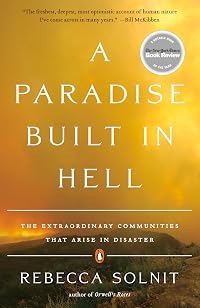
A Paradise Built in Hell: The Extraordinary Communities That Arise in Disaster
by Rebecca Solnit
On This Page
Description
Why is it that in the aftermath of a disaster, people suddenly become altruistic, resourceful, and brave? Award-winning author Solnit explores this phenomena, looking at major calamities from the past 100 years.Tags
Recommendations



























Member Recommendations

by Othemts

Member Reviews
I wondered, while reading through Solnit's use of five great case studies between 1906-2006, how the author would have seen two later developments, the responses Hurricane Harvey and Maria where extraordinary citizens such as the Cajun Navy or World Kitchens performed heroic acts in the face of government and large agency failures. Or with the pandemic where average citizens began to make each other masks, or take in their neighbors during the financial crises in some cases while others, fed with news of shortages, horded toilet paper and other essentials – creating shortages.
,
Her narrative shows examples where, often the people closest to the crisis often respond in the most positive ways, cutting through the bureaucracy and finding show more ways to help each other, responses that seem at odds with the fears of lawmakers that civilization has a thin veneer and will breakdown in a crisis.
Solnit offers a fairly balanced look where people concerned with each other’s safety will often cut through the prejudice and find ways to assist each other while others, fed a steady stream of fear and images of looting from the media will give into panic, and the idea of societal collapse will become a self-fulfilling prophecy.
Her look at the aftermath of Hurricane Katrina, which featured some of the best (rescuing, sharing, murual aid) and worst behavior (racist shootings of persons of color fueled by false narratives of looting) by citizens. I appreciate the fact that Solnit resists the easy or one-size-fits-all answer while delivering a sobering assessment that flawed theories about human nature, scarcity, the depiction of a people one crisis away from descending into chaos and the need for protection – have their weaknesses revealed during catastrophe and hierarchies we cling to in better times find themselves reversed in crisis.
While there are commendable acts of heroism that take place it is clear that often heroism is necessitated by failures to act by those who have the most resources to act, or failures to report accurately by those with the resources to reach the wider public. Solnit's writing shows a public behaviors that, without the steady diet of fear, leave room for hope -- but because that diet of fear isn't going anywere soon, shows that there is much work to be done in the communities starting with the hyper-individualistic ways of living and the narrative of a distrusted, easily panicked public that is often exacerbated by racial and class disparities. show less
,
Her narrative shows examples where, often the people closest to the crisis often respond in the most positive ways, cutting through the bureaucracy and finding show more ways to help each other, responses that seem at odds with the fears of lawmakers that civilization has a thin veneer and will breakdown in a crisis.
Solnit offers a fairly balanced look where people concerned with each other’s safety will often cut through the prejudice and find ways to assist each other while others, fed a steady stream of fear and images of looting from the media will give into panic, and the idea of societal collapse will become a self-fulfilling prophecy.
Her look at the aftermath of Hurricane Katrina, which featured some of the best (rescuing, sharing, murual aid) and worst behavior (racist shootings of persons of color fueled by false narratives of looting) by citizens. I appreciate the fact that Solnit resists the easy or one-size-fits-all answer while delivering a sobering assessment that flawed theories about human nature, scarcity, the depiction of a people one crisis away from descending into chaos and the need for protection – have their weaknesses revealed during catastrophe and hierarchies we cling to in better times find themselves reversed in crisis.
While there are commendable acts of heroism that take place it is clear that often heroism is necessitated by failures to act by those who have the most resources to act, or failures to report accurately by those with the resources to reach the wider public. Solnit's writing shows a public behaviors that, without the steady diet of fear, leave room for hope -- but because that diet of fear isn't going anywere soon, shows that there is much work to be done in the communities starting with the hyper-individualistic ways of living and the narrative of a distrusted, easily panicked public that is often exacerbated by racial and class disparities. show less
Through the exploration of five events over the past century, Solnit explores how Western societies behave during disasters. She debunks the pop-culture myth that crowds turn into angry mobs during disasters, and demonstrates that there is something innate about us that gives people what it takes to step up during disasters.
Are there any exceptions to this rule? It turns out that elites, officials, and racists fail to find their humanity during disasters. Katrina in New Orleans highlighted the worst of the wealthy, bureaucracy, and white supremacy. While the news was busy reporting about roving black gangs, white supremacists (including police) went out “game hunting” for blacks, killing dozens if not hundreds of innocent black man, show more throwing their bodies in the river or burning them.
Sociologists have termed the incompetence of the wealthy during disasters “elite panic,” and it is an increasingly concerning trend. You may have been hearing about billionaires converting old nuclear silos into bunkers, or buying up vast tracts of land in New Zealand. If the apocalypse comes to pass, it will be of their own doing.
Another interesting note: money becomes worthless during disasters, and gift culture dominates. Neither cash nor barter or relevant. Anarchy (decentralized self-organization) is our best bet for survival during disaster.
Through this exploration of extremes, Solnit brings into question the existence of class structure and wealth inequality. If these we can be civil and compassionate with each other in the worst of situations, why do we let people go back to being homeless and forgotten in everyday life? If many people’s lives improve during disasters, shouldn’t that be a canary in the coal mine, alerting us that we’re doing something fundamentally wrong?
If there’s anything we can count on in our future, it is disaster. If you’d like to get a sense of what might be involved, and how these times might become some of the most meaningful periods of your life, this book comes recommended. show less
Are there any exceptions to this rule? It turns out that elites, officials, and racists fail to find their humanity during disasters. Katrina in New Orleans highlighted the worst of the wealthy, bureaucracy, and white supremacy. While the news was busy reporting about roving black gangs, white supremacists (including police) went out “game hunting” for blacks, killing dozens if not hundreds of innocent black man, show more throwing their bodies in the river or burning them.
Sociologists have termed the incompetence of the wealthy during disasters “elite panic,” and it is an increasingly concerning trend. You may have been hearing about billionaires converting old nuclear silos into bunkers, or buying up vast tracts of land in New Zealand. If the apocalypse comes to pass, it will be of their own doing.
Another interesting note: money becomes worthless during disasters, and gift culture dominates. Neither cash nor barter or relevant. Anarchy (decentralized self-organization) is our best bet for survival during disaster.
Through this exploration of extremes, Solnit brings into question the existence of class structure and wealth inequality. If these we can be civil and compassionate with each other in the worst of situations, why do we let people go back to being homeless and forgotten in everyday life? If many people’s lives improve during disasters, shouldn’t that be a canary in the coal mine, alerting us that we’re doing something fundamentally wrong?
If there’s anything we can count on in our future, it is disaster. If you’d like to get a sense of what might be involved, and how these times might become some of the most meaningful periods of your life, this book comes recommended. show less
This book is subtitled "the extraordinary communities that arise in disaster" which pretty much says it all. Taking a sociological approach, looking at peoples' responses to major disasters, rather than focusing on official responses, Solnit talks about how, in most disasters, survivors tend to band together and act as a community, in an altrustic way, almost a utopia. This is contrary to popular perception (and disaster movies) which shows that people typically become mobs of looters, or murder and rape and pillage weaker survivors.
Though survivors rarely panic, elites (including governments and other "official responders" such as the military or police), Solnit says, often do react badly in what she calls elite panic. She cites the show more 1906 San Francisco earthquake and the Katrina response as two key instances of "elite panic."
Solnit looks at a number of disasters--the S.F. earthquake, the Halifax explosion during World War 1, the London blitz, and, more recently, 9/11 and Katrina. The chapters on Katrina were most heartrending.
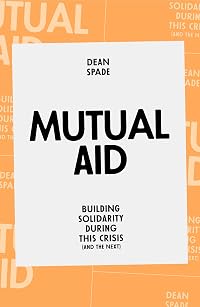
Between disasters, Solnit's interludes address various philosophical, sociological, and related issues, such as mutual aid. The quality of these were more uneven, though I absolutely loved the chapters on the disasters themselves and their aftermaths.
I think this book could end up being one of my favorites of the year though I admit that it might not be for everyone. If you're a firm believer in law and order or trust the government, this book might not be for you. Solnit gets a bit preachy at times but overall, this is a tremendous book. show less
Though survivors rarely panic, elites (including governments and other "official responders" such as the military or police), Solnit says, often do react badly in what she calls elite panic. She cites the show more 1906 San Francisco earthquake and the Katrina response as two key instances of "elite panic."
Solnit looks at a number of disasters--the S.F. earthquake, the Halifax explosion during World War 1, the London blitz, and, more recently, 9/11 and Katrina. The chapters on Katrina were most heartrending.
Between disasters, Solnit's interludes address various philosophical, sociological, and related issues, such as mutual aid. The quality of these were more uneven, though I absolutely loved the chapters on the disasters themselves and their aftermaths.
I think this book could end up being one of my favorites of the year though I admit that it might not be for everyone. If you're a firm believer in law and order or trust the government, this book might not be for you. Solnit gets a bit preachy at times but overall, this is a tremendous book. show less
Stories of human altruism in natural disasters. Solnit argues that most people behave their best in natural(ish) disasters, rather than panicking or selfishly trampling others to survive. Though there are always a few bad apples, she points out that, both in San Francisco in 1906 and New Orleans after Katrina, it was the troops/police that did most of the greedy (nonsurvival) looting. In fact, it’s elites who tend to panic about property rights, causing much more suffering and even freewheeling, but often discriminatory, murder. The average person is much more likely, as people did in the Twin Towers, to help others escape danger at risk of their own lives. Solnit suggests that this is because most people have a powerful need to feel show more useful and to be part of something larger; because ordinary life under late capitalism is so draining—a disaster in slow motion—crisis brings not only loss and suffering but also opportunity to forget the past and the future and focus on taking care of each other in the moment. Solnit’s examples are heartening, but also limited by the fact that they involve people focused on physical, nonhuman threats—when we fight each other, we’re not quite as altruistic. show less
Solnit’s book is built on the hypothesis that times of disasters bring out the best in humanity as people band together to help one another to survive. It’s an optimistic view that runs counter to the usual narrative of self-interest and mob violence but one Solnit illustrates with examples from history including the San Francisco Earthquake, the explosion in Halifax harbor, the London Blitz, the Mexico City earthquake and Hurricane Katrina. In all of these cases ordinary people responded to help one another and build community. The response of governments and authorities in these scenarios is depicted as at best too slow to mobilize to respond to the immediate needs of communities in distress and at worse too ready to treat show more citizens as criminals through policies such shooting “looters.” Solnit introduces the interesting concept of “elite panic” where the wealthy and power expect chaos and anarchy and thus respond with force where none is needed. Solnit details how this negative view of human nature misinforms public policy in response to disaster and leads to greater suffering. Hurricane Katrina is a particularly horrifying account as authorities were ready to arrest and imprison people rather than offer rescue and relief. Armed white people were able to get away with slaughtering poor black people because of the belief that they were criminals rather than survivors in need of compassion. This book is a must read to gain a better understanding of human nature in both its best and worst elements. show less
4.5 probably. This is a rare book that makes you fundamentally assess your view of humanity. Solnit uses the sociology of disasters to examine human nature, highlighting that hugely positive way that communities and individuals respond in times of stress. She highlights the breaking down of social barriers and the sense of purpose and almost joy that people report in the aftermath of earthquakes, floods and other disasters. In contrast to popular (and government) beliefs, people don't revert to brutal individualists when social structures break down, instead they often pull together, share resources, risk their lives for strangers and build remarkable grassroots communities under immense stress.
The contrast with how people experience show more day to day life is marked, and Solnit explores the implications of this positive view of human nature for the ways in which we structure society. She's an unashamed radical and there are times when the book veers a little close to polemic, but the overarching effect is revelatory - the world as we largely experience it fails to really capitalise on the extraordinary human potential for community and generosity. The individual case studies are captivating in their own right (and heart-breaking, particularly the New Orleans story), but the book is much more than just a history of disaster responses. show less
The contrast with how people experience show more day to day life is marked, and Solnit explores the implications of this positive view of human nature for the ways in which we structure society. She's an unashamed radical and there are times when the book veers a little close to polemic, but the overarching effect is revelatory - the world as we largely experience it fails to really capitalise on the extraordinary human potential for community and generosity. The individual case studies are captivating in their own right (and heart-breaking, particularly the New Orleans story), but the book is much more than just a history of disaster responses. show less
I am a big fan of Solnit’s and consider her River of Shadows: Eadweard Muybridge and the Technological Wild West one of my all time favorites. For the first two thirds of A Paradise Built in Hell, however,I found the repetition of the author's main point that quasi-utopian communities often, or even almost always, arise during disasters a bit tedious. Most interesting to me were the details of the particular disasters themselves. I appreciated the accounts rather more than the theorizing. Solnit seems at first to be offering a fairly unnuanced alternative reading of disaster to that of Naomi Klein's The Shock Doctrine: the Rise of Disaster Capitalism and, indeed, Solnit mentions Klein and her different depiction of how we react to show more disaster.
The sections of the book that focus on the 1906 San Francisco and 1985 Mexico City earthquakes as well as the bombing of the World Trade Center towers in New York City in 2001, the 1989 Loma Prieta earthquake in San Francisco, the explosion of a munitions ship in Halifax in 1917 and several other incidents can be summed up by a quote from Dorothy Day, “While the crisis lasted, people loved each other.” The earthquake in Mexico City stands out in Solnit's view because peoples’ response to that disaster and the government's mishandling of it resulted in enduring changes to Mexican politics and government. She claims that Mexico offers a glimpse of what might be if the spontaneous blossoming of civic society that happens during a disaster could be normalized into an exuberant everyday phenomenon; in her words, the challenge is “how to maintain a sense of purpose and solidarity in the absence of emergencies.” She also claims that “the real revolution may be the period between regimes, not the new regime . . . .Certainly the period immediately after, or during, the revolution comes closest to the anarchist ideal of a society without a state, a moment when everyone has agency and no one has ultimate authority, when the society invents itself as it goes along.”
Solnit gives many examples of the “elite panic” that perpetuates and acts based upon urban disaster myths, in the mistaken belief that their role is to maintain order and stability and defend against the murder, mayhem and especially property “crimes” such as “looting” that they expect, rather than to mitigate suffering or save lives. In the final section of the book, “New Orleans: Common Grounds and Killers,” Solnit's analysis becomes more complex, and this section provides, I think, the real meat of the book and redeems it from its earlier redundancy and obviousness. Solnit reinforced my sense that that particular disaster, even more than 9/11, has been a defining one for our nation. When I first saw the photos coming out of New Orleans in August of 2005, I thought that finally, the entire world was seeing the U.S. at its ugliest: the poverty, the racism, the contempt for human welfare and human lives on the part of virtually all levels of government, but especially the federal government. Once again, I found that my rather entrenched cynicism could be shocked afresh . And yet, as Solnit eloquently demonstrates, there is another side to the story, as there is to the story of 9/11: how some people (sometimes, most people) come together to do what is necessary and help each other out, without considerations of personal gain or even safety and how that becomes a peak positive experience for many, all the while the disaster is horrific, and, in the case of Hurricane Katrina, catastrophic. show less
The sections of the book that focus on the 1906 San Francisco and 1985 Mexico City earthquakes as well as the bombing of the World Trade Center towers in New York City in 2001, the 1989 Loma Prieta earthquake in San Francisco, the explosion of a munitions ship in Halifax in 1917 and several other incidents can be summed up by a quote from Dorothy Day, “While the crisis lasted, people loved each other.” The earthquake in Mexico City stands out in Solnit's view because peoples’ response to that disaster and the government's mishandling of it resulted in enduring changes to Mexican politics and government. She claims that Mexico offers a glimpse of what might be if the spontaneous blossoming of civic society that happens during a disaster could be normalized into an exuberant everyday phenomenon; in her words, the challenge is “how to maintain a sense of purpose and solidarity in the absence of emergencies.” She also claims that “the real revolution may be the period between regimes, not the new regime . . . .Certainly the period immediately after, or during, the revolution comes closest to the anarchist ideal of a society without a state, a moment when everyone has agency and no one has ultimate authority, when the society invents itself as it goes along.”
Solnit gives many examples of the “elite panic” that perpetuates and acts based upon urban disaster myths, in the mistaken belief that their role is to maintain order and stability and defend against the murder, mayhem and especially property “crimes” such as “looting” that they expect, rather than to mitigate suffering or save lives. In the final section of the book, “New Orleans: Common Grounds and Killers,” Solnit's analysis becomes more complex, and this section provides, I think, the real meat of the book and redeems it from its earlier redundancy and obviousness. Solnit reinforced my sense that that particular disaster, even more than 9/11, has been a defining one for our nation. When I first saw the photos coming out of New Orleans in August of 2005, I thought that finally, the entire world was seeing the U.S. at its ugliest: the poverty, the racism, the contempt for human welfare and human lives on the part of virtually all levels of government, but especially the federal government. Once again, I found that my rather entrenched cynicism could be shocked afresh . And yet, as Solnit eloquently demonstrates, there is another side to the story, as there is to the story of 9/11: how some people (sometimes, most people) come together to do what is necessary and help each other out, without considerations of personal gain or even safety and how that becomes a peak positive experience for many, all the while the disaster is horrific, and, in the case of Hurricane Katrina, catastrophic. show less
Members
- Recently Added By
Published Reviews
ThingScore 83
Highly recommended. ***All levels/libraries.
added by Christa_Josh
Emergency planning, such as securing levees, can help protect the vulnerable. Yet state-sponsored projects don't fit into Solnit's picture of spontaneous, anarchic recovery, so they get little attention here. Nonetheless, this is a bracing, timely book.
added by Shortride
The West Coast essayist and social critic Rebecca Solnit is the kind of rugged, off-road public intellectual America doesn’t produce often enough. It’s been fascinating to watch her zigzagging career unfold.
added by Shortride
Lists

BingoDOG - Books With Natural Disasters: Nonfiction
18 works; 5 members

Accidents, Disasters, and Tragedies
175 works; 7 members

Urban Planning (Michelle TBR)
39 works; 3 members

The Joe Rogan Experience Library
254 works; 3 members

San Francisco One City One Book Selections
15 works; 2 members
Author Information

47+ Works 17,276 Members
Rebecca Solnit writes extensively on photography and landscape. She is a contributing editor to Art Issues and Creative Camera and is the author of three books. She has contributed essays to several museum catalogues including Crimes and Splendors: The Desert Cantos of Richard Misrach and the Whitney Museum's Beat Culture and the New America. She show more was a 1993 recipient of a National Endowment for the Arts Fellowship. (Bowker Author Biography) show less
Some Editions
Awards and Honors
Common Knowledge
- Canonical title
- A Paradise Built in Hell: The Extraordinary Communities That Arise in Disaster
- Original publication date
- 2009
- Important events
- The Blitz; Hurricane Katrina; World War II (1939 | 1945)
- First words
- Who are you? Who are we? In times of crisis, these are life-and-death questions.
- Quotations
- The utilitarian argument against fiestas, parades, carnivals, and general public merriment is that they produce nothing. But they do: they produce society. They renew the reasons why we might want to belong and the feeling th... (show all)at we do. p 173
For the past 20 years, U.S. radicals have been speaking of ‘the politics of prefiguration’: of the idea that you can and must embody whatever liberty, justice, democracy you aspire to, and in doing so in your self, your c... (show all)ommunity, or your movement you achieve a degree of victory, whatever you do beyond that. Thus political demonstrations around the country have become less like complaints and more like celebrations. p 177
But disaster doesn’t sort us out by preferences; it drags us into emergencies that require we act, and act altruistically, bravely, and with initiative in order to survive or save the neighbors, no matter how we vote or wha... (show all)t we do for a living. The positive emotions that rise in those unpromising circumstances demonstrate that social ties and meaningful work are deeply desired, readily improvised, and intensely rewarding. The very structure of our economy and society prevents these goals from being achieved. The structure is also ideological, a philosophy that best serves the wealthy and powerful but shapes all of our lives, reinforced as the conventional wisdom disseminated by the media, from news hours to disaster movies. The facets of that ideology have been called individualism, capitalism, and Social Darwinism and have appeared in the political philosophies of Thomas Hobbes and Thomas Malthus, as well as the work of most conventional contemporary economists who presume we seek personal gain for rational reasons and refrain from looking at the ways a system skewed to that end damages what else we need for our survival and desire for our well-being. Disaster demonstrates this, since among the factors determining whether you will live or die are the health of your immediate community and the justness of your society. We need ties, but they along with purposefulness, immediacy, and agency also give us joy – the startling, sharp joy I found in accounts of disaster survivors. These account demonstrate that the citizens any paradise would need – the people who are brave enough, resourceful enough, and generous enough – already exist. The possibility of paradise hovers on the cusp of coming into being, so much so that it takes powerful forces to keep such a paradise at bay. If paradise now arises in hell, it’s because in the suspension of the usual order and the failure of most systems, we are free to live and act another way. p 7 - Last words
- (Click to show. Warning: May contain spoilers.)The task before us is to recognize the possibilities visible through that gateway and endeavor to bring them into the realm of the everyday.
- Publisher's editor
- Slovak, Paul
- Blurbers
- Vanderbilt, Tom; McKibben, Bill; Garner, Dwight; Hochschild, Adam
- Canonical DDC/MDS
- 303.485
- Canonical LCC
- HV553.S59
Classifications
- Genres
- Sociology, Nonfiction, General Nonfiction, History
- DDC/MDS
- 303.485 — Society, government, & culture Social sciences, sociology & anthropology Social processes Social change Causes of change Disasters
- LCC
- HV553 .S59 — Social sciences Social pathology. Social and public welfare. Criminology Social pathology. Social and public welfare. Emergency management Relief in case of disasters
- BISAC
Statistics
- Members
- 1,029
- Popularity
- 25,319
- Reviews
- 33
- Rating
- (3.70)
- Languages
- English, Italian, Spanish
- Media
- Paper, Audiobook, Ebook
- ISBNs
- 10
- ASINs
- 7