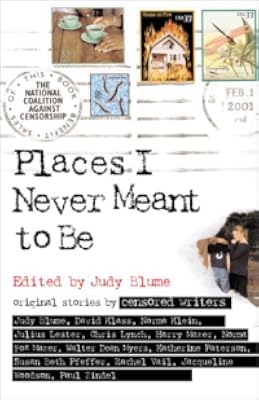
Places I Never Meant to Be : Original Stories by Censored Writers
by Judy Blume (Editor)
On This Page
Description
A collection of short stories accompanied by short essays on censorship by twelve authors whose works have been challenged in the past.Tags
Recommendations



Member Reviews
I first picked this book up on a whim. I heard about it from another source a few years back and saw that it had several authors in it that I read as a child/middle schooler. At the time I had little experience with censorship or banned books (my school district, by in large, held an indifferent opinion towards the reading material of their students) so when I saw that Judy Blume had been censored several times I kind of stared in stupification. It's Judy Blume for crying out loud--she was almost as popular a choice for me as the Baby Sitter's Club books or the Boxcar Children. I never in my life thought she was inappropriate.
Apparently quite a few people did.
In her introduction to "Places I Never Meant To Be" (which you can read online show more here, at her webpage) she talks about a particular book that first her mother told her she couldn't read until she was older, and then a public librarian told her she couldn't read without permission from her parents. A Rage to Live by John O'Hara was the book. I never read it, but Blume explains that once she had read it far from being influenced by the going-ons of the characters in the book, she was interested in reading the rest of O'Hara's books.
The other contributors to the anthology don't express similar stories, but they do talk about when their books had been challenged, their feelings, how it influenced their writing or the fight that ensued. Their stories push the boundaries of what is considered 'age appropriate'. In "Spear" by Julius Lester, he tackles the issue of a mixed-race (potential) couple when both sides are racist and narrow-minded, in "Going Sentimental" Rachel Viehl paints an unfettered look at losing one's virginity, and in "You Come, too, A-ron" by Harry Mazer talks about Aaron and Kenny in the foster system.
These aren't stories filled with sex, drugs and (my favorite reason for censorship) disrespect for authorities and adults. They're real stories about real problems teenagers face. Some end well, others end sadly and a few end with a bittersweet wistfulness, but they don't try to sugar coat reality. And maybe that's why parents and teachers censor or ban their books. Keep the real world from intruding. They can't change reality, but they can keep it from touching the children as long as possible.
Not all the stories were to my liking. Katherine Paterson's story "The Red Dragonfly" seemed disjointed to me and too subtle (and I credit her book, Rebels of the Heavenly Kingdom, as first getting me interested in asian history) for me to understand. And other authors I had never read before (oddly Norma Fox Mazer and Walter Dean Meyers, though I remember their books on my shelves).
I don't read genre fiction as a rule (reality depresses me), but I don't think that I am meant to 'enjoy' the book. Not in the same way that I enjoy Brandon Sanderson's epic fantasies or Georgette Heyer's historical romances at least. This anthology was thought-provoking and interesting, something I recommend if you want stories to discuss and reflect on. show less
Apparently quite a few people did.
In her introduction to "Places I Never Meant To Be" (which you can read online show more here, at her webpage) she talks about a particular book that first her mother told her she couldn't read until she was older, and then a public librarian told her she couldn't read without permission from her parents. A Rage to Live by John O'Hara was the book. I never read it, but Blume explains that once she had read it far from being influenced by the going-ons of the characters in the book, she was interested in reading the rest of O'Hara's books.
The other contributors to the anthology don't express similar stories, but they do talk about when their books had been challenged, their feelings, how it influenced their writing or the fight that ensued. Their stories push the boundaries of what is considered 'age appropriate'. In "Spear" by Julius Lester, he tackles the issue of a mixed-race (potential) couple when both sides are racist and narrow-minded, in "Going Sentimental" Rachel Viehl paints an unfettered look at losing one's virginity, and in "You Come, too, A-ron" by Harry Mazer talks about Aaron and Kenny in the foster system.
These aren't stories filled with sex, drugs and (my favorite reason for censorship) disrespect for authorities and adults. They're real stories about real problems teenagers face. Some end well, others end sadly and a few end with a bittersweet wistfulness, but they don't try to sugar coat reality. And maybe that's why parents and teachers censor or ban their books. Keep the real world from intruding. They can't change reality, but they can keep it from touching the children as long as possible.
Not all the stories were to my liking. Katherine Paterson's story "The Red Dragonfly" seemed disjointed to me and too subtle (and I credit her book, Rebels of the Heavenly Kingdom, as first getting me interested in asian history) for me to understand. And other authors I had never read before (oddly Norma Fox Mazer and Walter Dean Meyers, though I remember their books on my shelves).
I don't read genre fiction as a rule (reality depresses me), but I don't think that I am meant to 'enjoy' the book. Not in the same way that I enjoy Brandon Sanderson's epic fantasies or Georgette Heyer's historical romances at least. This anthology was thought-provoking and interesting, something I recommend if you want stories to discuss and reflect on. show less
As the subtitle says, this is a collection of stories by written by writers who have often been banned or censored. The writers are best known for their work for the YA and children's markets, and I recognize a few from my own youth (e.g. Paul Zindel, Norma Klein). Along with the 12 stories, each writer also has a short essay on their experiences with censorship, and there are essays on censorship from the editor and from the director of the National Coalition Against Censorship. I found all the essays very interesting and inspiring.
As for the stories themselves, there were only two I didn't care for, so I think that makes this a successful anthology. I can tell that several of these stories will stick with me for years. These stories show more represent some of the better writing in the YA field. I particularly liked "Going Sentimental," by Rachel Vail, "Spear," by Julius Lester, "Ashes, by Susan Beth Pfeffer, and "Baseball Camp," by David Klass (and I am NOT a baseball fan).
Recommended for: anyone who appreciates quality YA, short story lovers, teachers, librarians and anyone interested in censorship issues. show less
As for the stories themselves, there were only two I didn't care for, so I think that makes this a successful anthology. I can tell that several of these stories will stick with me for years. These stories show more represent some of the better writing in the YA field. I particularly liked "Going Sentimental," by Rachel Vail, "Spear," by Julius Lester, "Ashes, by Susan Beth Pfeffer, and "Baseball Camp," by David Klass (and I am NOT a baseball fan).
Recommended for: anyone who appreciates quality YA, short story lovers, teachers, librarians and anyone interested in censorship issues. show less
A good collection of short stories for young adults, whose authors were all targets of various forms of censorship. The stories by Jacqueline Woodson and Walter Dean Myers are standouts.
This is an important book. I'm glad my library owns it. I would never dream of telling any of you what you, or your kids, should or should not read. However, I did not particularly enjoy the stories, just as I'm not a big fan of most of the novels that the included authors have written.
At least I got one misapprehension/ confusion out of my head. [a:Norma Klein|56326|Norma Klein|https://d.gr-assets.com/authors/1274322052p2/56326.jpg] and [a:Norma Fox Mazer|70862|Norma Fox Mazer|https://d.gr-assets.com/authors/1256002427p2/70862.jpg] are two different people. (Doncha just hate it when you've never had the opportunity to recognize something like this? It reminds me that it's only recently that I learned the difference between [a:Richard show more Peck|22414|Richard Peck|https://d.gr-assets.com/authors/1299893364p2/22414.jpg] and [a:Robert Newton Peck|17541|Robert Newton Peck|https://d.gr-assets.com/authors/1309161608p2/17541.jpg].) show less
At least I got one misapprehension/ confusion out of my head. [a:Norma Klein|56326|Norma Klein|https://d.gr-assets.com/authors/1274322052p2/56326.jpg] and [a:Norma Fox Mazer|70862|Norma Fox Mazer|https://d.gr-assets.com/authors/1256002427p2/70862.jpg] are two different people. (Doncha just hate it when you've never had the opportunity to recognize something like this? It reminds me that it's only recently that I learned the difference between [a:Richard show more Peck|22414|Richard Peck|https://d.gr-assets.com/authors/1299893364p2/22414.jpg] and [a:Robert Newton Peck|17541|Robert Newton Peck|https://d.gr-assets.com/authors/1309161608p2/17541.jpg].) show less
Meh. I loved a lot of these writers when I was a pre-teen, but most of these stories fell flat. Didn't finish it.
Old favorite. Also, it's Judy Blume! Awesome collection.
Must read.
Members
- Recently Added By
Author Information

Judy Blume was born in Elizabeth, New Jersey on February 12, 1938. She received a bachelor's degree in education from New York University in 1961. Her first book, The One in the Middle Is the Green Kangaroo, was published in 1969. Her other books include Are You There, God? It's Me Margaret; Then Again, Maybe I Won't; Tales of a Fourth Grade show more Nothing; Otherwise Known as Sheila the Great; and Blubber. Her adult titles include Wifey, Smart Women, Summer Sisters, and In the Unlikely Event. In 1996, she received the American Library Association's Margaret A. Edwards Award for Lifetime Achievement and in 2004, she received the National Book Foundation's Medal for Distinguished Contribution to American Letters. (Bowker Author Biography) show less
All Editions
Awards and Honors
Distinctions
Common Knowledge
- Canonical title
- Places I Never Meant to Be : Original Stories by Censored Writers
- Original publication date
- 1999
- Dedication
- For Leanne Katz, our champion
Your spirit lives on - First words
- When I was growing up I'd heard that if a movie or book was "Banned in Boston" everybody wanted to see it or read it right away [Introduction]
For as long as I could remember, my mother had been giving me advice and telling me things about life so that I wouldn't, as she said, make the same mistakes she had. [Meeting the Mugger] - Last words
- (Click to show. Warning: May contain spoilers.)He decided that what he had just written was the biggest piece of baloney he had ever read and returned to his room, chuckling to himself. [Something Which Is Non-Existent]
(Click to show. Warning: May contain spoilers.)If she were alive today, Norma would still be speaking out on the same issues, encouraging other writers to keep going, full steam ahead. [A Tribute to Norma Klein by Judy Blume] - Original language
- English
- Disambiguation notice
- Contents: Introduction. Censorship: a personal view / Judy Blume -- A letter from Joan Bertin, Executive Director, National Coalition Against Censorship -- Meeting the mugger / Norma Fox Mazer -- Spear / Julius Lester -- Goin... (show all)g sentimental / Rachel Vail -- The red dragonfly / Katherine Paterson -- July Saturday / Jacqueline Woodson -- You come, too, A-Ron / Harry Mazer -- The beast is in the labyrinth / Walter Dean Myers-- Ashes / Susan Beth Pfeffer --
Baseball camp / David Klass -- Love and centipedes / Paul Zindel -- Lie, no lie / Chris Lynch -- Something which is non-existent / Norma Klein -- About the Contributors
Each story is followed by an author's afterword "on censorship," except the last one which has "A Tribute to Norma Klein" by Judy Blume.
Classifications
- Genres
- Fiction and Literature, Teen, Young Adult
- DDC/MDS
- 363.31 — Society, government, & culture Social problems and social services Public Safety - Police, Crime Investigation Terrorism, Disasters, Civil Defense Censorship
- LCC
- PZ5 .P6635 — Language and Literature Fiction and juvenile belles lettres Fiction and juvenile belles lettres Juvenile belles lettres
- BISAC
Statistics
- Members
- 337
- Popularity
- 93,785
- Reviews
- 7
- Rating
- (3.90)
- Languages
- English
- Media
- Paper
- ISBNs
- 3
- ASINs
- 1