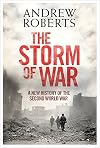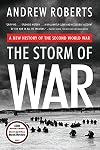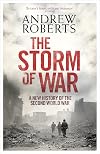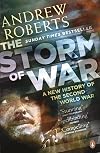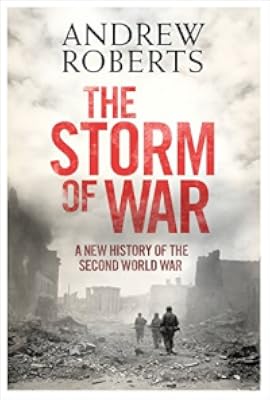
The Storm of War: A New History of the Second World War
by Andrew Roberts
On This Page
Description
A comprehensive history of World War II analyzes the factors that affected the war's outcome and presents stories of many little-known individuals whose experiences displayed the epitome of courage and self-sacrifice.Tags
Recommendations

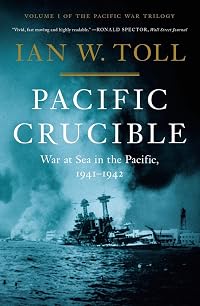


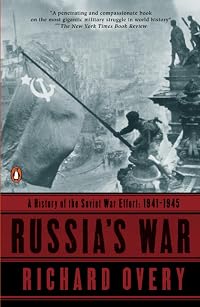
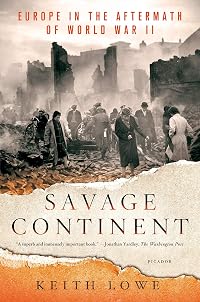
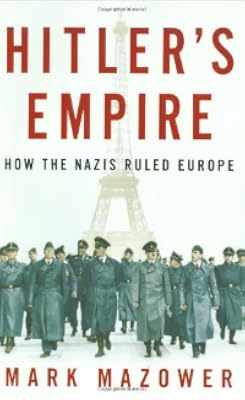







Member Reviews
There are two things that are true of me as a reader.
1. I read a lot of books.
2. I read a lot of books about World War Two.
Because I am obsessive (this is probably an understatement) about tracking my reading I can calculate this exactly if I want to, but I’m guessing that around 20-30% of my reading is centered about the Second World War. Which is a rather roundabout way of introducing my thoughts on Andrew Roberts one-volume history of World War Two. I rarely give out 5 stars for a book, but this would be like 4.85 stars if one could give such a rating, and since it is my post I can.
Here is one thing that I liked, and one thing that I disliked in this book. To be clear I liked a lot more than one thing, and really only disliked show more one thing, but I’m trying to keep this short.
What I Liked - Churchill’s Zingers
Winston Churchill was possibly the most quotable person in history this side of Jesus. His speeches are legendary. His genius with language was best described by President John F. Kennedy (who actually stole it from Edward R. Murrow), “He mobilized the English language and sent it into battle.” I knew about Churchill’s mastery of language, what I didn’t know was that during the war he delighted in sticking it to Hitler in the press. Take this excerpt from a speech before Parliament:
When Herr Hitler escaped his bomb on July 20th he described his survival as providential; I think that from a purely military point of view we can all agree with him, for certainly it would be most unfortunate if the Allies were to be deprived, in the closing phases of the struggle, of that form of warlike genius by which Corporal Schickelgruber has so notably contributed to our victory.(1)
He gigs Hitler, not just by crediting him the success of Allies, he also uses his family’s original surname before it was changed to Hitler. This was convenient for Churchill because Adolph Hitler hated his father, and it also slyly pointed out that Hitler couldn’t even prove his own Aryan heritage. He did this many times, and we can only dream of what Winston would have been like on Twitter.
What I Didn’t Like - The Missing Pacific
The only quibble that I have with Roberts’s history is that the war in the Pacific Theater gets the short straw. The book is impeccably researched and wonderfully written, and as a British writer he does a good job of being fair to the rest of the Allies, but the war effort in Europe takes up the vast majority of his work. I tested this theory by doing some searches (Viva la ebooks! Long live Kindle!) to see how many times the names of different Generals/Admirals occured. Here were the results:
MacArthur – 20
Patton – 95
Montgomery – 118
Eisenhower – 70
Rommel – 147
Guderian – 85
Nimitz – 8
It’s still a great book, but it needed more of the Pacific. How can a comprehensive history of the Second World War only mention Nimitz and MacArthur a combined 28 times?
Okay, the small rant is over. It was a great book, and it is hard to beat it in one volume, even it gives the Pacific the short end of the stick..
Stats
Pages - 797
Edition Read - Ebook
Sharp Score - 4.75 show less
1. I read a lot of books.
2. I read a lot of books about World War Two.
Because I am obsessive (this is probably an understatement) about tracking my reading I can calculate this exactly if I want to, but I’m guessing that around 20-30% of my reading is centered about the Second World War. Which is a rather roundabout way of introducing my thoughts on Andrew Roberts one-volume history of World War Two. I rarely give out 5 stars for a book, but this would be like 4.85 stars if one could give such a rating, and since it is my post I can.
Here is one thing that I liked, and one thing that I disliked in this book. To be clear I liked a lot more than one thing, and really only disliked show more one thing, but I’m trying to keep this short.
What I Liked - Churchill’s Zingers
Winston Churchill was possibly the most quotable person in history this side of Jesus. His speeches are legendary. His genius with language was best described by President John F. Kennedy (who actually stole it from Edward R. Murrow), “He mobilized the English language and sent it into battle.” I knew about Churchill’s mastery of language, what I didn’t know was that during the war he delighted in sticking it to Hitler in the press. Take this excerpt from a speech before Parliament:
When Herr Hitler escaped his bomb on July 20th he described his survival as providential; I think that from a purely military point of view we can all agree with him, for certainly it would be most unfortunate if the Allies were to be deprived, in the closing phases of the struggle, of that form of warlike genius by which Corporal Schickelgruber has so notably contributed to our victory.(1)
He gigs Hitler, not just by crediting him the success of Allies, he also uses his family’s original surname before it was changed to Hitler. This was convenient for Churchill because Adolph Hitler hated his father, and it also slyly pointed out that Hitler couldn’t even prove his own Aryan heritage. He did this many times, and we can only dream of what Winston would have been like on Twitter.
What I Didn’t Like - The Missing Pacific
The only quibble that I have with Roberts’s history is that the war in the Pacific Theater gets the short straw. The book is impeccably researched and wonderfully written, and as a British writer he does a good job of being fair to the rest of the Allies, but the war effort in Europe takes up the vast majority of his work. I tested this theory by doing some searches (Viva la ebooks! Long live Kindle!) to see how many times the names of different Generals/Admirals occured. Here were the results:
MacArthur – 20
Patton – 95
Montgomery – 118
Eisenhower – 70
Rommel – 147
Guderian – 85
Nimitz – 8
It’s still a great book, but it needed more of the Pacific. How can a comprehensive history of the Second World War only mention Nimitz and MacArthur a combined 28 times?
Okay, the small rant is over. It was a great book, and it is hard to beat it in one volume, even it gives the Pacific the short end of the stick..
Stats
Pages - 797
Edition Read - Ebook
Sharp Score - 4.75 show less
There’s no lack of books about World War II, but Andrew Roberts’s readable, relatively concise, generally disinterested overview of the entire war is a valuable contribution to the field.
At 600 pages, this is of course not a short book, but there is simply no way to do justice to the now almost-unimaginable breadth and depth of WWII in a truly compact form. There were too many fronts, too many battles, too many causes and effects, too many acts of heroism and sacrifice, too many blunders that may have turned the tide of the war . . . .
Roberts is particularly strong in balancing coverage of the western and eastern fronts. It’s inevitable that historians of the war find writing about ‘their end’ of Europe more congenial; show more Roberts, an Englishman, does not shortchange his coverage of the western front and Africa, but he shines in bringing out the enormity of the war in Russia – something it’s easy for those of us in the west to overlook.
Another strength is the close coverage and analysis of how Hitler and his generals interacted and made decisions. If Roberts can be said to have a thesis or ‘angle’ on the war, it is that Hitler lost it because of his ideological blinders.
I also appreciated Roberts's willingness to discuss dispassionately the allied bombings of Germany, and the US atomic bombs dropped on Japan. I happen to agree with his conclusions on these acts' moral justification, but even those who disagree should be able to appreciate Roberts's efforts to portray the cultural and moral context of the desperate times in which they were carried out.
So does Roberts cut any corners in keeping his account to such a reasonable length? Those interested primarily in the war in the Pacific may find The Storm of War lacking. The chapters on both the Japanese conquests and the US/allied reconquests are brief, and go into detail only sporadically.
On the whole, however, this is a well-written, generally excellent account of the 20th century’s signature event. It would make a superb university text, and is to be recommended to anyone looking for a ‘big picture’ account of the war. show less
At 600 pages, this is of course not a short book, but there is simply no way to do justice to the now almost-unimaginable breadth and depth of WWII in a truly compact form. There were too many fronts, too many battles, too many causes and effects, too many acts of heroism and sacrifice, too many blunders that may have turned the tide of the war . . . .
Roberts is particularly strong in balancing coverage of the western and eastern fronts. It’s inevitable that historians of the war find writing about ‘their end’ of Europe more congenial; show more Roberts, an Englishman, does not shortchange his coverage of the western front and Africa, but he shines in bringing out the enormity of the war in Russia – something it’s easy for those of us in the west to overlook.
Another strength is the close coverage and analysis of how Hitler and his generals interacted and made decisions. If Roberts can be said to have a thesis or ‘angle’ on the war, it is that Hitler lost it because of his ideological blinders.
I also appreciated Roberts's willingness to discuss dispassionately the allied bombings of Germany, and the US atomic bombs dropped on Japan. I happen to agree with his conclusions on these acts' moral justification, but even those who disagree should be able to appreciate Roberts's efforts to portray the cultural and moral context of the desperate times in which they were carried out.
So does Roberts cut any corners in keeping his account to such a reasonable length? Those interested primarily in the war in the Pacific may find The Storm of War lacking. The chapters on both the Japanese conquests and the US/allied reconquests are brief, and go into detail only sporadically.
On the whole, however, this is a well-written, generally excellent account of the 20th century’s signature event. It would make a superb university text, and is to be recommended to anyone looking for a ‘big picture’ account of the war. show less
I found this book slow, meticulous, detailed, and much more thorough than I expected or was prepared for. I think it would be hard to present so much information in a way that is any more exciting, but I still wouldn't recommend this to anybody who isn't already very well versed with the specifics.
Good read but very little "new" material. That said, Roberts is a very entertaining writer.
Primarily a military history of all of the different fronts of the Second World War. I found the statistics hard going at times, but I see how they're an important part of the story.
Near the end, you get the standard defense of the use of atomic bombs on Hiroshima and Nagasaki (many more lives would have been lost had the bombs not been used). This is obviously controversial.
You also get a catalog of all of Hitler's mistakes with the conclusion that Hitler's military thinking would have been so much better if only he hadn't been a Nazi!
I appreciate the British point of view of the author, and my understanding of what went on in the world from 1939 to 1945 is greatly improved.
Near the end, you get the standard defense of the use of atomic bombs on Hiroshima and Nagasaki (many more lives would have been lost had the bombs not been used). This is obviously controversial.
You also get a catalog of all of Hitler's mistakes with the conclusion that Hitler's military thinking would have been so much better if only he hadn't been a Nazi!
I appreciate the British point of view of the author, and my understanding of what went on in the world from 1939 to 1945 is greatly improved.
It’s clear from this book that Andrew Roberts is a fan of recycling, as this book is little more than a rehashing of the war as covered by others. Contrary to the subtitle, there is little that is “new” here; instead the reader gets a fairly standard interpretation of the war that is largely dependent on the work of others. Worse, his account concentrates heavily on the ground war involving Germany; the war against Japan in Asia is covered in only three of the book’s eighteen chapters, while the air and naval campaign in the West is crammed into a fourth. Roberts’s readable writing style will make this a good introduction for readers new to the conflict, but to someone already familiar with the war this book will be a show more reworking of what they have already read elsewhere. show less
4841. The Storm of War A New History of the Second World War. by Andrew Roberts (read 22 Jul 2011) I read the author's masterful work, Masters and Commanders, on Dec 3, 2010, with much appreciation. So this book said some of the same things as that book--no doubt why I felt I was trodding ground I had trod before. But Roberts is, I think, very fair, and has less pro-British bias than some English authors. He does a good job cataloging Hitler's big mistakes such as letting the Dunkirk evasion happen, invading Russia before he conquered Britain, declaring war on the U.S., and of course his stupid policy against the Jews and its horrible consequences. This is a well-written and finely nuanced account telling well the story of the main show more event of my lifetime. The final chapter is full of opinions which I think are convincingly shown in the book to be right. show less
Members
- Recently Added By
Author Information

46+ Works 7,936 Members
Andrew Roberts was born on January 13, 1963 in Hammersmith, England. He studied at Gonville and Caius College and earned his B.A. degree in Modern History in 1985. He began his post-graduate career in corporate finance as an investment banker and private company director with the London merchant bank Robert Fleming & Co. He published his first show more historical book in 1991. He went on to become a public commentator appearing in several periodicals such as The Daily Telegraph and The Spectator. Roberts himself is best known for his 2009 non-fiction work The Storm of War A look at the Second World War covering historical factors such as Hitler's rise to power and the organisation of Nazi Germany, the book received the British Army Military Book of the Year Award for 2010. In 2018 his work, Churchill: Walking with Destiny, made the Bestseller List. (Bowker Author Biography) show less
Awards and Honors
Common Knowledge
- Original title
- The Storm of War : A new history of the Second World War
- Original publication date
- 2011
- People/Characters
- Alan Cunningham
- Important places
- Germany; France
- Important events
- World War II (1939 | 1945); Holocaust
- Epigraph*
- Zelf heb ik er het volste vertrouwen in dat als iedereen zijn plicht doet, en er niets wordt verwaarloosd, en als de beste maatregelen worden genomen, zoals ze nu genomen worden, dat we dan opnieuw zullen bewijzen in staat te... (show all) zijn ons eigen eiland te verdedigen, de storm van de oorlog te verduren, en de dreiging van tirannie te overleven, desnoods jarenlang, desnoods alleen.
Winston Churchill, Lagerhuis, 4 juni 1940 - Dedication
- To the memory of Frank Johnson (1943-2006)
- First words*
- Aan boord van de Deutschlan, een vestzakslagschip van 11.700 ton, vond op donderdag 12 april 1934 een ontmoeting plaats tussen kanselier Adolf Hitler en generaal Werner von Blomberg, die als Reichswehrminister de politieke le... (show all)iding had over de Duitse strijdkrachten. Aan boord van het schip sloot het tweetal een geheime overeenkomst: de nazileider zou na het overlijden van Paul von Hindenburg met steun van het leger president kunnen worden, mits de Reichswehr volledige zeggenschap zou behouden over alle militaire zaken.
- Last words*
- (Click to show. Warning: May contain spoilers.)Analyses van Hitlers nederlaag schilderen hem doorgaans af als een strategische imbeciel - 'korporaal Hitler' - of als een dwaas, maar die verklaring voldoet duidelijk niet. De echte reden waarom Hitler de oorlog verloor was dezelfde reden die hem ertoe bracht die oorlog te ontketenen: hij was een nazi.
- Original language*
- Inglese
*Some information comes from Common Knowledge in other languages. Click "Edit" for more information.
Classifications
Statistics
- Members
- 939
- Popularity
- 28,506
- Reviews
- 17
- Rating
- (4.03)
- Languages
- 10 — Czech, Dutch, English, Estonian, Finnish, German, Hebrew, Norwegian (Bokmål), Portuguese, Spanish
- Media
- Paper, Audiobook, Ebook
- ISBNs
- 29
- ASINs
- 9