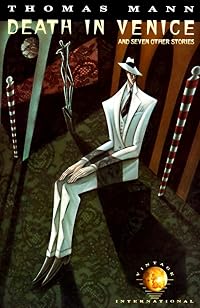
Death in Venice and Seven Other Stories
by Thomas Mann 
On This Page
Description
Eight complex stories illustrative of the author's belief that "a story must tell itself," highlighted by the high art style of the famous title novella.Tags
Recommendations











Member Recommendations
Member Reviews
On the second page of this fine short novel the protagonist, Gustave von Aschenbach, goes on a walk to "refresh" himself and soon finds himself in a cemetery whose mortuary is "a structure in the Byzantine style". Like a wind from the East the place mesmerizes him with mystical symbols until he is "brought back to reality by the sight of a man standing in the portico". This man presents an exotic visage with red hair and represents a motif that will recur several times during the story. The image of this man, perhaps, leads Aschenbach to a simple longing for travel and then a hallucination that suggests the impulse of Eros or the throes of Dionysus. Whichever it is the setting is ominous as we are reminded that "his life was on the show more wane" and he plans to travel south on a journey.
The narrative takes the writer Gustav von Aschenbach to Venice, where he falls in love with an adolescent boy before subsequently dying in the cholera-stricken city. Mann’s masterly command of language and play with mythology, his psychological profile of the artistic mind, and the novella’s contrast between cold artistic discipline and the power of Eros is magnificent both in its form and substance.
Aschenbach is introduced as an esteemed author who has produced literary works known for their formalism and neo-classical style. He has chosen an ascetic, disciplined life, a life of “noble purity, simplicity and symmetry”, for the sake of his creativity, success and national reputation. At the beginning of Death in Venice, we find the fifty-three year old writer unable to write a perfectly balanced work. The walk he takes at the beginning of the narrative occurs in an unnamed town that can be identified as Munich. The year, presented in the text as “19—”, is actually 1911. Since Mann opted not to provide a precise date, the narrative contains a timeless, ahistorical dimension despite being grounded in contemporary events.
In the figure of a stranger whom Aschenbach sees at the mortuary, Mann alludes to medieval personifications of death, and also to the Greek god Hermes, the guide to the Underworld. But the messenger of death is also a messenger of life. The text links him to the cult of life and the god of Asian origins, Dionysus. Mann's original intention was to write a treatise on the Nietzschean contrast between the god of reason, Apollo, and the god of unreason, Dionysus. In his description of Aschenbach’s journey into Venice, Mann includes encounters with a Charon-like figure, and an old queen of a man bereft of dignity. These characters echo the original man he met in the cemetery and serve as messengers signalling Aschenbach’s looming fate, and as conspicuous representations of the transience and ugliness of life.
The Venice depicted by Mann is "the fallen queen, flattering and dubious beauty . . . half fairy tale, half tourist trap". It is a vision presented in its sordid reality and in its mythical splendor. At the hotel Aschenbach catches sight of a beautiful, fourteen-year-old Polish boy named Tadzio who is vacationing with his family. Aschenbach is immediately attracted to his idealized perfection, comparing him to a Greek statue and an artistic masterpiece. Although the sultry air of Venice makes him feel unwell, he reverses his intention to leave the city. From now on, his life is controlled by Eros, his desire, as he continues to observe Tadzio.
With references to the Platonic idea that physical attraction inspired by Eros leads to spiritual knowledge, Mann diverts readers from the fact that Aschenbach’s attraction to Tadzio is primarily physical, not metaphysical. The ability of Thomas Mann to weave together character and theme and setting to achieve this perfection is uncanny and I do not believe he achieved any better in his longer fictions, great as they are. This is also one of the few novels that received a superlative treatment on film though, in the end, Visconti's film does not surpass the original.
Among the several stories included in this volume The Blood of the Volsungs is another one that stands out in its differences and its use of music as a foundation.
This little drama begins at the dining-room table where both the theme of generational conflict between the parents and children of the Aarenhold family and 'racial' conflict between the family and an outsider, a government bureaucrat named Beckerath who is engaged to Sieglinde, the elder of two daughters in the family. In this story music is intertwined with the plot beginning with the twin brother, Siegmund, who with his sister mirror the siblings in Act One of Wagner's opera Die Valkyrie. But the musical influence goes beyond this as when, for example, one of the children taps out Hunding's motif (Sieglinde's husband from Valkyrie) when Beckerath appears for lunch; through the musical interlude at the opera which the siblings attend; and the ensuing incestuous behavior of the same upon returning home.
These themes are played out over a single day in the life of this family. We see the children, turning away from the valetudinarianism of their father and mother, focusing on their own interests. These interests do not include the sort of hard work that Beckerath represented and they looked down on him as well. And from his perspective "they contradicted everything--as though they found it impossible, discreditable, lamentable, not to contradict."
The importance of race is most intense for Siegmund whom is presented as contemplating his racial characteristics as he prepares for the evening with Sieglinde. But also he is depicted as completely lacking in any interest in creating anything with his life; instead he is consumed with a passion for maintaining his toilette, for preparing himself for the day, as the day passes away quickly with no actual happenings. This was no surprise to the family for they exhibited a "lack of expectations" that conspired to rob him of any "actuality".
This may sound like a strange story. Perhaps it is, but Mann succeeds in presenting high tragedy in the form of melodrama. His satire seems well-suited to critique the superficial nature of the bourgeoisie at the end of the nineteenth century (Mann wrote the story in 1905). The strength of the story comes in great part from the high art of the operatic drama that underlies it. It may be that Mann in an indirect way was indicating how powerful Wagner's genius really could be. show less
The narrative takes the writer Gustav von Aschenbach to Venice, where he falls in love with an adolescent boy before subsequently dying in the cholera-stricken city. Mann’s masterly command of language and play with mythology, his psychological profile of the artistic mind, and the novella’s contrast between cold artistic discipline and the power of Eros is magnificent both in its form and substance.
Aschenbach is introduced as an esteemed author who has produced literary works known for their formalism and neo-classical style. He has chosen an ascetic, disciplined life, a life of “noble purity, simplicity and symmetry”, for the sake of his creativity, success and national reputation. At the beginning of Death in Venice, we find the fifty-three year old writer unable to write a perfectly balanced work. The walk he takes at the beginning of the narrative occurs in an unnamed town that can be identified as Munich. The year, presented in the text as “19—”, is actually 1911. Since Mann opted not to provide a precise date, the narrative contains a timeless, ahistorical dimension despite being grounded in contemporary events.
In the figure of a stranger whom Aschenbach sees at the mortuary, Mann alludes to medieval personifications of death, and also to the Greek god Hermes, the guide to the Underworld. But the messenger of death is also a messenger of life. The text links him to the cult of life and the god of Asian origins, Dionysus. Mann's original intention was to write a treatise on the Nietzschean contrast between the god of reason, Apollo, and the god of unreason, Dionysus. In his description of Aschenbach’s journey into Venice, Mann includes encounters with a Charon-like figure, and an old queen of a man bereft of dignity. These characters echo the original man he met in the cemetery and serve as messengers signalling Aschenbach’s looming fate, and as conspicuous representations of the transience and ugliness of life.
The Venice depicted by Mann is "the fallen queen, flattering and dubious beauty . . . half fairy tale, half tourist trap". It is a vision presented in its sordid reality and in its mythical splendor. At the hotel Aschenbach catches sight of a beautiful, fourteen-year-old Polish boy named Tadzio who is vacationing with his family. Aschenbach is immediately attracted to his idealized perfection, comparing him to a Greek statue and an artistic masterpiece. Although the sultry air of Venice makes him feel unwell, he reverses his intention to leave the city. From now on, his life is controlled by Eros, his desire, as he continues to observe Tadzio.
With references to the Platonic idea that physical attraction inspired by Eros leads to spiritual knowledge, Mann diverts readers from the fact that Aschenbach’s attraction to Tadzio is primarily physical, not metaphysical. The ability of Thomas Mann to weave together character and theme and setting to achieve this perfection is uncanny and I do not believe he achieved any better in his longer fictions, great as they are. This is also one of the few novels that received a superlative treatment on film though, in the end, Visconti's film does not surpass the original.
Among the several stories included in this volume The Blood of the Volsungs is another one that stands out in its differences and its use of music as a foundation.
This little drama begins at the dining-room table where both the theme of generational conflict between the parents and children of the Aarenhold family and 'racial' conflict between the family and an outsider, a government bureaucrat named Beckerath who is engaged to Sieglinde, the elder of two daughters in the family. In this story music is intertwined with the plot beginning with the twin brother, Siegmund, who with his sister mirror the siblings in Act One of Wagner's opera Die Valkyrie. But the musical influence goes beyond this as when, for example, one of the children taps out Hunding's motif (Sieglinde's husband from Valkyrie) when Beckerath appears for lunch; through the musical interlude at the opera which the siblings attend; and the ensuing incestuous behavior of the same upon returning home.
These themes are played out over a single day in the life of this family. We see the children, turning away from the valetudinarianism of their father and mother, focusing on their own interests. These interests do not include the sort of hard work that Beckerath represented and they looked down on him as well. And from his perspective "they contradicted everything--as though they found it impossible, discreditable, lamentable, not to contradict."
The importance of race is most intense for Siegmund whom is presented as contemplating his racial characteristics as he prepares for the evening with Sieglinde. But also he is depicted as completely lacking in any interest in creating anything with his life; instead he is consumed with a passion for maintaining his toilette, for preparing himself for the day, as the day passes away quickly with no actual happenings. This was no surprise to the family for they exhibited a "lack of expectations" that conspired to rob him of any "actuality".
This may sound like a strange story. Perhaps it is, but Mann succeeds in presenting high tragedy in the form of melodrama. His satire seems well-suited to critique the superficial nature of the bourgeoisie at the end of the nineteenth century (Mann wrote the story in 1905). The strength of the story comes in great part from the high art of the operatic drama that underlies it. It may be that Mann in an indirect way was indicating how powerful Wagner's genius really could be. show less
Death in Venice by Thomas Mann is a story of obsession and isolation. Aschenbach, a writer of rarefied fictions, takes a holiday to Venice where he sees a beautiful youth of 15 years. He is immediately taken in by the boy's beauty and very quickly becomes obsessed with him. Aschenbach finds he is staying at the same hotel as the boy, so he studies the boy's daily habits, making sure that he is at the beach when the boy will be, ready for breakfast when the boy is, he even follows his family when the boy goes on tours of the city. He never attempts to meet the boy or to speak with him though he does learn his name, Tadzio, and quite a bit of his family history.
Is Aschenbach a man in love or just a man obsessed? He learns as much as he show more can about Tadzio from secondhand sources like the hotel barber, but his knowledge remains so limited that the Tazio he comes to love is largely a Tadzio of his own imagination. Aschenbach can see what the boy looks like, but he does not know him in any real way. Aschenbach indulges in his obsession, staying on at the hotel as long as he can, in spite of the very real threat of a cholera outbreak in the emptying city.
The city becomes a metaphor for Aschebach. Its decay, its age, its vulnerablity to disease are all mirrored in Aschenbach. The facade Venice puts on to attract visitors is mirrored in the fancy suits the fifty plus man wears in an attempt to make himself attractive. Neither the city nor the man can do much to really attract the attentions of a beautiful youth, those days are gone for both. The city provides attractions for the boy's aging mother and aunt who've brought their children in tow; the man can do nothing more than follow along trying to steal a glimpse of the youth he will not have again in any form.
For all of its melancholy, all of its atmosphere of decay and the fact that the main character never talks to the object of his desire, Death in Venice is a highly readable story. While I did not really like Aschenbach at first, and I honestly can't say that I'm too fond of him by the end either, his story does become compelling. He does become a sympathetic character in spite of it all. By then end our understanding of what is happening to him has deepened making his story a haunting one.
I'm giving Death in Venice by Thomas Mann five out of five stars. show less
Is Aschenbach a man in love or just a man obsessed? He learns as much as he show more can about Tadzio from secondhand sources like the hotel barber, but his knowledge remains so limited that the Tazio he comes to love is largely a Tadzio of his own imagination. Aschenbach can see what the boy looks like, but he does not know him in any real way. Aschenbach indulges in his obsession, staying on at the hotel as long as he can, in spite of the very real threat of a cholera outbreak in the emptying city.
The city becomes a metaphor for Aschebach. Its decay, its age, its vulnerablity to disease are all mirrored in Aschenbach. The facade Venice puts on to attract visitors is mirrored in the fancy suits the fifty plus man wears in an attempt to make himself attractive. Neither the city nor the man can do much to really attract the attentions of a beautiful youth, those days are gone for both. The city provides attractions for the boy's aging mother and aunt who've brought their children in tow; the man can do nothing more than follow along trying to steal a glimpse of the youth he will not have again in any form.
For all of its melancholy, all of its atmosphere of decay and the fact that the main character never talks to the object of his desire, Death in Venice is a highly readable story. While I did not really like Aschenbach at first, and I honestly can't say that I'm too fond of him by the end either, his story does become compelling. He does become a sympathetic character in spite of it all. By then end our understanding of what is happening to him has deepened making his story a haunting one.
I'm giving Death in Venice by Thomas Mann five out of five stars. show less
Death in Venice by Thomas Mann
This novella, at only 73 pages in my Triangle Classic version, should have taken me a few hours to read. Instead it took a week, partially on account of 'real life' intruding on preferred occupations. However, I can't fully blame real life for my slow pace, as I found the first 14 pages or so quite dense, convoluted and near impenetrable. Finally after the sixth or seventh time rereading, I sighed and went on, hoping to be able to ken the rest without a full and thorough knowledge of those precious pages. I hoped I'd picked up enough of the ambiance.
An aging, somewhat reclusive author, stifled by his narrow existence, quite out of character, wishes to get away from his life, to vacation, escape, call it show more what he will, it stems from a general malaise, and dissatisfaction with his lot in life. He finally travels to Venice, a place where he has unsuccessfully attempted previous vacations, hoping this time will be the charm. Ironically, it is, or is it?
Gustave Aschenbach has lead a solitary life, essentially a loveless life. There was a wife, a child in his past, but these are swept over quickly, he has devoted his life to his Art, his Writing. He feels all emotion, all sensory input more intensely than most, and suffers for it, but sacrifices that pain to his gods.
This is not the Venice of romance novels, this Venice is rank, humid, and unhealthy, presented in a way I have not seen before. Mann's prose captures the miasma that surrounds the city, the reader can smell the rankness and unhealthy vapors that rise from the canals, we can smell the disease, the fear of the citizenry, and shrink from it. When Aschenbach eats a handful of over ripe strawberries, we feel and smell the softness and decaying sweetness.
In a sultry Venice, lightening strikes, and Aschenbach falls deeply and hopelessly in love, with a young Polish boy, a boy whose whole physical demeanor speaks of the Greek poets and ancient sculpture. Aschenbach, in spite of his strong, almost over-powering feelings, shows humble nobility of character and never directly approaches the boy, he worships from afar, they barely speak in fact. Exquisitely aware of each other, their eyes speak the volumes they cannot. Mann seems to create a lover's triangle consisting of the boy, Tadzio, Aschenbach and Venice itself, with Aschenbach shadowing his object of desire through the rapidly emptying City, helpless to stop himself and leave the place before the quarantine is imposed and he is trapped. But in a real sense he is already trapped by his quiet but deadly obsession.
An obsession that could claim his life, or Tadzio's. To whom does the death in the title refer? One? Both? Venice's death?
I wasn't sure till the very end.
Read, and enjoy.
I highly recommend this novella. 4.5/5 show less
This novella, at only 73 pages in my Triangle Classic version, should have taken me a few hours to read. Instead it took a week, partially on account of 'real life' intruding on preferred occupations. However, I can't fully blame real life for my slow pace, as I found the first 14 pages or so quite dense, convoluted and near impenetrable. Finally after the sixth or seventh time rereading, I sighed and went on, hoping to be able to ken the rest without a full and thorough knowledge of those precious pages. I hoped I'd picked up enough of the ambiance.
An aging, somewhat reclusive author, stifled by his narrow existence, quite out of character, wishes to get away from his life, to vacation, escape, call it show more what he will, it stems from a general malaise, and dissatisfaction with his lot in life. He finally travels to Venice, a place where he has unsuccessfully attempted previous vacations, hoping this time will be the charm. Ironically, it is, or is it?
Gustave Aschenbach has lead a solitary life, essentially a loveless life. There was a wife, a child in his past, but these are swept over quickly, he has devoted his life to his Art, his Writing. He feels all emotion, all sensory input more intensely than most, and suffers for it, but sacrifices that pain to his gods.
This is not the Venice of romance novels, this Venice is rank, humid, and unhealthy, presented in a way I have not seen before. Mann's prose captures the miasma that surrounds the city, the reader can smell the rankness and unhealthy vapors that rise from the canals, we can smell the disease, the fear of the citizenry, and shrink from it. When Aschenbach eats a handful of over ripe strawberries, we feel and smell the softness and decaying sweetness.
In a sultry Venice, lightening strikes, and Aschenbach falls deeply and hopelessly in love, with a young Polish boy, a boy whose whole physical demeanor speaks of the Greek poets and ancient sculpture. Aschenbach, in spite of his strong, almost over-powering feelings, shows humble nobility of character and never directly approaches the boy, he worships from afar, they barely speak in fact. Exquisitely aware of each other, their eyes speak the volumes they cannot. Mann seems to create a lover's triangle consisting of the boy, Tadzio, Aschenbach and Venice itself, with Aschenbach shadowing his object of desire through the rapidly emptying City, helpless to stop himself and leave the place before the quarantine is imposed and he is trapped. But in a real sense he is already trapped by his quiet but deadly obsession.
An obsession that could claim his life, or Tadzio's. To whom does the death in the title refer? One? Both? Venice's death?
I wasn't sure till the very end.
Read, and enjoy.
I highly recommend this novella. 4.5/5 show less
Exposition, exposition, exposition. Mann is the painterly sort of writer who seems to think that if you describe a setting with enough detail, then the conflict will naturally emerge. This seems like an impressionistic mode of writing - we learn a lot of odds and ends about each protagonist in each story before we understand what the story is actually about. The author in the title story spends time traveling in southern Europe and eventually ends up in Europe, has an encounter with a gondolier, ends up in a hotel where he becomes obsessed with a young Polish boy. The point? Well, the point seems to be create a mood of unresolved foreboding. Readers who need clear plot structure will probably be frustrated by Mann. This collection of show more stories makes me want to investigate his novels. Thanks for reading my review. show less
A tricky collection of short stories that often deals with the consequences of obsession, the Prey is often unreachable and distant yet palpable enough to propel the characters to delve deep down the dark depths of overindulgence. The Predator broods. Frequently, it's too late to extricate themselves from it. Some can be a little inane whilst the other short stories mirror the brewing political turmoil in Germany during Mann's time.
It seems that this collection I procured have different contents compared to what others have around here. Maybe if this collection was comprised of what the others have I would've appreciate it better.
Death in Venice (3.5/5)
Hyper-fixation on a beautiful young boy who undoubtedly represents the frame of youth show more and the envy plus the repressed desire it entails. This is probably one of the most popular short stories of Mann. Beautiful words.
Tonio Kröger (3.5/5)
An ordinary story with extraordinary prose about an artist as an outcast to society. It's rather depressing and remorseful.
Mario and the Magician (3/5)
A taxing and underwhelming story if not for its themes of liberalism and liberty amidst the growing fascism in Germany which are not too apparent until I made my research.
Disorder and Early Sorrow (2.5/5)
I am still not very sure what this is about. A family chronicle, perhaps, but not that interesting and, well, forgettable. Ask me about it and my mind is blank. Regarded as a portrait of Mann's own family.
A Man and His Dog (4/5)
Dogs, these silly, adorable creatures which always occupy an affectionate space in our hearts. A delightful tale of the adventures of a man and his dog. Tender and amusing, it is another evidence as to why dogs are considered as a man's best friend.
The Blood of the Walsungs (4/5)
Is the most forbidden fruit the most delicious? This short story is both unsettling and (I'm making a stretch) a little disgusting then climaxes (pun not intended) to a sense of emotional revenge. This is intriguingly the most compelling short story in this collection for me. It has left me disturbed and I cannot forget it.
Tristan (3.5/5)
An unrequited love in a sanatorium, anti-romantic with a case of delusions and assumptions like a case of beer you binge in the middle of a wearisome night. A juxtaposition to Tristan and Isolde.
Felix Krull (3/5)
Another narrative chronicling the downfall of a wealthy family and the inevitable change in social status that forces its members to adapt to things they are unaccustomed to (or not). It is paragraphs and paragraphs of family drama that we've all seen in soap operas ending in a sad but not surprising note. show less
It seems that this collection I procured have different contents compared to what others have around here. Maybe if this collection was comprised of what the others have I would've appreciate it better.
Death in Venice (3.5/5)
Hyper-fixation on a beautiful young boy who undoubtedly represents the frame of youth show more and the envy plus the repressed desire it entails. This is probably one of the most popular short stories of Mann. Beautiful words.
Tonio Kröger (3.5/5)
An ordinary story with extraordinary prose about an artist as an outcast to society. It's rather depressing and remorseful.
Mario and the Magician (3/5)
A taxing and underwhelming story if not for its themes of liberalism and liberty amidst the growing fascism in Germany which are not too apparent until I made my research.
Disorder and Early Sorrow (2.5/5)
I am still not very sure what this is about. A family chronicle, perhaps, but not that interesting and, well, forgettable. Ask me about it and my mind is blank. Regarded as a portrait of Mann's own family.
A Man and His Dog (4/5)
Dogs, these silly, adorable creatures which always occupy an affectionate space in our hearts. A delightful tale of the adventures of a man and his dog. Tender and amusing, it is another evidence as to why dogs are considered as a man's best friend.
The Blood of the Walsungs (4/5)
Is the most forbidden fruit the most delicious? This short story is both unsettling and (I'm making a stretch) a little disgusting then climaxes (pun not intended) to a sense of emotional revenge. This is intriguingly the most compelling short story in this collection for me. It has left me disturbed and I cannot forget it.
Tristan (3.5/5)
An unrequited love in a sanatorium, anti-romantic with a case of delusions and assumptions like a case of beer you binge in the middle of a wearisome night. A juxtaposition to Tristan and Isolde.
Felix Krull (3/5)
Another narrative chronicling the downfall of a wealthy family and the inevitable change in social status that forces its members to adapt to things they are unaccustomed to (or not). It is paragraphs and paragraphs of family drama that we've all seen in soap operas ending in a sad but not surprising note. show less
This is Thomas Mann’s classic novelette. The central character, Gustave von Aschenbach, retreats to Venice to escape writer's block and problems in his personal life. He is attracted to Venice by its beauty and its ability to overcome challenges that periodically threaten its existence. Anyone reading this novelette is alerted to the likelihood there will be death in the story and are continually wondering if Aschenbach is going to die. That is a constant presence as one is reading the story. It is to Mann’s great credit that the word death never appears until the very last word of the very last sentence. But it is constantly on a reader’s mind trying to determine why this attention-getting word is the very first word of the show more title. Surely somewhere somehow someone is going to die. Will it be Aschenbach? Stay tuned is the constant, behind the lines, message.
There is almost no dialogue in this story. Aschenbach is by himself and has no one to talk to. What we learn is through his inner thoughts and the narrator’s descriptions.. The narrator seems to know what Aschenbach is thinking. Aschenbach’s entire life has been a search for beauty. He looks around him and analyzes everything in the light of the classical forms of beauty described in Greek literature. But his attention is quickly drawn to a young Polish boy who everyone calls Tadziu. He believes Tadziu is a shortened form of Thaddeus. Initially he just sees Tadziu from afar, playing with his friends. Eventually he needs a closer look. He sees in Tadziu the embodiment of what Aschenbach considers beauty. Soon he begins to arrange his visits to the beach to coincide with when he expects Tadziu to be there. Then he starts following Tadziu. Tadziu senses his presence and gives him minor acknowledgement. Tadziu sees him. Aschenbach is ecstatic. Today we would see this as stalking and pedophilia and be repulsed but no such issues seem to bother Mann. At best there is some concern for potential homosexuality. That is there but it is never voiced.
At one point Aschenbach decides to leave. Only as he is about to get on a train he learns his luggage has gone ahead without his permission. He decides to return to Venice. He begins to notice that some streets are being disinfected. No one is willing to share with him the reason. They tell him about the Sirocco winds and the summer heat. He follows Tadziu’s Polish family as they also ignore the situation. But people begin to leave the hotel. He eventually is told that the plague is the reason why the streets of Venice are being disinfected. Even the Polish family finally decides to leave. That’s enough for him. He’ll leave the next morning. But it’s too late. The prophecy of the title is fulfilled. He dies during the night. Not unexpected.
I had not heard of any films being made of this story. But a check of IMDB revealed that Benjamin Britten had turned it into an opera and Luchino Visconti made a movie of it in 1971. How would Visconti deal with a story told mainly by a narrator and having little dialogue. By changing Achenbach from a writer to a composer and using very long visuals of the beautiful city and sea and several flashbacks Visconti overcame the lack of dialogue. It was slow moving but easier to follow than the novelette. Another change was to make Tadziu’s awareness of being watched appear much earlier and more often than in the novel. It’s worth renting on Amazon Prime. show less
There is almost no dialogue in this story. Aschenbach is by himself and has no one to talk to. What we learn is through his inner thoughts and the narrator’s descriptions.. The narrator seems to know what Aschenbach is thinking. Aschenbach’s entire life has been a search for beauty. He looks around him and analyzes everything in the light of the classical forms of beauty described in Greek literature. But his attention is quickly drawn to a young Polish boy who everyone calls Tadziu. He believes Tadziu is a shortened form of Thaddeus. Initially he just sees Tadziu from afar, playing with his friends. Eventually he needs a closer look. He sees in Tadziu the embodiment of what Aschenbach considers beauty. Soon he begins to arrange his visits to the beach to coincide with when he expects Tadziu to be there. Then he starts following Tadziu. Tadziu senses his presence and gives him minor acknowledgement. Tadziu sees him. Aschenbach is ecstatic. Today we would see this as stalking and pedophilia and be repulsed but no such issues seem to bother Mann. At best there is some concern for potential homosexuality. That is there but it is never voiced.
At one point Aschenbach decides to leave. Only as he is about to get on a train he learns his luggage has gone ahead without his permission. He decides to return to Venice. He begins to notice that some streets are being disinfected. No one is willing to share with him the reason. They tell him about the Sirocco winds and the summer heat. He follows Tadziu’s Polish family as they also ignore the situation. But people begin to leave the hotel. He eventually is told that the plague is the reason why the streets of Venice are being disinfected. Even the Polish family finally decides to leave. That’s enough for him. He’ll leave the next morning. But it’s too late. The prophecy of the title is fulfilled. He dies during the night. Not unexpected.
I had not heard of any films being made of this story. But a check of IMDB revealed that Benjamin Britten had turned it into an opera and Luchino Visconti made a movie of it in 1971. How would Visconti deal with a story told mainly by a narrator and having little dialogue. By changing Achenbach from a writer to a composer and using very long visuals of the beautiful city and sea and several flashbacks Visconti overcame the lack of dialogue. It was slow moving but easier to follow than the novelette. Another change was to make Tadziu’s awareness of being watched appear much earlier and more often than in the novel. It’s worth renting on Amazon Prime. show less
For me (and how often is that the caveat when we feel we have read something important that did not resonate), this is a group of remarkably uninspired stories. There is lush detail, no doubt. The descriptions of the places and the people are brought to life. But there is nothing to tell about them. And, when something is told, I found little to resonate so that I cared what was happening. The best of this group is “Mario and the Magician” about a magician with apparent mind control abilities who embarrasses the wrong person during his show. In this case, the descriptions of the character and the locale all built to support the story (which supported the characters and the locale.) The absolute worst – “A Man and His Dog”. I show more like dogs just as well as the next person, but this is more than I ever wanted to know. It feels like the author was trying to complete a required word count for submission to a collection of original stories about dogs (and I’ll bet this shows up in many of such collections.)
For me to understand the power of Thomas Mann will take the reading of some other materials. And reading these has meant that it will be a while before I try again. show less
For me to understand the power of Thomas Mann will take the reading of some other materials. And reading these has meant that it will be a while before I try again. show less
Members
- Recently Added By
Lists

Short Story Collections and Anthologies
261 works; 42 members

Publishing Triangle 100 Best Lesbian and Gay Novels
97 works; 6 members

Literary Works Read in College
316 works; 15 members

Books With Place Names in the Title
215 works; 10 members

Books Set in Italy
167 works; 19 members

20th Century Literature
1,161 works; 55 members
Author Information

Thomas Mann was born into a well-to-do upper class family in Lubeck, Germany. His mother was a talented musician and his father a successful merchant. From this background, Mann derived one of his dominant themes, the clash of views between the artist and the merchant. Mann's novel, Buddenbrooks (1901), traces the declining fortunes of a merchant show more family much like his own as it gradually loses interest in business but gains an increasing artistic awareness. Mann was only 26 years old when this novel made him one of Germany's leading writers. Mann went on to write The Magic Mountain (1924), in which he studies the isolated world of the tuberculosis sanitarium. The novel was based on his wife's confinement in such an institution. Doctor Faustus (1947), his masterpiece, describes the life of a composer who sells his soul to the devil as a price for musical genius. Mann is also well known for Death in Venice (1912) and Mario the Magician (1930), both of which portray the tensions and disturbances in the lives of artists. His last unfinished work is The Confessions of Felix Krull, Confidence Man (1954), a brilliantly ironic story about a nineteenth-century swindler. An avowed anti-Nazi, Mann left Germany and lived in the United States during World War II. He returned to Switzerland after the war and became a celebrated literary figure in both East and West Germany. In 1929 he was awarded the Nobel Prize for literature. (Bowker Author Biography) show less
Thomas Mann has a Legacy Library. Legacy libraries are the personal libraries of famous readers, entered by LibraryThing members from the Legacy Libraries group.
All Editions
Some Editions
Awards and Honors
Notable Lists
Series
Belongs to Publisher Series
Vintage Original (V-3)
Vintage Books (V-3)
Work Relationships
Common Knowledge
- Canonical title
- Death in Venice and Seven Other Stories
- Original publication date
- 19121954
- People/Characters
- Gustav von Aschenbach; Tadzio
- Publisher's editor
- Mitchell, Susan
- Blurbers
- Pick, Robert
- Original language
- German
- Disambiguation notice
- Contains: Death in Venice, Mario and the Magician, Disorder and Early Sorrow, A Man and His Dog, Felix Krull [short story], The Blood of the Walsungs, Tristan, and Tonio Kroeger. Do not combine with other collections containi... (show all)ng different stories.
Classifications
- Genres
- Fiction and Literature, General Fiction
- DDC/MDS
- 833.912 — Literature & rhetoric German & related literatures German fiction 1900- 1900-1990 1900-1945
- LCC
- PT2625 .A44 .A25 — Language and Literature German, Dutch and Scandinavian literatures German literature Individual authors or works 1860/70-1960
- BISAC
Statistics
- Members
- 2,607
- Popularity
- 7,236
- Reviews
- 19
- Rating
- (3.88)
- Languages
- English
- Media
- Paper, Ebook
- ISBNs
- 7
- ASINs
- 25