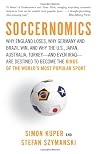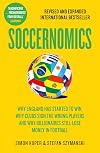
Soccernomics: Why England Loses, Why Germany and Brazil Win, and Why the U.S., Japan, Australia, Turkey--and Even Iraq--Are Destined to Become the Kings of the World's Most Popular Sport
by Simon Kuper, Stefan Szymanski, Stefan Szymanski
On This Page
Description
Using insights and analogies from economics, statistics, psychology, and business to cast a new and entertaining light on how the game of soccer works, "Soccernomics" reveals the often surprisingly counterintuitive truths about the world's most popular game. An essential guide for the 2010 World Cup.Tags
Recommendations





























Member Recommendations

chazzard The authors of Soccernomics frequently refer to Moneyball, and apply similar statistical methods.
20

by anonymous user
Member Reviews
With the World Cup in full swing, soccer clichés slide from the mouths of devoted supporters and objective commentators.
Read any World Cup match report or listen to a sports-talk radio station and you will inevitably hear points documented in Kuper’s book:
“… The penalty looks like the most unfair device in all of sports …” (p. 114); “… Whenever a country bids to host a World Cup or an Olympics, its politicians prophesy an ‘economic bonanza’ …” (p. 236); or “… An African country would ‘soon’ win the World Cup” (p. 306).
Since these sayings and many others like them become recognized as true in virtue of their logic alone, Kuper and Szymanski offer Soccernomics as a remedy to heal the biases that keep show more fans, players, and management in a bedridden state of clichés and superficial knowledge.
Written along the lines of Moneyball by Michael Lewis, Kuper and Szymanski suggest that soccer ought to be evaluated not by well-trodden clichés but by the data. With the wit of a creative writer and the statistical graphs of an economist, Soccernomics splits into three sections that seek to find answers debunking common sayings.
The Clubs: Racism, Stupidity, Bad Transfers, Capital Cities, the Mirage of the NFL, and What Actually Happened in That Penalty Shoot-Out in Moscow
This portion of the book dives into the business of soccer. It describes the continually poor decisions made by most clubs, and provides anecdotes of successful people bucking the trend of unwise financial decisions such as Arsѐne Wenger, a trained economist and the manager of the North London soccer club Arsenal, and Jean-Michel Aulas, a former software entrepreneur who is now the president of the soccer club Olympique Lyon located in the French city of Lyon.
Aulas in particular became notable for his process of purchasing players in their early 20s when they were cheaper and selling them for top Euro as they hit their prime ages of 27 to 29.
The Fans: Loyalty, Suicides, Happiness, and the Country with the Best Supporters
After outlining the soccer business, Kuper and Szymanski proceed to the consumer, where the authors seek to learn more about the buying practices of the fans. Are people life-long fans of one team or do they support many? Is the passion for soccer so great that when teams lose fans commit suicide?
Countries: Rich and Poor, Tom Thumb, Guus Ghiddink, Saddam, and the Champions of the Future
Although the sections on The Clubs and The Fans provide fascinating information on how professional soccer leagues worldwide run their “businesses” and how people respond to the product on the pitch — a term used in soccer to refer to the playing field — I was particularly interested in the Countries section.
Most soccer fans share a common conception, something along the lines of “since a large percentage of athletes come from poor or working-class backgrounds, poor nations will eventually become the world powers of soccer.”
At first glance, this reasoning seems to be correct. Wayne Rooney, who is the 2010 season’s leading scorer in the English Premier League, (widely considered the most prestigious league in the world) grew up in a home with a father who was often unemployed. While most middle-class parents encouraged their children to put down the soccer ball and get back to arithmetic, Wayne Rooney’s situation allowed him to continue practicing dribbling, passing, and shooting the soccer ball.
Of course, Soccernomics is not generalizing that all poor families are indifferent to education. Instead, the idea is that poor children are more likely to see sports as an avenue out of poverty.
Based in Malcom Gladwell’s Outliers: The Story of Success, the writers argue that it takes 10,000 hours to become world-class at a certain skill. If living conditions allowed Rooney to practice more and become more skilled at a faster pace than children putting time in other activities, many figure that the same should apply to the youth in impoverished nations.
Poverty as a Game Changer
However, the data prove this concept to be false. Kuper and Szymanski write,
“Growing tall is not just a matter of what you eat. When children become ill, their growth is interrupted, and because poor children tend to get ill more often than rich ones, they usually end up shorter … The ghost of apartheid will bug the Bafana [The nickname of the South African national soccer team] at the World Cup. One reason South Africans are so bad at soccer is that most of them didn’t get enough good food” (p. 266).
Considering the population of South Africa and popularity of the sport, the South African soccer team should be one of the dominant nations. However, the argument of the writers becomes even more convincing when we see that in this current World Cup, not only has South Africa become the first host nation in history to not advance from the group stages to the knockout stages, but also out of the five African nations represented in the tournament, only Ghana advanced to the playoff rounds.
In addition to a 10,000-hour rule, Kuper and Szymanski propose a “fifteen-thousand-dollar rule” as the minimum per capita income for a nation to succeed at international sports. Although Wayne Rooney grew up in a poor neighborhood relative to the rest of England, he still had nourishing meals and access to medical care. For many prospective soccer players around the world, the reality of poverty will deny them the goals of international athletic stardom.
While we watch the World Cup, it is imperative for people to remember the disadvantages people in poor countries must endure.
Although the common sentiment in the sports world is that international sporting events give poor countries a chance to compete on equal ground with rich countries, the facts tell us that poverty provides a crippling shortcoming in competition. Poverty has devastating consequences. Not only does it alter the quality of life by limiting basic necessities, but also rids poor countries of the ability to experience the unifying joy of bringing home a world championship.
As a soccer fan, I thoroughly enjoyed this book. A reader might need a minimal understanding of how soccer works, but Kuper and Szymanski have an inviting prose that is open to those outside of soccer fandom. Considering that it is a World Cup year, I would recommend Soccernomics to anyone who has even the slightest interest in soccer. Since the writers do a fantastic job of breaking down the fiscal side of creating a strong professional club as well as a strong national team, I would also suggest this book to anyone who is interested in the economics of sport.
Although soccer brings a gentle reminder of the devastating impact of poverty in our broken world, the sport carries a unifying aspect illustrated every four years at the World Cup.
Originally Posted at http://spu.edu/depts/sbe/cib/reviews/review-soccernomics.asp show less
Read any World Cup match report or listen to a sports-talk radio station and you will inevitably hear points documented in Kuper’s book:
“… The penalty looks like the most unfair device in all of sports …” (p. 114); “… Whenever a country bids to host a World Cup or an Olympics, its politicians prophesy an ‘economic bonanza’ …” (p. 236); or “… An African country would ‘soon’ win the World Cup” (p. 306).
Since these sayings and many others like them become recognized as true in virtue of their logic alone, Kuper and Szymanski offer Soccernomics as a remedy to heal the biases that keep show more fans, players, and management in a bedridden state of clichés and superficial knowledge.
Written along the lines of Moneyball by Michael Lewis, Kuper and Szymanski suggest that soccer ought to be evaluated not by well-trodden clichés but by the data. With the wit of a creative writer and the statistical graphs of an economist, Soccernomics splits into three sections that seek to find answers debunking common sayings.
The Clubs: Racism, Stupidity, Bad Transfers, Capital Cities, the Mirage of the NFL, and What Actually Happened in That Penalty Shoot-Out in Moscow
This portion of the book dives into the business of soccer. It describes the continually poor decisions made by most clubs, and provides anecdotes of successful people bucking the trend of unwise financial decisions such as Arsѐne Wenger, a trained economist and the manager of the North London soccer club Arsenal, and Jean-Michel Aulas, a former software entrepreneur who is now the president of the soccer club Olympique Lyon located in the French city of Lyon.
Aulas in particular became notable for his process of purchasing players in their early 20s when they were cheaper and selling them for top Euro as they hit their prime ages of 27 to 29.
The Fans: Loyalty, Suicides, Happiness, and the Country with the Best Supporters
After outlining the soccer business, Kuper and Szymanski proceed to the consumer, where the authors seek to learn more about the buying practices of the fans. Are people life-long fans of one team or do they support many? Is the passion for soccer so great that when teams lose fans commit suicide?
Countries: Rich and Poor, Tom Thumb, Guus Ghiddink, Saddam, and the Champions of the Future
Although the sections on The Clubs and The Fans provide fascinating information on how professional soccer leagues worldwide run their “businesses” and how people respond to the product on the pitch — a term used in soccer to refer to the playing field — I was particularly interested in the Countries section.
Most soccer fans share a common conception, something along the lines of “since a large percentage of athletes come from poor or working-class backgrounds, poor nations will eventually become the world powers of soccer.”
At first glance, this reasoning seems to be correct. Wayne Rooney, who is the 2010 season’s leading scorer in the English Premier League, (widely considered the most prestigious league in the world) grew up in a home with a father who was often unemployed. While most middle-class parents encouraged their children to put down the soccer ball and get back to arithmetic, Wayne Rooney’s situation allowed him to continue practicing dribbling, passing, and shooting the soccer ball.
Of course, Soccernomics is not generalizing that all poor families are indifferent to education. Instead, the idea is that poor children are more likely to see sports as an avenue out of poverty.
Based in Malcom Gladwell’s Outliers: The Story of Success, the writers argue that it takes 10,000 hours to become world-class at a certain skill. If living conditions allowed Rooney to practice more and become more skilled at a faster pace than children putting time in other activities, many figure that the same should apply to the youth in impoverished nations.
Poverty as a Game Changer
However, the data prove this concept to be false. Kuper and Szymanski write,
“Growing tall is not just a matter of what you eat. When children become ill, their growth is interrupted, and because poor children tend to get ill more often than rich ones, they usually end up shorter … The ghost of apartheid will bug the Bafana [The nickname of the South African national soccer team] at the World Cup. One reason South Africans are so bad at soccer is that most of them didn’t get enough good food” (p. 266).
Considering the population of South Africa and popularity of the sport, the South African soccer team should be one of the dominant nations. However, the argument of the writers becomes even more convincing when we see that in this current World Cup, not only has South Africa become the first host nation in history to not advance from the group stages to the knockout stages, but also out of the five African nations represented in the tournament, only Ghana advanced to the playoff rounds.
In addition to a 10,000-hour rule, Kuper and Szymanski propose a “fifteen-thousand-dollar rule” as the minimum per capita income for a nation to succeed at international sports. Although Wayne Rooney grew up in a poor neighborhood relative to the rest of England, he still had nourishing meals and access to medical care. For many prospective soccer players around the world, the reality of poverty will deny them the goals of international athletic stardom.
While we watch the World Cup, it is imperative for people to remember the disadvantages people in poor countries must endure.
Although the common sentiment in the sports world is that international sporting events give poor countries a chance to compete on equal ground with rich countries, the facts tell us that poverty provides a crippling shortcoming in competition. Poverty has devastating consequences. Not only does it alter the quality of life by limiting basic necessities, but also rids poor countries of the ability to experience the unifying joy of bringing home a world championship.
As a soccer fan, I thoroughly enjoyed this book. A reader might need a minimal understanding of how soccer works, but Kuper and Szymanski have an inviting prose that is open to those outside of soccer fandom. Considering that it is a World Cup year, I would recommend Soccernomics to anyone who has even the slightest interest in soccer. Since the writers do a fantastic job of breaking down the fiscal side of creating a strong professional club as well as a strong national team, I would also suggest this book to anyone who is interested in the economics of sport.
Although soccer brings a gentle reminder of the devastating impact of poverty in our broken world, the sport carries a unifying aspect illustrated every four years at the World Cup.
Originally Posted at http://spu.edu/depts/sbe/cib/reviews/review-soccernomics.asp show less
What a great book! I didn’t really know what to expect, other than that it seemed like a popular book on soccer. It is also rather thick at around 450 pages. But as soon as I started reading I was hooked. It is extremely well written, and endlessly fascinating.
The authors have used statistical analysis in many areas related to soccer, such as penalty shots, manager impact, fan loyalty, most soccer-crazy country and the transfer market. It could have been a rather dry book, but it is not. There are so many interesting observations and conclusions in the chapters, and the writing is top-notch.
I particularly liked the chapter on which city teams have been successful in the European Cup. In it, the authors point out that teams that have show more been dominating are all from provincial cities, like Manchester, Barcelona, Munich, Marseille and Milan. For the most parts, the capitals have not done so well. As they write: the town of Nottingham still has more trophies – two – than London, Paris, Istanbul, Berlin and Moscow combined. The explanation they offer is that a lot of people moved to industrial towns a century ago, and one thing that united them was soccer. The capitals on the other hand had many other things to unite them, and did not need soccer in the same way. This pattern of which cities have the most successful soccer teams is rather obvious to me once it has been pointed out, yet I never made the connection myself before I read Soccernomics.
I also really liked the chapter on penalty taking. They write about the 2008 Champions League final between Chelsea and Manchester United that was decided on penalties. Chelsea had access to research about which side Van der Sar usually was diving to, depending on if the penalty taker was right-footed or left-footed. In the end, Van der Sar figured out the system Chelsea was using, and saved the last penalty to win the game for Manchester United. There are many more examples in this chapter on the use of statistics for penalty taking, and it is fascinating reading.
The chapter towards the end of the book on the rise of Spanish soccer was also very interesting. The authors’ thesis on why some countries are more successful in soccer than others is that the connected-ness and exchange of ideas between countries is the most important factor. Spain is an interesting example. In the 1970s, when Spain became more open, there was a heavy Dutch influence (Johan Cruijff, Rinus Michels) that proved very beneficial for Spanish soccer. The chapter does a very good tracing and analysing this development.
These were three chapters that stood out for me, but that doesn’t mean the others were bad. I thoroughly enjoyed all of them. My only little quibble is that when analysing the importance of the manager for a team, they concluded that it is quite rare that they have a big impact – team results are mostly determined by the quality of the players, with a few notable exceptions such as Alex Ferguson. But in the chapter on the English national team, they conclude that they have performed better with a foreign manager than with local manager. This seems a bit contradictory to me, but perhaps I misunderstood.
All in all though, a really great book. I have recommended it to everybody I know that is interested in soccer. show less
The authors have used statistical analysis in many areas related to soccer, such as penalty shots, manager impact, fan loyalty, most soccer-crazy country and the transfer market. It could have been a rather dry book, but it is not. There are so many interesting observations and conclusions in the chapters, and the writing is top-notch.
I particularly liked the chapter on which city teams have been successful in the European Cup. In it, the authors point out that teams that have show more been dominating are all from provincial cities, like Manchester, Barcelona, Munich, Marseille and Milan. For the most parts, the capitals have not done so well. As they write: the town of Nottingham still has more trophies – two – than London, Paris, Istanbul, Berlin and Moscow combined. The explanation they offer is that a lot of people moved to industrial towns a century ago, and one thing that united them was soccer. The capitals on the other hand had many other things to unite them, and did not need soccer in the same way. This pattern of which cities have the most successful soccer teams is rather obvious to me once it has been pointed out, yet I never made the connection myself before I read Soccernomics.
I also really liked the chapter on penalty taking. They write about the 2008 Champions League final between Chelsea and Manchester United that was decided on penalties. Chelsea had access to research about which side Van der Sar usually was diving to, depending on if the penalty taker was right-footed or left-footed. In the end, Van der Sar figured out the system Chelsea was using, and saved the last penalty to win the game for Manchester United. There are many more examples in this chapter on the use of statistics for penalty taking, and it is fascinating reading.
The chapter towards the end of the book on the rise of Spanish soccer was also very interesting. The authors’ thesis on why some countries are more successful in soccer than others is that the connected-ness and exchange of ideas between countries is the most important factor. Spain is an interesting example. In the 1970s, when Spain became more open, there was a heavy Dutch influence (Johan Cruijff, Rinus Michels) that proved very beneficial for Spanish soccer. The chapter does a very good tracing and analysing this development.
These were three chapters that stood out for me, but that doesn’t mean the others were bad. I thoroughly enjoyed all of them. My only little quibble is that when analysing the importance of the manager for a team, they concluded that it is quite rare that they have a big impact – team results are mostly determined by the quality of the players, with a few notable exceptions such as Alex Ferguson. But in the chapter on the English national team, they conclude that they have performed better with a foreign manager than with local manager. This seems a bit contradictory to me, but perhaps I misunderstood.
All in all though, a really great book. I have recommended it to everybody I know that is interested in soccer. show less
I've had this book waiting to be read on my bookcase for as long as I can remember. I've picked it up several times but always decided to read something else due to the length of it (450ish pages). It is written by a football journalist, Kuper, and a football fan economist, Szymanski, with the view to exploring the truth behind a lot of the generally accepted football maxims. While there are parts of the books which are really good, such as exploring why teams started to sign black players in the 80's when the league was basically racist, most of it feels slightly cherry picked. There are also some startling contradictions. For example, in the first half of the book Rafa Benitez is portrayed as doing a poor job because he spent a lot of show more money on players per point achieved. Then towards the end of the book he is portrayed as a good manager because of his wage bill per point achieved. Even if you ignore this contradiction most football fans accept that managers rarely get the final say in the signings they make and it if often done by committee. I know for a fact that Benitez really needed a winger when he first came to Liverpool. The club wouldn't or couldn't buy who he wanted so he ended up with Antonio Nunez as he was the only available player who fitted the price point. Nunez was a poor signing but Benitez should not be held solely accountable for it.
Another telling section deals with how Barcelona train kids at their youth setup and how this delivers value for money. Unfortunately for the writers this section was written after the academy had produced the likes of Victor Valdez, Xavi, Andres Iniesta, Pedro, Sergio Busquets, and Leo Messi. I say unfortunate because since then they have produced very few if any players who have gone on to become stars in the first team with Sergi Roberto being the only real exception. Successful academies tend to have 'golden generations' which excel. The academies then produce players who mainly end up transfered to other teams with the odd player making it in the first team and Barcelona have followed this common pattern. The writers also extol the fact that the academy focuses on techincal skill and not athleticism when it comes to training their players. Being a small player is not a problem to them and they actively look for players other teams have overlooked. They use Leo Messi to prove this point. This convieniently misses the fact that Messi had a condition that needed growth hormone treatment from the age of 13 until he became an adult. When he joined Barcelona as a kid one of the big drivers was that the club would pay for the medical treatment he needed, something his family couldn't afford in Argentina. His size was an issue, and although there was a medical need, they never the less took steps to ensure he wasn't too small to succeed. Admittedly this is a minor point but I felt it would have been better suited to use Andres Iniesta for this example.
A final nail in the coffin for me is the fact that Damien Comolli is used as an example of the direction teams should go in when appointing a director of football. Unfortunately, he proved to not be particularly good at identifying talent during his time at Liverpool and left after a string of players failed to make the grade. He was also considered a failure at Saint-Etienne and is currently not working in football at all. show less
Another telling section deals with how Barcelona train kids at their youth setup and how this delivers value for money. Unfortunately for the writers this section was written after the academy had produced the likes of Victor Valdez, Xavi, Andres Iniesta, Pedro, Sergio Busquets, and Leo Messi. I say unfortunate because since then they have produced very few if any players who have gone on to become stars in the first team with Sergi Roberto being the only real exception. Successful academies tend to have 'golden generations' which excel. The academies then produce players who mainly end up transfered to other teams with the odd player making it in the first team and Barcelona have followed this common pattern. The writers also extol the fact that the academy focuses on techincal skill and not athleticism when it comes to training their players. Being a small player is not a problem to them and they actively look for players other teams have overlooked. They use Leo Messi to prove this point. This convieniently misses the fact that Messi had a condition that needed growth hormone treatment from the age of 13 until he became an adult. When he joined Barcelona as a kid one of the big drivers was that the club would pay for the medical treatment he needed, something his family couldn't afford in Argentina. His size was an issue, and although there was a medical need, they never the less took steps to ensure he wasn't too small to succeed. Admittedly this is a minor point but I felt it would have been better suited to use Andres Iniesta for this example.
A final nail in the coffin for me is the fact that Damien Comolli is used as an example of the direction teams should go in when appointing a director of football. Unfortunately, he proved to not be particularly good at identifying talent during his time at Liverpool and left after a string of players failed to make the grade. He was also considered a failure at Saint-Etienne and is currently not working in football at all. show less
This book is labeled “World Cup Edition”, so you think you’re getting a book about the World Cup. Wrong! This book is about English soccer with a couple chapters about Spain, South Africa, and the like thrown in at the end.
It’s obvious that this book was repackaged with minimal changes (from the first Soccernomics book) to coincide with 2014 World Cup. As a book that has practically nothing about the World Cup in it, that is some blatant false advertising. I can forgive a lot of things in a book, but not such an obvious disregard for the truth.
To make it worse, they contradict themselves rather a lot (for example saying that having more money doesn’t make you happier, then flipping by saying it does). Soccernomics was a very show more frustrating book to read. It was well written, but the authors have no regard for consistency or the truth. It had so much potential, but they just screwed it up. show less
It’s obvious that this book was repackaged with minimal changes (from the first Soccernomics book) to coincide with 2014 World Cup. As a book that has practically nothing about the World Cup in it, that is some blatant false advertising. I can forgive a lot of things in a book, but not such an obvious disregard for the truth.
To make it worse, they contradict themselves rather a lot (for example saying that having more money doesn’t make you happier, then flipping by saying it does). Soccernomics was a very show more frustrating book to read. It was well written, but the authors have no regard for consistency or the truth. It had so much potential, but they just screwed it up. show less
If you love both soccer and math as I do, or you simply want to acquire a rational framework for understanding why various national teams succeed and fail at the beautiful game, you owe it to yourself to read Kuper and Szymanski. This updated edition is well timed to be the ideal contextual read for Euro 2012. You don't need to understand regression analysis to understand the various analyses in this book. And there are at least as many entertaining anecdotes as statistical tables.
There's a special bonus insight for Canadians—it turns out that we are, by this book's mathematical model, the biggest soccer underachiever of all nations on earth. Maybe Danny Koevermans was on to something when he called Toronto FC "the worst team in the show more world", but he should have saved his criticism for a team that includes some past and current TFC starters—the Canadian men's national team. Go Canada! show less
There's a special bonus insight for Canadians—it turns out that we are, by this book's mathematical model, the biggest soccer underachiever of all nations on earth. Maybe Danny Koevermans was on to something when he called Toronto FC "the worst team in the show more world", but he should have saved his criticism for a team that includes some past and current TFC starters—the Canadian men's national team. Go Canada! show less
Some really interesting statistical/economic analyses of various big questions in soccer and sports. Great opening about England's patterns in the World Cup (the book was written before the 2010 Cup, and things played out very closely to predictions). The chapter on penalty kicks and the 2008 Champions League final was fascinating--professional penalty-takers mix it up instinctively. Interesting bits on how fans act, as well.
Pardon the pun, but really a tale of two halves. Section 1 on how clubs should obey the central tenets of soccernomics was very strong, full of illuminating anecdotes and great examples. After that, the sections on fan loyalty and which countries over/underachieve were a bit of a slog. I'd recommend it highly, provided you stopped at page 212.
Members
- Recently Added By
Published Reviews
ThingScore 100
Now, along comes Soccernomics, a sharply written and provocative examination of the world's game seen through the prism of economics and statistical data. It demolishes almost everything that most soccer fans believe about the game and how professional soccer teams should operate.
added by chazzard
Author Information

20+ Works 2,104 Members
Simon Kuper is one of the world's leading writers on soccer. The winner of the William Hill prize for sports book of the year in Britain, Kuper writes a weekly-column for the Financial Times. He lives in Paris.
1 Work 867 Members
11 Works 1,094 Members
Stefan Szymanski is Professor of Economics at Cass Business School, City University of London, where he runs the Sports Business Network.
Awards and Honors
Series
Belongs to Publisher Series
Critica Diabolis (194)
Common Knowledge
- Canonical title*
- Warum England immer verliert und andere kuriose Fußballphänomene
- Original title
- Soccernomics
- Original publication date
- 2009
- People/Characters
- Arsene Wenger; Arsenal FC; Guus Hiddink; Olympique Lyonnais; Manchester United FC; Football (show all 7); Soccer
- Important places
- Moscow, Russia; London, England, UK; Lyon, Rhône, Auvergne-Rhône-Alpes, France
- Important events
- World Cup
- First words
- This book began in the Hilton in Istanbul.
- Last words
- (Click to show. Warning: May contain spoilers.)Only poverty does.
*Some information comes from Common Knowledge in other languages. Click "Edit" for more information.
Classifications
- Genres
- Sports and Leisure, Economics, Nonfiction, General Nonfiction
- DDC/MDS
- 796.334 — Arts & recreation Recreation, sports, and performing arts Athletic and outdoor sports and games Ball sports Inflated ball driven by the foot Soccer
- LCC
- GV943.9 .S64 .K88 — Geography, Anthropology and Recreation Recreation. Leisure Recreation. Leisure Sports Ball games: Baseball, football, golf, etc.
- BISAC
Statistics
- Members
- 887
- Popularity
- 30,605
- Reviews
- 24
- Rating
- (3.68)
- Languages
- 11 — Dutch, English, Estonian, Finnish, French, German, Italian, Malay, Portuguese, Spanish, Turkish
- Media
- Paper, Audiobook, Ebook
- ISBNs
- 31
- ASINs
- 17