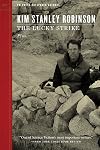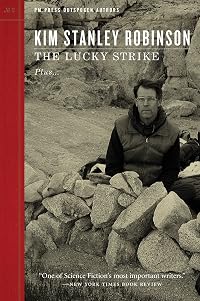
The Lucky Strike
by Kim Stanley Robinson
On This Page
Description
Combining dazzling speculation with a profoundly humanist vision, this astounding alternate history tale presents a dramatic encounter with destiny wrapped around a simple yet provocative premise: the terrifying question of what might have happened if the fateful flight over Hiroshima had gone a bit differently. An extensive interview with the author, offering insight into his fiction and philosophies, is also included.Tags
Recommendations







Member Reviews
Rating: 4.5* of five
The Publisher Says: Combining dazzling speculation with a profoundly humanist vision, this astounding alternate history tale presents a dramatic encounter with destiny wrapped around a simple yet provocative premise: the terrifying question of what might have happened if the fateful flight over Hiroshima had gone a bit differently. An extensive interview with the author, offering insight into his fiction and philosophies, is also included.
My Review: A fifty-seven page novella of alternative developments on Tinian Island in the run-up to the atom bombing of Japan in 1945. A sixteen-page essay on the nature of alternative history and its quantum influences. And a twenty-page interview of author Robinson by fellow show more author Terry Bisson.
In short, my little corner of Heaven delivered early.
I said some unkind things about talented writer Ian Tregillis's novel Bitter Seeds, having to do with that novel's use of superhero-y claptrap. Here is the diametric opposite of that novel, and thus the almost certain recipient of my most celebratory smiles. I'd probably give even a crummy alternative history novel, one presented in prose so wooden as to be describable as carpentered not written, three stars after that thoroughly disagreeable experience.
Happily, though, Robinson's accustomed prose mastery is intact and I needed no unhappy comparisons to convince me to award the story its four and a half stars. Frank January, bombardier of the Lucky Strike, is older than his crewmates, apart from them in social ways; they see him as Other, as he sees himself. Their responses to him help form his course of action when the Lucky Strike is called to duty as the carrier of the atomic bomb after the failure of the Enola Gay. Hiroshima is spared its place in history. Lives are lost, it's true, but January cannot bring himself to rain devastation down on the city most of us use in our mental inventory of metaphors as representative of annihilation.
The story ends as January's fate is decided. And, had there not been an essay called “A Sensitive Dependence on Initial Conditions” included in the book, I might have given The Lucky Strike three and a half stars, because the implications of the events in the story are so, well, so monumental, so completely brain-bending, that leaving me where it did would produce readerly, ummm, well interruptus of literary sort, with attendant shouts of anger and dismay.
The essay goes into some very interesting and convincing philosophical explorations of the nature of alternative historical fiction, likening the course of history to the particle-and-wave nature of light. Robinson uses The Lucky Strike as his lens of explanation, running through many possible outcomes of the facts as presented in the story used to explain the butterfly effect, the great man theory, and other established formulations of the central conundrum of history: Why did that happen the way it did? It's a terrific essay, one I want to have for my personal library, and it's been a struggle against my inner book-Gollum not to keep the liberry book and say I lost it....
Finally, the interview. I enjoyed reading the author's thoughts on SF, on writing, on politics (we're close on this subject), and I found his assertion that science and leftism are closely allied perceptive and heartening, since I believe that science and logic will eventually grind superstition and conservatism under their boot-heels.
I sure as hell hope so, anyway, since I do NOT want to live in a future hag-ridden by viciousness. show less
The Publisher Says: Combining dazzling speculation with a profoundly humanist vision, this astounding alternate history tale presents a dramatic encounter with destiny wrapped around a simple yet provocative premise: the terrifying question of what might have happened if the fateful flight over Hiroshima had gone a bit differently. An extensive interview with the author, offering insight into his fiction and philosophies, is also included.
My Review: A fifty-seven page novella of alternative developments on Tinian Island in the run-up to the atom bombing of Japan in 1945. A sixteen-page essay on the nature of alternative history and its quantum influences. And a twenty-page interview of author Robinson by fellow show more author Terry Bisson.
In short, my little corner of Heaven delivered early.
I said some unkind things about talented writer Ian Tregillis's novel Bitter Seeds, having to do with that novel's use of superhero-y claptrap. Here is the diametric opposite of that novel, and thus the almost certain recipient of my most celebratory smiles. I'd probably give even a crummy alternative history novel, one presented in prose so wooden as to be describable as carpentered not written, three stars after that thoroughly disagreeable experience.
Happily, though, Robinson's accustomed prose mastery is intact and I needed no unhappy comparisons to convince me to award the story its four and a half stars. Frank January, bombardier of the Lucky Strike, is older than his crewmates, apart from them in social ways; they see him as Other, as he sees himself. Their responses to him help form his course of action when the Lucky Strike is called to duty as the carrier of the atomic bomb after the failure of the Enola Gay. Hiroshima is spared its place in history. Lives are lost, it's true, but January cannot bring himself to rain devastation down on the city most of us use in our mental inventory of metaphors as representative of annihilation.
The story ends as January's fate is decided. And, had there not been an essay called “A Sensitive Dependence on Initial Conditions” included in the book, I might have given The Lucky Strike three and a half stars, because the implications of the events in the story are so, well, so monumental, so completely brain-bending, that leaving me where it did would produce readerly, ummm, well interruptus of literary sort, with attendant shouts of anger and dismay.
The essay goes into some very interesting and convincing philosophical explorations of the nature of alternative historical fiction, likening the course of history to the particle-and-wave nature of light. Robinson uses The Lucky Strike as his lens of explanation, running through many possible outcomes of the facts as presented in the story used to explain the butterfly effect, the great man theory, and other established formulations of the central conundrum of history: Why did that happen the way it did? It's a terrific essay, one I want to have for my personal library, and it's been a struggle against my inner book-Gollum not to keep the liberry book and say I lost it....
Finally, the interview. I enjoyed reading the author's thoughts on SF, on writing, on politics (we're close on this subject), and I found his assertion that science and leftism are closely allied perceptive and heartening, since I believe that science and logic will eventually grind superstition and conservatism under their boot-heels.
I sure as hell hope so, anyway, since I do NOT want to live in a future hag-ridden by viciousness. show less
This slim book includes the eponymous novella "The Lucky Strike," a closely-related essay "Sensitive Dependence on Initial Conditions," and an interview with author Kim Stanley Robinson by Terry Bisson. I would totally recommend it as a chaser for anyone who has just finished Robinson's The Years of Rice and Salt and can't stop thinking about it. (Not that further ideas on those lines will stop anyone thinking.) The story and the essay deal with philosophy of history, and the evolving understanding of the relationship between chance and determinism, under the sign of non-linear dynamics and its "strange attractors," as well as the relationship of all of this business to any understanding of free will.
The interview was entertaining, and show more reassured me that despite the prominence of Robinson's scientific curiosity and social conscience, his ambitions as a writer are primarily literary. I especially enjoyed his angry rejoinder to those who object to the expository elements of his style: "go read Moby Dick, Dostoevsky, Garcia Marquez, Jameson, Bakhtin, Joyce, Sterne--learn a little bit about what fiction can do, and then come back to me when you're done. That would be never, and I could go about my work in peace" (87). show less
The interview was entertaining, and show more reassured me that despite the prominence of Robinson's scientific curiosity and social conscience, his ambitions as a writer are primarily literary. I especially enjoyed his angry rejoinder to those who object to the expository elements of his style: "go read Moby Dick, Dostoevsky, Garcia Marquez, Jameson, Bakhtin, Joyce, Sterne--learn a little bit about what fiction can do, and then come back to me when you're done. That would be never, and I could go about my work in peace" (87). show less
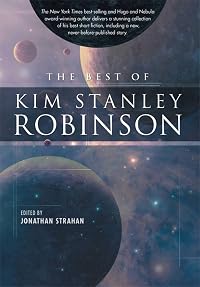
Both stories are included in the 2010 short story collection 'The Best Of Kim Stanley Robinson' – which collects 23 stories – so if you have that, or plan to get it, the question is if that interview merits the purchase.
"The Lucky Strike" is an alternative history set at the end of World War 2. I enjoyed it very much, even though I accidentally read a huge spoiler on Goodreads. Mildly unfortunate, it also shows Robinson’s power: appreciation for this story doesn’t hinge on the power of surprise.
The story envisions an alternative course for the end of WW2: the Enola Gay crashes during an exercise, and as a result Little Boy will be dropped on Japan by a different crew. The bombardier becomes Frank January, instead of Thomas show more Ferebee.
‘Frank’ being a recurring name in Robinson’s oeuvre, here he’s a stand-in for the conscientious objector. Other stuff is recognizably KSR as well, like FDR worship, an emphasis on the astonishing nature of human beings, and great writing about the vastness of our planet.
With limited means, Robinson manages to paint convincing characters – young, tribal, testosterone military men with emotions that are understandable given the stressful war environment. His understanding of consciousness shows: “The mind struggles longer in its traps than any fox.” The story is nuanced, but at the same time I felt Robinson’s choice to portray Frank as reader a form of tribalism itself: team emphatic readers vs. team non-reader brutes.
Whether the attacks on the city centers were necessary is up for debate. There’s an interesting comment by Paul Burgess on kimstanleyrobinson.info about the matter. Yes, the Hiroshima and Nagasaki bombings might have saved more lives than they costed. But remarks like that miss the point of this story – especially if you read it together with A Sensitive Dependence. The Lucky Strike isn’t so much about mapping out a valid, realistic leftist alternative history, but is about the choices we can make as individuals.
(...)
Full review on Weighing A Pig show less
"The Lucky Strike" is an alternative history set at the end of World War 2. I enjoyed it very much, even though I accidentally read a huge spoiler on Goodreads. Mildly unfortunate, it also shows Robinson’s power: appreciation for this story doesn’t hinge on the power of surprise.
The story envisions an alternative course for the end of WW2: the Enola Gay crashes during an exercise, and as a result Little Boy will be dropped on Japan by a different crew. The bombardier becomes Frank January, instead of Thomas show more Ferebee.
‘Frank’ being a recurring name in Robinson’s oeuvre, here he’s a stand-in for the conscientious objector. Other stuff is recognizably KSR as well, like FDR worship, an emphasis on the astonishing nature of human beings, and great writing about the vastness of our planet.
With limited means, Robinson manages to paint convincing characters – young, tribal, testosterone military men with emotions that are understandable given the stressful war environment. His understanding of consciousness shows: “The mind struggles longer in its traps than any fox.” The story is nuanced, but at the same time I felt Robinson’s choice to portray Frank as reader a form of tribalism itself: team emphatic readers vs. team non-reader brutes.
Whether the attacks on the city centers were necessary is up for debate. There’s an interesting comment by Paul Burgess on kimstanleyrobinson.info about the matter. Yes, the Hiroshima and Nagasaki bombings might have saved more lives than they costed. But remarks like that miss the point of this story – especially if you read it together with A Sensitive Dependence. The Lucky Strike isn’t so much about mapping out a valid, realistic leftist alternative history, but is about the choices we can make as individuals.
(...)
Full review on Weighing A Pig show less
This is a very powerful story that I have read before, but on my second or maybe third reading it really hit hard. Would the end of WW2 have been different if Roosevelt had not died? More to the point, maybe a demonstration of the atomic bomb offshore from Tokyo, for example, would have saved the lives and destruction of Hiroshima and Nagasaki. This story is among the best alternative history speculations. This particular book containing the story and discussion is the best.
So great! It's really got me thinking about the philosophy of history, and Walter Benjamin's idea that the stories we tell can "foreclose" both certain pasts and even certain futures. Great, economical writing - I'll definitely be reading more of Robinson!
I don't always love Kim Stanley Robinson (I thought the Mars trilogy could have been one book, with far less useless words) but Lucky Strike and the other story were just the right mix of good story telling and a wise use of words. There is a lot of depth in a small amount of pages. I really want to give it four and a half stars, but that's not an option
Really just a set of two short stories, or one novella and a short story. Then a long interview with the author about writing, his social thoughts, and such. The main story is about what happens if the crew that was to fly the Enola Gay crashed and never bombed Japan and that task fell on another crew. Another crew that might make different decisions about dropping an atomic bomb. Interesting story -but probably not worth publishing basically alone in this short form.
Members
- Recently Added By
Lists

Best Alternate History
111 works; 60 members

Books Read in 2020
4,379 works; 124 members
Author Information

146+ Works 49,407 Members
Kim Stanley Robinson was born in Orange County, California on March 23, 1952. He received a B. A. and Ph. D. from the University of California at San Diego and an M. A. from Boston University. His first trilogy of books, Orange County, collectively won a Nebula Award and two Hugo Awards. His other works include the Mars trilogy, 2312, and Aurora. show more He has won an Asimov Award, a World Fantasy Award, a Locus Reader's Poll Award, and a John W. Campbell Award. (Bowker Author Biography) show less
Some Editions
Series
Belongs to Publisher Series
Work Relationships
Common Knowledge
- Canonical title
- The Lucky Strike
- Original publication date
- 2009
- Important events
- World War II (1939 | 1945); Atomic Bombings of Hiroshima and Nagasaki (1945)
Classifications
Statistics
- Members
- 200
- Popularity
- 161,847
- Reviews
- 16
- Rating
- (4.02)
- Languages
- English, Greek, Turkish
- Media
- Paper, Ebook
- ISBNs
- 7
- ASINs
- 3