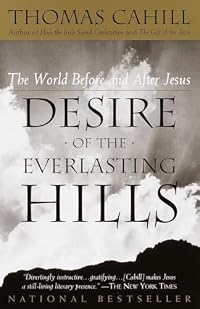
Desire of the Everlasting Hills: The World Before and After Jesus
by Thomas Cahill
Hinges of History (3)
On This Page
Description
A fresh look at the impact of Jesus & early Christianity on the shaping of Western civilization.Tags
Recommendations






Member Reviews
I found very little redeeming about this book and finally abandoned it about 2/3 through.
The author has a very secular understanding of the Bible and Jewish history. He misses half the point, the whole point, and all of the beauty most of the time. His chapters on the life of Jesus were full of mocking untruths and misunderstandings. I get the overall impression that this author calls himself a "Christian" but I'd love to read something like this from an actual whole Bible believer.
Even taking into consideration his odd sense of humor (at one point I wrote in my notes: "it takes a bit to get his humor. I think I’m probably more sensitive than I should be with some of his points.") his very skewed interpretation of the impact of Jesus show more and the Bible makes this book extremely disappointing. In fact, looking over his biography, this is the perfect example of someone who hears the word, studies the word, (paid good, good money to learn the Hebrew Bible even), but completely misses the message.
I often wondered, "is he actually a respected historian?" (He describes martyrdom as a genre of mythology.) I couldn't get past the screwy interpretations that Paul and the first century church were not encouraging their followers to follow Torah. The author misunderstands, misinterprets, and misrepresents Torah throughout. It takes more than big words and reputation to make a scholar. This one can’t get his own theology straight, saying on one page that 2 Timothy couldn’t possibly have been written by Paul but on the next page encouraging us to imagine Paul “thinking, as he wrote in Second Timothy…”. Ok then.
He relegates Revelation to a silly fun mystery story written by a bored John in exile. He cracks the 666 code for us (oh thank you, wise scholar!) and explains (with a "big duh!!! mentality) that it merely refers to Nero. News flash: 666 using gematria also works for several phrases including the name Barak Obama, Prince Arthur, Thomas Cruise, and "This is a Hoax". When whoever this person is is actually revealed, this passage will be made clear, just as the ones about the delivery of the mark of the beast or the fact that the whole world will look on the dead witnesses were made more understandable once technology caught up and revealed possible scenarios.
The nonsense probably didn't stop there, but that's where I stopped. I can't stomach this "scholarly" misrepresented garbage. I'd encourage potential readers to save time and do their own research. Much of what he talks about is common knowledge of history---this book was more about furthering the enemy's secular agenda disguised as modern day Christianity. show less
The author has a very secular understanding of the Bible and Jewish history. He misses half the point, the whole point, and all of the beauty most of the time. His chapters on the life of Jesus were full of mocking untruths and misunderstandings. I get the overall impression that this author calls himself a "Christian" but I'd love to read something like this from an actual whole Bible believer.
Even taking into consideration his odd sense of humor (at one point I wrote in my notes: "it takes a bit to get his humor. I think I’m probably more sensitive than I should be with some of his points.") his very skewed interpretation of the impact of Jesus show more and the Bible makes this book extremely disappointing. In fact, looking over his biography, this is the perfect example of someone who hears the word, studies the word, (paid good, good money to learn the Hebrew Bible even), but completely misses the message.
I often wondered, "is he actually a respected historian?" (He describes martyrdom as a genre of mythology.) I couldn't get past the screwy interpretations that Paul and the first century church were not encouraging their followers to follow Torah. The author misunderstands, misinterprets, and misrepresents Torah throughout. It takes more than big words and reputation to make a scholar. This one can’t get his own theology straight, saying on one page that 2 Timothy couldn’t possibly have been written by Paul but on the next page encouraging us to imagine Paul “thinking, as he wrote in Second Timothy…”. Ok then.
He relegates Revelation to a silly fun mystery story written by a bored John in exile. He cracks the 666 code for us (oh thank you, wise scholar!) and explains (with a "big duh!!! mentality) that it merely refers to Nero. News flash: 666 using gematria also works for several phrases including the name Barak Obama, Prince Arthur, Thomas Cruise, and "This is a Hoax". When whoever this person is is actually revealed, this passage will be made clear, just as the ones about the delivery of the mark of the beast or the fact that the whole world will look on the dead witnesses were made more understandable once technology caught up and revealed possible scenarios.
The nonsense probably didn't stop there, but that's where I stopped. I can't stomach this "scholarly" misrepresented garbage. I'd encourage potential readers to save time and do their own research. Much of what he talks about is common knowledge of history---this book was more about furthering the enemy's secular agenda disguised as modern day Christianity. show less
The hinge in history that has been the central pillar of Western civilization is not a cultural change nor a particular people but one man, Jesus of Nazareth. Thomas Cahill explores the developments of thought before and after Jesus in Desire of the Everlasting Hills through the lens of Greco-Roman and Jewish cultures, his mother Mary, Paul, Luke, Early Christians, and John to reveal how one life both continued and changed the progression of Western thought.
Over the course of 320 pages, Thomas Cahill focused on Jesus of Nazareth as the central figure in the West. However from the outset Cahill makes it clear that the role of Jesus is how others perceived him both during his life and after his time on Earth. While following Jesus during show more his ministry, Cahill highlighted the essential Jewishness of Jesus’ message and how some considered his message unrealistic while others found hope. After Jesus’ time on Earth, a phrase I must use since Cahill does not state one way or another on the event of the Resurrection save mentioning it, the essence of his divinity was shaped by Paul’s Jewish perspective, Luke’s gentile perspective, and John the Evangelist’s intimate perspective. Cahill’s conclusion is that while Jesus is central to the West, the West as a whole has essentially ignored his teachings but a small few due resulting in the slow but development of the ideas that define Western civilization.
While Cahill’s analysis and themes are a thought provoking read, I did have some serious issues. The first is the same as in his previous book, The Gift of the Jews, which is in some of Cahill’s interpretation and subsequent logical construction of his evidence whether through scripture or an analysis of non-Biblical sources to weave his thesis. The second is partially related and that is Cahill tries to weave a middle course between Jesus as man and Jesus as divine without really take a stand either way. While objectivity can be commended, the book read as a Christian trying too hard to look discuss Jesus from a secular point of view.
Regardless of one’s view of Jesus of Nazareth, no one can deny that he is the central figure of West. Thomas Cahill attempts to bring forth Jesus through the view of those around him and how they interpreted his life and teachings. While Desire of the Everlasting Hills is not a perfect book, it is thought-provoking in viewing Jesus of Nazareth back in the first century AD and into today’s increasing secular society. show less
Over the course of 320 pages, Thomas Cahill focused on Jesus of Nazareth as the central figure in the West. However from the outset Cahill makes it clear that the role of Jesus is how others perceived him both during his life and after his time on Earth. While following Jesus during show more his ministry, Cahill highlighted the essential Jewishness of Jesus’ message and how some considered his message unrealistic while others found hope. After Jesus’ time on Earth, a phrase I must use since Cahill does not state one way or another on the event of the Resurrection save mentioning it, the essence of his divinity was shaped by Paul’s Jewish perspective, Luke’s gentile perspective, and John the Evangelist’s intimate perspective. Cahill’s conclusion is that while Jesus is central to the West, the West as a whole has essentially ignored his teachings but a small few due resulting in the slow but development of the ideas that define Western civilization.
While Cahill’s analysis and themes are a thought provoking read, I did have some serious issues. The first is the same as in his previous book, The Gift of the Jews, which is in some of Cahill’s interpretation and subsequent logical construction of his evidence whether through scripture or an analysis of non-Biblical sources to weave his thesis. The second is partially related and that is Cahill tries to weave a middle course between Jesus as man and Jesus as divine without really take a stand either way. While objectivity can be commended, the book read as a Christian trying too hard to look discuss Jesus from a secular point of view.
Regardless of one’s view of Jesus of Nazareth, no one can deny that he is the central figure of West. Thomas Cahill attempts to bring forth Jesus through the view of those around him and how they interpreted his life and teachings. While Desire of the Everlasting Hills is not a perfect book, it is thought-provoking in viewing Jesus of Nazareth back in the first century AD and into today’s increasing secular society. show less
This book is an interesting look at the cultures, people, languages, and events that shaped the world around Jesus. From the influence of Alexander the Great and the Greeks on the Jews to the personalities and writing styles of Jesus's early followers, many intriguing influences are discussed. While not comprehensive, Cahill's mostly-secular work is both engaging and accessible.
Between 1995 and 2013, Thomas Cahill released a series of books called The Hinges of History, about, as one might guess, critical turning points the history of western civilization. This book, the third in the series, is about the impact Jesus, his teachings, and his followers had on history.
Cahill presents the Mediterranean world before the birth of Jesus, what we know about his life--and yes, historians that have studied his time agree he existed--and how his teachings and his followers changed the prevalent worldview after him. He examines not just what the New Testament tells us directly, but what textual analysis tells us about the New Testament. This includes when the Gospels were written, the clear evidence that different Gospels show more were written at different times, closer to or further from the death of Jesus, that some parts of the New Testament were apparently based on an earlier source document closer to Jesus' own lifetime, etc. And of course, Mathew, Mark, Luke, John, and Paul all show different cultural, social, and economic backgrounds, reflected in how they tell Jesus' story, including what incidents they tell or omit, or emphasize or de-emphasize.
Interwoven with all this is the broader history of the region and era, how this affected the Jesus movement as well as broader Jewish culture--because for much of this period, the Jesus movement was simply one of many Jewish splinter belief groups. Of the many Jewish denominations of the time, only two, the Pharisees and the Christians, survived the end of the ancient world. Unfortunately, they became fratricidal enemies, with the Christians, in the long run, doing overwhelmingly most of the damage.
Cahill is at all times both careful and respectful, valuing every culture's contributions. The previous volume in this series was The Gifts of the Jews: How a Tribe of Desert Nomads Changed the Way Everyone Thinks and Feels, while the next one was Sailing the Wine-Dark Sea: Why the Greeks Matter. This is a serious look at an important piece of our history, not an evangelical work. It's well-written, thoughtful, and in the case of this audiobook edition, I liked the job the narrator did.
Recommended.
I bought this audiobook. show less
Cahill presents the Mediterranean world before the birth of Jesus, what we know about his life--and yes, historians that have studied his time agree he existed--and how his teachings and his followers changed the prevalent worldview after him. He examines not just what the New Testament tells us directly, but what textual analysis tells us about the New Testament. This includes when the Gospels were written, the clear evidence that different Gospels show more were written at different times, closer to or further from the death of Jesus, that some parts of the New Testament were apparently based on an earlier source document closer to Jesus' own lifetime, etc. And of course, Mathew, Mark, Luke, John, and Paul all show different cultural, social, and economic backgrounds, reflected in how they tell Jesus' story, including what incidents they tell or omit, or emphasize or de-emphasize.
Interwoven with all this is the broader history of the region and era, how this affected the Jesus movement as well as broader Jewish culture--because for much of this period, the Jesus movement was simply one of many Jewish splinter belief groups. Of the many Jewish denominations of the time, only two, the Pharisees and the Christians, survived the end of the ancient world. Unfortunately, they became fratricidal enemies, with the Christians, in the long run, doing overwhelmingly most of the damage.
Cahill is at all times both careful and respectful, valuing every culture's contributions. The previous volume in this series was The Gifts of the Jews: How a Tribe of Desert Nomads Changed the Way Everyone Thinks and Feels, while the next one was Sailing the Wine-Dark Sea: Why the Greeks Matter. This is a serious look at an important piece of our history, not an evangelical work. It's well-written, thoughtful, and in the case of this audiobook edition, I liked the job the narrator did.
Recommended.
I bought this audiobook. show less
I don't think I could possibly sing the praises of this book enough. It is an excellent discourse on just what is so special about Christ and about the faith, Christianity, named after him. Cahill is an intelligent, rational thinker and an articulate, nearly poetic, individual both at the same time. This is a very rare combination indeed, and one that leads Cahill in this book, as in the others I've read by him, to be able to work through problems logically, cogently explain the solution he's reached, and, even when you disagree with that solution, offer you some deep insights along the way.
This is the 3rd in Thomas Cahill's Hinges of History series. Like its predecessors, this book is well written and researched. He examines the impact of the teachings of Jesus on Western culture, through an in-depth analysis of the writings of Peter, Paul, Luke, and John. It is an interesting and insightful book,
Why is it that texts which present themselves as overviews, summations, or syntheses find it so difficult to cite specific supporting evidence instead of alluding to it?
Mr. Cahill's book might be better subtitled "The New Testament in Context." He provides some background material on the age, and then readings of each of the portrayals of Jesus. This is no mean feat. However, it is not what the book claims to explicate, which is the specific impact of Jesus on the world and why he was such a pivotal figure. You get a sense of it from the discussion of the Gospel of Luke and the Pauline letters, but there's little demonstration, merely statements. The last chapter, summarizing all that happened after the writing of the Gospels, has the show more feel of post hoc ergo propter hoc about it.
But the book did make me pick up the Bible again, and the bibliographical essay did have interesting leads for further reading. show less
Mr. Cahill's book might be better subtitled "The New Testament in Context." He provides some background material on the age, and then readings of each of the portrayals of Jesus. This is no mean feat. However, it is not what the book claims to explicate, which is the specific impact of Jesus on the world and why he was such a pivotal figure. You get a sense of it from the discussion of the Gospel of Luke and the Pauline letters, but there's little demonstration, merely statements. The last chapter, summarizing all that happened after the writing of the Gospels, has the show more feel of post hoc ergo propter hoc about it.
But the book did make me pick up the Bible again, and the bibliographical essay did have interesting leads for further reading. show less
Members
- Recently Added By
Author Information

Awards and Honors
Distinctions
Series

Common Knowledge
- Canonical title
- Desire of the Everlasting Hills: The World Before and After Jesus
- Original publication date
- 1999-11
- People/Characters
- Alexander the Great; Judas Maccabeus; Antiochus IV; Jesus Christ
- Important places
- Judah; Greece; Macedonia; The Levant
- Important events
- Alexander the Great's Conquest; Death of Alexander the Great; Maccabean Revolt
- Dedication
- To Joey. Christ minds: Christ's interest, what to avow or amend There, eyes them, heart wants, care haunts, foot follows kind, Their ransom, their rescue, and first, fast, last friend.
- First words
- The axial age was over.
- Quotations
- The purpose of the Gospel is to comfort the afflicted and afflict the comfortable.
- Last words
- (Click to show. Warning: May contain spoilers.)He is the Life.
Love Him in the World of the Flesh.
And at your marriage all its occasions shall dance for joy.
Classifications
Statistics
- Members
- 2,106
- Popularity
- 9,704
- Reviews
- 20
- Rating
- (3.75)
- Languages
- 6 — Dutch, English, Italian, Spanish, Swedish, Portuguese (Portugal)
- Media
- Paper, Audiobook, Ebook
- ISBNs
- 23
- ASINs
- 13