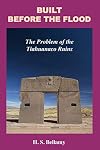
Built before the flood;: The problem of the Tiahuanaco ruins
by Hans Schindler Bellamy
On This Page
Description
The ancient site of Tiahuanaco in Bolivia is one of the greatest archaeological mysteries in the world. Some experts date it to 17,000 years ago, although no one has conclusively determined its age. Located at the southern end of Lake Titicaca at about 13,000 feet above sea level, one can find oceanic seashells in the area and ruins of extensive docks on an earlier shoreline. How could this be? This book takes a radical approach by presenting evidence, found at Tiahuanaco, for Earth having show more had a different moon in the remote past. According to the author, the gravitational pull of this moon caused higher water levels in the area. It also caused a different rotational spin of our planet that is accurately documented in the ancient calendar, found and interpreted by the author and others, that appears on the face of Tiahuanaco's most iconic landmark, the Gate of the Sun. This well researched book contains many notes, charts, and diagrams to support the author's claims, as well as an Index and Bibliography for further reference. show lessTags
Member Reviews
Most readers are going to bring Tiwanaku-specific expectations to this book (logically so, since "Tiahuanaco"--the Spanish rendering of "Tiwanaku"--appears in the subtitle), and those readers will be disappointed. It is about Tiwanaku, sort of, but Bellamy regards the celebrated archaeological site primarily as a proof of Hanns Hörbiger's discredited "cosmic ice" theory, and devotes much more space to an explanation of that theory (specifically, of its alleged impact on Tiwanaku's geographical location) than to any analysis of Tiwanaku itself. Could Earth once have been orbited by another satellite before it captured its present Moon, and could that earlier satellite have orbited closer and closer to Earth, finally breaking apart and show more causing cataclysmic upheaval? This part of Hörbiger's theory, at least, seems plausible enough to me. But Bellamy, like Hörbiger himself, insists on unequivocal acceptance. He maintains that this theory is the only possible explanation for Tiwanaku's Gate of the Sun, which he interprets as a calendar documenting a significantly shorter solar year than our present one. Bellamy attributes this to the distorting influence of the earlier moon that eventually broke apart.
Possible? Certainly, but it doesn't tell us anything about the Tiwanaku people or their background. The author is content to leave these mysteries essentially unaddressed because he's more interested in Hörbiger's theory than in Tiwanaku. It's a sincere, serious-minded effort nonetheless, and worthy of a three-star rating. (That being said, Bellamy's explanation of the calendar is lengthy, tedious, and--at least to the average reader not smitten by Hörbiger--seemingly arbitrary. A circular symbol on the Gate of the Sun absolutely means thus and such, except in cases where it absolutely doesn't. And if so many of these interpretations are irrefutably correct, how can the meaning of some symbols remain--as he concedes--unknown? If the theory actually hangs together as well as Bellamy claims, shouldn't the significance of these obscure symbols, in relation to the others, soon become apparent? Despite his repeated assurances, it feels more like detailed guesswork than an airtight hypothesis. He assumes a lot, and you just have to accept it if you intend to get through the book.) Bellamy does draw the reader's attention to the many depictions of toxodons at Tiwanaku: surely an indication of the city's great age, since toxodons became extinct 11,000 years ago. show less
Possible? Certainly, but it doesn't tell us anything about the Tiwanaku people or their background. The author is content to leave these mysteries essentially unaddressed because he's more interested in Hörbiger's theory than in Tiwanaku. It's a sincere, serious-minded effort nonetheless, and worthy of a three-star rating. (That being said, Bellamy's explanation of the calendar is lengthy, tedious, and--at least to the average reader not smitten by Hörbiger--seemingly arbitrary. A circular symbol on the Gate of the Sun absolutely means thus and such, except in cases where it absolutely doesn't. And if so many of these interpretations are irrefutably correct, how can the meaning of some symbols remain--as he concedes--unknown? If the theory actually hangs together as well as Bellamy claims, shouldn't the significance of these obscure symbols, in relation to the others, soon become apparent? Despite his repeated assurances, it feels more like detailed guesswork than an airtight hypothesis. He assumes a lot, and you just have to accept it if you intend to get through the book.) Bellamy does draw the reader's attention to the many depictions of toxodons at Tiwanaku: surely an indication of the city's great age, since toxodons became extinct 11,000 years ago. show less
Ratings
Members
- Recently Added By
Author Information
8+ Works 56 Members
Classifications
Statistics
- Members
- 13
- Popularity
- 1,766,828
- Reviews
- 1
- Rating
- (4.00)
- Languages
- English
- Media
- Paper
- ISBNs
- 1
- ASINs
- 1