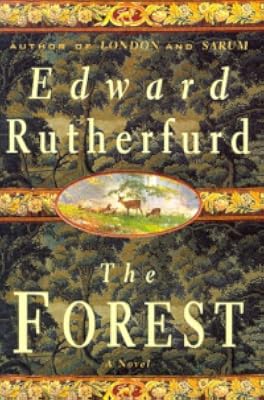
The Forest
by Edward Rutherfurd
On This Page
Description
NATIONAL BESTSELLER • “Rutherford brings England’s New Forest to life” ( The Seattle Times ) in this companion to the critically acclaimed Sarum From the time of the Norman Conquest to the present day, the New Forest, along England’s southern coast, has remained an almost mythical place. It is here that Saxon and Norman kings rode forth with their hunting parties, and where William the Conqueror’s son Rufus was mysteriously killed. The mighty oaks of the forest were used show more to build the ships for Admiral Nelson’s navy, and the fishermen who lived in Christchurch and Lymington helped Sir Francis Drake fight off the Spanish Armada. The New Forest is the perfect backdrop for the families who people this epic story. The feuds, wars, loyalties, and passions of many hundreds of years reach their climax in a crime that shatters the decorous society of Bath in the days of Jane Austen, whose family lived on the edge of the Forest. Edward Rutherfurd is a master storyteller whose sense of place and character—both fictional and historical—is at its most vibrant in The Forest. “As entertaining as Sarum and Rutherford’s other sweeping novel of British history, London. ”— The Boston Globe show lessTags
Recommendations






Member Reviews
''Even the forest grows new oaks.''
When I see a book by Edward Rutherfurd, the effects are the same as when I see a creation by Ken Follett. I believe that most die-hard lovers of Historical Fiction have placed these two writers on a high pedestal. Rutherfurd's books aren't heavy on the romance element like Follett's and this is a significant plus for me. So, it was with great enthusiasm that I started reading The Forest and I was not disappointed.
But why did Rutherfurd choose to write about the Forest? Well, The New Forest in the county of Hampshire is a place steeped in history and folklore. It is the largest ancient forest in England and therefore, it stands as an everlasting witness to many crucial moments in British History. Prince show more Richard and William II, the sons of William the Conqueror, died in the Forest and the legend goes that they died as a punishment for their father's faults. A mix of folktales and apocryphas covers the area making it one of the most fascinating and mystical places to visit in England. A version of King Arthur's legend claims that there is a hidden lake said to have been the birthplace of Excalibur and the domain of the Lady of the Lake. On July 31 in 1940, the English witches gathered in the New Forest and raised a powerful cone to stop the advances of Hitler's forces. Many stories of ghosts and weird, unexplained sightings grace the place and the village of Beaulieu is particularly high in the list of strange activity.
It goes without saying that all these elements are present in Rutherfurd's book and dealt with in a unique, beautiful way. The history of the forest is told in nine stories, through the eyes of two opposing families (Rutherfurd's favourite technique) and their course over the ages and the generations. Each story centers around two powerful themes, the struggle for power and the worries over the preservation of the forest. We see that the machinations people use to climb up the ladder of society and the effects of greed over the natural environment are similar through time in an eerie, discomforting way.
For me, the stories that really stand out in The Forest are ''The Hunt'', ''Beaulieu'', ''Alice'' and ''The Albion Park'', although each story is a necessary piece of the beautiful puzzle the writer has created. In ''The Hunt'' , set in the era of William the Conqueror, we meet a wonderful allusion of Man Vs Nature in the form of the agony of a young doe to protect her newly-born fawn during the continuous huntings of the nobles in the sacred forest. Like the beautiful doe, Adela -the heroine of the story- is trying to break free from the patriarchal society, being in the unfortunate position of having a noble name but no dowry.
''Beaulieu'' is set in the era of Edward I, the well-known Longshanks. Here, we see the games the Church uses to gain control of the Forest over the noblemen. At the heart of the story is a beautiful relationship between two people who are separated by the Law of God and the laws of men alike. Brother Adam is an extremely well-written character and I would surely read a novel with him as the central hero.
''Alice'' is derived from a well-documented trial case, during the Restoration era. Rutherfurd focuses on a woman's fight to protect herself and her children from the follies of her husband, in the midst of a mad civil war about Religion and Power. Yes, the story is obviously set in the terrifying years of Cromwell's revolution and its aftermath.
In ''Albion Park'', the longest story in the book set in 1794, he has created characters that are possible to anger you to the high heavens.Mrs Grockleton, a hybrid of Mrs Bennet and Catherine De Bourgh, Adelaide Albion, the unmarried aunt who has remained stuck in the feuds of the past and wants to control everything and everyone, Louise who strongly resembles the empty-headed, gold-digging girls in Jane Austen's books and Fanny, the main heroine, who is very intelligent but so docile and devoted to her family that she needs a rather big shock in order to face reality. I could notice some elements from Austen's Emma in Fanny's character, but without the sharpness of spirit and liveness of character that characterize our favourite matchmaker.
The last part of the book ties the past and the present in a brilliant way. I don't have much to say about Rutherfurd's writing, I am not able to. His descriptions take you right into the heart of the mystical forest, you can feel the wind, see the leaves change, the huts, the running deer, the chirping of the birds. He manages to use the right form of language for every era he depicts, and it is simply astonishing. You'd think that ''Albion Park'' has been written by Jane Austen, his interactions are so faithful, his research shows the traces of a great Historical Fiction writer, equal to Ken Follett and much better than Bernard Cornwell. His books are a source of knowledge and a jewell for every bookcase.
So, on to the next one. Will it be [b:London|92160|London|Edward Rutherfurd|https://images.gr-assets.com/books/1320450619s/92160.jpg|3139753] or [b:Russka: The Novel of Russia|92162|Russka The Novel of Russia|Edward Rutherfurd|https://images.gr-assets.com/books/1320541880s/92162.jpg|1269162]?
Decisions.... show less
When I see a book by Edward Rutherfurd, the effects are the same as when I see a creation by Ken Follett. I believe that most die-hard lovers of Historical Fiction have placed these two writers on a high pedestal. Rutherfurd's books aren't heavy on the romance element like Follett's and this is a significant plus for me. So, it was with great enthusiasm that I started reading The Forest and I was not disappointed.
But why did Rutherfurd choose to write about the Forest? Well, The New Forest in the county of Hampshire is a place steeped in history and folklore. It is the largest ancient forest in England and therefore, it stands as an everlasting witness to many crucial moments in British History. Prince show more Richard and William II, the sons of William the Conqueror, died in the Forest and the legend goes that they died as a punishment for their father's faults. A mix of folktales and apocryphas covers the area making it one of the most fascinating and mystical places to visit in England. A version of King Arthur's legend claims that there is a hidden lake said to have been the birthplace of Excalibur and the domain of the Lady of the Lake. On July 31 in 1940, the English witches gathered in the New Forest and raised a powerful cone to stop the advances of Hitler's forces. Many stories of ghosts and weird, unexplained sightings grace the place and the village of Beaulieu is particularly high in the list of strange activity.
It goes without saying that all these elements are present in Rutherfurd's book and dealt with in a unique, beautiful way. The history of the forest is told in nine stories, through the eyes of two opposing families (Rutherfurd's favourite technique) and their course over the ages and the generations. Each story centers around two powerful themes, the struggle for power and the worries over the preservation of the forest. We see that the machinations people use to climb up the ladder of society and the effects of greed over the natural environment are similar through time in an eerie, discomforting way.
For me, the stories that really stand out in The Forest are ''The Hunt'', ''Beaulieu'', ''Alice'' and ''The Albion Park'', although each story is a necessary piece of the beautiful puzzle the writer has created. In ''The Hunt'' , set in the era of William the Conqueror, we meet a wonderful allusion of Man Vs Nature in the form of the agony of a young doe to protect her newly-born fawn during the continuous huntings of the nobles in the sacred forest. Like the beautiful doe, Adela -the heroine of the story- is trying to break free from the patriarchal society, being in the unfortunate position of having a noble name but no dowry.
''Beaulieu'' is set in the era of Edward I, the well-known Longshanks. Here, we see the games the Church uses to gain control of the Forest over the noblemen. At the heart of the story is a beautiful relationship between two people who are separated by the Law of God and the laws of men alike. Brother Adam is an extremely well-written character and I would surely read a novel with him as the central hero.
''Alice'' is derived from a well-documented trial case, during the Restoration era. Rutherfurd focuses on a woman's fight to protect herself and her children from the follies of her husband, in the midst of a mad civil war about Religion and Power. Yes, the story is obviously set in the terrifying years of Cromwell's revolution and its aftermath.
In ''Albion Park'', the longest story in the book set in 1794, he has created characters that are possible to anger you to the high heavens.Mrs Grockleton, a hybrid of Mrs Bennet and Catherine De Bourgh, Adelaide Albion, the unmarried aunt who has remained stuck in the feuds of the past and wants to control everything and everyone, Louise who strongly resembles the empty-headed, gold-digging girls in Jane Austen's books and Fanny, the main heroine, who is very intelligent but so docile and devoted to her family that she needs a rather big shock in order to face reality. I could notice some elements from Austen's Emma in Fanny's character, but without the sharpness of spirit and liveness of character that characterize our favourite matchmaker.
The last part of the book ties the past and the present in a brilliant way. I don't have much to say about Rutherfurd's writing, I am not able to. His descriptions take you right into the heart of the mystical forest, you can feel the wind, see the leaves change, the huts, the running deer, the chirping of the birds. He manages to use the right form of language for every era he depicts, and it is simply astonishing. You'd think that ''Albion Park'' has been written by Jane Austen, his interactions are so faithful, his research shows the traces of a great Historical Fiction writer, equal to Ken Follett and much better than Bernard Cornwell. His books are a source of knowledge and a jewell for every bookcase.
So, on to the next one. Will it be [b:London|92160|London|Edward Rutherfurd|https://images.gr-assets.com/books/1320450619s/92160.jpg|3139753] or [b:Russka: The Novel of Russia|92162|Russka The Novel of Russia|Edward Rutherfurd|https://images.gr-assets.com/books/1320541880s/92162.jpg|1269162]?
Decisions.... show less
''Even the forest grows new oaks.''
When I see a book by Edward Rutherfurd, the effects are the same as when I see a creation by Ken Follett. I believe that most die-hard lovers of Historical Fiction have placed these two writers on a high pedestal. Rutherfurd's books aren't heavy on the romance element like Follett's and this is a significant plus for me. So, it was with great enthusiasm that I started reading The Forest and I was not disappointed.
But why did Rutherfurd choose to write about the Forest? Well, The New Forest in the county of Hampshire is a place steeped in history and folklore. It is the largest ancient forest in England and therefore, it stands as an everlasting witness to many crucial moments in British History. show more Prince Richard and William II, the sons of William the Conqueror, died in the Forest and the legend goes that they died as a punishment for their father's faults. A mix of folktales and apocryphas covers the area making it one of the most fascinating and mystical places to visit in England. A version of King Arthur's legend claims that there is a hidden lake said to have been the birthplace of Excalibur and the domain of the Lady of the Lake. On July 31 in 1940, the English witches gathered in the New Forest and raised a powerful cone to stop the advances of Hitler's forces. Many stories of ghosts and weird, unexplained sightings grace the place and the village of Beaulieu is particularly high in the list of strange activity.
It goes without saying that all these elements are present in Rutherfurd's book and dealt with in a unique, beautiful way. The history of the forest is told in nine stories, through the eyes of two opposing families (Rutherfurd's favourite technique) and their course over the ages and the generations. Each story centers around two powerful themes, the struggle for power and the worries over the preservation of the forest. We see that the machinations people use to climb up the ladder of society and the effects of greed over the natural environment are similar through time in an eerie, discomforting way.
For me, the stories that really stand out in The Forest are ''The Hunt'', ''Beaulieu'', ''Alice'' and ''The Albion Park'', although each story is a necessary piece of the beautiful puzzle the writer has created. In ''The Hunt'' , set in the era of William the Conqueror, we meet a wonderful allusion of Man Vs Nature in the form of the agony of a young doe to protect her newly-born fawn during the continuous huntings of the nobles in the sacred forest. Like the beautiful doe, Adela -the heroine of the story- is trying to break free from the patriarchal society, being in the unfortunate position of having a noble name but no dowry.
''Beaulieu'' is set in the era of Edward I, the well-known Longshanks. Here, we see the games the Church uses to gain control of the Forest over the noblemen. At the heart of the story is a beautiful relationship between two people who are separated by the Law of God and the laws of men alike. Brother Adam is an extremely well-written character and I would surely read a novel with him as the central hero.
''Alice'' is derived from a well-documented trial case, during the Restoration era. Rutherfurd focuses on a woman's fight to protect herself and her children from the follies of her husband, in the midst of a mad civil war about Religion and Power. Yes, the story is obviously set in the terrifying years of Cromwell's revolution and its aftermath.
In ''Albion Park'', the longest story in the book set in 1794, he has created characters that are possible to anger you to the high heavens.Mrs Grockleton, a hybrid of Mrs Bennet and Catherine De Bourgh, Adelaide Albion, the unmarried aunt who has remained stuck in the feuds of the past and wants to control everything and everyone, Louise who strongly resembles the empty-headed, gold-digging girls in Jane Austen's books and Fanny, the main heroine, who is very intelligent but so docile and devoted to her family that she needs a rather big shock in order to face reality. I could notice some elements from Austen's Emma in Fanny's character, but without the sharpness of spirit and liveness of character that characterize our favourite matchmaker.
The last part of the book ties the past and the present in a brilliant way. I don't have much to say about Rutherfurd's writing, I am not able to. His descriptions take you right into the heart of the mystical forest, you can feel the wind, see the leaves change, the huts, the running deer, the chirping of the birds. He manages to use the right form of language for every era he depicts, and it is simply astonishing. You'd think that ''Albion Park'' has been written by Jane Austen, his interactions are so faithful, his research shows the traces of a great Historical Fiction writer, equal to Ken Follett and much better than Bernard Cornwell. His books are a source of knowledge and a jewell for every bookcase. show less
When I see a book by Edward Rutherfurd, the effects are the same as when I see a creation by Ken Follett. I believe that most die-hard lovers of Historical Fiction have placed these two writers on a high pedestal. Rutherfurd's books aren't heavy on the romance element like Follett's and this is a significant plus for me. So, it was with great enthusiasm that I started reading The Forest and I was not disappointed.
But why did Rutherfurd choose to write about the Forest? Well, The New Forest in the county of Hampshire is a place steeped in history and folklore. It is the largest ancient forest in England and therefore, it stands as an everlasting witness to many crucial moments in British History. show more Prince Richard and William II, the sons of William the Conqueror, died in the Forest and the legend goes that they died as a punishment for their father's faults. A mix of folktales and apocryphas covers the area making it one of the most fascinating and mystical places to visit in England. A version of King Arthur's legend claims that there is a hidden lake said to have been the birthplace of Excalibur and the domain of the Lady of the Lake. On July 31 in 1940, the English witches gathered in the New Forest and raised a powerful cone to stop the advances of Hitler's forces. Many stories of ghosts and weird, unexplained sightings grace the place and the village of Beaulieu is particularly high in the list of strange activity.
It goes without saying that all these elements are present in Rutherfurd's book and dealt with in a unique, beautiful way. The history of the forest is told in nine stories, through the eyes of two opposing families (Rutherfurd's favourite technique) and their course over the ages and the generations. Each story centers around two powerful themes, the struggle for power and the worries over the preservation of the forest. We see that the machinations people use to climb up the ladder of society and the effects of greed over the natural environment are similar through time in an eerie, discomforting way.
For me, the stories that really stand out in The Forest are ''The Hunt'', ''Beaulieu'', ''Alice'' and ''The Albion Park'', although each story is a necessary piece of the beautiful puzzle the writer has created. In ''The Hunt'' , set in the era of William the Conqueror, we meet a wonderful allusion of Man Vs Nature in the form of the agony of a young doe to protect her newly-born fawn during the continuous huntings of the nobles in the sacred forest. Like the beautiful doe, Adela -the heroine of the story- is trying to break free from the patriarchal society, being in the unfortunate position of having a noble name but no dowry.
''Beaulieu'' is set in the era of Edward I, the well-known Longshanks. Here, we see the games the Church uses to gain control of the Forest over the noblemen. At the heart of the story is a beautiful relationship between two people who are separated by the Law of God and the laws of men alike. Brother Adam is an extremely well-written character and I would surely read a novel with him as the central hero.
''Alice'' is derived from a well-documented trial case, during the Restoration era. Rutherfurd focuses on a woman's fight to protect herself and her children from the follies of her husband, in the midst of a mad civil war about Religion and Power. Yes, the story is obviously set in the terrifying years of Cromwell's revolution and its aftermath.
In ''Albion Park'', the longest story in the book set in 1794, he has created characters that are possible to anger you to the high heavens.Mrs Grockleton, a hybrid of Mrs Bennet and Catherine De Bourgh, Adelaide Albion, the unmarried aunt who has remained stuck in the feuds of the past and wants to control everything and everyone, Louise who strongly resembles the empty-headed, gold-digging girls in Jane Austen's books and Fanny, the main heroine, who is very intelligent but so docile and devoted to her family that she needs a rather big shock in order to face reality. I could notice some elements from Austen's Emma in Fanny's character, but without the sharpness of spirit and liveness of character that characterize our favourite matchmaker.
The last part of the book ties the past and the present in a brilliant way. I don't have much to say about Rutherfurd's writing, I am not able to. His descriptions take you right into the heart of the mystical forest, you can feel the wind, see the leaves change, the huts, the running deer, the chirping of the birds. He manages to use the right form of language for every era he depicts, and it is simply astonishing. You'd think that ''Albion Park'' has been written by Jane Austen, his interactions are so faithful, his research shows the traces of a great Historical Fiction writer, equal to Ken Follett and much better than Bernard Cornwell. His books are a source of knowledge and a jewell for every bookcase. show less
This tome is advertised as a companion piece to the earlier Rutherfurd novel, Sarum, and it is just that. Whereas Sarum dealt primarily with the more urbanized area in and around Salisbury, The Forest deals with the adjacent rural area encompassed by the King's Forest.
Very similar in style and scope to other Rutherfurd works, it is still my opinion that his best work remains Russka. Perhaps due to having read roughly half a dozen of Rutherfurd's novels, I'm beginning to appreciate them less and less. "Familiarity breeds contempt." I've run into some of the same thing in Clancy and Michener (and more keenly with Cirque du Soliel) where I found that their later works were less satisfying than earlier efforts. Perhaps this is more an show more issue pertaining to the reader than the author.
If The Forest were the first Rutherfurd work I ever read, perhaps it would be my favorite, who knows. In any event, The Forest is an entertaining and reliable read. It is pure Rutherfurd, and if you enjoyed other works by that author, you will not be disappointed, but will not likely be bowled over. show less
Very similar in style and scope to other Rutherfurd works, it is still my opinion that his best work remains Russka. Perhaps due to having read roughly half a dozen of Rutherfurd's novels, I'm beginning to appreciate them less and less. "Familiarity breeds contempt." I've run into some of the same thing in Clancy and Michener (and more keenly with Cirque du Soliel) where I found that their later works were less satisfying than earlier efforts. Perhaps this is more an show more issue pertaining to the reader than the author.
If The Forest were the first Rutherfurd work I ever read, perhaps it would be my favorite, who knows. In any event, The Forest is an entertaining and reliable read. It is pure Rutherfurd, and if you enjoyed other works by that author, you will not be disappointed, but will not likely be bowled over. show less
(abandoned)
I've been plodding along this forest trail for over a month, with no end in sight. This book is the story of England's New Forest in Hampshire and follows the usual Rutherfurd format of tracing multiple families through the generations over the centuries, while incorporating actual famous historical personages. It covers about 900 years, from William Rufus's time to the early 2000s.
You definitely have to be in the right mood for that sort of thing, and I thought I was when I started. And I really, really wanted to like this book. However, I felt a distinct shortage of actual famous historical personages, especially in comparison to Rutherfurd's book about London, which has so many historical personages you almost start show more thinking the fictional ones ARE historical. Part of the fun of Rutherfurd's books is seeing fictional people interact with real ones and learn how famous historical landmarks or names or concepts came to be (or at least could have come to be), so the excess of fictional people was making me restless.
As for historical information, I do expect a fair bit of info-dump in this sort of book, but this book felt like someone had taken every display at the New Forest Museum, put it in a jug, and simply poured it into a book-shaped vessel with very little extra flavouring. And what flavour there was was a bit on the weird side, like the interludes with the pale deer and her stag (awkward!). It was like drinking a fruit smoothie and suddenly tasting anchovies.
The book was not entirely bad: I particularly enjoyed the bits with King Charles II, and Mrs. Grockleton gave me flashbacks to Mrs. Bennet in Pride and Prejudice -- it was the social climbing and making connections with the wealthier neighbours that did it, as well as her interaction with her long-suffering husband. But overall I became exhausted with the book and had to call it quits.
If you want a second opinion, a colleague of mine really enjoyed this book. It was his first Rutherfurd, and that may have something to do with it. I would suggest that, if you're planning to read this book, it may be more helpful to have a personal connection with the New Forest, visit the museum, get a feel for it before reading. Or it may also be suited to those who simply enjoy multi-generational family stories that are light on the historical side of things. If you pick it up, I hope you like it! show less
I've been plodding along this forest trail for over a month, with no end in sight. This book is the story of England's New Forest in Hampshire and follows the usual Rutherfurd format of tracing multiple families through the generations over the centuries, while incorporating actual famous historical personages. It covers about 900 years, from William Rufus's time to the early 2000s.
You definitely have to be in the right mood for that sort of thing, and I thought I was when I started. And I really, really wanted to like this book. However, I felt a distinct shortage of actual famous historical personages, especially in comparison to Rutherfurd's book about London, which has so many historical personages you almost start show more thinking the fictional ones ARE historical. Part of the fun of Rutherfurd's books is seeing fictional people interact with real ones and learn how famous historical landmarks or names or concepts came to be (or at least could have come to be), so the excess of fictional people was making me restless.
As for historical information, I do expect a fair bit of info-dump in this sort of book, but this book felt like someone had taken every display at the New Forest Museum, put it in a jug, and simply poured it into a book-shaped vessel with very little extra flavouring. And what flavour there was was a bit on the weird side, like the interludes with the pale deer and her stag (awkward!). It was like drinking a fruit smoothie and suddenly tasting anchovies.
The book was not entirely bad: I particularly enjoyed the bits with King Charles II, and Mrs. Grockleton gave me flashbacks to Mrs. Bennet in Pride and Prejudice -- it was the social climbing and making connections with the wealthier neighbours that did it, as well as her interaction with her long-suffering husband. But overall I became exhausted with the book and had to call it quits.
If you want a second opinion, a colleague of mine really enjoyed this book. It was his first Rutherfurd, and that may have something to do with it. I would suggest that, if you're planning to read this book, it may be more helpful to have a personal connection with the New Forest, visit the museum, get a feel for it before reading. Or it may also be suited to those who simply enjoy multi-generational family stories that are light on the historical side of things. If you pick it up, I hope you like it! show less
EVen though there's no chance that this book could equal Paris in my mind, I was surprised to find it an over-all ore enjoyable read than London. The characters were a lot more varied (which helped in keeping me interested), but as with Paris finding out about an entirely new set of history was what really kept the story going. The Forest as a setting may not have the dynamic personality of a capital city, but the subset of people who live on or around the land are still a unique group. In fact, the Forest itself is actually more of an influence on these people than the urban settings of London and Paris; the Forest dictates shelter, food, safety, danger, and provides a stage which cannot truely be shaped by the players.
If you've enjoyed this author's other works such as Russka, London, or Sarum, then you should enjoy this book since it's written in the same style, with multiple family lines throughout the eras. I absolutely love historical fiction that spans multiple eras, and this book goes through about 900 years of history (1099-2000) and the author does a great job of weaving events from the world in general within the location of the New Forest and its surroundings (the Spanish Armada, the politics of England and the trials and tribulations of its kings and the Commonwealth, etc)
Another fun historical fiction/family saga from a solid author. Definitely recommended for history nerds.
Another fun historical fiction/family saga from a solid author. Definitely recommended for history nerds.
Few places lie closer to the heart of the nation's heritage than the New Forest. Now, Edward Rutherfurd, weaves its history and legends into compelling fiction. From the mysterious killing of King William Rufus, treachery and witchcraft, smuggling and poaching run through this epic tale of well-born ladies, lowly woodsmen, sailors, merchants and Cistercian monks. The feuds, wars, loyalties and passions of generations reach their climax in a crime that shatters the decorous society of Jane Austen's Bath, and whose ramifications continue through the age of the Victorian railway builders to the ecologists of the present day
The edition I had came in at just under 900 pages, and had been sitting on my shelf for a while, as I was avoiding my show more larger books in favour of the smaller, shorter stories to carry around in my handbag.
A few days off work meanwhile meant that I was able to finally attack this book! I dont know what I was expecting when I brought it and apart from the size, why I kept putting it off. However this is a story about the New Forest (with some of the characters BEING the forest - such as trees and animals), the families who live in and around the place, the effect that nature has on the people around, and the effect that politics and "history" has on the different needs that different people have for a large swathe of land.
So Rutherford has managed to reflect a large amount of the history of Britain in the small details of the "small" people, very few of them being memorable or important but nevertheless a novel way of taking the reader through nearly 1000 years of history. show less
The edition I had came in at just under 900 pages, and had been sitting on my shelf for a while, as I was avoiding my show more larger books in favour of the smaller, shorter stories to carry around in my handbag.
A few days off work meanwhile meant that I was able to finally attack this book! I dont know what I was expecting when I brought it and apart from the size, why I kept putting it off. However this is a story about the New Forest (with some of the characters BEING the forest - such as trees and animals), the families who live in and around the place, the effect that nature has on the people around, and the effect that politics and "history" has on the different needs that different people have for a large swathe of land.
So Rutherford has managed to reflect a large amount of the history of Britain in the small details of the "small" people, very few of them being memorable or important but nevertheless a novel way of taking the reader through nearly 1000 years of history. show less
Members
- Recently Added By
Lists

Favourite Books
1,819 works; 316 members
Historical Fiction
889 works; 90 members

Top Five Books of 2021
604 works; 181 members

To Read
8 works; 2 members

Huxley's Reading Log 2019
24 works; 1 member

Time-Sweep Novels
28 works; 3 members

History in the long view
55 works; 3 members
Author Information

35+ Works 24,711 Members
Edward Rutherford is a pseudonym for Francis Edward Wintle. A writer of historical novels, he has also found success with multigenerational epics. His first book Sarum: The Novel of England was published in 1987. It was followed in 1991 with Russka: The Novel of Russia. He has also published two novels which cover the story of Ireland from the show more time just before Saint Patrick to the twentieth century: Dublin: Foundation (The Princes of Ireland) and Ireland: Awakening (The Rebels of Ireland). His books have been translated into twenty languages. Wintle was born in 1948, in Wiltshire, England. He attended Cambridge University and graduated with honors in English. His title's Paris and Sarum: The Novel of England made The New York Times Best Seller List. (Bowker Author Biography) show less
Work Relationships
Is contained in
Is abridged in
Common Knowledge
- Canonical title
- The Forest
- Original title
- The Forest
- Original publication date
- 2000
- Important places
- Hampshire, England, UK; New Forest, Hampshire, England, UK
- Dedication
- This book is dedicated to the New Forest Museum.
An inspiration and a joy. - First words
- High over Sarum the small plane flew.
- Original language
- English
Classifications
Statistics
- Members
- 2,330
- Popularity
- 8,508
- Reviews
- 47
- Rating
- (3.86)
- Languages
- 7 — Danish, English, French, German, Italian, Portuguese, Spanish
- Media
- Paper, Audiobook, Ebook
- ISBNs
- 37
- ASINs
- 15