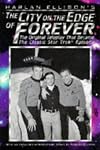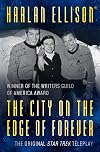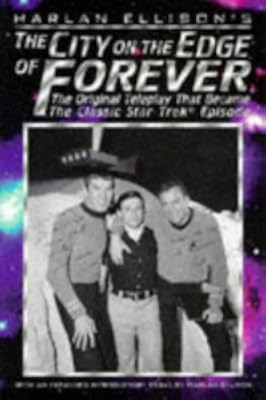
The City on the Edge of Forever: The Original Teleplay that Became the Classic Star Trek Episode
by Harlan Ellison
City on the Edge of Forever (works)
On This Page
Description
Fiction. Science Fiction. The original teleplay that became the classic Star Trek episode, with an expanded introductory essay by Harlan Ellison, The City on the Edge of Forever has been surrounded by controversy since the airing of an "eviscerated" version—which subsequently has been voted the most beloved episode in the series' history. In its original form, The City on the Edge of Forever won the 1966–67 Writers Guild of America Award for Best Teleplay. As aired, it won the 1967 Hugo show more Award.The City on the Edge of Forever is, at its most basic, a poignant love story. Ellison takes the listener on a breathtaking trip through space and time, from the future, all the way back to 1930s America. In this harrowing journey, Kirk and Spock race to apprehend a renegade criminal and restore the order of the universe. It is here that Kirk faces his ultimate dilemma: a choice between the universe—or his one true love.This edition makes available the astonishing teleplay as Ellison intended it to be aired. The author's introductory essay reveals all of the details of what Ellison describes as a "fatally inept treatment" of his creative work. Was he unjustly edited, unjustly accused, and unjustly treated? show lessTags
Recommendations















Member Reviews
I love Harlan Ellison. The more ranty he gets, the better I like him. I love the original Star Trek, too.
So, hell, this is a match made in heaven, right? Well, I think it's more accurate to say City on the Edge of Forever was the match that launched a three-decade flame war between Ellison and Roddenberry.
As with all arguments, I firmly believe the truth is somewhere between what Roddenberry says and what Ellison says, but I gotta say, knowing what a putz Roddenberry could be, I do angle more toward Ellison's version of things.
That said, there is also a point where you let things go...but that ain't Ellison's style. I firmly believe the man might have died years ago, but the fury burning inside him keeps him going. And like I said, show more when he rants, his outbursts are wonderfully terrible to behold. It's even better when he reads them himself.
As for his version of the scripts, yes, they're much more Ellison than what made it to the screen. Was it Trek? Maybe not as much as it became in the end. Is it good? Yup. Would it have worked better than what we got? Who the hell knows?
Ellison isn't the first to bitch about what they did to his words, nor will he be the last (Stephen King and Kubrick's The Shining anyone?). What Ellison's always railed against is those that come after and edit his work. My initial thought is, then why the hell do you deal with any television?
I honestly think he likes the pain. It gives him years of rants to feed off.
For all that, this is an interesting volume. If you love Ellison, then you really should read it. If you love Roddenberry and all his bullshit "Great Bird of the Galaxy" crap, stay away. show less
So, hell, this is a match made in heaven, right? Well, I think it's more accurate to say City on the Edge of Forever was the match that launched a three-decade flame war between Ellison and Roddenberry.
As with all arguments, I firmly believe the truth is somewhere between what Roddenberry says and what Ellison says, but I gotta say, knowing what a putz Roddenberry could be, I do angle more toward Ellison's version of things.
That said, there is also a point where you let things go...but that ain't Ellison's style. I firmly believe the man might have died years ago, but the fury burning inside him keeps him going. And like I said, show more when he rants, his outbursts are wonderfully terrible to behold. It's even better when he reads them himself.
As for his version of the scripts, yes, they're much more Ellison than what made it to the screen. Was it Trek? Maybe not as much as it became in the end. Is it good? Yup. Would it have worked better than what we got? Who the hell knows?
Ellison isn't the first to bitch about what they did to his words, nor will he be the last (Stephen King and Kubrick's The Shining anyone?). What Ellison's always railed against is those that come after and edit his work. My initial thought is, then why the hell do you deal with any television?
I honestly think he likes the pain. It gives him years of rants to feed off.
For all that, this is an interesting volume. If you love Ellison, then you really should read it. If you love Roddenberry and all his bullshit "Great Bird of the Galaxy" crap, stay away. show less
Harlan Ellison is well known for his tantrums, so if you want to preserve your blood pressure, skip the long rant that opens this book and go right to the story treatments and script. I'm old enough to have seen City first run as a child, not to mention many times in re-runs since, but I still went back and watched the DVD after I'd finished this book, just to make a fresh comparison. Perhaps 50 years of stories had built up too many expectations, but I really don't see how the original was so wonderful compared to the aired result. I must have been channeling D.C. Fontana while I read it, because I found her afterword to exactly express my thoughts while I was reading - this is very well written but it just wouldn't work in a 60s TV show more series. Later season TNG or DS9 could have made it, as could any SF show from the 21st century, but in the sixties episodes were required to be stand-alone, to be shown in random order in syndication. Characters had to be put back the way you found them at the end of each story, with no time for reaction to traumatic events the next week.
The original story treatments especially gave away far too much, with the Guardians telling Kirk and Spock exactly what they had to do to fix the timestream in the first treatment and then just dropping very specific hints in later drafts. Some of the best parts of the episode are in how they have to work out where/who the focal point is and how the change happens.
Harlen still has an excellent point that there is no excuse for the misinformation Roddenberry and others continued to repeat for decades. Scotty is never even mentioned in the script, let alone being the drug dealer character. It's also clear that while Gene R. had a final pass at revising the script, most of the rewrite was by Gene Coon and D.C. Fontana and that was only after multiple revisions by Ellison, contrary to the oft-repeated claims of non-cooperation.
I liked that Ellison gave Janice Rand such a significant part in the early drafts. Pity Grace Lee Whitney's contract with the show was up by the time City got made. Uhura's part in the aired episode is much more stereotypical of the time. show less
The original story treatments especially gave away far too much, with the Guardians telling Kirk and Spock exactly what they had to do to fix the timestream in the first treatment and then just dropping very specific hints in later drafts. Some of the best parts of the episode are in how they have to work out where/who the focal point is and how the change happens.
Harlen still has an excellent point that there is no excuse for the misinformation Roddenberry and others continued to repeat for decades. Scotty is never even mentioned in the script, let alone being the drug dealer character. It's also clear that while Gene R. had a final pass at revising the script, most of the rewrite was by Gene Coon and D.C. Fontana and that was only after multiple revisions by Ellison, contrary to the oft-repeated claims of non-cooperation.
I liked that Ellison gave Janice Rand such a significant part in the early drafts. Pity Grace Lee Whitney's contract with the show was up by the time City got made. Uhura's part in the aired episode is much more stereotypical of the time. show less
I read this because The City on the Edge of Forever is one of my favourite Star Trek episodes and I wanted to read the original screenplay. However I didn't know about the immense feud between Ellison and Gene Roddenberry (the creator of Star Trek). I downloaded this and I was at about 30% before the story even began as Ellison writes a very long and bitter and childish rant against Roddenberry and the way he changed his original screenplay. The episode was filmed in 1969, Roddenberry died in 1991 and Ellison released his essay and screenplay as a book in 1994 – he found it very easy to slag off Roddenberry when he could no longer tell his side of the story but clearly didn't have the balls to release it while he was alive. However show more the screenplay is very good and it is different from the episode that actually aired but that doesn’t detract from it, it just adds more depth to it. show less
The City on the Edge of Forever is ranked among the top episodes of the original Star Trek series. It was written by renowned science fiction author Harlan Ellison. But what was filmed and aired was not what Ellison wrote. He spent the next thirty years fighting with Gene Roddenberry, the creator of Star Trek, and the legions of fans who held Rodenberry in deity-like devotion to tell the story of what happened to his version.
The audiobook is broken into sections. It includes an introductory essay by Ellison, the two different “treatments” the script went through, the script itself, the revised script and an afterwards written by Peter David, D.C. Fontana, David Gerrold, DeForest Kelley, Walter Koenig, Leonard Nimoy, Melinda show more Snodgrass and George Takei.
Harlan’s introductory essay is filled with vitriol. Since he narrates this section himself, it comes through loud but not clear. I had a hard time understanding everything that was said. Mr. Ellison’s emotion makes his speech unclear. Personally I feel this would have been better handled by a professional narrator.
The treatments of the script are interesting. It is a winding road that takes us through the offices of Roddenberry and the TV executives. Each had their own perspective on what the story should look like. Ellison’s objections to the changes were overruled and ignored. When he tried to publicly discuss his dissatisfaction with the changed script, he was vilified by Roddenberry.
The scripts, teleplays, differ greatly from what was aired. Listening to the teleplays as they were intended to be done is amazing. Several of the concepts/plot points were eliminated because either Rodenberry or the network execs were offended with them. SPOILER ALERT: One of these eliminated concepts shows up in a later episode where the Enterprise in an alternate universe is a pirate ship END SPOILER ALERT. Another concept that the network found offensive shows up in a Star Trek: Voyager episode if I remember correctly. All in all Ellison’s original teleplay was wonderful and elegant. What the public saw was considered one of the best episodes of the series. But if you have only ever had hamburger steak, you do not know how fantastic prime rib can be.
The narration and performance of the audio book is good. The only part I really had issue with was the previously mentioned parts narrated by the author himself. Everything else was clear and easy to understand. There are several narrators, male and female, some with direct connections to the Star Trek franchise. They all do a good job. This is a must for Star Trek fans.
Review first posted at https://audiobookreviewer.com/reviews/the-city-on-the-edge-of-forever-by-harlan-... . I received a free copy of the audio in exchange for an honest review. show less
The audiobook is broken into sections. It includes an introductory essay by Ellison, the two different “treatments” the script went through, the script itself, the revised script and an afterwards written by Peter David, D.C. Fontana, David Gerrold, DeForest Kelley, Walter Koenig, Leonard Nimoy, Melinda show more Snodgrass and George Takei.
Harlan’s introductory essay is filled with vitriol. Since he narrates this section himself, it comes through loud but not clear. I had a hard time understanding everything that was said. Mr. Ellison’s emotion makes his speech unclear. Personally I feel this would have been better handled by a professional narrator.
The treatments of the script are interesting. It is a winding road that takes us through the offices of Roddenberry and the TV executives. Each had their own perspective on what the story should look like. Ellison’s objections to the changes were overruled and ignored. When he tried to publicly discuss his dissatisfaction with the changed script, he was vilified by Roddenberry.
The scripts, teleplays, differ greatly from what was aired. Listening to the teleplays as they were intended to be done is amazing. Several of the concepts/plot points were eliminated because either Rodenberry or the network execs were offended with them. SPOILER ALERT: One of these eliminated concepts shows up in a later episode where the Enterprise in an alternate universe is a pirate ship END SPOILER ALERT. Another concept that the network found offensive shows up in a Star Trek: Voyager episode if I remember correctly. All in all Ellison’s original teleplay was wonderful and elegant. What the public saw was considered one of the best episodes of the series. But if you have only ever had hamburger steak, you do not know how fantastic prime rib can be.
The narration and performance of the audio book is good. The only part I really had issue with was the previously mentioned parts narrated by the author himself. Everything else was clear and easy to understand. There are several narrators, male and female, some with direct connections to the Star Trek franchise. They all do a good job. This is a must for Star Trek fans.
Review first posted at https://audiobookreviewer.com/reviews/the-city-on-the-edge-of-forever-by-harlan-... . I received a free copy of the audio in exchange for an honest review. show less
Harlan Ellison is a brilliant science fiction writer. Nobody can deny this. Unfortunately, Harlan Ellison is a horrible writer of history. This volume, which contains the original, unfilmed script for The City on the Edge of Forever begins with a tedious, ranting, 75-page introduction. Ellison sets forth his version of the controversy regarding the script changes and takes the opportunity to attack some of his critics as well as others in show business with whom he's had bad experiences. The story treatments and Ellison's original script (as well as the partial second draft) offer wonderful insight into the process of writing for television and present a masterful original story that was watered down for television. Unfortunately, the show more introduction dampens the reader's resolve to read the script. The Afterwords, from the likes of D.C Fontana, Leonard Nimoy, and George Takei, would work so much better as an introduction. Though a great writer, Ellison would have benefited from an editor restraining his ranting and keeping his attention on the facts of the case for the introduction. The most astounding part of it is, this edition of the book expanded the introduction by 15,000 words! If you can make it past that, the original version of The City on the Edge of Forever is science fiction at its best. show less
I've read this script through four times and I've cried every time. Can't not give it five stars, would be unethical.
Have to comment on how it compares with the episode as produced, I suppose.
Roddenberry's opinion that it wouldn't have worked as an episode because of budget and time restrictions, and because having a drug-dealer on the enterprise is very against-tone for the original Star Trek, is all probably correct.
Ellison probably could have fixed most of the issues Roddenberry had with some rewrites. There were already many rewrites, not sure what broke down between them.
The denouement's critical moment is focused on Kirk's actions in production and Spock in original script - personally I think having Kirk be the primary mover show more there was a better choice. Almost the entire rest of the script besides that, Ellison's works better.
If only we'd had a full-length Star Trek movie treatment with this script, give it time to stretch out and breathe. That's what City really needed, artistically. show less
Have to comment on how it compares with the episode as produced, I suppose.
Roddenberry's opinion that it wouldn't have worked as an episode because of budget and time restrictions, and because having a drug-dealer on the enterprise is very against-tone for the original Star Trek, is all probably correct.
Ellison probably could have fixed most of the issues Roddenberry had with some rewrites. There were already many rewrites, not sure what broke down between them.
The denouement's critical moment is focused on Kirk's actions in production and Spock in original script - personally I think having Kirk be the primary mover show more there was a better choice. Almost the entire rest of the script besides that, Ellison's works better.
If only we'd had a full-length Star Trek movie treatment with this script, give it time to stretch out and breathe. That's what City really needed, artistically. show less
For those interested in the life of Hollywood screenwriters, or the devoted Star Trek (original series) fan, it is a must-read bucket list book. The details that differ between what was aired in April, 1967 and the original screenplay Ellison wrote are revealed here for the first time ever.
Note: the first section of this book is a rant 30 years in the making that could have been edited. Not a lot, not a little, just edited. Gene Roddenberry making an ass of himself on the convention circuit and painting himself as the only creative person in Star Trek history is pretty well documented. Ellison could have saved himself some blood pressure meds if he had published this book earlier than 1996 to set the record straight about his original show more script and how he felt Roddenberry's et. al.'s treatment of it was wrong/malicious/unkind/untrue. Oh, and if you are not a fan of bad language or ranting, just skip the first part. Or read the script and its later treatment and come back to the first part later. It could have been 5 pages and gotten the message across jes' fine, thank-ee.
In my own opinion, what Ellison's original teleplay creates in subtlety, the final, aired script creates in depth. A mysterious reference to blue and gold by the Guardians of Forever does nothing to answer the most important question: "Why does Edith Keeler have to die?" Ellison misses that point entirely in trying to create a love interest for Kirk, and the aired episode manages to capture both. show less
Note: the first section of this book is a rant 30 years in the making that could have been edited. Not a lot, not a little, just edited. Gene Roddenberry making an ass of himself on the convention circuit and painting himself as the only creative person in Star Trek history is pretty well documented. Ellison could have saved himself some blood pressure meds if he had published this book earlier than 1996 to set the record straight about his original show more script and how he felt Roddenberry's et. al.'s treatment of it was wrong/malicious/unkind/untrue. Oh, and if you are not a fan of bad language or ranting, just skip the first part. Or read the script and its later treatment and come back to the first part later. It could have been 5 pages and gotten the message across jes' fine, thank-ee.
In my own opinion, what Ellison's original teleplay creates in subtlety, the final, aired script creates in depth. A mysterious reference to blue and gold by the Guardians of Forever does nothing to answer the most important question: "Why does Edith Keeler have to die?" Ellison misses that point entirely in trying to create a love interest for Kirk, and the aired episode manages to capture both. show less
Members
- Recently Added By
Lists

Five star books
1,767 works; 110 members
Author Information

Harlan Ellison was born in Cleveland, Ohio on May 27, 1934. He was the author of numerous short story collections including Strange Wine; The Beast that Shouted Love at the Heart of the World; Harlan Ellison's Watching; Deathbird Stories; Repent Harlequin! Said the Ticktockman; I Have No Mouth and I Must Scream; and Stalking the Nightmare: Stories show more and Essays. He received numerous awards including the Hugo Award, the Nebula Award, the Bram Stoker Award, the Lifetime Achievement Award from the Horror Writer's Association, the Edgar Allen Poe Award, and the Grand Master Award for lifetime achievement from the Science Fiction and Fantasy Writers of America. He was inducted into the Science Fiction Hall of Fame in 2011. He published two collections of his columns on television for the Los Angeles Free Press entitled The Glass Teat and The Other Glass Teat. He edited several anthologies including Dangerous Visions: 33 Original Stories and Medea: Harlan's World. He received the Milford Award for Lifetime Achievement in Editing. He also wrote scripts for TV series including Burke's Law, The Alfred Hitchcock Hour, Voyage to the Bottom of the Sea, and The Man from U.N.C.L.E. He served as creative consultant on the new version of The Twilight Zone in the 1980s and as conceptual consultant on Babylon 5. He won the Writer's Guild of America's Award for Most Outstanding Teleplay four times. He died on June 27, 2018 at the age of 84. (Bowker Author Biography) show less
Some Editions
Series

Work Relationships
Is contained in
Common Knowledge
- Canonical title
- The City on the Edge of Forever: The Original Teleplay that Became the Classic Star Trek Episode
- Original title
- The City on the Edge of Forever: The Original Teleplay that Became the Classic Star Trek Episode
- Alternate titles
- The City on the Edge of Forever: The Original Teleplay that Became the Classic Star Trek Episode
- Original publication date
- 1977-11
- People/Characters
- James T. Kirk; James T. Kirk (Captain); Spock; Leonard McCoy; Edith Keeler; William Shatner (show all 9); Guardian of Forever; Joan Collins; Leonard Nimoy
- Important places
- Gateway; Earth
- Important events
- Discovery of the Guardian of Forever; Death of Edith Keeler
- Related movies
- Star Trek: The City on the Edge of Forever (1967 | s1e28 | IMDb)
- Epigraph
- "It's not the vision I had." Gully Jimson, The Horse's Mouth by Joyce Cary
- First words
- Space: the final frontier.
- Quotations
- I am endeavoring, Ma'am, to construct a mnemonic memory circuit using stone knives and bearskins.
"Where would you estimate we belong, Miss Keeler?"
"You, Spock, at Jim Kirk's side...it's as if you have always been there and always will."
"Let me help." A hundred years from now a famous writer will use those very words and recommend them even over "I love you." - Last words
- (Click to show. Warning: May contain spoilers.)Earth's history has been restored.
- Disambiguation notice
- This is not the same work as the fotonovel of the episode. Please keep them separate.
Classifications
Statistics
- Members
- 590
- Popularity
- 49,942
- Reviews
- 17
- Rating
- (3.64)
- Languages
- English
- Media
- Paper, Audiobook, Ebook
- ISBNs
- 13
- ASINs
- 7