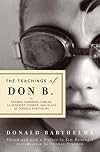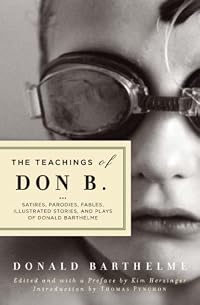
The Teachings of Don B.: Satires, Parodies, Fables, Illustrated Stories, and Plays of Donald Barthelme
by Donald Barthelme
On This Page
Description
"Barthelme . . . happens to be one of a handful of American authors, there to make us look bad, who know instinctively how to stash the merchandise, bamboozle the inspectors, and smuggle their nocturnal contraband right on past the checkpoints of daylight 'reality.'" --Thomas Pynchon, from the Introduction Sixty-three rare or previously uncollected works by a master of the American short story form *A hypothetical episode of Batman hilariously slowed down to soap-opera speed. *A game of show more baseball as played by T. S. Eliot and Willem "Big Bull" de Kooning. *A recipe for feeding sixty pork-sotted celebrants at your daughter's wedding. *An outlandishly illustrated account of a scientific quest for God. These astonishing tropes of the imagination could only have been generated by Donald Barthelme, who--until his death in 1989--seemed intent on goosing American letters into taking a quantum leap. Gleeful, melancholy, erudite, and wonderfully subversive, The Teachings of Don B. is a literary testament cum time bomb, with the power to blast any reader into an altered state of consciousness. "A small education in laughter, melancholy, and the English language." --The New York Times Book Review "Barthelme, who died in 1989, was a distinctive master of fragments . . . Anger, wit, extravagant associations and disassociations; these would be less memorable if it were not for Barthelme's ability to evoke dreams and the tenderness with which he does it." --Los Angeles Times show lessTags
Recommendations













Member Reviews
The consensus on Barthelme is that he launched the postmodern short-story form in the US. A very thoughtful review by James Wolcott ('Bookforum,' February / March 2008, pp. 9-10), sums it up very well:
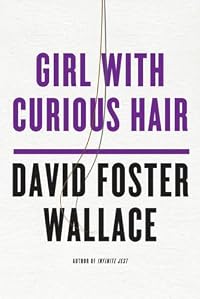
'Today, I would hazard... the track marks of Barthelme's suave, subversive cunning are to be found less in postmod fiction -- although David Foster Wallace's dense foliage of footnotes suggests a Bathelmean undergrowth and George Saunders's arcade surrealism has a runaway-nephew quality -- than in the conscientiously oddball, studiedly offhand, hiply recherché, mock-anachronistic formalism of 'McSweeney's,' 'The Believer,' 'The Crier,' and related organs of articulate mumblecore.'
I would add three things:
1. The current generation of show more young MFA writing program candidates see the 'McSweeney's' option as one of their main goals. So in that sense, Barthelme is a ubiquitous influence.
2. Dave Hickey, the art critic, is a spiritual child of Barthelme's; and Hickey's kind of art criticism is increasingly influential. (I go into this in my pamphlet, 'What Happened to Art Criticism?')
3. George Saunders's essay on Barthelme, in 'The Brain-Dead Megaphone,' is the best thing written on Barthelme, if you're looking for a guide.
So it's indisputable that Barthelme is part of the history of postwar American writing. But is he someone to read now? Reading this collection, I was struck by just how much of it has lost its shine. There are hilarious pieces, and sometimes the wit is as sharp as it seemed in the 1970s. But Barthelme's liberal politics are really very predictable -- as easily predictable as his quips are surprising. And his absurdism has always been a safe version of real absurdism. If you're interested in surrealist or absurdist shock, read Raymond Roussel, or Daniil Kharms (who has been praised by George Saunders, in the 'New York Times Book Review.') As Wolcott points out, the entire New Fiction movement was subjected to a typically devastating critique by Gore Vidal ('American Plastic: The Matter of Fiction') in 1976; Vidal thought the movement, including Pynchon, was contrived and derivative of french experimental fiction. I'd rather trace it to Russian and central European absurdist literature and surrealism, but the significance is the same: Barthelme is watered-down, domesticated, playful, harmless absurdism. Never too angry, seldom directly polemic, never despairing. (That would be gauche, of course.) After a few days reading Barthelme, the happiness of seeing plodding seriousness exploded continuously and brilliantly right in my face when I least expected it but really not-so-secretly expected it all along pales, and I begin to wish for some real pain, and laughter that doesn't come with a little grimace of acknowledged artifice or complicity, or an unnatural heave. show less
'Today, I would hazard... the track marks of Barthelme's suave, subversive cunning are to be found less in postmod fiction -- although David Foster Wallace's dense foliage of footnotes suggests a Bathelmean undergrowth and George Saunders's arcade surrealism has a runaway-nephew quality -- than in the conscientiously oddball, studiedly offhand, hiply recherché, mock-anachronistic formalism of 'McSweeney's,' 'The Believer,' 'The Crier,' and related organs of articulate mumblecore.'
I would add three things:
1. The current generation of show more young MFA writing program candidates see the 'McSweeney's' option as one of their main goals. So in that sense, Barthelme is a ubiquitous influence.
2. Dave Hickey, the art critic, is a spiritual child of Barthelme's; and Hickey's kind of art criticism is increasingly influential. (I go into this in my pamphlet, 'What Happened to Art Criticism?')
3. George Saunders's essay on Barthelme, in 'The Brain-Dead Megaphone,' is the best thing written on Barthelme, if you're looking for a guide.
So it's indisputable that Barthelme is part of the history of postwar American writing. But is he someone to read now? Reading this collection, I was struck by just how much of it has lost its shine. There are hilarious pieces, and sometimes the wit is as sharp as it seemed in the 1970s. But Barthelme's liberal politics are really very predictable -- as easily predictable as his quips are surprising. And his absurdism has always been a safe version of real absurdism. If you're interested in surrealist or absurdist shock, read Raymond Roussel, or Daniil Kharms (who has been praised by George Saunders, in the 'New York Times Book Review.') As Wolcott points out, the entire New Fiction movement was subjected to a typically devastating critique by Gore Vidal ('American Plastic: The Matter of Fiction') in 1976; Vidal thought the movement, including Pynchon, was contrived and derivative of french experimental fiction. I'd rather trace it to Russian and central European absurdist literature and surrealism, but the significance is the same: Barthelme is watered-down, domesticated, playful, harmless absurdism. Never too angry, seldom directly polemic, never despairing. (That would be gauche, of course.) After a few days reading Barthelme, the happiness of seeing plodding seriousness exploded continuously and brilliantly right in my face when I least expected it but really not-so-secretly expected it all along pales, and I begin to wish for some real pain, and laughter that doesn't come with a little grimace of acknowledged artifice or complicity, or an unnatural heave. show less
I recently read a great short story by Donald Barthelme, "Cortes and Montezuma", online, and it reminded me how much I had enjoyed his short stories when I first encountered them in my twenties. Looking to reacquaint myself with his work, I picked up this miscellany. There is some really good stuff in here, such as the title story; subtitled "A Yankee Way of Knowledge", it's a dead-on parody of Carlos Castaneda. I loved the subtle shifts in tone of "The Joker's Greatest Triumph" as well.
But a lot of the material in this book had been uncollected elsewhere, and it shows in parodies that are too obvious and little illustrated stories that reminded me of Spike Milligan's lesser work.
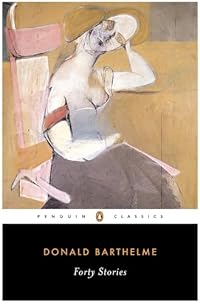
I still love Barthelme's fiction, and I'm going to hunt show more down a copy of one of the classic short story collections, like "Forty Stories", but this isn't the book I'd recommend to those starting out to discover his work. show less
But a lot of the material in this book had been uncollected elsewhere, and it shows in parodies that are too obvious and little illustrated stories that reminded me of Spike Milligan's lesser work.
I still love Barthelme's fiction, and I'm going to hunt show more down a copy of one of the classic short story collections, like "Forty Stories", but this isn't the book I'd recommend to those starting out to discover his work. show less
Ratings
Members
- Recently Added By
Author Information

68+ Works 7,772 Members
Donald Barthelme was born on April 7, 1931, and was one of the major U.S. short story writers and novelists of the late twentieth century. Barthelme satirized American life. Born in Philadelphia, Barthelme spent part of his early life in Houston, Texas, and began to write fiction while working as a journalist, director of an art museum and show more university publicist. These occupations became fuel for his creative fire. His arsenal of techniques included parodies of television shows, radio plays and recipes, long and elaborate metaphors, complex dream sequences, and a break-neck narrative pace. After the publication of his first collection, Come Back Dr. Caligari (1964), Barthelme became a full-time writer of short stories and novels. The latter included Snow White (1967), The Dead Father (1975), and Paradise (1986). Barthelme also published three more short story collections, 60 Stories (1981), Overnight to Many Distant Cities (1983), and 40 Stories (1987). Barthelme died of cancer in 1989. (Bowker Author Biography) show less
All Editions
Common Knowledge
- Original publication date
- 1992 (collection) (collection)
Classifications
Statistics
- Members
- 230
- Popularity
- 141,091
- Reviews
- 2
- Rating
- (3.92)
- Languages
- English, Spanish
- Media
- Paper, Ebook
- ISBNs
- 7
- ASINs
- 1