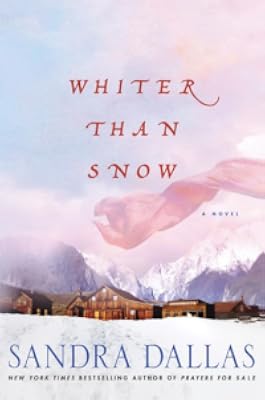
Whiter Than Snow
by Sandra Dallas
On This Page
Description
The powerful story of a small Colorado town after a devastating avalanche, and the life changing effects it has on the people who live there. Set in 1920.Tags
Recommendations


























Member Recommendations

Member Reviews
3.5***
Just after four o’clock on a spring afternoon in 1920, the Colorado mining town of Swandyke is changed forever. An avalanche hurtles down the rocky slope above the town, burying nine children on their way home from school. The disaster cut across social class, religious and racial differences and affects everyone in the town from the owner of the Fourth of July Mine to the Jewish prostitute to the only Negro mine worker.
Dallas tells us about the disaster early, and we know right away the names of the nine children engulfed in the huge mass of snow, ice and rock. Then she backtracks and tells us the stories of these families and how they came to live in Swandyke. Along the way we learn of the horrors of the Civil War and show more Andersonville, the treatment of newly freed slaves after the war, and the life of Jewish immigrants in the tenements of New York. We visit wealthy homes and impoverished ones. Hard lives are eased with education, or made harder by lack of same. In this way we come to understand these men and women whose lives will be changed by events of that spring day. Despite already knowing what will happen, Dallas has the events of that fateful day unfold in a way that builds suspense and dread. The reader is just as anxious as the parents of the buried children, as men from the mine frantically dig with every available shovel, pick and tool to uncover them. Every resident, whether their children were caught in the slide or not, will feel the anguish of that day. United in grief, people forgive past hurts and exercise compassion. The final scene is heartbreaking, but leaves the reader with a sense of hope. show less
Just after four o’clock on a spring afternoon in 1920, the Colorado mining town of Swandyke is changed forever. An avalanche hurtles down the rocky slope above the town, burying nine children on their way home from school. The disaster cut across social class, religious and racial differences and affects everyone in the town from the owner of the Fourth of July Mine to the Jewish prostitute to the only Negro mine worker.
Dallas tells us about the disaster early, and we know right away the names of the nine children engulfed in the huge mass of snow, ice and rock. Then she backtracks and tells us the stories of these families and how they came to live in Swandyke. Along the way we learn of the horrors of the Civil War and show more Andersonville, the treatment of newly freed slaves after the war, and the life of Jewish immigrants in the tenements of New York. We visit wealthy homes and impoverished ones. Hard lives are eased with education, or made harder by lack of same. In this way we come to understand these men and women whose lives will be changed by events of that spring day. Despite already knowing what will happen, Dallas has the events of that fateful day unfold in a way that builds suspense and dread. The reader is just as anxious as the parents of the buried children, as men from the mine frantically dig with every available shovel, pick and tool to uncover them. Every resident, whether their children were caught in the slide or not, will feel the anguish of that day. United in grief, people forgive past hurts and exercise compassion. The final scene is heartbreaking, but leaves the reader with a sense of hope. show less
First and foremost I read Sandra Dallas because she is such a great storyteller. In Whiter Than Snow she tells the story of a small mining town in Colorado where, on an April day in 1920, an avalanche roars down the mountain and across the road where nine schoolchildren are on their way home. As the anxious people start to dig, the reader is taken on a backward journey into the lives of each of the mothers and fathers that are so desperately hoping that their children will be saved.
These back stories are varied and include estranged sisters, a troubled civil war veteran, a prostitute, a wife of the mine manager and a black man. Unfortunately, I felt the characters were a little contrived and the stories weren’t as fresh or original as show more I would have liked. It was very clear from the first chapter that only some of the children would survive and my curiosity was aroused to see which family would see their loved one restored.
I would say Whiter Than Snow was a solid story, but I have learned to expect a little more from this author, so I felt this one wasn’t equal to her best work. This is a story of love, redemption, and forgiveness but somehow I didn’t quite feel the sense of connection and empathy that I usually do with this author’s characters. show less
These back stories are varied and include estranged sisters, a troubled civil war veteran, a prostitute, a wife of the mine manager and a black man. Unfortunately, I felt the characters were a little contrived and the stories weren’t as fresh or original as show more I would have liked. It was very clear from the first chapter that only some of the children would survive and my curiosity was aroused to see which family would see their loved one restored.
I would say Whiter Than Snow was a solid story, but I have learned to expect a little more from this author, so I felt this one wasn’t equal to her best work. This is a story of love, redemption, and forgiveness but somehow I didn’t quite feel the sense of connection and empathy that I usually do with this author’s characters. show less
Sandra Dallas has the ability to sculpt the events of an everyday life into something compelling. Though this book has at its heart a cataclysmic event for a small town in Colorado, the book is primarily made up of the back-stories of some of the people caught up in the terrible events of a spring afternoon in 1920, when nine children, headed home from school, were buried by an avalanche. The town of Swandyke responds, but not before the reader has been taken into the past to learn the history of six of the parents.
Avalanches are strange and mysterious beasts -- it's hard to appreciate the magnitude of their power until to actually see what they can leave in their wake. I've only known of avalanche rescue in current times. To read show more about the valiant efforts in the time of the book was sobering. The image of one of the fathers digging for his child is one that will haunt me. show less
Avalanches are strange and mysterious beasts -- it's hard to appreciate the magnitude of their power until to actually see what they can leave in their wake. I've only known of avalanche rescue in current times. To read show more about the valiant efforts in the time of the book was sobering. The image of one of the fathers digging for his child is one that will haunt me. show less
In "Whiter Than Snow," Sandra Dallas offers another look at life in Colorado's gold mining towns during the late nineteenth and early twentieth centuries, a time when the hardiest, most adventurous (or, perhaps, most desperate) souls were willing to risk their lives for a steady job in a company town. Swandyke, near Tenmile Range, is filled with people who have come to the cold little town for a variety of reasons. Some are in hiding from creditors or the law; some just kept moving westward, failing in one move after the other, until they ended up in Colorado; and its lone black resident is here because he struck a white man and had to run for his life in the middle of the night.
Swandyke is a town in which the privacy of others is show more respected. Those who want to keep to themselves can do so for years. The men, many of whom are of the hard-drinking variety, work the mine; the women stay home and raise their children, teach in the town schoolhouse, or work in the local brothel. Life in Swandyke, especially in the wintertime, is tough but, by the spring of 1920, life there has become routine for most of its residents.
That will change, though, at 4:10 p.m. on April 20, 1920 when an avalanche gobbles up nine Swandyke school children as they make their way home form their little schoolhouse. Five of the avalanche victims are the children of two estranged sisters, one is the son of the mine manager, one is the only black child in the town, one is the daughter of a prostitute, and the other is being raised by his Civil War veteran grandfather.
The author remarks in the book's very first chapter that only four of the nine children will survive. The rest of "Whiter Than Snow" deals with who the nine children are and how their families came to be in Swandyke, Colorado, working for the big Fourth of July mine. Dallas tells their story in a series of flashbacks and backstories involving each of the six families that have had children snatched away by the avalanche. The reader learns of the strengths, weaknesses, hopes and dreams of each parent, a group of people with very little in common other than their work at the mine and their love for their children. Suddenly, though these people have hardly interacted before, they come together in a wave of mutual support that will help the most unfortunate of them survive the five terrible losses just ahead.
As the book's main characters are being developed, the novel is steadily building to a dramatic climax during which the reader will finally learn which children survive and which do not. The townspeople know they have less than twenty minutes to dig survivors from beneath the snow - and, one-by-one, they will bring children to the surface in their race against the clock. For five children, it is too late. If you begin this book, you will not quit reading until you find out which five.
Rated at: 4.0 show less
Swandyke is a town in which the privacy of others is show more respected. Those who want to keep to themselves can do so for years. The men, many of whom are of the hard-drinking variety, work the mine; the women stay home and raise their children, teach in the town schoolhouse, or work in the local brothel. Life in Swandyke, especially in the wintertime, is tough but, by the spring of 1920, life there has become routine for most of its residents.
That will change, though, at 4:10 p.m. on April 20, 1920 when an avalanche gobbles up nine Swandyke school children as they make their way home form their little schoolhouse. Five of the avalanche victims are the children of two estranged sisters, one is the son of the mine manager, one is the only black child in the town, one is the daughter of a prostitute, and the other is being raised by his Civil War veteran grandfather.
The author remarks in the book's very first chapter that only four of the nine children will survive. The rest of "Whiter Than Snow" deals with who the nine children are and how their families came to be in Swandyke, Colorado, working for the big Fourth of July mine. Dallas tells their story in a series of flashbacks and backstories involving each of the six families that have had children snatched away by the avalanche. The reader learns of the strengths, weaknesses, hopes and dreams of each parent, a group of people with very little in common other than their work at the mine and their love for their children. Suddenly, though these people have hardly interacted before, they come together in a wave of mutual support that will help the most unfortunate of them survive the five terrible losses just ahead.
As the book's main characters are being developed, the novel is steadily building to a dramatic climax during which the reader will finally learn which children survive and which do not. The townspeople know they have less than twenty minutes to dig survivors from beneath the snow - and, one-by-one, they will bring children to the surface in their race against the clock. For five children, it is too late. If you begin this book, you will not quit reading until you find out which five.
Rated at: 4.0 show less
On a perfect April day in 1920, a cornice of snow breaks free and becomes a fatal avalanche which kills four children walking home from school in a tiny Colorado mining community. Sandra Dallas opens her latest novel with this event, and then backtracks to explore the lives of the families involved in the tragedy. What follows is a series of linked short stories of each of the main characters. Dallas brings the stories full circle when, at the end of the book, she returns to the mining town in the aftermath of the avalanche and brings closure to her characters’ personal journeys. In an interview about the book, Dallas says:
Each of the chapters involves subjects I wanted to explore.
These include a difficult relationship between sisters show more which is complicated by jealousy and misunderstanding; the post-Civil war treatment of African Americans; women’s rights and class differences – including a woman who finds her future at risk when her father loses his money, and an immigrant woman who turns to prostitution to support her young daughter; and finally post-traumatic stress, in this case surrounding a man who served in the Union army and feels guilty for the death of one of his friends. Each of the multi-layered stories could almost stand on their own – which gave an unusual depth to the completed novel.
Dallas explores the aftermath of tragedy, specifically the randomness of loss and the importance of community in navigating that loss. She captures the closeness of a mining community which often has to face tragedy and finds themselves isolated by the geography of the mountains and long winters.
It was the way things were done there. The grief of one was the grief of all. – from Whiter Than Snow, page 254 -
Sandra Dallas is considered an historical fiction writer – and Whiter Than Snow is indeed a slice of history inserted into fiction; but, I think Dallas writes beyond her genre in this novel by looking at the psychological make-up of her characters within the context of history. Readers might be interested to know that Swandyke is an actual town – although it is now a ghost town – but Dallas imagines the avalanche and its impact on the people.
I found Whiter Than Snow to be a quick, provocative read which will appeal to readers who enjoy historical fiction and character driven stories.
Recommended. show less
Each of the chapters involves subjects I wanted to explore.
These include a difficult relationship between sisters show more which is complicated by jealousy and misunderstanding; the post-Civil war treatment of African Americans; women’s rights and class differences – including a woman who finds her future at risk when her father loses his money, and an immigrant woman who turns to prostitution to support her young daughter; and finally post-traumatic stress, in this case surrounding a man who served in the Union army and feels guilty for the death of one of his friends. Each of the multi-layered stories could almost stand on their own – which gave an unusual depth to the completed novel.
Dallas explores the aftermath of tragedy, specifically the randomness of loss and the importance of community in navigating that loss. She captures the closeness of a mining community which often has to face tragedy and finds themselves isolated by the geography of the mountains and long winters.
It was the way things were done there. The grief of one was the grief of all. – from Whiter Than Snow, page 254 -
Sandra Dallas is considered an historical fiction writer – and Whiter Than Snow is indeed a slice of history inserted into fiction; but, I think Dallas writes beyond her genre in this novel by looking at the psychological make-up of her characters within the context of history. Readers might be interested to know that Swandyke is an actual town – although it is now a ghost town – but Dallas imagines the avalanche and its impact on the people.
I found Whiter Than Snow to be a quick, provocative read which will appeal to readers who enjoy historical fiction and character driven stories.
Recommended. show less
In 1920, an avalanche hit the mining town of Swandyke, Colorado, just as school let out. There were kids on the street, just heading home, as the snow came tumbling down... The book starts by letting us know this, then backs up to find out about the lives of some of the parents (and one grandparent) of those children. Then, the book leads up to the avalanche itself.
There was no historical/author’s note, so I had to look this up to see if it really happened. It appears that Swandyke was a real town; now it’s a ghost town with some items and buildings, but I couldn’t find any mention of an avalanche that buried children there. However, this is a really good story. It was easy to get the characters mixed up a bit, as there were so show more many, and with one chapter on each family’s history, it took a minute when they were mentioned again to remember who was who. Even still, I enjoyed all of those families’ stories, though one stood out a bit more than the others for me (the black man working at the mine who had a young daughter). show less
There was no historical/author’s note, so I had to look this up to see if it really happened. It appears that Swandyke was a real town; now it’s a ghost town with some items and buildings, but I couldn’t find any mention of an avalanche that buried children there. However, this is a really good story. It was easy to get the characters mixed up a bit, as there were so show more many, and with one chapter on each family’s history, it took a minute when they were mentioned again to remember who was who. Even still, I enjoyed all of those families’ stories, though one stood out a bit more than the others for me (the black man working at the mine who had a young daughter). show less
In the first chapter we read of all the possible things that might have touched off the avalanche above Swandyke, CO in April of 1920 sending a huge slide of snow down the mountain just as the children are being let out of school and walking home along the road in its path. Then the story backtracks to give us the life stories of the families whose children are walking that road. We read about two estranged sisters, mother to five of the children, the mine engineer and his wife, one boy, a Black sawmill worker, a daughter, a veteran of the Civil War, a granddaughter, and a prostitute, a daughter before circling back to the tragedy. The character studies were well done. Each family had some secret or scandal or hardship in their past but show more a love for the children. If I had to decide after reading their stories which would be the ones to lose their child I don't think I would want to make that decision. Very thought provoking, but with a hopeful note at the end. show less
Members
- Recently Added By
Lists

Novels That Take Place In Colorado or Wyoming
20 works; 3 members

BingoDOG - Books With Natural Disasters: Fiction
39 works; 11 members

A Rainbow of Books: Colors in the Title
570 works; 24 members
Author Information

36+ Works 8,710 Members
Sandra Dallas graduated from the University of Denver with a degree in journalism and began her writing career as a reporter with Business Week. While a reporter, she began writing nonfiction which include Sacred Paint, which won the National Cowboy Hall of Fame Western Heritage Wrangler Award, and The Quilt That Walked to Golden, recipient of the show more Independent Publishers Association Benjamin Franklin Award. Turning to fiction in 1990, Sandra has published a number of novels including Buster Midnight's Cafe, Alice's Tulips, and Prayers For Sale. She is the recipient of the Women Writing the West Willa Award for New Mercies, and two-time winner of the Western Writers of America Spur Award, for The Chili Queen and Tallgrass. In addition, she was a finalist for the Colorado Book Award, the Mountain and Plains Booksellers Association Award, and a four-time finalist for the Women Writing the West Willa Award. (Bowker Author Biography) show less
Awards and Honors
Awards
Common Knowledge
- Original publication date
- 2010-04
- People/Characters
- Lucy Patch; Dolly Patch; Joe Cobb; Grace Foote; Minder Evans; Ester Schnable
- Important places
- Fort Madison, Iowa, USA; Swandyke, Colorado, USA; Colorado, USA
- Epigraph
- Purge me with hyssop, and I shall be clean: wash me, and I shall be whiter than snow. -- Psalm 51:7
- Dedication
- This book is for
Forrest Athearn
Our best buddy - First words
- No one knew what triggered the Swandyke avalanche that began at exactly 4:10 P.M. on April 20 1920.
- Last words
- (Click to show. Warning: May contain spoilers.)Minder knew there would be another.
Classifications
Statistics
- Members
- 354
- Popularity
- 89,147
- Reviews
- 27
- Rating
- (3.93)
- Languages
- English
- Media
- Paper, Audiobook, Ebook
- ISBNs
- 16
- ASINs
- 3