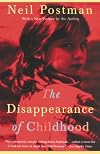
The Disappearance of Childhood
by Neil Postman
On This Page
Description
From the vogue for nubile models to the explosion in the juvenile crime rate, this modern classic of social history and media traces the precipitous decline of childhood in America today-and the corresponding threat to the notion of adulthood. Deftly marshaling a vast array of historical and demographic research, Neil Postman suggests that childhood is a relatively recent invention, which came into being as the new medium of print imposed divisions between children and adults. But now these show more divisions are eroding under the barrage of television, which turns the adult secrets of sex and violence into popular entertainment and pitches both news and advertising at the intellectual level of ten-year olds. show lessTags
Recommendations


































Member Recommendations

Member Reviews
The first half of this book is a terrific rundown of the history of the development of the concept of childhood, and, as Postman's argument goes, the decline of that concept in the last century. The second half is Postman continuing his argument and coming off as a huge curmudgeon. I mean, he says that the character of Felix Unger is the best example of an adult on television at the time of writing. 'Nuff said.
Postman costruisce una precisa storia delle diverse evoluzioni dell'idea di infanzia, giungendo - al solito sulla scorta di McLuhan - ad affermare che è soprattutto il ruolo dei media a dar forma all'idea stessa (e quindi al suo successo o declino). Se la civiltà della stampa ha generato l'infanzia, il telegrafo e poi la tv l'hanno messa in crisi, livellando adulti e fanciulli e tornando a uno stato simile a quello del medio evo. Postman scrive nel 1982 e le sue osservazioni sul computer sono solo abbozzate. Interessante chiedersi come proseguire queste osservazioni pensando a come internet ha cambiato ulteriormente il rapporto con autorità, istruzione, opinione e dunque di nuovo le relazioni fra adulti e bambini.
Малко е тъпо да питаме какво е детство и от кога го има нали? Та нали всички сме били деца? Да, ама не съвсем, поне според автора на "Изчезващото детство".
Нийл Постман се опитва да докаже, че през по-голямата част от историята на човечеството идеята за "детство" не е съществувала така, както я възприемаме сега, че на децата е гледано като на дребни, глупави възрастни и че чак последните 200-300 години появата на show more печатното слово в ежедневието разделя рязко човечеството на можещи и неможещи да четат, съответно да функционират пълноценно в модерния свят, да осмислят и обсъждат идеи, по-широки от непосредственото им обкръжение и т.н.
И, пак според автора, появата и широкото разпространение на "картинни" медии (телевизия) започва да подрива тази разлика, правейки децата по-еквивалентни на възрастните в разбирането и навигирането на света.
Докато идеите на книгата безспорно са интересни и заслужаващи замисляне, авторът определено, поне според мен, изпитва трудности да ги докаже. Никак не помага фактът, че той разглежда като "човешка история и съвремие" само западноевропейската цивилизация и не включва в разсъжденията си нито човека преди "цивилизационния" период (откриване на земеделието преди десетина хиляди години), нито коя да е друга култура.
От гледна точка на масовото разпространение на електронните медии (след написването на книгата) сами можем да си правим изводите дали детството изчезва, дали възрастните стават по-инфантилни или децата по-оправни, дали се засилва или намалява разделението между субкултурите и обществата на децата и тези на възрастните. show less
Нийл Постман се опитва да докаже, че през по-голямата част от историята на човечеството идеята за "детство" не е съществувала така, както я възприемаме сега, че на децата е гледано като на дребни, глупави възрастни и че чак последните 200-300 години появата на show more печатното слово в ежедневието разделя рязко човечеството на можещи и неможещи да четат, съответно да функционират пълноценно в модерния свят, да осмислят и обсъждат идеи, по-широки от непосредственото им обкръжение и т.н.
И, пак според автора, появата и широкото разпространение на "картинни" медии (телевизия) започва да подрива тази разлика, правейки децата по-еквивалентни на възрастните в разбирането и навигирането на света.
Докато идеите на книгата безспорно са интересни и заслужаващи замисляне, авторът определено, поне според мен, изпитва трудности да ги докаже. Никак не помага фактът, че той разглежда като "човешка история и съвремие" само западноевропейската цивилизация и не включва в разсъжденията си нито човека преди "цивилизационния" период (откриване на земеделието преди десетина хиляди години), нито коя да е друга култура.
От гледна точка на масовото разпространение на електронните медии (след написването на книгата) сами можем да си правим изводите дали детството изчезва, дали възрастните стават по-инфантилни или децата по-оправни, дали се засилва или намалява разделението между субкултурите и обществата на децата и тези на възрастните. show less
A Postman book, which like many Postman books, argues that a bad thing that is happening in society is caused by the destruction of print culture. We have examples of the disappearance of childhood now that Postman would never have dreamed of. I have observed with my own eyes the sexually suggestive attire for eight year old girls in major department stores at least ten years ago and it has only gotten worse since then. Now I have the Postman explanation for all this.
Besides this, he makes an interesting distinction between "craft literacy", where the ability to read and write is restricted to a certain group with specialized reading skills, and "social literacy" where the ability to read and write is widespread in a population. He show more argues that social literacy, which had existed in parts of the Roman Empire, died out in those locations after the Empire's fall, and was not restored until the invention of the printing press. show less
Besides this, he makes an interesting distinction between "craft literacy", where the ability to read and write is restricted to a certain group with specialized reading skills, and "social literacy" where the ability to read and write is widespread in a population. He show more argues that social literacy, which had existed in parts of the Roman Empire, died out in those locations after the Empire's fall, and was not restored until the invention of the printing press. show less
A compact volume that I'm reading for a research project. Every page contains information/observations that I am compelled to mark for citation later. Postman makes an interesting case for the creating of "childhood" with the advent of the printing press and its disappearance with technology and a visual culture.
A compelling and convincing argument from a man whose intelligence is matched by his big-heartedness. It reads quickly but any three or four-sentence passage can provoke an hour of conversation. Highly recommended.
Neil Postman says that childhood disappeared in the dark ages because literacy, education, and shame were lost. Childhood began when one was 7 years old because all the information they had was the same as the adults had. There were no adult secrets or process of developing skills that adults needed (e.g., reading).
"Television cannot whisper."
"Television cannot whisper."
Members
- Recently Added By
Lists

Shaykh Hamza's Book Recommendations
439 works; 3 members

Books Read in 2010
631 works; 11 members

Top Five Books of 2024
795 works; 264 members
Author Information

32+ Works 12,777 Members
Born in Brooklyn, New York, and educated at the State University of New York and Columbia University, Neil Postman is a communications theorist, educator, and writer who has been deeply involved with the issue of the impact of the media and advanced communications technology on American culture. In his many books, Postman has strongly opposed the show more idea that technology will "save" humanity. In fact, he has focused on the negative ways in which television and computers alter social behavior. In his book Technopoly, Postman argues that the uncontrolled growth of technology destroys humanity by creating a culture with no moral structure. Thus, technology can be a dangerous enemy as well as a good friend. Postman, who is married and has three children, currently is a professor of media ecology at New York University and editor of Et Cetera, the journal of general semantics. In addition to his books, he has contributed to various magazines and periodicals, including Atlantic and The Nation. He has also appeared on the television program Sunrise Semester. Postman is the holder of the Christian Lindback Award for Excellence in Teaching from New YorkUniversity. (Bowker Author Biography) show less
Common Knowledge
- Canonical title*
- La desaparición de la niñez
- Original title
- The Disappearance of Childhood
- Original publication date
- 1982
- Dedication
- To Shelley
- First words
- As I write, twelve- and thirteen-year-old girls are among the highest-paid models in America.
- Last words
- (Click to show. Warning: May contain spoilers.)Those who insist on remembering shall provide a noble service.
- Blurbers
- Navasky, Victor
*Some information comes from Common Knowledge in other languages. Click "Edit" for more information.
Classifications
- Genres
- Sociology, Nonfiction, General Nonfiction
- DDC/MDS
- 305.23 — Society, Government, and Culture Social sciences, sociology & anthropology Social group - Age, Gender, Ethnicity Age groups Young people up to 20
- LCC
- HQ767.9 .P67 — Social sciences The family. Marriage, Women and Sexuality The Family. Marriage. Women The family. Marriage. Home
- BISAC
Statistics
- Members
- 772
- Popularity
- 36,056
- Reviews
- 11
- Rating
- (3.93)
- Languages
- 11 — Danish, Dutch, English, Finnish, German, Italian, Norwegian (Bokmål), Portuguese, Spanish, Swedish, Turkish
- Media
- Paper, Audiobook, Ebook
- ISBNs
- 24
- ASINs
- 1