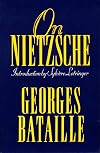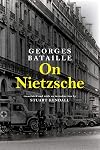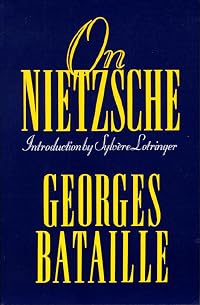
On Nietzsche
by Georges Bataille
On This Page
Description
"Georges Bataille wrote On Nietzsche in the final months of the Nazi occupation of France in order to cleanse the German philosopher of the "stain of Nazism." More than merely a treatise on Nietzsche, the book is as much a work of ethics in which thought is put to the test of experience and experience pushed to its limits. At once personal and political, it was written as an act of war, its publication contingent upon the German retreat. The result is a poetic and philosophical--and show more occasionally harrowing--record of life during wartime. Following Inner Experience and Guilty, On Nietzsche is the third volume of Bataille's Summa Atheologica. Haunted by the recognition that "existence cannot be at once autonomous and viable," herein the author yearns for community from the depths of personal isolation and transforms Nietzsche's will to power into his own will to chance. This new translation includes Memorandum, a selection of 280 passages from Nietzsche's works edited and introduced by Bataille. Originally published separately, Bataille planned to include the text in future editions of On Nietzsche. This edition also features the full notes and annotations from the French edition of Bataille's Oeuvres Comple?tes, as well as an incisive introductory essay by Stuart Kendall that situates the work historically, biographically, and philosophically."--Publisher's description. show lessTags
Recommendations




Member Reviews
Bataille usa Nietzsche para continuar a delirar na sua busca do ser. Mas é uma busca tingida pela individualidade, do indivíduo contra o espírito gregário. Daquele que rejeita o ocultamento de ser, quando este dá origem a algo, a uma forma de encarar as coisas, a uma criação que se estabiliza em redes de significados e ganhos. Então o ser é uma espécie de nada, sem vantagem, sem recompensa. Bataille vê isso em Nietzsche, na afirmação da chance surgida da junção do eterno retorno e do super-humano. Não torna o super-humano um humano melhor porvir, mas o porvir eterno do humano, que afirma e se perde na chance.
Ademais, forma extremamente excêntrica. Mistura de análise, diálogo, com um memorando de citações de show more Nietzsche, artigos de 2 páginas e um debate. show less
Ademais, forma extremamente excêntrica. Mistura de análise, diálogo, com um memorando de citações de show more Nietzsche, artigos de 2 páginas e um debate. show less
“Don’t take our word for it! Alas, we’re not all that logical. We say God - though in reality God is a person, a particular individual. We speak to him. We address him by name - he is the God of Abraham and Jacob. We treat him just like anybody else, like a personal being...”
“So he’s a whore?”
“____________________________________”
This work is turgid with concepts structured like thicket bushes, with terms such as ‘summit’, ‘chance’, ‘risk’, ‘impalement’, ‘laughter’ and ‘theopathy’ bristling with contradictory value judgements. We have here limit concepts that induce a pendulum to continually swing between anguish and unbridled joy, clinging on to a minute prospect of naked chance. Us, the race show more of gamblers, not being able to recognise the permeable border between eroticism and ascetic mysticism - of a God we make a whore out of, a God weak due to his immutable nature.... never taking a chance (and chance, against the vicissitudes of time, being the most affable thing) - we are forever lacerated by attempts to communicate with one another, by trying to tell one another about the labyrinthine logic of the summit we each clamour towards.
I believe this work, in conjunction with Virilio’s Speed and Politics, really does provide a bulletproof anthropology, a perfect assessment of the current state of affairs. Speed and Politics has a macroscopic lens which becomes hyper focused in Bataille’s own interior monologue, with the fraught tension of occupied France being the backdrop of these contemplative diary entries seeing Bataille pushing toward the beyond of his particularlity, attempting to affect an abortive summit toward a transcendent nothingness.
This book’s a real beauty. show less
“So he’s a whore?”
“____________________________________”
This work is turgid with concepts structured like thicket bushes, with terms such as ‘summit’, ‘chance’, ‘risk’, ‘impalement’, ‘laughter’ and ‘theopathy’ bristling with contradictory value judgements. We have here limit concepts that induce a pendulum to continually swing between anguish and unbridled joy, clinging on to a minute prospect of naked chance. Us, the race show more of gamblers, not being able to recognise the permeable border between eroticism and ascetic mysticism - of a God we make a whore out of, a God weak due to his immutable nature.... never taking a chance (and chance, against the vicissitudes of time, being the most affable thing) - we are forever lacerated by attempts to communicate with one another, by trying to tell one another about the labyrinthine logic of the summit we each clamour towards.
I believe this work, in conjunction with Virilio’s Speed and Politics, really does provide a bulletproof anthropology, a perfect assessment of the current state of affairs. Speed and Politics has a macroscopic lens which becomes hyper focused in Bataille’s own interior monologue, with the fraught tension of occupied France being the backdrop of these contemplative diary entries seeing Bataille pushing toward the beyond of his particularlity, attempting to affect an abortive summit toward a transcendent nothingness.
This book’s a real beauty. show less
Articulated well what I'd been feeling/thinking about Nietzsche and the void he and Hume unveil in metaethics.
100 BAT 2
Ratings
Members
- Recently Added By
Author Information

239+ Works 12,348 Members
Georges Bataille was a French poet, novelist, and philosopher. He was born in Billon, Puy-de-Dome, in central France on September 10, 1897. His father was already blind and paralyzed from syphilis when Bataille was born. In 1915, Bataille's father died, his mind destroyed by his illness. The death marked his son for life. While working at the show more Bibliotheque National in Paris during the 1920s, Bataille underwent psychoanalysis and became involved with some of the intellectuals in the Surrealist movement, from whom he learned the concept of incongruous imagery in art. In 1946 he founded the journal Critique, which published the early work of some of his contemporaries in French intellectual life, including Roland Barthes and Jacques Derrida. Bataille believed that in the darkest moments of human existence-in orgiastic sex and terrible death-lay ultimate reality. By observing them and even by experiencing them, actually in sex and vicariously in death, he felt that one could come as close as possible to fully experiencing life in all its dimensions. Bataille's works include The Naked Beast at Heaven's Gate (1956), A Tale of Satisfied Desire (1953), Death and Sensuality: A Study of Eroticism and the Taboo (1962), and The Birth of Art: Prehistoric Painting (1955). Bataille died in Paris on July 8, 1962. (Bowker Author Biography) show less
Some Editions
Common Knowledge
- Canonical title
- On Nietzsche
- Original title
- Sur Nietzsche, volonté de chance
- People/Characters
- Nietzsche, Friedrich Wilhelm, 1844-1900
Classifications
Statistics
- Members
- 282
- Popularity
- 114,233
- Reviews
- 4
- Rating
- (3.92)
- Languages
- 8 — English, French, German, Italian, Japanese, Portuguese, Spanish, Turkish
- Media
- Paper, Ebook
- ISBNs
- 20
- ASINs
- 6