On This Page
Description
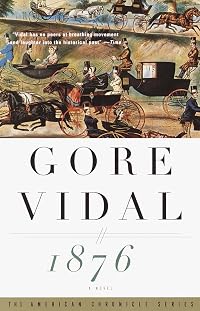
The third volume of Gore Vidal's series of historical novels aimed at demythologizing the American past, 1876 explores the political scandals of the Grant administration and the intrigues of that year's presidential election. Charles Schermerhorn Schuyler, Aaron Burr's unacknowledged son, returns to America after his self-imposed exile, hoping to arrange a marriage for his daughter Emma, but the two soon find themselves at the centers of American social and political power at a time when the show more fading ideals of the young republic were being replaced by the excitement of empire. show lessTags
Recommendations

















Member Reviews
Having read Burr, I went straight to its sequel, 1876, in which Burr narrator Charlie Schuyler returns to America after forty years in France. It's the Gilded Age, and everything is as different from the 1830s as in some ways it is the same. It's ten years after the terrible Civil War, and General (now President) Ulysses S. Grant is nearing the end of a more or less openly corrupt administration's second term. Several high-ranking members of the party of Lincoln are looking to succeed Grant and continue the status quo. Against them stands the priggish but upright reformer Samuel Tilden, governor of New York, the presumptive Democratic nominee. Schuyler, having lost his fortune in the Crash of 1873, resumes journalism in the United show more States while seeking an advantageous marriage for his widowed French daughter and an ambassadorial post for himself under the future President Tilden. Just as Burr consisted mostly of the young Schuyler's record of Burr's dictated memoir, 1876 is essentially the older Schuyler's notes for his book on the 1876 presidential campaign.
The older Schuyler is a much better narrator than his younger self: life has made him wry, and his pithy asides and descriptions are often hilarious. His financial anxiety and his continual fish-out-of-water perspective provide drama and perspective; he has a stake in everything that happens on both personal and political fronts. I personally liked this edition of Schuyler quite a bit, and my liking kept me engaged unti the remarkable election of 1876 reached its insane pick. Bush vs. Gore 2000? That was nothing. The military on standby as votes are counted, disputed, and manipulated, and public outcry reaches fever pitch? Trump vs. Biden was not at all new.
Just as Burr ended with a bit of an unforeseen but clearly foreshadowed twist, so too does 1876. I'm not sure I believe it, but it fits Vidal's view of human motivation, as I described it in my review of Burr. All in all, I enjoyed 1876 a great deal. I look forward to reading other books in the series. show less
The older Schuyler is a much better narrator than his younger self: life has made him wry, and his pithy asides and descriptions are often hilarious. His financial anxiety and his continual fish-out-of-water perspective provide drama and perspective; he has a stake in everything that happens on both personal and political fronts. I personally liked this edition of Schuyler quite a bit, and my liking kept me engaged unti the remarkable election of 1876 reached its insane pick. Bush vs. Gore 2000? That was nothing. The military on standby as votes are counted, disputed, and manipulated, and public outcry reaches fever pitch? Trump vs. Biden was not at all new.
Just as Burr ended with a bit of an unforeseen but clearly foreshadowed twist, so too does 1876. I'm not sure I believe it, but it fits Vidal's view of human motivation, as I described it in my review of Burr. All in all, I enjoyed 1876 a great deal. I look forward to reading other books in the series. show less
I am always a little uncomfortable with historical novels that treat real figures in fictional situations. That said, this is brilliant recreation of its period, and includes a number of marvelously drawn characters. Vidal evokes the look, attitudes, tastes and smells of the era, with relatively little of the self-conscious explanation of cultural peculiarities that can make historical fiction seem meretricious and forced. The main fictional character, Charles Schuyler, who is also the narrator by way of his supposed diary/memoir is an enormously attractive character, and his beautiful daughter (a widow, but a princess through marriage) is fascinating as she maneuvers her way through the social intricacies of the New York upper crust. show more Vidal's concern to point out parallels between the United States of Hayes's administration would be more annoying if many of his concerns weren't still so pertinent and valid 50 years later. show less
Very enjoyable. Vidal is in his element in 1876 - in contrast to Lincoln, where his admiration for Abe made the book slightly dry for my liking, almost everybody involved in the events of this novel is corrupt, fatuous or otherwise awful and he's free to be as waspish as he likes.
I haven't been swept up by the Narratives of Empire novels as much as as Julian or Creation (at least not so far), but this is good fun. I look forward to the next instalment.
I haven't been swept up by the Narratives of Empire novels as much as as Julian or Creation (at least not so far), but this is good fun. I look forward to the next instalment.
I recently heard that approximately 80% of Americans have not read (or even listened to) a book in the past year. Considering the ease with which we can now access books and the variety of formats available, I find this sad and troubling if true.
Friends and family members will comment that I am making up for the lack of reading among my countrymen (well this might be true since this is the 36th book I read this year). Hopefully, a review may spark some interest in a book readers may otherwise have overlooked. One should not feel tied to a "best- seller" list to enjoy reading pleasure.
This novel was published in 1976, during the Bicentennial. As I remember, Bicentennial celebrations and battle reenactments were an important part of show more recognizing the history of our country and most people were very excited about it.. Therefore, I expected the Centennial Exhibition to feature prominently in this book, but it was only mentioned briefly as a back-drop to what the story was really about- politics! That is, the corruption scandals surrounding President Grant's Administration, his decision not to seek a 3rd term, the Republican and Democratic Conventions of 1876, the Election of 1876 and the Inauguration of President Rutherford B. Hayes.
The story takes place in NYC and Washington D.C., and is seen through the eyes of the narrator, a fictitious reporter named Charles Schuyler who works for the NY Herald, headed by the very real and infamous James Gordon Bennet.
Although the character of Charles Schuyler is fictitious, most of the characters in the book lived at the time and were part of the NY and Washington social and political scene. Some of the historical figures who make appearances as characters are: the Astors, Vanderbilts, Garfields, and Grants, as well as Mark Twain, William Cullens Bryant and Victor Hugo.
Although Vidal takes liberties with these historical figures as "characters" in the book, many incidents did really happen. For instance, James ("Jamie") Bennett was the owner and publisher of the New York Herald who actually funded the search for Dr. Livingston, as well as a doomed search for the Northwest passage through the Arctic Circle, solely to increase readership of his paper.
Vidal does a great job of humorously recounting his many misadventures, including his visit to his fiancee's home on New Year's Day in 1877 (see page 321). I have read about this visit elsewhere, and resulted in Bennett's self- imposed exile to Europe out of shame and possible murder by her family members.
Mostly though, the book dramatically recounts the turmoil surrounding the contested election between Samuel Tilden and Rutherford Hayes (whom the characters refer to as both "Rutherfraud" and "His Fraudulency"). As mentioned before, the book is written through the eyes of a reporter who openly supports Tilden in the hope of attaining a post in his administration. Therefore, Vidal, a political activist and one time Democratic Candidate, makes biting observations regarding not only the social elite (of which he was a part), politics, and journalists, many of which made me chuckle such as:
"I have always found it strange that a nation whose prosperity is based entirely upon cheap immigrant labor should be so unrelentingly xenophobic" (p. 280).
"Explain to me sir", said the workman, "in what way is this election differs from that infamous election where Louis Napoleon destroyed the French republic and made himself emperor" (p. 314)
and then, as now, a toast to "good government!" (p. 346)
The book is historically accurate and no matter what your political leanings you will enjoy this book if you are interested in historical fiction. show less
Friends and family members will comment that I am making up for the lack of reading among my countrymen (well this might be true since this is the 36th book I read this year). Hopefully, a review may spark some interest in a book readers may otherwise have overlooked. One should not feel tied to a "best- seller" list to enjoy reading pleasure.
This novel was published in 1976, during the Bicentennial. As I remember, Bicentennial celebrations and battle reenactments were an important part of show more recognizing the history of our country and most people were very excited about it.. Therefore, I expected the Centennial Exhibition to feature prominently in this book, but it was only mentioned briefly as a back-drop to what the story was really about- politics! That is, the corruption scandals surrounding President Grant's Administration, his decision not to seek a 3rd term, the Republican and Democratic Conventions of 1876, the Election of 1876 and the Inauguration of President Rutherford B. Hayes.
The story takes place in NYC and Washington D.C., and is seen through the eyes of the narrator, a fictitious reporter named Charles Schuyler who works for the NY Herald, headed by the very real and infamous James Gordon Bennet.
Although the character of Charles Schuyler is fictitious, most of the characters in the book lived at the time and were part of the NY and Washington social and political scene. Some of the historical figures who make appearances as characters are: the Astors, Vanderbilts, Garfields, and Grants, as well as Mark Twain, William Cullens Bryant and Victor Hugo.
Although Vidal takes liberties with these historical figures as "characters" in the book, many incidents did really happen. For instance, James ("Jamie") Bennett was the owner and publisher of the New York Herald who actually funded the search for Dr. Livingston, as well as a doomed search for the Northwest passage through the Arctic Circle, solely to increase readership of his paper.
Vidal does a great job of humorously recounting his many misadventures, including his visit to his fiancee's home on New Year's Day in 1877 (see page 321). I have read about this visit elsewhere, and resulted in Bennett's self- imposed exile to Europe out of shame and possible murder by her family members.
Mostly though, the book dramatically recounts the turmoil surrounding the contested election between Samuel Tilden and Rutherford Hayes (whom the characters refer to as both "Rutherfraud" and "His Fraudulency"). As mentioned before, the book is written through the eyes of a reporter who openly supports Tilden in the hope of attaining a post in his administration. Therefore, Vidal, a political activist and one time Democratic Candidate, makes biting observations regarding not only the social elite (of which he was a part), politics, and journalists, many of which made me chuckle such as:
"I have always found it strange that a nation whose prosperity is based entirely upon cheap immigrant labor should be so unrelentingly xenophobic" (p. 280).
"Explain to me sir", said the workman, "in what way is this election differs from that infamous election where Louis Napoleon destroyed the French republic and made himself emperor" (p. 314)
and then, as now, a toast to "good government!" (p. 346)
The book is historically accurate and no matter what your political leanings you will enjoy this book if you are interested in historical fiction. show less
I finished the book 2 days after the still undecided 2020 US election. Parts of 1876 mirrored the current situation (too close for comfort). Interesting read about an important election often brushed over in American history. A good sign of a good history book is if I ended up googling lots of facts and figures. I did that a lot in this book.
My first book by Gore Vidal and I thought it very insightful, humorous, and informative. Charles Schuyler and his widowed daughter, Emma, has returned to the United States after spending thirty years in France. Things have changed! Schuyler has worked as a journalist in France for American papers; now he is returning to find his daughter a new husband. They both receive welcomes from the elite of New York City and are invited to all the best parties. Emma soon finds herself pursued by the boring, proper, and financially secure John Apgar who she agrees to marry because she does like him - nothing about love ever enters the picture. Charles meanwhile writes free lance for a variety of papers including the New York Times and the NY show more Harold. A cast of all of New York's best plays a part.
President Grant(Republican) is in office and while he was a Civil War hero, his administration is raft with corruption and he is no longer popular much to his chagrin. Samuel Tilden is predicted to be the Democratic candidate for the election of 1876 but the Republican nominee is up for grabs. Politicians, socialites, journalists, senators, and military veterans all have their ideas.
Gore does an excellent job of telling the story of the very corrupt election of 1876 in a thoroughly enjoyable way. Although, I must admit many of the political characters become confusing toward the end of the book. This is the first election where the popular vote which was won by Tilden was overturned by the electorial vote.
A great book to read in light of today's political scene - corruption was everywhere as everyone grabbed for their bit of power or money. Many of Charles Schuyler's thoughts could apply today.
Interesting book. Makes me want to read more Vidal. show less
President Grant(Republican) is in office and while he was a Civil War hero, his administration is raft with corruption and he is no longer popular much to his chagrin. Samuel Tilden is predicted to be the Democratic candidate for the election of 1876 but the Republican nominee is up for grabs. Politicians, socialites, journalists, senators, and military veterans all have their ideas.
Gore does an excellent job of telling the story of the very corrupt election of 1876 in a thoroughly enjoyable way. Although, I must admit many of the political characters become confusing toward the end of the book. This is the first election where the popular vote which was won by Tilden was overturned by the electorial vote.
A great book to read in light of today's political scene - corruption was everywhere as everyone grabbed for their bit of power or money. Many of Charles Schuyler's thoughts could apply today.
Interesting book. Makes me want to read more Vidal. show less
The history in the fiction provided by Gore Vidal of one of America's most scandalous corrupt times including elections is helpful and interesting if a bit shallow. The fiction part seems little more than filler and is unpleasantly bitter and often tedious. Still, this is a must read. Gore's insight, partly the result of his own political family, is unique and without peer. His picking the fraudulent 1876 presidential election starts with his sound historical/political judgment.
Quotes: (page 76) “History and politics are my field, and New York seems not to be rich in either in either historians or true political writers despite the often interesting efforts of the Adams descendant who edits Boston's News American Review. But I am show more unfair to my countrymen. I have been here too short a time to judge. Also, I tend to compare the home product with Paris at a time when I think that city is, what in its eternal arrogance Paris thinks itself always to be, a city of true light with Taine and Renan ablaze, and a thousand ideas stirring.”
(page 182) “The so-called Whisky Ring began in 1870, when Grant appointed an old crony named General (naturally) John McDonald as chief of the Revenue Offce in St. Louis. Like Babcock, McDonald served with Grant at Vicksburg, and whoever served with the great commander during that celebrated campaign may have, if he wants, the key yo the mint. In any case, the tax on whisky in the West did not go to the government but to McDonald and his cronies, as well as to Babcock and, perhaps, to the President himself. To date some ten million dollars have been stolen.
'Is the President involved?' I am deeply curious.”
(page 336) “'Zach. Chandler has ordered the Interior Department to investigate Tilden's taxes. Back in '62, during the worst of the war, Tilden said that his income for the year was only seven thousand dollars. Actually, it was more than a hundred thousand.'
'I should think that by not paying the infamous tax on income, Tilden would be something of a hero.'
'Boys in Blue, said Jamie, combing his mustache with his fingers. 'Union in peril. Slaves to be freed. Every dollar needed. Patriotic duty. Down with the Copperhead Democrats. Oh, The New York Times is getting ready to pour it on. There is no crime their editors would not commit to help the Republican party,'” show less
Quotes: (page 76) “History and politics are my field, and New York seems not to be rich in either in either historians or true political writers despite the often interesting efforts of the Adams descendant who edits Boston's News American Review. But I am show more unfair to my countrymen. I have been here too short a time to judge. Also, I tend to compare the home product with Paris at a time when I think that city is, what in its eternal arrogance Paris thinks itself always to be, a city of true light with Taine and Renan ablaze, and a thousand ideas stirring.”
(page 182) “The so-called Whisky Ring began in 1870, when Grant appointed an old crony named General (naturally) John McDonald as chief of the Revenue Offce in St. Louis. Like Babcock, McDonald served with Grant at Vicksburg, and whoever served with the great commander during that celebrated campaign may have, if he wants, the key yo the mint. In any case, the tax on whisky in the West did not go to the government but to McDonald and his cronies, as well as to Babcock and, perhaps, to the President himself. To date some ten million dollars have been stolen.
'Is the President involved?' I am deeply curious.”
(page 336) “'Zach. Chandler has ordered the Interior Department to investigate Tilden's taxes. Back in '62, during the worst of the war, Tilden said that his income for the year was only seven thousand dollars. Actually, it was more than a hundred thousand.'
'I should think that by not paying the infamous tax on income, Tilden would be something of a hero.'
'Boys in Blue, said Jamie, combing his mustache with his fingers. 'Union in peril. Slaves to be freed. Every dollar needed. Patriotic duty. Down with the Copperhead Democrats. Oh, The New York Times is getting ready to pour it on. There is no crime their editors would not commit to help the Republican party,'” show less
Members
- Recently Added By
Lists

Best Political Fiction
92 works; 12 members

1970s
657 works; 23 members

The American Experience
173 works; 18 members

Rory Gilmore Book Club
193 works; 5 members

Books With Numbers in the Title
308 works; 13 members

Publisher's Weekly Bestsellers - Part II - 1940 - 1979
355 works; 5 members

Swinging Seventies
255 works; 18 members

The Torchlight List
95 works; 1 member
Author Information

168+ Works 31,282 Members
Gore Vidal was born Eugene Luther Gore Vidal Jr. on October 3, 1925 at the U.S. Military Academy at West Point, New York. He did not go to college but attended St. Albans School in Washington and graduated from Phillips Exeter Academy in New Hampshire in 1943. He enlisted in the Army, where he became first mate on a freight supply ship in the show more Aleutian Islands. His first novel, Williwaw, was published in 1946 when he was twenty-one years old and working as an associate editor at the publishing company E. P. Dutton. The City and the Pillar was about a handsome, athletic young Virginia man who gradually discovers that he is homosexual, which caused controversy in the publishing world. The New York Times refused to advertise the novel and gave a negative review of it and future novels. He had such trouble getting subsequent novels reviewed that he turned to writing mysteries under the pseudonym Edgar Box and then gave up novel-writing altogether for a time. Once he moved to Hollywood, he wrote television dramas, screenplays, and plays. His films included I Accuse, Suddenly Last Summer with Tennessee Williams, Is Paris Burning? with Francis Ford Coppola, and Ben-Hur. His most successful play was The Best Man, which he also adapted into a film. He started writing novels again in the 1960's including Julian, Washington, D.C., Myra Breckenridge, Burr, Myron, 1876, Lincoln, Hollywood, Live From Golgotha: The Gospel According to Gore Vidal, and The Golden Age. He also published two collections of essays entitled The Second American Revolution, which won the National Book Critics Circle Award for criticism in 1982 and United States: Essays 1952-1992. In 2009, he received the National Book Awards lifetime achievement award. He died from complications of pneumonia on July 31, 2012 at the age of 86. (Bowker Author Biography) show less
Awards and Honors
Distinctions
Notable Lists
Series

Work Relationships
Common Knowledge
- Canonical title
- 1876
- Original publication date
- 1976
- People/Characters
- Ulysses S. Grant; Rutherford B. Hayes; Charles Schuyler; Samuel J. Tilden; Emma Schuyler
- Important places
- Washington, D.C., USA; New York, New York, USA
- Important events
- United States presidential election (1876)
- Dedication
- For Claire Bloom
- First words
- "That is New York." I pointed to the waterfront just ahead as if the city were mine.
- Last words
- (Click to show. Warning: May contain spoilers.)At the time of Mr. Schuyler's death, he was at work. . .
- Canonical DDC/MDS
- 813.54
- Canonical LCC
- PS3543.I26
Classifications
Statistics
- Members
- 1,390
- Popularity
- 17,092
- Reviews
- 22
- Rating
- (3.72)
- Languages
- 7 — English, German, Italian, Japanese, Russian, Spanish, Portuguese (Portugal)
- Media
- Paper, Audiobook, Ebook
- ISBNs
- 29
- ASINs
- 21