On the Improvement of the Understanding
by Baruch Spinoza
On This Page
Description
The Enlightenment thinker asserts that mental tranquility is achieved through knowledge of God in this brief philosophical treatise. Seventeenth-century philosopher Baruch Spinoza was one of the most original and important thinkers of his time. His magnum opus, Ethics, influenced generations of great minds from Karl Marx to Ludwig Wittgenstein and George Santayana. In this earlier work, Spinoza articulates his view that life is best lived with the supreme happiness of knowing God's show more infinite love. By extension, all earthly pursuits-including money, fame, and sex-are mere distractions from the greater joy of the soul's quietude. This edition of How to Improve Your Mind is translated by the philosopher and founder of the Philosophical Library, Dagobert D. Runes. Runes also provides exclusive commentary and biographical notes. show lessTags
Recommendations
















Member Reviews
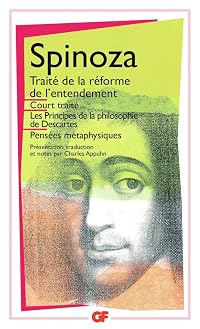
Le Traité de la réforme de l’entendement est un des ouvrages les plus importants du philosophe Baruch Spinoza (écrit inachevé entre 1665 et 1670), pour qui veut comprendre l’évolution de sa pensée ainsi que les fondements de sa théorie de la connaissance. Spinoza expose tout au début du livre ce qui constitue bien le credo de tous ses ouvrages philosophiques. Il veut différencier les vrais des faux biens, les buts qui nous apportent une satisfaction réelle de ceux qui ne nous apportent qu’une joie éphémère et illusoire. L’Éthique elle-même ne sera que le prolongement de ce projet.
Nov 12, 2010French
SPINOZA
LA REFORMA DEL ENTENDIMIENTO
Traducción del latín, prólogo y notas de Alfonso Castaño Piñán
Este breve tratado posee excepcional importancia paraconocer lafilosofía de Spinoza, ya que es una justificación metodológica de la Etica, su obra fundmental.
LA REFORMA DEL ENTENDIMIENTO
Traducción del latín, prólogo y notas de Alfonso Castaño Piñán
Este breve tratado posee excepcional importancia paraconocer lafilosofía de Spinoza, ya que es una justificación metodológica de la Etica, su obra fundmental.
Feb 6, 2018Spanish
> Babelio : https://www.babelio.com/livres/Spinoza-Traite-de-la-reforme-de-lentendement/1472...
> Un itinéraire vers la pensée, la sienne unie à celle de Spinoza. Un outil de libération. Traduction très claire, introduction simple et utile pour comprendre ce texte de jeunesse dans le cheminement de Spinoza. Et puis un format pour l'avoir dans sa poche quand on chemine.
—Danieljean (Babelio)
> Un itinéraire vers la pensée, la sienne unie à celle de Spinoza. Un outil de libération. Traduction très claire, introduction simple et utile pour comprendre ce texte de jeunesse dans le cheminement de Spinoza. Et puis un format pour l'avoir dans sa poche quand on chemine.
—Danieljean (Babelio)
Feb 12, 2021 (Edited)French
Librería 0. Estante 1.
Feb 13, 2020Spanish
Ratings
Members
- Recently Added By
Lists

Literary Works Read in College
316 works; 15 members
Author Information

333+ Works 10,109 Members
Baruch Spinoza was born in Amsterdam, the son of Portuguese Jewish refugees who had fled from the persecution of the Spanish Inquisition. Although reared in the Jewish community, he rebelled against its religious views and practices, and in 1656 was formally excommunicated from the Portuguese-Spanish Synagogue of Amsterdam and was thus effectively show more cast out of the Jewish world. He joined a group of nonconfessional Christians (although he never became a Christian), the Collegiants, who professed no creeds or practices but shared a spiritual brotherhood. He was also apparently involved with the Quaker mission in Amsterdam. Spinoza eventually settled in The Hague, where he lived quietly, studying philosophy, science, and theology, discussing his ideas with a small circle of independent thinkers, and earning his living as a lens grinder. He corresponded with some of the leading philosophers and scientists of his time and was visited by Leibniz and many others. He is said to have refused offers to teach at Heidelberg or to be court philosopher for the Prince of Conde. During his lifetime he published only two works, The Principles of Descartes' Philosophy (1666) and the Theological Political Tractatus (1670). In the first his own theory began to emerge as the consistent consequence of that of Descartes (see also Vol. 5). In the second, he gave his reasons for rejecting the claims of religious knowledge and elaborated his theory of the independence of the state from all religious factions. After his death (probably caused by consumption resulting from glass dust), his major work, the Ethics, appeared in his Opera Posthuma, and presented the full metaphysical basis of his pantheistic view. Spinoza's influence on the Enlightenment, on the Romantic Age, and on modern secularism has been tremendous. (Bowker Author Biography) show less

Baruch Spinoza has a Legacy Library. Legacy libraries are the personal libraries of famous readers, entered by LibraryThing members from the Legacy Libraries group.
Some Editions
Series
Belongs to Publisher Series
Work Relationships
Common Knowledge
- Canonical title
- On the Improvement of the Understanding
- Original title
- Tractatus de intellectus emendatione
- Original publication date
- 1677
- Original language
- Latin
- Disambiguation notice
- This work is only: "On the improvement of the understanding". Therefore it shoud not be mixed up with editions that combine this work with: "The Ethics" and: "The correspondence". That means too that the pictures of the cover... (show all)s of those editions with the combined works should be removed as a choice for this singular work.
Classifications
Statistics
- Members
- 199
- Popularity
- 164,021
- Reviews
- 4
- Rating
- (4.00)
- Languages
- 9 — Dutch, English, French, German, Italian, Japanese, Latin, Portuguese, Spanish
- Media
- Paper, Ebook
- ISBNs
- 40
- ASINs
- 7