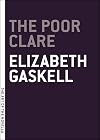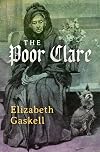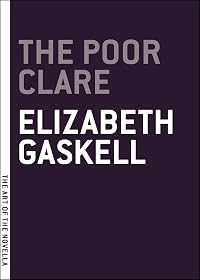
The Poor Clare
by Elizabeth Gaskell
On This Page
Description
As a writer, Elizabeth Gaskell often sought to cast light on the stark differences between social classes in the Victorian era. But in the remarkable novella "The Poor Clare," she takes issues of class, socioeconomic status, and religious differences out of the drawing room and embeds them in a spine-tingling tale of gothic suspense..
Tags
Recommendations



















Member Reviews
Another impulse checkout from the library based almost solely on being a Melville House novella.
It's really been a long time since I've read a gothic story, I've forgotten how fun they can be! While simultaneously being full of ringing class inequality indictments and length descriptions of architecture. But fun! Because, who really doesn't want to see an arrogant aristocrat suffer mightily for impulsively shooting a woman's beloved pet? But when lots of other people have to pay, too, it unexpectedly turns into a moral tale of forgiveness and redemption.
Wonderful.
It's really been a long time since I've read a gothic story, I've forgotten how fun they can be! While simultaneously being full of ringing class inequality indictments and length descriptions of architecture. But fun! Because, who really doesn't want to see an arrogant aristocrat suffer mightily for impulsively shooting a woman's beloved pet? But when lots of other people have to pay, too, it unexpectedly turns into a moral tale of forgiveness and redemption.
Wonderful.
In the front of my edition of this book (the Melville House edition that is part of their wonderful Art of the Novella series), there's a brief note that this particular edition is reprinted from Gaskell's Lizzie Leigh and Other Tales (1896 ed.); it first made its appearance in Dickens' Household Words in 1856.
I know that others have labeled this story as a Gothic tale, but in my mind, this story of revenge and redemption sits much more squarely in the supernatural zone. It is a compelling and eerie tale involving a horrific curse that will come to have serious repercussions beyond anything even remotely imaginable. It also opens a window onto anti-Catholic Britain, and reading carefully, it seems to be, in part, a plea for religious show more tolerance. After all, anti-Catholic feelings were still strong during Gaskell's lifetime, exacerbated by the influx of Irish immigrants coming to England during the Great Famine. Bottom line: as with most of Gaskell's short fiction, there's much more here than a simple tale.
While there are definitely strong undercurrents here, if you're a reader more focused on plot than subtext and just want a well-written, different and entertaining read, The Poor Clare is still a good choice for dark fiction readers. I loved it. It's almost like a mystery in parts; the only down side is that it is a bit abrupt at the end so beware. I had to go back through the last few pages more than once to make sure I got it right. Overall, though, it's one of the strangest tales I've read in a while, and it's a very good one. It's also very unlike Gaskell's other stories that I've read so it might be a new experience for readers who enjoy her work.
If anyone is interested in plot (and more) without spoilers, there's more at my reading journal. show less
I know that others have labeled this story as a Gothic tale, but in my mind, this story of revenge and redemption sits much more squarely in the supernatural zone. It is a compelling and eerie tale involving a horrific curse that will come to have serious repercussions beyond anything even remotely imaginable. It also opens a window onto anti-Catholic Britain, and reading carefully, it seems to be, in part, a plea for religious show more tolerance. After all, anti-Catholic feelings were still strong during Gaskell's lifetime, exacerbated by the influx of Irish immigrants coming to England during the Great Famine. Bottom line: as with most of Gaskell's short fiction, there's much more here than a simple tale.
While there are definitely strong undercurrents here, if you're a reader more focused on plot than subtext and just want a well-written, different and entertaining read, The Poor Clare is still a good choice for dark fiction readers. I loved it. It's almost like a mystery in parts; the only down side is that it is a bit abrupt at the end so beware. I had to go back through the last few pages more than once to make sure I got it right. Overall, though, it's one of the strangest tales I've read in a while, and it's a very good one. It's also very unlike Gaskell's other stories that I've read so it might be a new experience for readers who enjoy her work.
If anyone is interested in plot (and more) without spoilers, there's more at my reading journal. show less
These two novellas bear nothing in common. One is written by a female, British author, the other is written by a male, American writer. One wrote about family and class relationships, the other wrote about sea-faring adventures. The only common ground is that they were both written in the nineteenth century, pre-Civil War. And they are both rather...um...edgy or shocking.
The Poor Clare speaks elegantly of the Protestant/Catholic and class societal relationships in the north of England. This little story has Gothic overtones with a castle, curses, apparitions, etc. not at all like Gaskell's usual story. I had to double check the cover to make sure she was actually the author!
Melville House says, "The purposeful slaying of lonely show more Bridget's beloved dog unleashes a torrent of rage that surges down through the generations. In her desire for revenge, Bridget utters a fearful curse on the dog's killer: All that the murderer loves most, he will lose."
My take? Well, it's not a great as Wives and Daughters or North and South, but it is interesting. It's a bit hard to swallow at times because the "demon" or "apparition" seems so unbelievable. show less
The Poor Clare speaks elegantly of the Protestant/Catholic and class societal relationships in the north of England. This little story has Gothic overtones with a castle, curses, apparitions, etc. not at all like Gaskell's usual story. I had to double check the cover to make sure she was actually the author!
Melville House says, "The purposeful slaying of lonely show more Bridget's beloved dog unleashes a torrent of rage that surges down through the generations. In her desire for revenge, Bridget utters a fearful curse on the dog's killer: All that the murderer loves most, he will lose."
My take? Well, it's not a great as Wives and Daughters or North and South, but it is interesting. It's a bit hard to swallow at times because the "demon" or "apparition" seems so unbelievable. show less
It doesn't matter if it is the 18th century or the 21st century; you just don't shoot someone's dog.
Too short for much character development and the "gothic" part of the story wasn't very supernatural and overly religious.
Well done
Ratings
Members
- Recently Added By
Lists

Books Tagged Doppelganger
15 works; 1 member
Author Information

233+ Works 30,612 Members
Elizabeth Gaskell was born on September 29, 1810 to a Unitarian clergyman, who was also a civil servant and journalist. Her mother died when she was young, and she was brought up by her aunt in Knutsford, a small village that was the prototype for Cranford, Hollingford and the setting for numerous other short stories. In 1832, she married William show more Gaskell, a Unitarian clergyman in Manchester. She participated in his ministry and collaborated with him to write the poem Sketches among the Poor in 1837. Our Society at Cranford was the first two chapters of Cranford and it appeared in Dickens' Household Words in 1851. Dickens liked it so much that he pressed Gaskell for more episodes, and she produced eight more of them between 1852 and 1853. She also wrote My Lady Ludlow and Lois the Witch, a novella that concerns the Salem witch trials. Wives and Daughters ran in Cornhill from August 1864 to January 1866. The final installment was never written but the ending was known and the novel exists now virtually complete. The story centers on a series of relationships between family groups in Hollingford. Most critics agree that her greatest achievement is the short novel Cousin Phillis. Gaskell was also followed by controversy. In 1853, she offended many readers with Ruth, which explored seduction and illegitimacy that led the "fallen woman" into ostracism and inevitable prostitution. The novel presents the social conduct in a small community when tolerance and morality clash. Critics praised the novel's moral lessons but Gaskell's own congregation burned the book and it was banned in many libraries. In 1857, The Life of Charlotte Brontë was published. The biography was initially praised but angry protests came from some of the people it dealt with. Gaskell was against any biographical notice of her being written during her lifetime. After her death on November 12, 1865, her family refused to make family letters or biographical data available. (Bowker Author Biography) show less
Series
Belongs to Publisher Series
Work Relationships
Is contained in
Common Knowledge
- Canonical title
- The Poor Clare
- Original publication date
- 1856
- First words
- December 12th, 1747 - My life has been strangely bound up with extraordinary incidents, some of which occurred before I had any connection with the principal actors in them, or, indeed, before I even knew of their existence.
- Last words
- (Click to show. Warning: May contain spoilers.)"She is freed from the curse!" said she, as she fell back dead.
Classifications
Statistics
- Members
- 122
- Popularity
- 268,360
- Reviews
- 6
- Rating
- (3.43)
- Languages
- English
- Media
- Paper, Audiobook, Ebook
- ISBNs
- 25
- ASINs
- 6