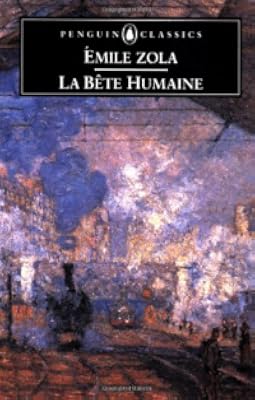
La Bête Humaine
by Émile Zola
Les Rougon-Macquart (Zola's recommended reading order) (15), Les Rougon-Macquart (publication order) (17)
On This Page
Description
Did possessing and killing amount to the same thing deep within the dark recesses of the human beast?La Bete humaine (1890), is one of Zola's most violent and explicit works. On one level a tale of murder, passion and possession, it is also a compassionate study of individuals derailed by atavistic forces beyond their control.Zola considered this his `most finely worked' novel, and in it he powerfully evokes life at the end of the Second Empire in France, where society seemed to be hurtling show more into the future like the new locomotives and railways it was building. While expressing the hope that human nature evolves througheducation and gradually frees itself of the burden of inherited evil, he is constantly reminding us that under the veneer of technological progress there remains, always, the beast within.This new translation captures Zola's fast-paced yet deliberately dispassionate style, while the introduction and detailed notes place the novel in its social, historical, and literary context. show lessTags
Recommendations














Member Reviews
Murder, sex and big steam locomotives: what could possibly go wrong...?
This is Zola's somewhat ironic look at the most-vaunted industrial achievement of the Second Empire, the French railway network, and it's also his attempt to take on Dostoevsky at his own game after reading Crime and punishment.
Being Zola, it's the fruit of enormous amounts of detailed research — he not only seems to understand how steam engines work at a technical level and what the driver and fireman are actually doing up there on the footplate, but he's also obviously absorbed all kinds of interesting social detail about how railway companies are organised, right down to the annual earnings of the woman in charge of the ladies' toilets at St Lazare station. His show more account of driving a train from Le Havre to Rouen in the snow has to be one of the all-time great pieces of railway writing, fiction or non-fiction. The railway incidents he describes in the book aren't things any railway company would want to happen, and they must have caused a few awkward moments for the railway officials who helped with his research, but they are all at least plausible. We get things that have become clichés, like murder in a moving train, the train stuck in the snow, the train-wreck, the person walking through the tunnel, and the runaway train, but we don't get Hollywood silliness of the Buster Keaton/Bugs Bunny type (uncoupling wagons in motion, walking on the roof of the train, demolishing carriages for firewood, etc.).
The murder plot is as sensational as we would wish: the couple who get away with murder but find their lives being destroyed by their shared knowledge of the guilty secret, the psychopath who gets the urge to murder a woman every time he is sexually aroused, but is otherwise quite sane and normal, the young woman whose jealousy pushes her over the edge into committing mass murder. (Incidentally, the psychopath Jacques Lantier shows us Zola's bizarre notion of genetics at its battiest: we're supposed to accept that his perverted urges are the result of the "bad blood" inherited from the heavy drinkers in L'Assommoir, without anyone pointing out to Zola that, quite apart from any scientific quibbles about whether acquired characteristics can be inherited, there's no sign that either Lantier or Gervaise was drinking heavily before the children were born.)
The political message is fairly straightforward, too: with the Empire on its last legs (it's 1869-1870) the criminal justice system is shown as a purely political tool, happy to file the case away if a trial might bring unpleasant details about the regime to light; equally happy to punish the innocent and let the guilty go free if that conveys the right political message. And Zola can't resist the temptation to close the book with the bluntest of political metaphors: a troop-train packed with drunken recruits eagerly singing patriotic songs as they hurtle east towards certain destruction with no-one on the footplate... show less
This is Zola's somewhat ironic look at the most-vaunted industrial achievement of the Second Empire, the French railway network, and it's also his attempt to take on Dostoevsky at his own game after reading Crime and punishment.
Being Zola, it's the fruit of enormous amounts of detailed research — he not only seems to understand how steam engines work at a technical level and what the driver and fireman are actually doing up there on the footplate, but he's also obviously absorbed all kinds of interesting social detail about how railway companies are organised, right down to the annual earnings of the woman in charge of the ladies' toilets at St Lazare station. His show more account of driving a train from Le Havre to Rouen in the snow has to be one of the all-time great pieces of railway writing, fiction or non-fiction. The railway incidents he describes in the book aren't things any railway company would want to happen, and they must have caused a few awkward moments for the railway officials who helped with his research, but they are all at least plausible. We get things that have become clichés, like murder in a moving train, the train stuck in the snow, the train-wreck, the person walking through the tunnel, and the runaway train, but we don't get Hollywood silliness of the Buster Keaton/Bugs Bunny type (uncoupling wagons in motion, walking on the roof of the train, demolishing carriages for firewood, etc.).
The murder plot is as sensational as we would wish: the couple who get away with murder but find their lives being destroyed by their shared knowledge of the guilty secret, the psychopath who gets the urge to murder a woman every time he is sexually aroused, but is otherwise quite sane and normal, the young woman whose jealousy pushes her over the edge into committing mass murder. (Incidentally, the psychopath Jacques Lantier shows us Zola's bizarre notion of genetics at its battiest: we're supposed to accept that his perverted urges are the result of the "bad blood" inherited from the heavy drinkers in L'Assommoir, without anyone pointing out to Zola that, quite apart from any scientific quibbles about whether acquired characteristics can be inherited, there's no sign that either Lantier or Gervaise was drinking heavily before the children were born.)
The political message is fairly straightforward, too: with the Empire on its last legs (it's 1869-1870) the criminal justice system is shown as a purely political tool, happy to file the case away if a trial might bring unpleasant details about the regime to light; equally happy to punish the innocent and let the guilty go free if that conveys the right political message. And Zola can't resist the temptation to close the book with the bluntest of political metaphors: a troop-train packed with drunken recruits eagerly singing patriotic songs as they hurtle east towards certain destruction with no-one on the footplate... show less
The Beast Within expands Zola's exploration of heredity and its effects on character, and whether or not such character traits can be influenced by environment; specifically, can the urge to do evil be tempered, or even completely suppressed. For the beast within is terrifying, capable of any and all depravities.
Jacques Lantier had the wrong heredity. Part of the illegitimate Macquart branch of the Rougon-Macquart families, he was the son of the ill fated Gervaise, who had gone off to Paris leaving the small boy in the care of Aunt Phasie, his father's cousin. Jacques appeared to be successful, to have broken the family curse. At twenty-six he was a driver on the Western Railway, skilled at his job, diligent and conscientious. However, show more his dedication to work masked a secret affliction.
Kill a woman! Kill a woman! The words had sounded in his ears since his early adolescence with the maddening , feverish insistence of unsated desire. Whereas other boys coming to puberty dreamed of possessing a woman, the only thing that excited him was the thought of killing one. It was pointless trying to deceive himself.
Such thoughts were provoked by intimate contact with women, so Jacques tried to sublimate himself completely in his work, in his care of the locomotive La Lison, which was "...like a mistress, soothing him and bringing him only happiness". There are suggestions that his impulses were preceded by various physical aura. At such times his body took on a life of its own; "he became the slave of the beast within".
The Beast Within has five murders, a probable murder, a suicide, pedophilia, possible incest and a wrongful conviction, so the pace is as swift as the trains that thunder through the tale. Standing by the side of the tracks, Jacques saw the first murder, that of President Grandmorin, president of the Western Railway. As the train flashed by, Jacques saw the knife thrust in the first class compartment. Wandering along, he wondered if he had really seen such a thing, and a woman too, for the glimpse was that of a moment. Confirmation came an hour later when the body was found beside the tracks. 'What he had merely dreamed of that man had actually done..."
By the end of the second chapter, all the murderers and victims have been introduced, and Grandmorin has been murdered. There were connections throughout, all centred on the railway that gave them their living. Statistically such a cluster would seem improbable, but Zola works his way through the motivations making it all believable. At the time he wrote this novel, railways were making their way across France
like a giant creature, a colossus that lay sprawled across the country, its head in Paris, its backbone stretching the length of the main line, its arms and legs spreading out along the branch lines and its hands and feet at Le Havre and at other towns it found its way to. On and on it went, soulless, triumphant, striding towards the future, straight as a die, wilfully disregarding whatever shreds of humanity survived on either side of it, hidden from view yet still clinging to their own hardy inner life, their ceaseless round of passion and crime.
Lacking alarms and emergency pulls, they became perfect sites for crime. There had been a high profile murder on the train in 1860 and another in 1886, both of which are echoed in The Beast Within. On another front, Zola had read the recently published Crime and Punishment, with its exploration of a killer's mind. Jack the Ripper was grabbing headlines. Scientists were looking for a criminal "type". How could a writer like Zola ignore such a stew?
Zola did not follow the commonly held beliefs though. Jacques is sympathetically portrayed as he struggles against his demons, leading a commendable life for the most part. He had few of the physical characteristics that the age regarded as indicative of a criminal. Those are reserved for the most innocent person in the novel.
Naturally the crimes that fill the novel could not take place unnoticed. The law stepped in. Zola reveals it to be as corrupt in its way as the most depraved killer. In France, the initial investigation was carried out by an appointed magistrate, not by the police. The magistrate decided whether or not a particular case would proceed to trial. This situation made political interference commonplace in any case suggesting scandal or bad press. Zola's legal types found a lack of evidence, suppressed and destroyed evidence, and knowingly convicted an innocent man, all this even before the Dreyfus case.
There is nothing like a reread of a great novel. It is never the same as the last time it was read. My memory of [The Beast Within] is almost entirely of the railway. Zola had made trains and station such an integral part of the book that convinced by his metaphors, I thought of La Lison as a human beast, a magnificent animal. As I read this time, I wondered how the rest of it had escaped me over the years. Perhaps part of it was two different translations. I had initially read it with the title La Bête Humaine, which I had translated as "the human beast", making the train the beast in my mind. That edition was translated by Leonard Tancock in 1977. Looking it over now, I realize that the dialogue seems stilted, so perhaps the characters did not come to life as they did in Whitehouse's translation. At any rate, this reread made a brilliant synthesis of the two, with its redirected focus. If you have never read a novel by Zola, this is an excellent place to start. show less
Jacques Lantier had the wrong heredity. Part of the illegitimate Macquart branch of the Rougon-Macquart families, he was the son of the ill fated Gervaise, who had gone off to Paris leaving the small boy in the care of Aunt Phasie, his father's cousin. Jacques appeared to be successful, to have broken the family curse. At twenty-six he was a driver on the Western Railway, skilled at his job, diligent and conscientious. However, show more his dedication to work masked a secret affliction.
Kill a woman! Kill a woman! The words had sounded in his ears since his early adolescence with the maddening , feverish insistence of unsated desire. Whereas other boys coming to puberty dreamed of possessing a woman, the only thing that excited him was the thought of killing one. It was pointless trying to deceive himself.
Such thoughts were provoked by intimate contact with women, so Jacques tried to sublimate himself completely in his work, in his care of the locomotive La Lison, which was "...like a mistress, soothing him and bringing him only happiness". There are suggestions that his impulses were preceded by various physical aura. At such times his body took on a life of its own; "he became the slave of the beast within".
The Beast Within has five murders, a probable murder, a suicide, pedophilia, possible incest and a wrongful conviction, so the pace is as swift as the trains that thunder through the tale. Standing by the side of the tracks, Jacques saw the first murder, that of President Grandmorin, president of the Western Railway. As the train flashed by, Jacques saw the knife thrust in the first class compartment. Wandering along, he wondered if he had really seen such a thing, and a woman too, for the glimpse was that of a moment. Confirmation came an hour later when the body was found beside the tracks. 'What he had merely dreamed of that man had actually done..."
By the end of the second chapter, all the murderers and victims have been introduced, and Grandmorin has been murdered. There were connections throughout, all centred on the railway that gave them their living. Statistically such a cluster would seem improbable, but Zola works his way through the motivations making it all believable. At the time he wrote this novel, railways were making their way across France
like a giant creature, a colossus that lay sprawled across the country, its head in Paris, its backbone stretching the length of the main line, its arms and legs spreading out along the branch lines and its hands and feet at Le Havre and at other towns it found its way to. On and on it went, soulless, triumphant, striding towards the future, straight as a die, wilfully disregarding whatever shreds of humanity survived on either side of it, hidden from view yet still clinging to their own hardy inner life, their ceaseless round of passion and crime.
Lacking alarms and emergency pulls, they became perfect sites for crime. There had been a high profile murder on the train in 1860 and another in 1886, both of which are echoed in The Beast Within. On another front, Zola had read the recently published Crime and Punishment, with its exploration of a killer's mind. Jack the Ripper was grabbing headlines. Scientists were looking for a criminal "type". How could a writer like Zola ignore such a stew?
Zola did not follow the commonly held beliefs though. Jacques is sympathetically portrayed as he struggles against his demons, leading a commendable life for the most part. He had few of the physical characteristics that the age regarded as indicative of a criminal. Those are reserved for the most innocent person in the novel.
Naturally the crimes that fill the novel could not take place unnoticed. The law stepped in. Zola reveals it to be as corrupt in its way as the most depraved killer. In France, the initial investigation was carried out by an appointed magistrate, not by the police. The magistrate decided whether or not a particular case would proceed to trial. This situation made political interference commonplace in any case suggesting scandal or bad press. Zola's legal types found a lack of evidence, suppressed and destroyed evidence, and knowingly convicted an innocent man, all this even before the Dreyfus case.
There is nothing like a reread of a great novel. It is never the same as the last time it was read. My memory of [The Beast Within] is almost entirely of the railway. Zola had made trains and station such an integral part of the book that convinced by his metaphors, I thought of La Lison as a human beast, a magnificent animal. As I read this time, I wondered how the rest of it had escaped me over the years. Perhaps part of it was two different translations. I had initially read it with the title La Bête Humaine, which I had translated as "the human beast", making the train the beast in my mind. That edition was translated by Leonard Tancock in 1977. Looking it over now, I realize that the dialogue seems stilted, so perhaps the characters did not come to life as they did in Whitehouse's translation. At any rate, this reread made a brilliant synthesis of the two, with its redirected focus. If you have never read a novel by Zola, this is an excellent place to start. show less
Murder on the Le Havre Express
By sally tarbox TOP 500 REVIEWER on 26 Jan. 2014
Format: Paperback
Zola at his riveting best. The novel opens with deputy stationmaster Roubaud discovering that his pretty young wife had been preyed upon by her guardian in her youth and planning to kill him.... Soon Jacques Lantier enters the story, a train driver who is fighting his affliction: the yearning to commit murder every time he sees a beautiful woman ("the wild beast in him, ready to bite")....Jacques, meanwhile, is adored by Flore, an Amazon type of woman, extraordinarily strong and fierce.
This all sounds far-fetched, as indeed it is. But Zola manages to craft an intensely powerful read, set against a totally convincing and well-researched show more background of the railway industry. Thus a train crash is vividly described:
"She was cooling, her live coals were falling out as cinders, the breath that had hissed so violently out of her pierced side was petering out into the oft whimpering of a crying child. Always so bright and shining, she was now soiled with dirt and dribble, lying on her back in a black sea of coal; it was like the tragic end of a thoroughbred steed knocked down in a street accident. For a little while it had been possible to see her organs still working in her torn-open body, her pistons still beating like twin hearts, the steam circulating through her slide-valves like the blood in her veins; but as though they were arms in convulsion her driving rods were now only quivering in the last struggles for life..." show less
By sally tarbox TOP 500 REVIEWER on 26 Jan. 2014
Format: Paperback
Zola at his riveting best. The novel opens with deputy stationmaster Roubaud discovering that his pretty young wife had been preyed upon by her guardian in her youth and planning to kill him.... Soon Jacques Lantier enters the story, a train driver who is fighting his affliction: the yearning to commit murder every time he sees a beautiful woman ("the wild beast in him, ready to bite")....Jacques, meanwhile, is adored by Flore, an Amazon type of woman, extraordinarily strong and fierce.
This all sounds far-fetched, as indeed it is. But Zola manages to craft an intensely powerful read, set against a totally convincing and well-researched show more background of the railway industry. Thus a train crash is vividly described:
"She was cooling, her live coals were falling out as cinders, the breath that had hissed so violently out of her pierced side was petering out into the oft whimpering of a crying child. Always so bright and shining, she was now soiled with dirt and dribble, lying on her back in a black sea of coal; it was like the tragic end of a thoroughbred steed knocked down in a street accident. For a little while it had been possible to see her organs still working in her torn-open body, her pistons still beating like twin hearts, the steam circulating through her slide-valves like the blood in her veins; but as though they were arms in convulsion her driving rods were now only quivering in the last struggles for life..." show less
"What did it matter if a few faceless members of the crowd had fallen by the wayside, crushed by its wheels! The dead had been removed, the blood wiped away; and people were on the move once more, bound towards the future."
How utterly captivating! By the time he wrote the 17th novel in the Rougon-Macquart series, Zola was at the height of his powers. This bloody and psychological thriller is surely one of the crowd-pleasers among his canon. The reader dashes along, spellbound, as we witness a murder from the point of view of the real killer, the suspected killer, the witness, the politically-compromised investigators, and those who hold pieces of the puzzle without realising it to be so.
In the introduction to the Oxford edition, show more translator Roger Pearson notes a contemporary review which dismissed the book as : "Too many trains, and too many crimes". I'm somewhat sympathetic; to the high-minded literary reader like myself, La Bête humaine is treading on dangerous ground, straddling genres typically disdained as airport fiction. Yet the novel bursts with life: Zola's command of character and tone, the intricate structure in which individual human psychology plays such a role, and the two unexpectedly linked symbols of the railway and the beast within us all.
Because Jacques Lantier, the witness and putative hero of the novel, has his own secret: since he was a teenager, Jacques has had a dark desire to kill a woman. To his credit, Jacques has fought against this craving, and seemingly suppressed it. He is thus known as a hard worker who had a deep period of melancholy in his youth, and who avoids women like the plague. But when he finds himself drawn to Severine, one of the suspects in the novel's (first) murder, all bets are off.
When Zola set out to write his series, the subject matter was an unflinching portrait of the oppressive Second Empire, but also of heredity; the author wished to explore the then-fashionable idea that traits - alcoholism, temper, melancholy, even a lust to kill - could be passed down through generations. But by 1889, Zola's scope had widened considerably. Even though we have followed the stories of Jacques' three siblings, his mother, and his great-grandmother, it becomes clear that Jacques doesn't want to murder because his ancestors are Lantiers and Macquarts. His desire for blood is deeply atavistic, it comes from our shared past, as animals ourselves. Conscience and ethics, the narrator notes, are merely inter-generational shared agreements, bequests left to us by our ancestors, who had to fight a brutal battle to reach this point. Jacques has stopped himself from killing, despite the great urge, because he knows it is wrong. He knows it is unfair to another human. He knows it is a despicable act. But the need keeps on building.
Other characters in the tapestry scheme to get rid of their neighbours, take a better apartment, gain a promotion, catch an adulterous rival, please the Empire, take revenge, free themselves from monetary woe. And rarely are they successful. Living within a society has forced us to discard some of the more visceral, more absolute means of furthering ourselves. That is the social contract, of course, and the majority of us have agreed to abide by it. But, the author asks - especially given that few people in this novel achieve their dreams using polite methods - how do we repress what we thought we had given up? We haven't been very long out of the cave, after all. In 1889, globalisation had created a new golden age of sensationalist media and what sells better than murder? Stories of blood and gore were on the front page of every street rag. Early detective fiction was progressing, and in two years' time, Sherlock Holmes would make his first appearance. And of course, in 1888, the media had been handed the gift of the most fascinating serial killer of them all: Jack the Ripper. Yes, the darkness within man was very much en vogue.
Zola makes his point with the powerful symbolism of the railway. The 19th century, of course, was the era that connected us all. Countries were no longer loose collaborations of distinct areas, but easily-accessible, firmly-bordered polities. With the railway came the ease of movement, the flight from rural to urban areas, the good of increased tourism and the bad of everyday demands. Midway through the novel, a train is stuck in a snowdrift, and one of the passengers expresses dismay that he will be late for a work meeting; imagine even his own grandparents being concerned about being late to a meeting held in another city! (Perhaps there is no greater marker to distinguish the "old days" from the new, than the first time that someone decided ships should leave at pre-arranged times on the clock, rather than merely when they were full.) The trains in La Bête humaine are the height of progress but they have already begun to encroach upon our necessary humanity. More to the point, they have created the sensation that we are fiercely modern, when in fact we are still just fierce. From Jacques and Severine to the dead man himself, appearances are not what they seem. Zola's characters are, as always, a salacious and determined bunch, each with their own intentions and sound motivations, clashing against one another. My favourites here include the uproarious train fireman Pecquex, and the "virgin warrior" Flore.
One element of Zola I find fascinating is how, later in life, he became more didactic, more of the old professor determined to make sure his readers understood the moral. Perhaps this is fair; some readers of the socially angry L'Assommoir, for instance, had decried the author as a "pornographer", refusing to listen to what he was trying to say. And so in recent novels in the series - notably Germinal and Earth - the narrative voice has showed signs of moralising in the final chapters. Here it is a delicate touch, but there is a clear sense that the novelist is controlling the characters' lives and adding layers to the symbolism (I'm not sure that he needs to make it clear that a train is symbolically travelling "into the future"). It may even seem absurd that so many major incidents take place near one particular station along the Le Havre-Paris express line, very convenient for his intertwined narratives. In the swirling vortices of the characters' psychology, however, Zola transforms this from "narrative contrivance" to "eerie fatalism". From the first chapters we know two facts - the killer's identity and Jacques' secret - and for the rest of the novel these facts are like trains on parallel tracks separated by a thick copse of trees, veering close to each other, than pulling away, veering closer still, and then separating at the last minute, while we watch, birdlike, from above, horrified yet fascinated by the possibility that they will eventually run into one another.
Both geographically and thematically, La Bête humaine sits in the outer circle of the series. Much of the action has taken place in Paris or in the town of Plassans, and most of the novels have been more explicitly about society's evils, as opposed to the evils that men do. But the Empire rears its ugly head in the form of the legal system, as uptight out-of-towners attempt to solve the seemingly impossible crime at the novel's centre. And in the final chapter, as we saw previously in Nana and Earth, war has been declared. All of the strands of the series have been leading up to the Franco-Prussian War. Now there are only three books to go; Zola must shift from the Empire's reign to its downfall. Perhaps, he is saying, the downfall was inside us all along. show less
How utterly captivating! By the time he wrote the 17th novel in the Rougon-Macquart series, Zola was at the height of his powers. This bloody and psychological thriller is surely one of the crowd-pleasers among his canon. The reader dashes along, spellbound, as we witness a murder from the point of view of the real killer, the suspected killer, the witness, the politically-compromised investigators, and those who hold pieces of the puzzle without realising it to be so.
In the introduction to the Oxford edition, show more translator Roger Pearson notes a contemporary review which dismissed the book as : "Too many trains, and too many crimes". I'm somewhat sympathetic; to the high-minded literary reader like myself, La Bête humaine is treading on dangerous ground, straddling genres typically disdained as airport fiction. Yet the novel bursts with life: Zola's command of character and tone, the intricate structure in which individual human psychology plays such a role, and the two unexpectedly linked symbols of the railway and the beast within us all.
Because Jacques Lantier, the witness and putative hero of the novel, has his own secret: since he was a teenager, Jacques has had a dark desire to kill a woman. To his credit, Jacques has fought against this craving, and seemingly suppressed it. He is thus known as a hard worker who had a deep period of melancholy in his youth, and who avoids women like the plague. But when he finds himself drawn to Severine, one of the suspects in the novel's (first) murder, all bets are off.
When Zola set out to write his series, the subject matter was an unflinching portrait of the oppressive Second Empire, but also of heredity; the author wished to explore the then-fashionable idea that traits - alcoholism, temper, melancholy, even a lust to kill - could be passed down through generations. But by 1889, Zola's scope had widened considerably. Even though we have followed the stories of Jacques' three siblings, his mother, and his great-grandmother, it becomes clear that Jacques doesn't want to murder because his ancestors are Lantiers and Macquarts. His desire for blood is deeply atavistic, it comes from our shared past, as animals ourselves. Conscience and ethics, the narrator notes, are merely inter-generational shared agreements, bequests left to us by our ancestors, who had to fight a brutal battle to reach this point. Jacques has stopped himself from killing, despite the great urge, because he knows it is wrong. He knows it is unfair to another human. He knows it is a despicable act. But the need keeps on building.
Other characters in the tapestry scheme to get rid of their neighbours, take a better apartment, gain a promotion, catch an adulterous rival, please the Empire, take revenge, free themselves from monetary woe. And rarely are they successful. Living within a society has forced us to discard some of the more visceral, more absolute means of furthering ourselves. That is the social contract, of course, and the majority of us have agreed to abide by it. But, the author asks - especially given that few people in this novel achieve their dreams using polite methods - how do we repress what we thought we had given up? We haven't been very long out of the cave, after all. In 1889, globalisation had created a new golden age of sensationalist media and what sells better than murder? Stories of blood and gore were on the front page of every street rag. Early detective fiction was progressing, and in two years' time, Sherlock Holmes would make his first appearance. And of course, in 1888, the media had been handed the gift of the most fascinating serial killer of them all: Jack the Ripper. Yes, the darkness within man was very much en vogue.
Zola makes his point with the powerful symbolism of the railway. The 19th century, of course, was the era that connected us all. Countries were no longer loose collaborations of distinct areas, but easily-accessible, firmly-bordered polities. With the railway came the ease of movement, the flight from rural to urban areas, the good of increased tourism and the bad of everyday demands. Midway through the novel, a train is stuck in a snowdrift, and one of the passengers expresses dismay that he will be late for a work meeting; imagine even his own grandparents being concerned about being late to a meeting held in another city! (Perhaps there is no greater marker to distinguish the "old days" from the new, than the first time that someone decided ships should leave at pre-arranged times on the clock, rather than merely when they were full.) The trains in La Bête humaine are the height of progress but they have already begun to encroach upon our necessary humanity. More to the point, they have created the sensation that we are fiercely modern, when in fact we are still just fierce. From Jacques and Severine to the dead man himself, appearances are not what they seem. Zola's characters are, as always, a salacious and determined bunch, each with their own intentions and sound motivations, clashing against one another. My favourites here include the uproarious train fireman Pecquex, and the "virgin warrior" Flore.
One element of Zola I find fascinating is how, later in life, he became more didactic, more of the old professor determined to make sure his readers understood the moral. Perhaps this is fair; some readers of the socially angry L'Assommoir, for instance, had decried the author as a "pornographer", refusing to listen to what he was trying to say. And so in recent novels in the series - notably Germinal and Earth - the narrative voice has showed signs of moralising in the final chapters. Here it is a delicate touch, but there is a clear sense that the novelist is controlling the characters' lives and adding layers to the symbolism (I'm not sure that he needs to make it clear that a train is symbolically travelling "into the future"). It may even seem absurd that so many major incidents take place near one particular station along the Le Havre-Paris express line, very convenient for his intertwined narratives. In the swirling vortices of the characters' psychology, however, Zola transforms this from "narrative contrivance" to "eerie fatalism". From the first chapters we know two facts - the killer's identity and Jacques' secret - and for the rest of the novel these facts are like trains on parallel tracks separated by a thick copse of trees, veering close to each other, than pulling away, veering closer still, and then separating at the last minute, while we watch, birdlike, from above, horrified yet fascinated by the possibility that they will eventually run into one another.
Both geographically and thematically, La Bête humaine sits in the outer circle of the series. Much of the action has taken place in Paris or in the town of Plassans, and most of the novels have been more explicitly about society's evils, as opposed to the evils that men do. But the Empire rears its ugly head in the form of the legal system, as uptight out-of-towners attempt to solve the seemingly impossible crime at the novel's centre. And in the final chapter, as we saw previously in Nana and Earth, war has been declared. All of the strands of the series have been leading up to the Franco-Prussian War. Now there are only three books to go; Zola must shift from the Empire's reign to its downfall. Perhaps, he is saying, the downfall was inside us all along. show less
Zola wrote this just after reading 'Crime and Punishment', and that book's influence is so patent as perhaps to make this work superfluous. The culprits' anxieties after their crime mimic Raskolnikov's, but the male characters' mentalities struck me as unrealistically violent. They rush to rage or to commit a terrible miscarriage of justice with barely a moment's thought. It does not feel to me like a slice of real life, as the kitchen-sink drama of 'L'Assommoir', or the despair and struggle of 'Germinal', did. Modern readers will also sadly find Zola very much "of his time" regarding gender, as he ascribes dishonesty and hypocrisy to women by nature.
Murder galore, in multiple case studies of men and women who kill; their thought process that urges, pressures and compels them to do it. Zola doesn't spend an iota of time on remorse (try Dostoevsky), in fact emphasizing how little of it his murderers feel. If that's not bad enough there's some nasty domestic abuse with zero repercussions, a serial pedophile rapist, gambling addiction, loose sexual morals ... generally nothing very nice going on. There's not really anybody to root for. And yet, perhaps due to the lack of remorse, there's not all that much gloom hanging over the proceedings. There's more in the way of romance, actually, with genuine thriller moments mixed in. Zola puts the railroad homework he did to good use in his show more descriptions of steam engine trains and their workings. There's a leaden clunk sound in their serving as metaphor for his theme, something stodgy in the works, but the finale works up a fine lasting image that I won't soon forget. show less
Zola's work is dark and the title is apt. Train enthusiasts might enjoy the historical aspects of the glory days of steam, and the notes provide useful information about the historical context of the politics and pending downfall of Napoleon III. While I have seen the movie version of Germinal, starring Gérard Depardieu, this is the only book of Zola's series I have read. While the series of twenty novels centres around the lines of the Rougon-Macquart families, providing a coherent framework for characters, this novel by itself seems to have many characters, where the protagonist passes the baton to other characters as "the beast within" transmigrates from one evil character to the next. One can only imagine how violent this novel show more appeared in its day - not in the graphic horror movie sense but in a dark (as opposed to Gothic) telling of human nature and the fine line between good and evil that presents itself as choices as we tread along our life trajectories. In Murder on the Orient Express, the reader experiences the twists and turns of an arguably justifiable sense of justice, whereas The Beast Within shows justice to be a human construct that frets against the bureaucracy. In many respects, the story provides an interesting counterfactual theme to Christie's masterpiece, but also Kafka's The Trial. The major differences are that Christie points to the failings of the bureaucracy to bring the guilty to justice, while Kafka points to the bureaucracy's ability to bring the innocent to non-justice. Zola, on the other hand, does the opposite of both. The evil are desiring a form of justice, but the bureaucracy won't let them, and the innocent are not condemned. Instead, the last years of France's Second Empire unfold in a tale of the worst of human nature, culminating in a runaway train that speeds to its inevitable demise amid a trail of banal evil where ultimately, everyone gets what they deserve. show less
Members
- Recently Added By
Lists

The Guardian's 1000 Novels Everyone Must Read
1,005 works; 552 members

1001 Books You Must Read Before You Die
1,448 works; 1,136 members

Best of French Literature
138 works; 26 members

Favourite Books
1,820 works; 316 members

Favourite 19th century fiction
257 works; 62 members

French Books
102 works; 15 members

Best public-transport fiction
72 works; 17 members

stories at work
43 works; 7 members

1,001 BYMRBYD Concensus
723 works; 27 members

1890s
49 works; 6 members
My list of 100 books to read next
100 works; 4 members
Paris, City of Lights
103 works; 17 members

Books Read in 2006
424 works; 8 members
Ten Train Thrillers
10 works; 1 member
Talk Discussions
Past Discussions
The Beast Within by Zola in Author Theme Reads (February 2014)
Author Information

706+ Works 36,019 Members
Zola was the spokesperson for the naturalist novel in France and the leader of a school that championed the infusion of literature with new scientific theories of human development drawn from Charles Darwin (see Vol. 5) and various social philosophers. The theoretical claims for such an approach, which are considered simplistic today, were show more outlined by Zola in his Le Roman Experimental (The Experimental Novel, 1880). He was the author of the series of 20 novels called The Rougon-Macquart, in which he attempted to trace scientifically the effects of heredity through five generations of the Rougon and Macquart families. Three of the outstanding volumes are L'Assommoir (1877), a study of alcoholism and the working class; Nana (1880), a story of a prostitute who is a femme fatale; and Germinal (1885), a study of a strike at a coal mine. All gave scope to Zola's gift for portraying crowds in turmoil. Today Zola's novels have been appreciated by critics for their epic scope and their visionary and mythical qualities. He continues to be immensely popular with French readers. His newspaper article "J'Accuse," written in defense of Alfred Dreyfus, launched Zola into the public limelight and made him the political conscience of his country. (Bowker Author Biography) show less
Some Editions
Awards and Honors
Series

Les Rougon-Macquart (Zola's recommended reading order)
20 works (15)

Les Rougon-Macquart (publication order)
21 works (17)
Belongs to Publisher Series
Work Relationships
Is contained in
Has the adaptation
Has as a student's study guide
Common Knowledge
- Canonical title
- La Bête Humaine
- Original title
- La Bête Humaine; La bête humaine
- Alternate titles
- The Beast Within; The Beast in Man; The Monomaniac
- Original publication date
- 1890; 1890 (1e édition originale française, G. Charpentier, Paris) (1e é | dition originale franç | aise, G. Charpentier, Paris)
- People/Characters
- Jacques Lantier; Roubaud; Séverine Roubaud
- Important places
- Paris, Île-de-France, France; Rouen, Seine-Maritime, Normandy, France; Le Havre, Seine-Maritime, Normandy, France
- Related movies
- Cruel Train (1995 | IMDb); La bestia humana (1957 | IMDb); Human Desire (1954 | IMDb); La bête humaine (1938 | IMDb); Die Bestie im Menschen (1920 | IMDb)
- First words
- Roubaud came into the room and put the pound loaf, pate and bottle of white wine on the table,
- Quotations
- More trains had passed, and another, a very long one, heading for Paris. As they all passed each other and in their inexorable mechanical power tore ahead to their distant goals in the future, they almost touched unwittingly ... (show all)the half severed head of this man whom another man had slaughtered (trans L. Tancock)
- Last words
- (Click to show. Warning: May contain spoilers.)With no human hand to guide it through the night, it roared on and on, a blind and deaf beast let loose amid death and destruction, laden with cannon fodder, these soldiers already silly with fatigue, drunk and bawling.
- Blurbers
- Chesterton, G. K.
- Original language
- French
Classifications
Statistics
- Members
- 1,874
- Popularity
- 11,549
- Reviews
- 27
- Rating
- (4.00)
- Languages
- 17 — Catalan, Czech, Danish, Dutch, English, Estonian, French, German, Greek, Hungarian, Italian, Japanese, Portuguese, Russian, Spanish, Swedish, Turkish
- Media
- Paper, Audiobook, Ebook
- ISBNs
- 117
- ASINs
- 56