
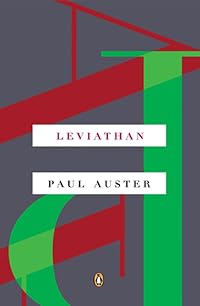
Leviathan
by Paul Auster
On This Page
Description
Leviathan begins when a woman finds an address book and steals a new identity. Or it begins with a sudden, violent death. Or it begins as Peter Aaron sits down to tell the story of his best friend, Benjamin Sachs - to take us, through a life, to the road in rural Wisconsin where Sachs has accidentally blown himself up. Aaron's sole aim is to tell the truth and preserve it, before those who are investigating the case invent a story of their own. Aaron's clues are the small mysteries of any show more lifetime. Sachs had a marriage Aaron envied, an intelligence he admired, a circle of friends he shared. And then suddenly, after a near-fatal fall that might or might not have been intentional, Sachs disappears. For a while, Aaron's only link to him is through Maria Turner, an artist, and the one witness to Sachs's balcony plunge. Periodically, Sachs reappears, talks manically, and vanishes again - in pursuit of mercy or salvation, in thrall to an idea. Since the first book in his brilliant and acclaimed "New York Trilogy," Paul Auster's "rare combination of talent, scope, and audacity" (The New Republic) has given us worlds in which chance and destiny collide, in which solitary protagonists take us on mysterious, soul-wrenching journeys unparalleled in contemporary fiction. His seventh novel is about friendship and betrayal, sexual desire and estrangement, and the unpredictable intrusions of violence in the everyday. Rooted in American mythology and archetype, Leviathan is both timeless and resolutely about this moment. It is a daring and immensely moving story by "one of America's most spectacularly inventive writers" (The Times Literary Supplement). show lessTags
Recommendations














Member Reviews
Ho molto amato Leviatano, un romanzo estremamente ben costruito che gira come un orologio e che ripropone tutti i temi cari all'autore: l’isolamento delle persone, l’incomunicabilità, l’impossibilità di conoscere davvero gli altri, il legame tra libere scelte e casualità, con queste ultime che tendono sempre a governare il vissuto dell’uomo. E se l’autore da un lato sembra convinto che il caso e le coincidenze determinino le esperienze, dall'altro egli è in grado di costruire l’architettura del romanzo in maniera straordinaria, con una precisione quasi maniacale: i cinque capitoli della stessa lunghezza, la struttura stessa dei capitoli, che si aprono con digressioni che anticipano quello che viene dopo spezzando la show more continuità del racconto, lo stile e il ritmo della narrazione che tengono il lettore avvinto alle pagine. Ho amato tutti i personaggi di questa storia incredibile, il loro modo di pensare, di parlare, di comportarsi: una caratterizzazione minuziosa, grazie alla quale tutto si incastra perfettamente e anche le circostanze più inverosimili prendono corpo e appaiono credibili nell'economia generale del romanzo. Dopo molti mesi in cui ho letto altro, Leviatano è stato un bellissimo ritorno a questo autore, che più di altri è in grado di toccare le mie corde.
Ho passato tutta la mia vita da adulto a scrivere storie, a mettere persone immaginarie in situazioni inaspettate e spesso inverosimili, ma nessuno dei miei personaggi ha mai vissuto un’esperienza così improbabile come Sachs quella notte a casa di Maria Turner. Se mi turba ancora raccontare quello che accadde è perché la realtà supera sempre ciò che riusciamo a immaginare. Per quanto sfrenati pensiamo che possano essere, i frutti della nostra fantasia non potranno mai tener testa all’imprevedibilità delle cose che il mondo reale erutta in continuazione. Adesso questa lezione mi sembra inevitabile. Tutto può succedere. E in un modo o nell’altro, succede sempre. show less
Ho passato tutta la mia vita da adulto a scrivere storie, a mettere persone immaginarie in situazioni inaspettate e spesso inverosimili, ma nessuno dei miei personaggi ha mai vissuto un’esperienza così improbabile come Sachs quella notte a casa di Maria Turner. Se mi turba ancora raccontare quello che accadde è perché la realtà supera sempre ciò che riusciamo a immaginare. Per quanto sfrenati pensiamo che possano essere, i frutti della nostra fantasia non potranno mai tener testa all’imprevedibilità delle cose che il mondo reale erutta in continuazione. Adesso questa lezione mi sembra inevitabile. Tutto può succedere. E in un modo o nell’altro, succede sempre. show less
I've never read a Paul Auster novel that I didn't like, but among the five or six titles I have read there are some that rank higher than others. Leviathan is one of those, because it seems to define what Auster is all about. It has the unreliable narrator, confronting two stories of different characters that can't be brought into agreement; the magnificent miniature portraits of the main characters, each single one of them a complete book in their own rights; the uncanny coincidences that lead to life-changing experiences; the distant scent of a proud and worthy America; and finally, the rise and, ultimately, unavoidably, the fall of an American hero.
The hero in this case is Benjamin Sachs, a writer like so many of Austers heroes, and show more by the time the reader has finished the first sentence of the book Benjamin Sachs is already dead, not just killed but almost annihilated by a bomb blast. In his familiar style, Auster takes the reader back and forth in his story, giving him from time to time a hint of what is to follow or sometimes going back to important moments already mentioned before and giving them a new perspective, creating layer upon layer of interpretation of what really happened - and ultimately questioning the notion that one is ever able to know what really happened. At one point the first person narrator Peter Aaron (a writer, unsurprisingly, sharing Austers initials) proposes that perhaps two different stories can be true at the same time.
One of the most intriguing characters in the book is Maria Turner, an undefined artist whose work centers on the act of observation. Her projects include photographing meetings with friends, posing as a stripper, shadowing strangers and paying a private detective to shadow her. This is Auster at his best: he mentions a few projects in passing, leaving the reader to fill in the details for himself.
Both these strategies, the layering and the compact miniature portraits, give Leviathan and other Auster novels their richness in detail: 245 (densely printed) pages that seem to hold as much information as classics twice that length. Despite all this, the reader never feels overwhelmed by the details, the novel doesn't seem to have a complicated structure, the storyline is clear and, despite the mystery, straightforward. The ability to be both complex, post-modern, even experimental and at the same time compelling, clear and convincing make Auster one of the greatest living writers, and Leviathan an incomparable experience to read. show less
The hero in this case is Benjamin Sachs, a writer like so many of Austers heroes, and show more by the time the reader has finished the first sentence of the book Benjamin Sachs is already dead, not just killed but almost annihilated by a bomb blast. In his familiar style, Auster takes the reader back and forth in his story, giving him from time to time a hint of what is to follow or sometimes going back to important moments already mentioned before and giving them a new perspective, creating layer upon layer of interpretation of what really happened - and ultimately questioning the notion that one is ever able to know what really happened. At one point the first person narrator Peter Aaron (a writer, unsurprisingly, sharing Austers initials) proposes that perhaps two different stories can be true at the same time.
One of the most intriguing characters in the book is Maria Turner, an undefined artist whose work centers on the act of observation. Her projects include photographing meetings with friends, posing as a stripper, shadowing strangers and paying a private detective to shadow her. This is Auster at his best: he mentions a few projects in passing, leaving the reader to fill in the details for himself.
Both these strategies, the layering and the compact miniature portraits, give Leviathan and other Auster novels their richness in detail: 245 (densely printed) pages that seem to hold as much information as classics twice that length. Despite all this, the reader never feels overwhelmed by the details, the novel doesn't seem to have a complicated structure, the storyline is clear and, despite the mystery, straightforward. The ability to be both complex, post-modern, even experimental and at the same time compelling, clear and convincing make Auster one of the greatest living writers, and Leviathan an incomparable experience to read. show less
Auster's prose is mesmerizing. Once you start reading, it simply pulls you along, as the narrative unfolds in a series of confessions, drawing the reader into greater and greater intimacy with the cast of strange and wonderful characters that populate the world of this novel. The twists and turns of the plot are bizarre and unexpected, stretching credulity, but all the more gripping for doing so. This is enthralling stuff.
This is, by most people's account, a minor novel of Auster's, and so it may be an especially go one to raise the question of what drives the work, as opposed to what happens when the writing succeeds in some more specific way. This book has a kind of unremitting literalism in its narrative. In a nearly blank, neutral voice, the narrator tells us dozens of dates, places, and names; in part that's justified by the notion that this is a book written at speed in order to provide legal evidence about one of the narrator's friends. But aside from that, the studiously neutral tone is increasingly difficult to understand. Auster barely uses adjectives; he doesn't pause to pick the write phrase, or find the right image; his writing is show more utilitarian and evidential, even when the subject is sex, love, murder, or jealousy.
After fifty pages or so I finally realized what that was all about: Auster is driven, in this book at least, with an overpowering desire to keep my attention, to be the one whose stories I want to hear. It's a kind of underlying urge to write, independent of his subject matter. It pushes so hard on his imagination that it even prevents him from pausing long enough to construct metaphors, analogies, figures of speech, or other tropes that could make the writing interesting in itself. A typical example of a trope is this:
"But a new element was added to the already unstable mixture of the past twenty-four hours, and it wound up producing a deadly compound, a beakerful of acid that hissed forth its dangers in a billowing profusion of smoke."
This passage, like others involving figures of speech, is a rare interruption in a generally prose that's generally free of metaphor, and it's awkward: first the "element" is a "compound," then it's a container of acid. The acid "hisses forth" (an overdone image, and a dramatic and clichéd qualifier), and then the "hiss" becomes "smoke." The sentence is confused and hard to picture; it's as if Auster were writing at speed, and couldn't be bothered to stop and tune up his images.
That sense of the rush to write also comes out in passages that seem never to have been re-read:
"Iris was just twenty-four back then, a dazzling blond presence, six feet tall with an exquisite Scandinavian face and and the deepest, merriest blue eyes t be found between heaven and hell."
It's not hard to find yourself writing boilerplate text, but even a single editing session should reveal and correct drivel like this.
In "Leviathan" it's as if the psychology, politics, characters, style, and mood of the novel are all arbitrary, and what matters is writing continuously, adding new plot elements with every sentence, propelling the story onward. I began to feel this (his intense desire to hold my attention no matter what the subject might be) as a kind of unslakable desire to compel attention, and in that way the book began to be more and more what it almost is: a book about an ambitious author and his struggle to write.
Auster is known for metafiction, and for writing about writing, and those devices might be the best expressions of what really matters to him--by which I don't mean participation in postmodernism and its possibilities, but his own ambition to keep a reader's undivided attention. I hope this observation can't be generalized across metafiction or literary postmodernism--that is, I hope many more things are at stake in self-referential fiction. It's often said that Auster practices a literary fiction version of popular crime fiction, blending metafiction with complex narratives. I imagine people generally mean that his work is an interesting, literary variation on the sorts of tight, complex narratives typical of crime fiction. But I wonder if it might not be better to say he uses devices of postmodernism in order todo what popular trade press authors do--write what Naipaul disparagingly called "puzzles." I can't imagine a reason for reading another of his books. show less
After fifty pages or so I finally realized what that was all about: Auster is driven, in this book at least, with an overpowering desire to keep my attention, to be the one whose stories I want to hear. It's a kind of underlying urge to write, independent of his subject matter. It pushes so hard on his imagination that it even prevents him from pausing long enough to construct metaphors, analogies, figures of speech, or other tropes that could make the writing interesting in itself. A typical example of a trope is this:
"But a new element was added to the already unstable mixture of the past twenty-four hours, and it wound up producing a deadly compound, a beakerful of acid that hissed forth its dangers in a billowing profusion of smoke."
This passage, like others involving figures of speech, is a rare interruption in a generally prose that's generally free of metaphor, and it's awkward: first the "element" is a "compound," then it's a container of acid. The acid "hisses forth" (an overdone image, and a dramatic and clichéd qualifier), and then the "hiss" becomes "smoke." The sentence is confused and hard to picture; it's as if Auster were writing at speed, and couldn't be bothered to stop and tune up his images.
That sense of the rush to write also comes out in passages that seem never to have been re-read:
"Iris was just twenty-four back then, a dazzling blond presence, six feet tall with an exquisite Scandinavian face and and the deepest, merriest blue eyes t be found between heaven and hell."
It's not hard to find yourself writing boilerplate text, but even a single editing session should reveal and correct drivel like this.
In "Leviathan" it's as if the psychology, politics, characters, style, and mood of the novel are all arbitrary, and what matters is writing continuously, adding new plot elements with every sentence, propelling the story onward. I began to feel this (his intense desire to hold my attention no matter what the subject might be) as a kind of unslakable desire to compel attention, and in that way the book began to be more and more what it almost is: a book about an ambitious author and his struggle to write.
Auster is known for metafiction, and for writing about writing, and those devices might be the best expressions of what really matters to him--by which I don't mean participation in postmodernism and its possibilities, but his own ambition to keep a reader's undivided attention. I hope this observation can't be generalized across metafiction or literary postmodernism--that is, I hope many more things are at stake in self-referential fiction. It's often said that Auster practices a literary fiction version of popular crime fiction, blending metafiction with complex narratives. I imagine people generally mean that his work is an interesting, literary variation on the sorts of tight, complex narratives typical of crime fiction. But I wonder if it might not be better to say he uses devices of postmodernism in order todo what popular trade press authors do--write what Naipaul disparagingly called "puzzles." I can't imagine a reason for reading another of his books. show less
This novel is about an eccentric writer who dies in a mysterious accident. His best friend captures his life’s drastic twists and turns through romances and weird obsessions. I enjoyed this novel; it was straightforward (unusual for Auster), but alluringly different. It had that unnerving feel of a story about a character too enigmatic for this world, too big and unbridled to fit in. I can’t really imagine knowing anyone like that.
For me the tale did not merit the lengthy narrative, the book within the book seemed contrived and interfered with the tension. I felt it was too much blathering and was in need of editing. Perhaps it's a case of not being able to latch on to either of the main male characters as sympathetic or interesting. The female protagonists started out as more captivating particularly since I'd seen museum exhibits of Sophie Calle and immediately recognized her in Maria but they were reduced to pretty much sexual objects as the tale continued. Is the narrator Peter Aaron the novelist Paul Auster and is it important to the story? The book talks a great deal about identity and stories and whether Aaron's recreation of Sachs' life is true and how show more far does truth go when told by another in a memoir. Did Sachs really die in Wisconsin? Is Aaron a reliable reporter of his friend's motivations and life? Is Auster? Do I need to read Hobbes Leviathan to find out? Other Auster books I liked better were Moon Palace, City of Glass.
Favorite quote: Books are born out of ignorance and if they go on living after they are written, it's only to the degree that they cannot be understood. (Auster. Leviathan, p. 40) show less
Favorite quote: Books are born out of ignorance and if they go on living after they are written, it's only to the degree that they cannot be understood. (Auster. Leviathan, p. 40) show less
My first Paul Auster, and to this day my favorite. His characters have never felt more as if they came from a Greek tragedy, unable to do anything but follow the strange path laid down by coincidences before them. And it got even more important after 9/11, with its subtle questioning of American patriotism and the apology it makes of a certain kind of terrorism.
Members
- Recently Added By
Lists

1001 Books You Must Read Before You Die
1,448 works; 1,130 members

Books Read in 2016
4,666 works; 199 members

Llibres que he llegit el 2019
42 works; 1 member

Books Read in 2003
257 works; 7 members

Metafiction
84 works; 21 members

Books Read in 2021
5,361 works; 113 members

living room bookshelf
150 works; 1 member

Great American Novels
158 works; 42 members
Author Information

101+ Works 64,827 Members
Paul Auster was born on February 3, 1947, in Newark, New Jersey. He received a B.A. and a M.A. in English and Comparative Literature from Columbia University. In addition to his career as a writer, Auster has been a census taker, tutor, merchant seaman, little-league baseball coach, and a telephone operator. He started his writing career as a show more translator. He soon gained popularity for the detective novels that make up his New York Trilogy. His other works include The Invention of Solitude; Leviathan; Moon Palace; Facing the Music; In the Country of Last Things; The Music of Chance; Mr. Vertigo; and The Brooklyn Follies. His latest novels are entitled, Invisible and Sunset Park. In addition to his novels, Auster has written screenplays and directed several films. He is the recipient of a fellowship from the National Endowment for the Arts and a French Prix Medicis for Foreign Literature. (Bowker Author Biography) show less
Some Editions
Awards and Honors
Awards
Distinctions
Series
Belongs to Publisher Series
Work Relationships
Common Knowledge
- Canonical title
- Leviathan
- Original title
- Leviathan
- Original publication date
- 1992
- People/Characters
- Benjamin Sachs; Peter Aaron; Fanny Goodman Sachs; Maria Turner; Lillian Stern
- Important places
- USA; New York, USA; New York, New York, USA; Vermont, USA; Berkeley, California, USA
- Epigraph
- Every actual State is corrupt.
Ralph Waldo Emerson - Dedication
- for Don DeLillo
- First words
- Six days ago, a man blew himself up by the side of a road in northern Wisconsin.
- Last words
- (Click to show. Warning: May contain spoilers.)We walked up the stairs together, and once we were inside, I handed him the pages of this book.
- Original language
- English
Classifications
Statistics
- Members
- 3,033
- Popularity
- 5,822
- Reviews
- 55
- Rating
- (3.82)
- Languages
- 22 — Catalan, Czech, Danish, Dutch, English, Finnish, French, German, Greek, Hebrew, Hungarian, Italian, Japanese, Norwegian (Bokmål), Polish, Romanian, Serbian, Slovenian, Spanish, Swedish, Turkish, Portuguese (Portugal)
- Media
- Paper, Audiobook, Ebook
- ISBNs
- 76
- ASINs
- 15