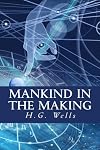
Mankind in the Making
by H. G. Wells
On This Page
Description
One of the primary motivations behind H. G. Wells most popular science fiction works was his exploration of the factors that could help or harm society. As a result, many of his novels and short stories explored utopian or dystopian worlds. In Mankind in the Making, he tackles the same topic from a nonfiction perspective, ruminating on the variables that serve optimal human development from conception to adulthood..
Tags
Recommendations























Member Reviews
Well's book reads more like a political manifesto and a long winded one at that. He looks on it as an essay in presentation and what he is presenting here is a guide to a better future. It is naïve, faintly Utopian and yet contains so much good common sense that you wonder why others can't see the world in the way Wells saw it when he published these "papers" in book form in 1903. It is like a statement for the birth of a new political Party which Wells calls New Republicans and no doubt when he was writing, he had hopes that something like that may come of it.
Wells tackles three major issues, infant mortality including eugenics, education and the importance of literature. He sees education and the acquisition of knowledge as key show more issues in shaping a better world and I cannot fault him on this. He destroys the arguments being put forward at the time in favour of selective breeding, but leaves the door on this issue ajar by saying that we need much more scientific knowledge before any decisions can be made. He castigates England's record on infant mortality pointing out that it is the terrible conditions that many poor families are forced to endure that is a major cause of deaths For the modern reader the social aspects of Wells investigations are not without interest; in three Counties in Northern England 233 out of 1000 infant deaths were caused by overlaying (Infants being "accidentally" suffocated by sleeping in the same bed as their parents). The whole tenor of his arguments are "come on we can do better than this". He takes the same approach when he discusses education in some detail in the longest section of the book.
Well's views on improvements in education are far reaching and sensible, however they would be guaranteed to upset almost everyone in the profession, because of his approach. He does not shy away from telling people how to do their jobs and his ideas on state intervention in the education process smacks of big socialism. The final section deals with literature and the importance of access to books. He wants to see well run and organized libraries in all schools and places of higher education, which is commendable, but then he strays into lecturing academics on how they should write and prepare text books and this is typical of his approach - too much interference. He also cheekily suggests that authors should be paid an annual salary as he rams home the point that knowledge is contained in the books people read and so the profession should be given all due importance.
Wells has interesting ideas on the use of the jury system, which he would like to see being extended to choosing government appointments and political candidates and he tackles the class system, seeing the pyramid topped by the monarchy as being one of the major stumbling blocks to progress. He is as scathing about American corruption as he is about England's procrastination and I love this quote:
"One gets the impression that the sort of mind that is passively stupid in England is often actively silly in America"
Well's ideas are progressive and mostly attuned to the way that I think about things, but I still found his approach misconceived. He has obviously done much research into this project and much of the writing comes from the heart, but at times he has let his pen run away with him. It is too long winded, and at times a little condescending and I am not too sure how much interest it would have for the modern reader. I will in future avoid any more of H G's political ramblings. A three star read.
New Republicans
If H G Wells ruled the world
Welcome Martians. show less
Wells tackles three major issues, infant mortality including eugenics, education and the importance of literature. He sees education and the acquisition of knowledge as key show more issues in shaping a better world and I cannot fault him on this. He destroys the arguments being put forward at the time in favour of selective breeding, but leaves the door on this issue ajar by saying that we need much more scientific knowledge before any decisions can be made. He castigates England's record on infant mortality pointing out that it is the terrible conditions that many poor families are forced to endure that is a major cause of deaths For the modern reader the social aspects of Wells investigations are not without interest; in three Counties in Northern England 233 out of 1000 infant deaths were caused by overlaying (Infants being "accidentally" suffocated by sleeping in the same bed as their parents). The whole tenor of his arguments are "come on we can do better than this". He takes the same approach when he discusses education in some detail in the longest section of the book.
Well's views on improvements in education are far reaching and sensible, however they would be guaranteed to upset almost everyone in the profession, because of his approach. He does not shy away from telling people how to do their jobs and his ideas on state intervention in the education process smacks of big socialism. The final section deals with literature and the importance of access to books. He wants to see well run and organized libraries in all schools and places of higher education, which is commendable, but then he strays into lecturing academics on how they should write and prepare text books and this is typical of his approach - too much interference. He also cheekily suggests that authors should be paid an annual salary as he rams home the point that knowledge is contained in the books people read and so the profession should be given all due importance.
Wells has interesting ideas on the use of the jury system, which he would like to see being extended to choosing government appointments and political candidates and he tackles the class system, seeing the pyramid topped by the monarchy as being one of the major stumbling blocks to progress. He is as scathing about American corruption as he is about England's procrastination and I love this quote:
"One gets the impression that the sort of mind that is passively stupid in England is often actively silly in America"
Well's ideas are progressive and mostly attuned to the way that I think about things, but I still found his approach misconceived. He has obviously done much research into this project and much of the writing comes from the heart, but at times he has let his pen run away with him. It is too long winded, and at times a little condescending and I am not too sure how much interest it would have for the modern reader. I will in future avoid any more of H G's political ramblings. A three star read.
New Republicans
If H G Wells ruled the world
Welcome Martians. show less
Ratings
Members
- Recently Added By
Author Information

1,547+ Works 108,637 Members
H. G. Wells was born in Bromley, England on September 21, 1866. After a limited education, he was apprenticed to a draper, but soon found he wanted something more out of life. He read widely and got a position as a student assistant in a secondary school, eventually winning a scholarship to the Royal College of Science in South Kensington, where show more he studied biology. He graduated from London University in 1888 and became a science teacher. He also wrote for magazines. When his stories began to sell, he left teaching to write full time. He became an author best known for science fiction novels and comic novels. His science fiction novels include The Time Machine, The War of the Worlds, The Wonderful Visit, The Island of Doctor Moreau, The Invisible Man, The First Men in the Moon, and The Food of the Gods. His comic novels include Love and Mr. Lewisham, Kipps: The Story of a Simple Soul, The History of Mr. Polly, and Tono-Bungay. He also wrote several short story collections including The Stolen Bacillus, The Plattner Story, and Tales of Space and Time. He died on August 13, 1946 at the age of 79. (Bowker Author Biography) show less
Classifications
Statistics
- Members
- 47
- Popularity
- 635,090
- Reviews
- 1
- Rating
- (2.38)
- Languages
- English
- Media
- Paper, Ebook
- ISBNs
- 31
- ASINs
- 2