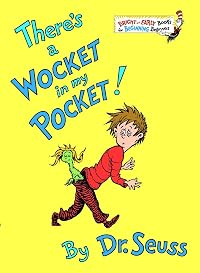
There's a Wocket in My Pocket! [abridged]
by Dr. Seuss
On This Page
Description
A household of unusual creatures help beginning readers recognize common "household" words.Tags
Recommendations






Member Reviews
Absolute absurdity reigns here, as Dr. Seuss takes us on a tour through a house populated by his strangest creations yet. From the titular wocket in the pocket to the zillow in the pillow, I'm not sure how the poor boy actually manages to live in such a mad-cap house! But I guess he'll never get lonely that way, since Seuss hasn't given him any siblings and his parents are noticeably nowhere to be found. Maybe this situation is worrying, but Seuss may be exploring the concept of childhood loneliness, and is presenting readers with a rather creative method of coping - spot a boring household object, think of a rhyme, and presto, you have an imaginative new companion to help fill your days! I imagine that this game would keep a bored show more child occupied for hours (if not days), but hopefully they aren't the kind of child to be scared of monsters in their house because the game could quickly get out of control! As for illustrations, I think that this is one of Dr. Seuss's stronger books, even though it lacks a real narrative and has no character development. He pairs colourful household objects with a bevy of even more imaginative creatures, so there is an endless amount of visual discovery here. Surprisingly, the compositions are also very creative, even though the setting is familiar, as Seuss puts his unique perspective and colour schemes to work. Overall, this is an excellent addition to his range for youngest readers as it is sure to stimulate their vocabulary, sight, and sense of humour. show less
There's a Wocket in my Pocket stands as one of Dr. Seuss's most ingenious early readers, turning the everyday corners of a house into a delightful playground of rhyming nonsense creatures that spark young imaginations. Through clever wordplay, Seuss transforms ordinary household items into homes for whimsical beings – from the BOFA on the SOFA to the NOOTH GRUSH on the TOOTH BRUSH – creating an infectious rhythm that makes learning to read feel like a treasure hunt rather than a task. The book's simple yet engaging illustrations perfectly complement the text, bringing these fanciful creatures to life while helping beginning readers connect words with objects in their own homes, making it a brilliant tool for building phonemic show more awareness and vocabulary. This playful exploration of sound and language not only entertains but also empowers young readers to create their own silly rhymes, proving that literacy development can be an adventure rather than a chore. show less
This has become one of my favorite Seuss stories, although it wasn't on my radar when I was a child (I was more interested in his big titles, like Cat in the Hat or The Grinch). I've been reading it out loud to my two year old daughter, though, and love this whimsical story. As with his other books, the rhymes here are silly and feature an abundance of strange creatures with made-up names. Actually, this story may have more crazy animals than any other, because the pattern of the text is that a creature lives inside just about every household object that you can think of, and their name rhymes with their domicile. For instance, a ghair lives under the chair and nubboards live in the cupboards.
The reason I like this particular story so show more much is because it reminds me of when I was a little girl, and saw the world with imaginative eyes. At the beginning the narrator, a young boy, says that his house is a little strange and he likes it that way. He likes meeting all the zany characters inhabiting his house, whether they're friendly (most are), unfriendly, or sometimes even a bit creepy. I can remember being able to envision the infinite possibilities around me, being able to see fairies or treasures or ghosts; now, that ability doesn't come as easily. I want my daughter to have as rich an imagination as this book portrays, and I personally like stepping back inside childish innocence and wonder for a time and remembering when a potential creature hid behind every door, under every blanket. show less
The reason I like this particular story so show more much is because it reminds me of when I was a little girl, and saw the world with imaginative eyes. At the beginning the narrator, a young boy, says that his house is a little strange and he likes it that way. He likes meeting all the zany characters inhabiting his house, whether they're friendly (most are), unfriendly, or sometimes even a bit creepy. I can remember being able to envision the infinite possibilities around me, being able to see fairies or treasures or ghosts; now, that ability doesn't come as easily. I want my daughter to have as rich an imagination as this book portrays, and I personally like stepping back inside childish innocence and wonder for a time and remembering when a potential creature hid behind every door, under every blanket. show less
I am a huge fan of all things Dr. Seuss, and this book is no exception. I love how There's a Wocket in my Pocket does well at showing rhyming sounds for young children in a playful manner with tons of different made up creatures. Not only that but the book Uses all caps to show the words that are being ryhmed. "All those NUPBOARDS in my CUPBOARDS. They're good to have ABOUT. But that NOOTH GRUSH in my TOOTH BRUSH... him i could do WITHOUT." This allows readers to see the words that sound the same and make connections sonic ally and visually.
As a steward and visitor to Little Free Libraries, I saw it as not uncommon for barely used Seuss titles to show up. I am trying to select and build a complete set in the best condition. I don't recall this one from my youth. Seuss could enthusiastically proffer a neologism. Here there is one on ever rhyming page and a zany character to match it.
This is another beginning book written by Dr. Seuss, and it certainly lives up to the Dr. Seuss standard of writing. One thing I especially love about this book is all the nonsense words it has in it. Not only are they fun to read, but they help kids learn to sound out words as well. Again, as with other Dr. Seuss books, the illustrations are as stunning as the writing is. I especially love the perspective drawings inside the house. It reminds me of what I would have imagined” Wayside school” would have looked like. There’s a lot of detail added to the drawings, so you find yourself looking at each little nook and cranny on the page. I think good illustrations can do just as much, if not more, for a book than a good plot. Each show more aspect of a book is important, from the characters, to the plot, to the pictures. One thing stands out about this book is that it exceeds and not just one of these categories, but all of them. The main idea of this book is to never put a cap on your imagination. show less
Summary: This is a book about a little boy who has a very big imagination. He talks about all of the creatures that live throughout his household. For instance, the "Woset in the Closet, the Jertain in the Curtain, and the Zelf up on the Shelf." He likes many of the creatures but there are some that scare him. He loves living with all his creatures and never wants to move from his house.
Personal Reaction: This book is my favorite Dr. Seuss book because it was one of the first books that helped my daughter really enjoy reading. She found it so silly which made her want to read it more and more. The rhymes are silly and are full of nonsense words, but this book really does address the concept of rhyming and makes it fun for younger show more readers. My daughter loves this story so much that we downloaded the interactive story on the iPad and it is quite entertaining.
Classroom Extensions:
1. Have the students come up with their own funny rhymes.
2. Ask the students to draw a picture of their favorite creature from the story.
3. Have the students create their very own creature. show less
Personal Reaction: This book is my favorite Dr. Seuss book because it was one of the first books that helped my daughter really enjoy reading. She found it so silly which made her want to read it more and more. The rhymes are silly and are full of nonsense words, but this book really does address the concept of rhyming and makes it fun for younger show more readers. My daughter loves this story so much that we downloaded the interactive story on the iPad and it is quite entertaining.
Classroom Extensions:
1. Have the students come up with their own funny rhymes.
2. Ask the students to draw a picture of their favorite creature from the story.
3. Have the students create their very own creature. show less
Members
- Recently Added By
Lists

Written and Illustrated By
805 works; 1 member
Author Information

794+ Works 358,521 Members
Theodor Seuss Geisel was born in Springfield, Massachusetts on March 2, 1904. He wrote and illustrated more than 45 picture books under the pseudonym Dr. Seuss. His first picture book, And to Think That I Saw It on Mulberry Street, was published in 1937. His other books included The Cat in the Hat, The Butter-Battle Book, The Lorax, The Bippolo show more Seed and Other Lost Stories, Fox in Socks: Dr. Seuss's Book of Tongue Tanglers, What Pet Should I Get?, and Oh, the Places You'll Go. In 1984, he received a Pulitzer Prize for his contributions to children's literature. He died of oral cancer on September 24, 1991 at the age of 87. (Bowker Author Biography) show less
Series
Belongs to Publisher Series
Work Relationships
Common Knowledge
- Canonical title
- There's a Wocket in My Pocket! [abridged]
- Original publication date
- 1974
- First words
- Did you ever have a feeling there's a ZAMP in your LAMP?
Did you ever have a feeling there's a WASKET in your BASKET? - Quotations
- Sometimes
I am quite CERTAIN
there's a JERTAIN
in the CURTAIN. - Last words
- (Click to show. Warning: May contain spoilers.)But the ZILLOW on my PILLOW always helps me fall asleep.
(Click to show. Warning: May contain spoilers.)And I hope we never leave it. - Disambiguation notice
- this is an abridged version - please do not combine with the original
Classifications
- Genres
- Children's Books, Picture Books, Poetry
- DDC/MDS
- 813.54 — Literature & rhetoric American literature in English American fiction in English 1900-1999 1945-1999
- LCC
- PZ8.3 .G276 .T — Language and Literature Fiction and juvenile belles lettres Fiction and juvenile belles lettres Juvenile belles lettres
- BISAC
Statistics
- Members
- 5,039
- Popularity
- 2,758
- Reviews
- 45
- Rating
- (4.11)
- Languages
- Chinese, English
- Media
- Paper
- ISBNs
- 7
- UPCs
- 1
- ASINs
- 3