On This Page
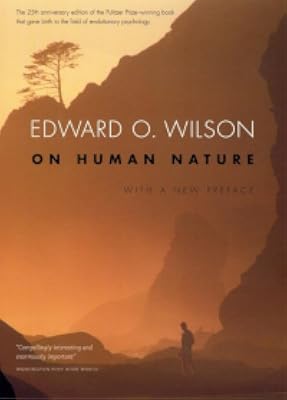
Description
In his new preface E. O. Wilson reflects on how he came to write this book: how The Insect Societies led him to write Sociobiology, and how the political and religious uproar that engulfed that book persuaded him to write another book that would better explain the relevance of biology to the understanding of human behavior.Tags
Recommendations




Member Reviews
Recently reissued for the 25th anniversary of its publication, Edward O. Wilson’s On Human Nature doesn’t wear that well. The main problem is that this isn’t a scientific work; it’s philosophy. Wilson seems to be attempting to write a kinder, gentler exposition of Sociobiology for the “intellectual” crowd (subtly echoing C.P. Snow’s complaint that, inexplicably, scientists are not considered “intellectuals”). It doesn’t really work. Wilson forgoes rigor for anecdotes, possibly feeling that they will be more accessible; thus we have various accounts of behavior among hunter-gatherer tribes, insect societies, and other social animals and how this is explained by natural selection. The catch here is that while a show more rigorous mathematical treatment can only be disproved by more mathematics, an anecdote can be dismissed by another anecdote. Wilson, in fact, gives an example – when he talked about altruism in Sociobiology one of his critics immediately came up with “How do you explain Mother Teresa?”. In On Human Nature he answers that criticism with a discussion of the fitness value of religious belief; a better counter would have been “Statistics”.
Wilson discusses aggression, sexuality, altruism and religion but only with various “just so stories”; they are all perfectly plausible but are unlikely to convince anybody who needs convincing. While he’s a literate and engaging writer, if you’re seriously interested in this sort of thing you’re better off with Dawkins or Pinker. show less
Wilson discusses aggression, sexuality, altruism and religion but only with various “just so stories”; they are all perfectly plausible but are unlikely to convince anybody who needs convincing. While he’s a literate and engaging writer, if you’re seriously interested in this sort of thing you’re better off with Dawkins or Pinker. show less
Disappointing. Wilson uses very dry language throughout, which makes it difficult to stay interested. And while the subject might have been groundbreaking when it came out in the 70s, now it's just kind of boring. There are some interesting observations on sexuality, witchcraft, and the pastoral nature of the Judeo-Christian monodeity, but they are not nearly enough to make up for the various ideological and literary shortcomings.
First, it's difficult to even tell what Wilson is trying to say, what his overarching point is. It takes careful reading to parse from some short comments what his true intentions are. For example, on page 54 he refers to a human infant as a "marvellous robot." So okay, we know he's a biological determinist, show more which also could have been evident given his acknowledgement to B.F. Skinner among others in the beginning. The only problem is that judging by Skinner's Walden Two, the man was a sociopath who advocated the creation of a behaviorally engineered utopia, a la Brave New World.
After this you know what Wilson is but you're not sure what he's after, and he takes you on a sometimes-interesting journey through the biological origins of aggression, sexuality, altruism and religion. Only towards the end do you begin to catch sight once more of what his goal might be. He says in the last chapter on p. 201:
So now we know that Wilson is a biological determinist who would not mind seeing science replace religion as the world's great faith, but he takes his views even further just a couple of pages later. He says on page 207:
While only a minor problem in comparison with the dangerous dogma he's deceptively espousing, I must also take issue with Wilson's patronizing treatment of "primitive" hunter-gatherer tribes. He seems to take it for granted that these people are the vestigial remnants of pre-civilization humanity, but a complete scientist would have to question this premise. Is it not possible that modern society split from its hunter-gatherer brethren back in the day, taking a divergent and parallel evolutionary path (e.g. what Daniel Quinn proposes)?
Also, his treatment of "primitive" aggression and egalitarianism betrays an ignorance on the subject. He cites Levi-Strauss but I found Pierre Clastre's interpretations (particularly his [b:Archeology of Violence|927436|Archeology of Violence|Pierre Clastres|http://d.gr-assets.com/books/1348610893s/927436.jpg|912438]) both more intriguing and convincing (even though flawed themselves). And though Wilson repeats it frequently, he never fully explains how an egalitarian society could possibly contain the "seeds" of tyranny and oppression. Probably because an explanation would give away that his statement (and thus his premise) doesn't hold water. It seems more reasonable that modern-day oppression and hunter-gatherer egalitarianism are two completely different beasts. show less
First, it's difficult to even tell what Wilson is trying to say, what his overarching point is. It takes careful reading to parse from some short comments what his true intentions are. For example, on page 54 he refers to a human infant as a "marvellous robot." So okay, we know he's a biological determinist, show more which also could have been evident given his acknowledgement to B.F. Skinner among others in the beginning. The only problem is that judging by Skinner's Walden Two, the man was a sociopath who advocated the creation of a behaviorally engineered utopia, a la Brave New World.
After this you know what Wilson is but you're not sure what he's after, and he takes you on a sometimes-interesting journey through the biological origins of aggression, sexuality, altruism and religion. Only towards the end do you begin to catch sight once more of what his goal might be. He says in the last chapter on p. 201:
What I am suggesting, in the end, is that the evolutionary epic is probably the best myth we will ever have.He says this in comparison to religions. So now we know that -- despite his mild protest -- he's out to replace religion with science. He is so intellectually enamored with the truth-seeking capacity of science that he imagines it to be the only worthwhile human pursuit. Another passage on p. 205 is telling:
Such a view will undoubtedly be opposed as elitist by some who regard economic and social problems as everywhere overriding. There is an element of truth in that objection. Can anything really matter while people starve in the Sahel and India and rot in the prisons of Argentina and the Soviet Union? In response it can be asked, do we want to know, in depth and for all time, why we care?Here he is implying that mere academic investigation is a justifiable substitute for helping less fortunate human beings. This is the problem with academia and science in general: they are too preoccupied by theoretical possibilities to bother with practical reality. And then they're shocked when the rest of the world isn't awed by their amazing ideas.
So now we know that Wilson is a biological determinist who would not mind seeing science replace religion as the world's great faith, but he takes his views even further just a couple of pages later. He says on page 207:
I believe that a remarkable effect will be the increasingly precise specification of history. One of the great dreams of social theorists -- Vico, Marx, Spencer, Spengler, Teggart, and Toynbee, among the most innovative -- has been to devise laws of history that can foretell something of the future of mankind. . . Now there is reason to entertain the view that the culture of each society travels along one or the other of a set of evolutionary trajectories whose full array is constrained by the genetic rules of human nature.So now he's gone from promoting science to promoting scientific historicism. Instead of going into the many dangers of historicism (i.e. the idea that we can somehow predict the future based on historical patterns), I'll just refer any interested readers to Karl Popper, who argued convincingly against it in The Open Society and Its Enemies. But then on the next page Wilson goes even further:
Human genetics is now growing quickly along with all other branches of science. In time, much knowledge concerning the genetic foundation of social behavior will accumulate, and techniques may become available for altering gene complexes by molecular engineering and rapid selection through cloning. At the very least, slow evolutionary change will be feasible through conventional eugenics. The human species can change its own nature. What will it choose? Will it remain the same, teetering on a jerrybuilt foundation of partly obsolete Ice-Age adaptations? Or will it press on toward still higher intelligence and creativity, accompanied by a greater -- or lesser -- capacity for emotional response? New patterns of sociality could be installed in bits and pieces. . .Hmm, loaded question much? I wonder which Wilson prefers? He ends the genetic engineer's wet dream with a weak word of caution:
But we are talking here about the very essence of humanity. Perhaps there is something already present in our nature that will prevent us from ever making such changes.And then he passes the buck to the folks a hundred years down the road:
In any case, and fortunately, this third dilemma belongs to later generations.Let's be clear about what Wilson is saying here. He is advocating genetic engineering, selective cloning, and a massive scale eugenics program, he is just too cowardly to come out and say it directly. Instead he prevaricates and whimpers about our humanity, but only after providing a ridiculous choice between two completely lopsided options. He's trying to cover his a$$ with half-hearted lip service. There's not much that bothers me more than a scientist who won't take responsibility for his/her ideas.
While only a minor problem in comparison with the dangerous dogma he's deceptively espousing, I must also take issue with Wilson's patronizing treatment of "primitive" hunter-gatherer tribes. He seems to take it for granted that these people are the vestigial remnants of pre-civilization humanity, but a complete scientist would have to question this premise. Is it not possible that modern society split from its hunter-gatherer brethren back in the day, taking a divergent and parallel evolutionary path (e.g. what Daniel Quinn proposes)?
Also, his treatment of "primitive" aggression and egalitarianism betrays an ignorance on the subject. He cites Levi-Strauss but I found Pierre Clastre's interpretations (particularly his [b:Archeology of Violence|927436|Archeology of Violence|Pierre Clastres|http://d.gr-assets.com/books/1348610893s/927436.jpg|912438]) both more intriguing and convincing (even though flawed themselves). And though Wilson repeats it frequently, he never fully explains how an egalitarian society could possibly contain the "seeds" of tyranny and oppression. Probably because an explanation would give away that his statement (and thus his premise) doesn't hold water. It seems more reasonable that modern-day oppression and hunter-gatherer egalitarianism are two completely different beasts. show less
Short, terse, concentrated and to the point without extraneous bullshit, florid language, personal anecdotes or dramatising. Joy to read. Unlike Jared Diamond not falling for wishful thinking and not afraid to touch on difficult topics - although writing this a few decades ago didn't carry the same kinds of risks as it does today.
If you are interested in thinking about human nature from the perspective of biology (or sociobiology, as Wilson defends), this is one of the books where you should start. Though a bit dated (understandably, for it was published in 1978), the discussion started with this book (or openly stated with its publication) is still very contemporary, for there is still a huge gap between the so-called Human Sciences (with its many socio studies varieties) and its more mythical (or ideological) premises, and the hard sciences, that fully accept (or to a great extent) the evolutionary theory as the basis for their work and understanding.
What Wilson wants with this book is to make the biological knowledge as the basis for all social sciences, as show more it is already happening in many fields (evolutionary psychology, behavioral economics, etc.). If you are already acquainted with the history of the evolution (almost a pun) of the social sciences at large, probably this book with look a bit quaint, since it misses (again, understandably) many of the subtleties of the contemporary discussions around these problems. However, if you, like me, do not have such a thorough knowledge about these issues, this book comes very handy, as it serves as a good introduction to the historical development, as well as to the scientific basis, to the problematic leading to Wilson's sociobiological proposal. show less
What Wilson wants with this book is to make the biological knowledge as the basis for all social sciences, as show more it is already happening in many fields (evolutionary psychology, behavioral economics, etc.). If you are already acquainted with the history of the evolution (almost a pun) of the social sciences at large, probably this book with look a bit quaint, since it misses (again, understandably) many of the subtleties of the contemporary discussions around these problems. However, if you, like me, do not have such a thorough knowledge about these issues, this book comes very handy, as it serves as a good introduction to the historical development, as well as to the scientific basis, to the problematic leading to Wilson's sociobiological proposal. show less
Staggeringly good; the product of a formidable (ha!) intellect. Calm, lucid, and bold in scope, this work explains the earlier themes of Sociobiology, with particular impact on the "anti-discipline" of sociology. Well worth a read, if you are at all interested in the biological basis of morality (or more generally, culture).
The book reveals how different characteristics of humans and society are explained from the point of evolution. Wilson challenges the tabula raza concept and other prejudices and misconceptions about the nature-nurture debate. Evolution has left its traces on the characteristics which are the speciality of human species, for example sex for pleasure, generosity, altruism and worship. The book is Darwinian, not only in its use of evolution, but in its restraint in drawing conclusions before an enormous amount of research and data has been brought to beach. He brings biological thought into social sciences and humanities.
Third of an unconsciously-unfolding trilogy Wilson composed which vector toward a "unified sociobiology"--the idea that show more his work explaining the "rigid systems of social insects" can be applied to vertebrates (his second volume), and humans (third).
The uncompromising application of evolutionary theory to all aspects of human existence shows a lot of promise, reflected here in his Chapters -- to which I simply add his own sentences:
1. Dilemma. Wilson names two "spiritual dilemmas".
"These are the central questions that the great philosopher David Hume said are of unspeakable importance: How does the mind work, and beyond that whey does it work in such a way and not another, and from these two considerations together, what is man's ultimate nature?" I love that -- "unspeakable importance"!
If human kind evolved by Darwinian natural selection, genetic chance and environmental necessity, not God, made the species. Deity can still be sought in the origin of the ultimate units of matter, in quarks and electron shells (Hans Kung was right to ask atheists whey there is something instead of nothing) but not in the origin of species.
The first "spiritual dilemma" is that no species possesses a purpose beyond the imperatives created by its genetic history. We have "no particular place to go".
The dissolution of transcendental goals, as mirages which disappear as we close upon them, will uncover the second dilemma: ethical premises are inherent in man's biological nature. We are about to blend biology and the social sciences.
Human behavior can be reduced to biology; but social sciences are so rich, that the absorption will beggar biology. [paraphrasing 13].
2. Heredity. "We live on a planet of staggering organic diversity."
"Projections based on intensive surveys of selected habitats indicate that the total number of animal species is between three and ten million." [15] Massive proof of genetic determinism.
3. Development. "The newly-fertilized egg, a corpuscle one two-hundredth of an inch in diameter, is not a human being....in nine months a human being has been created." [53]
4. Emergence. "If biology is destiny, as Freud once told us, what becomes of free will? ...It appears that our freedom is only a self-delusion." [71]
5. Aggression. "Are human beings innately aggressive?" [99]
6. Sex. "Sex is central to human biology and a protean phenomenon that permeates every aspect of our existence and takes new forms through each step in the life cycle." [121]
..."Diversity, and thus adaptability, explains why so many kinds of organisms bother with sexual reproduction." [123]
7. Altruism. " 'The blood of martyrs is the seed of the church'. With that chilling dictum the third-century theologian Tertullian confessed the fundamental flaw of human altruism, an intimation that the purpose of sacrifice is to raise one human group over another." [149]
8. Religion. "The predisposition to religious belief is the most complex and powerful force in the human mind and in all probability an ineradicable part of human nature. Emile Durkheim, an agnostic, characterized religious practice as the consecration of the group and the core of society." [169]
9. Hope. "The first dilemma has been created by the seemingly fatal deterioration of the myths of traditional religion and its secular equivalents, principal among which are ideologies based on a Marxian interpretation of history." [195]
"This mythopoeic drive can be harnessed to learning and the rational search for human progress if we finally concede that scientific materialism is itself a mythology defined in the noble sense." [200-]
"What I am suggesting, in the end, is that the evolutionary epic is probably the best myth we will ever have." show less
Third of an unconsciously-unfolding trilogy Wilson composed which vector toward a "unified sociobiology"--the idea that show more his work explaining the "rigid systems of social insects" can be applied to vertebrates (his second volume), and humans (third).
The uncompromising application of evolutionary theory to all aspects of human existence shows a lot of promise, reflected here in his Chapters -- to which I simply add his own sentences:
1. Dilemma. Wilson names two "spiritual dilemmas".
"These are the central questions that the great philosopher David Hume said are of unspeakable importance: How does the mind work, and beyond that whey does it work in such a way and not another, and from these two considerations together, what is man's ultimate nature?" I love that -- "unspeakable importance"!
If human kind evolved by Darwinian natural selection, genetic chance and environmental necessity, not God, made the species. Deity can still be sought in the origin of the ultimate units of matter, in quarks and electron shells (Hans Kung was right to ask atheists whey there is something instead of nothing) but not in the origin of species.
The first "spiritual dilemma" is that no species possesses a purpose beyond the imperatives created by its genetic history. We have "no particular place to go".
The dissolution of transcendental goals, as mirages which disappear as we close upon them, will uncover the second dilemma: ethical premises are inherent in man's biological nature. We are about to blend biology and the social sciences.
Human behavior can be reduced to biology; but social sciences are so rich, that the absorption will beggar biology. [paraphrasing 13].
2. Heredity. "We live on a planet of staggering organic diversity."
"Projections based on intensive surveys of selected habitats indicate that the total number of animal species is between three and ten million." [15] Massive proof of genetic determinism.
3. Development. "The newly-fertilized egg, a corpuscle one two-hundredth of an inch in diameter, is not a human being....in nine months a human being has been created." [53]
4. Emergence. "If biology is destiny, as Freud once told us, what becomes of free will? ...It appears that our freedom is only a self-delusion." [71]
5. Aggression. "Are human beings innately aggressive?" [99]
6. Sex. "Sex is central to human biology and a protean phenomenon that permeates every aspect of our existence and takes new forms through each step in the life cycle." [121]
..."Diversity, and thus adaptability, explains why so many kinds of organisms bother with sexual reproduction." [123]
7. Altruism. " 'The blood of martyrs is the seed of the church'. With that chilling dictum the third-century theologian Tertullian confessed the fundamental flaw of human altruism, an intimation that the purpose of sacrifice is to raise one human group over another." [149]
8. Religion. "The predisposition to religious belief is the most complex and powerful force in the human mind and in all probability an ineradicable part of human nature. Emile Durkheim, an agnostic, characterized religious practice as the consecration of the group and the core of society." [169]
9. Hope. "The first dilemma has been created by the seemingly fatal deterioration of the myths of traditional religion and its secular equivalents, principal among which are ideologies based on a Marxian interpretation of history." [195]
"This mythopoeic drive can be harnessed to learning and the rational search for human progress if we finally concede that scientific materialism is itself a mythology defined in the noble sense." [200-]
"What I am suggesting, in the end, is that the evolutionary epic is probably the best myth we will ever have." show less
pretty interesting tying the social sciences back to the hard sciences like biology and genetics.
pretty bold proposal to think that a study of the genetics and Darwinian evolution will eventually be able to describe the human condition and our potential futures.
one thing he only briefly mentioned but got absolutely right was how the brain is the most amazing thing.
pretty bold proposal to think that a study of the genetics and Darwinian evolution will eventually be able to describe the human condition and our potential futures.
one thing he only briefly mentioned but got absolutely right was how the brain is the most amazing thing.
Members
- Recently Added By
Lists

The Well-Educated Mind, Susan Wise Bauer, 2016
179 works; 3 members
Author Information

73+ Works 18,057 Members
He was born in Birmingham, Alabama, in 1929. He is currently Pellegrino University Research Professor & Honorary Curator in Entomology of the Museum of Comparative Zoology at Harvard. He is on the Board of Directors of the Nature Conservancy, Conservation International & the American Museum of Natural History. He lives in Lexington, Massachusetts. show more (Bowker Author Biography) show less
Some Editions
Awards and Honors
Awards
Series

Common Knowledge
- Original publication date
- 1978
- People/Characters
- Donald T. Campbell; Irven DeVore; Robin Fox; Daniel G. Freedman; Marvin Harris; Richard B. Lee (show all 9); Robert A. LeVine; John E. Pfeiffer; B. F. Skinner
- Epigraph
- What though these reasonings concerning human nature seem abstract ad of difficult comprehension, this affords no presumption of their falsehood. On the contrary, it seems impossible that what has hitherto escaped so many wis... (show all)e and profound philosophers can be very obvious and easy. And whatever pains these researches may cost us, we may think ourselves sufficiently rewarded, not only in point of profit but of pleasure, if, by that means, we can make any addition to our stock of knowledge in subjects of such unspeakable importance.
Hume, An Inquiry Concerning
Human Understanding - First words
- Preface -- On Human Nature is the third book in a trilogy that unfolded without my being consciously aware of any logical sequences until it was nearly finished.
- Quotations
- Our intimate social groupings contain on the order of ten to one hundred adults, never just two, as in most birds and marmosets, or up to thousands, as in many kinds of fishes and insects.
(p. 20) - Last words
- (Click to show. Warning: May contain spoilers.)But at another level, and in a new age, it also constructs the mythology of scientific materialism, guided by the corrective devices of the scientific method, addressed with precise and deliberately affective appeal to the deepest needs of human nature, and kept strong by the blind hopes that the journey on which we are now embarked will be farther and better than the one just completed.
- Blurbers
- Wade, Nicholas; Smith, John Maynard; McPherson, William
Classifications
- Genres
- Science & Nature, Nonfiction, Anthropology, Sociology, General Nonfiction, Philosophy
- DDC/MDS
- 304.5 — Society, government, & culture Social sciences, sociology & anthropology Factors affecting social behavior Genetic factors
- LCC
- GN365.9 .W54 — Geography, Anthropology and Recreation Anthropology Anthropology Ethnology. Social and cultural anthropology Culture and cultural processes
- BISAC
Statistics
- Members
- 1,128
- Popularity
- 22,507
- Reviews
- 13
- Rating
- (4.07)
- Languages
- 9 — Czech, Dutch, English, French, Italian, Polish, Croatian, Spanish, Turkish
- Media
- Paper, Audiobook, Ebook
- ISBNs
- 21
- UPCs
- 1
- ASINs
- 11