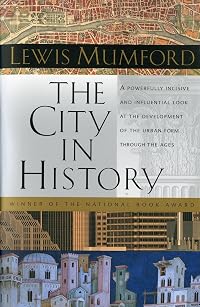
The City in History: Its Origins, Its Transformations, and Its Prospects
by Lewis Mumford
On This Page
Description
Examines the development and nature of the city from Egypt to Mesopotamia, Greece, Rome and the Middle Ages to the modern world.Tags
Recommendations
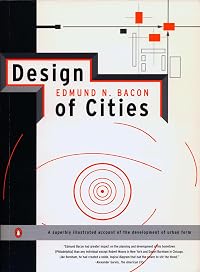
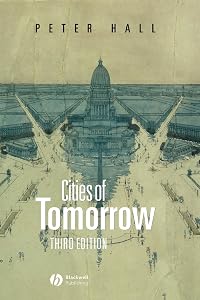
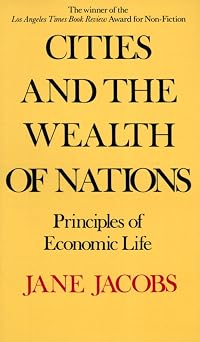

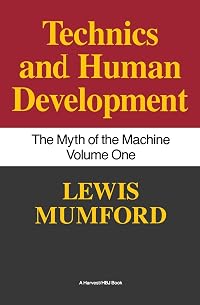










Member Recommendations

by anonymous user
Member Reviews
A survey of the roles that urban gatherings have played in Human history. We have enjoyed the city, and of course found great dissatisfaction with it. Mumford's survey gets frequent reprints, and is full of insights. I am sure the 19 year old me was a little out of his depths with these work, but mightily impressed with it.
Lewis Mumford's The City in History is neither a history nor is it about a delight for all things urbans. Granted, the time he was writing saw many urban fabrics and structures become too big and fractured. But it does have some good criticism and benefits. His bibliography is worth a serious glance. But his citations are lacking even though he casually references sources. He writes unapologetically from a western perspective knowing that his exposure is limited. His writing style could use some editing. But after all is said and done, this guy is a bit of a futurist. Replace some of the late 50's tech with todays and his speculation is either true, or we are accelerating towards his vision. Graphic references could have been selected show more better to understand the city in time rather than just as a means of criticism. The book did inform me and reinforced some of my concepts. But I just wish he spent some of his words on what makes people need, want and enjoy the city from a positive viewpoint. show less
This book is both dystopian an disturbing. As a history it is more a catalogue of mistakes and processes gone wrong than a simple history. The book is erudite and scholarly but hardly optimistic.
The only kind of urban center that gets the faintest nod of praise is the medieval village and its very few modern successors. The modern city is pictured as a vast growth that through technology is crushing the human spirit. Only Rotterdam escapes complete disdain.
For all the pessimism of the book it contains many important ideas that mankind will be forced to consider. How the computer and the cellphone would have effected his ideas I don't know and I think he is flat wrong in his perception of space exploration and the reasons for show more it.
Nevertheless the book is well worth reading with many ideas and problems that must be considered by the human race. Take a few hours or days to check it out. show less
The only kind of urban center that gets the faintest nod of praise is the medieval village and its very few modern successors. The modern city is pictured as a vast growth that through technology is crushing the human spirit. Only Rotterdam escapes complete disdain.
For all the pessimism of the book it contains many important ideas that mankind will be forced to consider. How the computer and the cellphone would have effected his ideas I don't know and I think he is flat wrong in his perception of space exploration and the reasons for show more it.
Nevertheless the book is well worth reading with many ideas and problems that must be considered by the human race. Take a few hours or days to check it out. show less
Redundantly dry but informative.
No doubt considered the classic history of the city. Too subjective and rather dated for my tastes. Dense, bleak.
The city’s development from ancient times to the modern age. Winner of the National Book Award. “One of the major works of scholarship of the twentieth century” (Christian Science Monitor). Index; illustrations.
Middle Ages Chapters 17-24
Members
- Recently Added By
Lists

Urban Planning (Michelle TBR)
39 works; 3 members

Best General History Books
103 works; 23 members

The War on Cars podcast
108 works; 1 member

Modern Library 100 Best Nonfiction Books
100 works; 8 members

Best Architecture Books
87 works; 13 members
Author Information

93+ Works 6,118 Members
Lewis Mumford has been referred to as one of the twentieth century's most influential "public intellectuals." A thinker and writer who denied the narrowness of academic speciality, Mumford embraced a cultural analysis that integrated technology, the natural environment, the urban environment, the individual, and the community. Although he lacked a show more formal university degree, Mumford wrote more than 30 books and 1,000 essays and reviews, which established his "organic" analysis of modern culture. His work defined the interdisciplinary studies movement, especially American studies; urban studies and city planning; architectural history; history of technology; and, most important in the present context, the interaction of science, technology, and society. Mumford was the editor of Dial, the most distinguished literary magazine of its era, and in 1920 he served as editor of Sociological Review in London and was strongly influenced by Sir Patrick Geddes, the Scottish botanist, sociologist, and town planner. In 1923, Mumford became a charter member of the Regional Planning Association of America, an experimental group that studied city problems from a regional as well as an ecological point of view. Mumford's well-known principle of "organicism" (the exploration of a cultural complex, where values, technology, individual personality, and the objective environment complement each other and together could build a world of fulfillment and beauty) was discussed in all of his work, spanning a career of nearly 70 years. Mumford's first book, The Story of Utopias (1922), introduces reliance on history to understand the present as well as to plan for the future. His books on architectural history and his works in urban studies established Mumford's reputation as the leading American critic of architecture and city planning. Each book views and analyzes the city, or built environment, in the context of form, function, and purpose within the larger culture. Mumford's books are focused on technology's role in civilization, especially "the machine" and "megatechnics." As a result, they have provided formative direction and structure to science, technology, and society studies and have established Mumford's stature as one of the foremost social critics of the twentieth century. Mumford's most profound and important analysis of technology (and the work that most directly influenced interdisciplinary technology-society studies) is the two-volume The Myth of the Machine:Volume 1, Technics and Human Development (1967), and Volume 2, The Pentagon of Power (1970). It was written following World War II (during which Mumford lost his son) after the deployment of atomic weapons by Russia and the United States, and during the arms race. This major work reflects a noticeable reinterpretation of the role of technology and a deep pessimism regarding "megatechnics," a metaphor Mumford uses for intrusive, all-encompassing systems of control and oppressive order. He views the military-industrial complex (the most horrendous "megamachine") as destroyer of the emotive and organic aspects of life. Mumford argues against the loss of personal autonomy and the organic world by electricity-based computer systems. Mumford died on January 26, 1990. (Bowker Author Biography) show less
Some Editions
Awards and Honors
Awards
Distinctions
Common Knowledge
- Original publication date
- 1961
- First words
- What is the city? How did it come into existence?
- Last words
- (Click to show. Warning: May contain spoilers.)That magnification of all the dimensions of life, through emotional communion, rational communion, technological mastery, and above all, dramatic representation, has been the supreme office of the city in history. And it remains the chief reason for the city's continued existence.
- Canonical DDC/MDS
- 301.36; 307.7609
- Canonical LCC
- HT111
Classifications
- Genres
- Sociology, Nonfiction, History, Anthropology, General Nonfiction, Art & Design
- DDC/MDS
- 301.36 — Society, government, & culture Social sciences, sociology & anthropology Sociology and anthropology Formerly: Ecology and community Urban studies
- LCC
- HT111 — Social sciences Communities. Classes. Races Communities. Classes. Races Urban groups. The city. Urban sociology
- BISAC
Statistics
- Members
- 1,580
- Popularity
- 14,474
- Reviews
- 10
- Rating
- (4.16)
- Languages
- 10 — Chinese, English, French, German, Hungarian, Italian, Portuguese, Croatian, Spanish, Turkish
- Media
- Paper, Ebook
- ISBNs
- 24
- UPCs
- 1
- ASINs
- 17