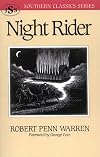
Night Rider
by Robert Penn Warren
On This Page
Description
Warren's first novel, set during the tobacco wars that raged in Kentucky and Tennessee in the early part of this century. Percy Munn is one of Warren's innocent idealists whose delusions become murderous as he attempts to define himself by action in the unfolding violence around him. Southern Classics Series.Tags
Recommendations
















Member Reviews
The setting for this story was the Tobacco Wars in Kentucky in the early 20th century. It was the big tobacco company versus the planters. Of course, the big tobacco companies had the upper hand and then the planters association (small time) resorted to violence and vigilantism. The main character in the book, Percy Munn, began as a civic-minded young attorney. However, over the course of the book he became a 3-time murderer and rapist. He justifies all of his actions in that he believes it was for the betterment of all in the long run. In the end, he is shot in the back by U.S. troops sent in to quell the violence. This was a violent and bleak book. I really didn't want to finish it, but for some reason I did! This was more history show more than fiction, which I liked. At 477 pages, I felt it was too long show less
Ratings
Members
- Recently Added By
Author Information

138+ Works 14,504 Members
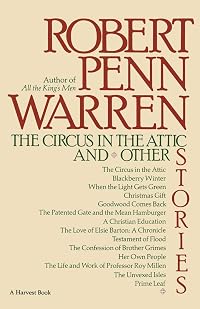
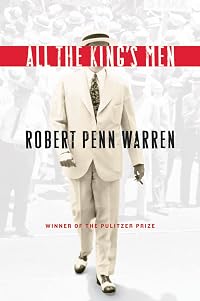
Robert Penn Warren, the first Poet Laureate of the United States, was an unusually versatile writer who tried his hand at almost every kind of literature. In all of these forms, he achieved recognition and distinction, but it is as a poet, critic, and novelist that he was most widely known. Writing almost always about his native South, Warren show more produced 10 novels and a collection of short stories, The Circus in the Attic and Other Stories (1948). By far the most successful of his novels is All the King's Men (1946), the story of a southern politician and demagogue named Willie Stark, which Warren based on the rise and fall of Huey Long. Warren was considered one of the most influential of the New Critics, whose influence on the teaching of literature in American schools and universities during the late 1940s and 1950s could scarcely be overestimated. Because All the King's Men seemed to be the very epitome of what a good work of literature should be in New Critical terms---a complicated but highly readable narrative filled with irony and ambiguity---the novel came to be used widely in courses on modern fiction. It won both the Pulitzer Prize and the Southern Authors Award in 1947. Warren's other novels are disappointing by comparison. Following the success of All the King's Men, however, Warren seemed to turn to more loosely told stories about dramatic and romantic subjects, such as the interracial theme of Band of Angels (1955) or the natural catastrophes that serve as the crisis background for The Cave (1959) and Flood: A Romance of Our Time (1964). Wilderness: A Tale of the Civil War (1961) is an allegory of a man's spiritual quest for truth about himself and the world. Meet Me in the Green Glen (1971), the story of a tragic love affair, seemed to mark a return to the tighter structure and more complex artistry of Warren's earlier novels, but A Place to Come To (1977), his last novel, in which an elderly and renowned scholar who seems to owe much to Warren himself looks back on his family's past in an effort to find the meaning of his life, struck some reviewers as a confused and tired work. Sometime midway through his career as a novelist it is as if Warren stopped thinking of himself as a southern writer in the tradition of William Faulkner and turned instead to Thomas Wolfe for inspiration. Although in retrospect that switch must be regretted, no one can deny the immense influence of Robert Penn Warren on modern letters. Warren's poetry is intellectual, rich in powerful images, and has its roots in the pre-Civil War South. He continued to write impressive poetry almost until the time of his death. (Bowker Author Biography) show less
Some Editions
Awards and Honors
Series
Belongs to Publisher Series
Common Knowledge
- Canonical title
- Night Rider
- Original title
- Night Rider
- Original publication date
- 1939
- People/Characters
- Percy "Perse" Munn
- Important places
- Kentucky, USA
- First words
- When the train slowed at the first jarring application of the brakes, the crowd packed in the aisle of hte coach swayed crushingly forward.
- Last words
- (Click to show. Warning: May contain spoilers.)Lying there, while the solid ground lurched and heaved beneath him in a long swell, he drowsily heard the voices down the slope calling emptily, like the voices of boys at a game in the dark.
Classifications
- Genres
- Fiction and Literature, General Fiction, Historical Fiction
- DDC/MDS
- 813.52 — Literature & rhetoric American literature in English American fiction in English 1900-1999 1900-1945
- LCC
- PS3545 .A748 .N5 — Language and Literature American literature American literature Individual authors 1900-1960
- BISAC
Statistics
- Members
- 139
- Popularity
- 236,760
- Reviews
- 1
- Rating
- (3.06)
- Languages
- English, French, Polish
- Media
- Paper, Ebook
- ISBNs
- 8
- ASINs
- 8