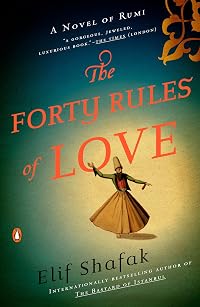
The Forty Rules of Love
by Elif Shafak
On This Page
Description
In this follow-up to her acclaimed 2007 novel The Bastard of Istanbul, Turkish author Elif Shafak unfolds two tantalizing parallel narratives-one contemporary and the other set in the thirteenth century, when Rumi encountered his spiritual mentor, the whirling dervish known as Shams of Tabriz-that together incarnate the poet's timeless message of love.Ella Rubenstein is forty years old and unhappily married when she takes a job as a reader for a literary agent. Her first assignment is to show more read and report on Sweet Blasphemy, a novel written by a man named Aziz Zahara. Ella is mesmerized by his tale of Shams' search for Rumi and the dervish's role in transforming the successful but unhappy cleric into a committed mystic, passionate poet, and advocate of love. She is also taken with Shams's lessons, or rules, which offer insight into an ancient philosophy based on the unity of all people and religions, and the presence of love in each and every one of us. As she reads on, she realizes that Rumi's story mirrors her own and that Zahara-like Shams-has come to set her free. show lessTags
Recommendations


















Member Recommendations
Member Reviews
The reviews and critiques here on Shafak's novel are probably as split as opinion about her in her home country, from which she has been exiled and is under the danger of death if she returns. I found it funny to see some women equating this story to a Harlequin. As a man, I saw none of that. Maybe some folks have difficulty understanding the love in this book, as inspired by Rumi, as it actually has very little to do with romance. The largest love story involved in the book that born of intellect and spiritual searching between Rumi and a Sufi, and there is absolutely no romantic connection between the two. Sure, there is a modern story of love and loss that has some romance in it which is told over the top of the Rumi story. But ever show more the modern story has more to do with a woman who is finding her identity and all that entails than finding a lover. Shafak is an altogether overlooked storyteller - perhaps because she is female or because of her ethnicity in this time when it's vogue to hate people from that part of the world or perhaps because of the stories she tells. This one, equal parts Dickens and Coelho, was provocative and well written. show less
Steeped in magic and mysticism, The Forty Rules of Love is a book like no other and Shams of Tabriz a character like no other.
The novel explores two developing relationships over two alternating timelines: travelling dervish Shams of Tabriz and Islamic Jurist and mystic poet Rumi in Konya in the middle of the 13th century; Boston resident Ella Rubenstein, married mother of three and reader for a literary agency and Aziz, the author of a manuscript telling the story of Sham’s forty rules of love, in 2008.
Exploring Sufism, faith and love, loneliness, emptiness and despair, filling a gaping void and becoming the person you’re meant to be, The Forty Rules of Love is moving, mesmerising and enlightening.
I wasn’t so bothered by the show more present day timeline but could’ve read about life in and around Rumi’s household – the leper, the drunk and the whore; the sons, the second wife and the protégé – forever. show less
The novel explores two developing relationships over two alternating timelines: travelling dervish Shams of Tabriz and Islamic Jurist and mystic poet Rumi in Konya in the middle of the 13th century; Boston resident Ella Rubenstein, married mother of three and reader for a literary agency and Aziz, the author of a manuscript telling the story of Sham’s forty rules of love, in 2008.
Exploring Sufism, faith and love, loneliness, emptiness and despair, filling a gaping void and becoming the person you’re meant to be, The Forty Rules of Love is moving, mesmerising and enlightening.
I wasn’t so bothered by the show more present day timeline but could’ve read about life in and around Rumi’s household – the leper, the drunk and the whore; the sons, the second wife and the protégé – forever. show less
This is a beautiful book journey between the 13th and 21st century. Narrating a woman's experience on reading a book about love's spindling essence which takes her and us into a world of dervishes and sufi mysticism, a world where Rumi is discovered by a wandering dervish, Shams of Tabriz; we travel in a sufiana era when people knew little about their own mysteries.
I don't want to give away essential book plots by revealing my favourite parts from the book but reading this book has been a wonderful exercise in understanding the longing for love we all feel and are unable to express & convey to our loved ones. There are rules and why they are forty is also a great story that's unfolded as we move through Ella and Aziz from 21st century show more to Rumi, Desert Rose, Kimya and Shams in the 13th century while imagining the quaint towns of Samarkand and Konya. This has been a wondrous affair to engage in at midnight. Nothing soothes the stressed mind as reading verses of love. show less
I don't want to give away essential book plots by revealing my favourite parts from the book but reading this book has been a wonderful exercise in understanding the longing for love we all feel and are unable to express & convey to our loved ones. There are rules and why they are forty is also a great story that's unfolded as we move through Ella and Aziz from 21st century show more to Rumi, Desert Rose, Kimya and Shams in the 13th century while imagining the quaint towns of Samarkand and Konya. This has been a wondrous affair to engage in at midnight. Nothing soothes the stressed mind as reading verses of love. show less
Do not judge a book by its cover. Despite the gorgeous cover and the promise of a lyrical tale involving the filial love between a mystic and a poet in thirteenth century Anatolia, this book was a disappointment.
I finished it with a feeling of irritation. I didn't like the modern love story that was interleaved with the medieval one. I failed to see how the two were linked. The thirteenth century characters, expressing themselves in modern American slang, just didn't feel right. As far as the two central characters were concerned:- I never felt any affinity towards Rumi and by the end of the book I'd grown to positively dislike Shams.
The "Forty Rules" that were scattered throughout the book as little pearls of wisdom were inspirational show more in their own right. But their use in the book felt a bit contrived. show less
I finished it with a feeling of irritation. I didn't like the modern love story that was interleaved with the medieval one. I failed to see how the two were linked. The thirteenth century characters, expressing themselves in modern American slang, just didn't feel right. As far as the two central characters were concerned:- I never felt any affinity towards Rumi and by the end of the book I'd grown to positively dislike Shams.
The "Forty Rules" that were scattered throughout the book as little pearls of wisdom were inspirational show more in their own right. But their use in the book felt a bit contrived. show less
The love between Rumi and Shams is fascinating, another dimension of love, but I didn't like The Forty Rules of Love... maybe because the word "rules" is the worst to apply to a Love that is beyond any model, rule, myth and stereotype we use to make it understandable, ordinary, petty experience
Wishlist | Blog | Facebook | Twitter | Instagram | Ko-fi
Reading The Forty Rules of Love was like enduring a spiritual journey myself! What made this experience even more incredible was that I read this book whilst I was on a road trip across Europe last summer.
Synopsis:
Discover the forty rules of love…
Ella Rubinstein has a husband, three teenage children, and a pleasant home. Everything that should make her confident and fulfilled. Yet there is an emptiness at the heart of Ella’s life – an emptiness once filled by love.
So when Ella reads a manuscript about the thirteenth-century Sufi poet Rumi and Shams of Tabriz, and his forty rules of life and love, her world is turned upside down. She embarks on a journey to meet the mysterious show more author of this work.
It is a quest infused with Sufi mysticism and verse, taking Ella and us into an exotic world where faith and love are heartbreakingly explored…
Thoughts:
Even though there is the usual synopsis – this book is so much more than that. Through the lives of Ella, Rumi, Shams of Tabriz, Aziz and many more characters, we were transported to Turkey! And through their stories, we experience love, faith, poetry, freedom and self-fulfilment. Diving into these pages not only made me feel all kinds of ways, but it amplified these feelings.
The culture, the places, the people and the raw emotions spoke to me in a way I haven’t felt in a long time from a book. Perhaps it has to do with the fact I was born in Macedonia. Perhaps with the fact I’ve been to Turkey a couple of times, especially to Konya – a town that features in this book very often. But I think regardless of my biases and experiences, this book would have had the exact same effect on me. It’s so beautifully written and once it was all over, I wanted so much more. I cannot recommend it enough! Below I have listed a lot of my favourite quotes from the book. I hope you enjoy reading them as much as I did!
“If a stone hits a river, the river will treat it as yet another commotion in its steady tumultuous course. Nothing unusual. Nothing unmanageable. If a stone hits a lake, however, the lake will never be the same again.”
“Love came to Ella as suddenly and brusquely as if a stone had been hurled from out of nowhere into the tranquil pond of her life.”
“For despite what some people say, love is not only a sweet feeling bound to come and quickly go away.”
“The Path to the Truth is a labor of the heart, not of the head. Make your heart your primary guide! Not your mind. Meet, challenge, and ultimately prevail over your nafs with your heart.”
“Intellect and love are made of different materials. Intellect ties people in knots and risks nothing, but love dissolves all tangles and risks everything. Intellect is always cautious and advises. ‘Beware too much ecstasy,’ whereas love says, ‘Oh, never mind! Take the plunge!’ Intellect does not easily break down, whereas love can effortlessly reduce itself to rubble. But treasures are hidden among ruins. A broken heart hides treasures.”
“Most of the problems of the world stem from linguistic mistakes and simple misunderstandings. Don’t ever take words at face value. When you step into the zone of love, language as we know it becomes obsolete. That which cannot be put into words can only be grasped through silence.”
“Patience does not mean to passively endure. It means to be farsighted enough to trust the end result of a process. What does patience mean? It means to look at the thorn to see the rose, to look at the night and see the dawn. Impatience means to be so shortsighted as to not be able to see the outcome.”
“Try not to resist the changes that come your way. Instead let life live through you. And do not worry that your life is turning upside down. How do you know that the side you are used to is better than the one to come?”
“Personally, I didn’t think there was anything wrong with sadness. Just the opposite – hypocrisy made people happy, and truth made them sad.”
“The whole universe is contained within a single human being – you. Everything that you see around, including the things you might not be fond of and even the people you despise or abhor, is present within you in varying degrees. Therefore, do not look for Sheitan outside yourself either. The devil is not an extraordinary force that attacks from without. It is an ordinary voice within. If you get to know yourself fully, facing with honesty and hardness both your dark and bright sides, you will arrive at a supreme form of consciousness.”
“Did you know that in mystic thought forty symbolises the ascent from one level to a higher one and spiritual awakening? When we mourn we mourn for forty days. When a baby is born it takes forty days for him to get ready to start life on earth. And when we are in love we need to wait forty days to be sure of our feelings.”
“If you want to change the way others treat you, you should first change the way you treat yourself. Unless you learn to love yourself, fully and sincerely, there is no way you can be loved. Once you achieve this stage, however, be thankful for every thorn that others might throw at you. It is a sign that you will soon be showered in roses.”
“While pretty flowers are instantly plucked, few people pay attention to plants and thorns and prickles. But the truth is, great medicines are often made from these.”
“How can love be worthy of its name if one selects solely the pretty things and leaves out the hardships? It is easy to enjoy the good and dislike the bad. Anybody can do that. The real challenge is to love the good and the bad together, not because you need to take the rough with the smooth, but because you need to go beyond such descriptions and accept love in its entirety.”
“Language, he said, did more to hide than reveal the Truth, and as a result people constantly misunderstand and misjudge one another. In a world beset with mistranslations, there was no use in being resolute about any topic, because it might as well be that even our strongest convictions were caused by a simple misunderstanding.”
“In this world take pity on three kinds of people. The rich man who has lost his fortune, the well-respected man who has lost his respectability, and the wise man who is surrounded by ignorants.” show less
Reading The Forty Rules of Love was like enduring a spiritual journey myself! What made this experience even more incredible was that I read this book whilst I was on a road trip across Europe last summer.
Synopsis:
Discover the forty rules of love…
Ella Rubinstein has a husband, three teenage children, and a pleasant home. Everything that should make her confident and fulfilled. Yet there is an emptiness at the heart of Ella’s life – an emptiness once filled by love.
So when Ella reads a manuscript about the thirteenth-century Sufi poet Rumi and Shams of Tabriz, and his forty rules of life and love, her world is turned upside down. She embarks on a journey to meet the mysterious show more author of this work.
It is a quest infused with Sufi mysticism and verse, taking Ella and us into an exotic world where faith and love are heartbreakingly explored…
Thoughts:
Even though there is the usual synopsis – this book is so much more than that. Through the lives of Ella, Rumi, Shams of Tabriz, Aziz and many more characters, we were transported to Turkey! And through their stories, we experience love, faith, poetry, freedom and self-fulfilment. Diving into these pages not only made me feel all kinds of ways, but it amplified these feelings.
The culture, the places, the people and the raw emotions spoke to me in a way I haven’t felt in a long time from a book. Perhaps it has to do with the fact I was born in Macedonia. Perhaps with the fact I’ve been to Turkey a couple of times, especially to Konya – a town that features in this book very often. But I think regardless of my biases and experiences, this book would have had the exact same effect on me. It’s so beautifully written and once it was all over, I wanted so much more. I cannot recommend it enough! Below I have listed a lot of my favourite quotes from the book. I hope you enjoy reading them as much as I did!
“If a stone hits a river, the river will treat it as yet another commotion in its steady tumultuous course. Nothing unusual. Nothing unmanageable. If a stone hits a lake, however, the lake will never be the same again.”
“Love came to Ella as suddenly and brusquely as if a stone had been hurled from out of nowhere into the tranquil pond of her life.”
“For despite what some people say, love is not only a sweet feeling bound to come and quickly go away.”
“The Path to the Truth is a labor of the heart, not of the head. Make your heart your primary guide! Not your mind. Meet, challenge, and ultimately prevail over your nafs with your heart.”
“Intellect and love are made of different materials. Intellect ties people in knots and risks nothing, but love dissolves all tangles and risks everything. Intellect is always cautious and advises. ‘Beware too much ecstasy,’ whereas love says, ‘Oh, never mind! Take the plunge!’ Intellect does not easily break down, whereas love can effortlessly reduce itself to rubble. But treasures are hidden among ruins. A broken heart hides treasures.”
“Most of the problems of the world stem from linguistic mistakes and simple misunderstandings. Don’t ever take words at face value. When you step into the zone of love, language as we know it becomes obsolete. That which cannot be put into words can only be grasped through silence.”
“Patience does not mean to passively endure. It means to be farsighted enough to trust the end result of a process. What does patience mean? It means to look at the thorn to see the rose, to look at the night and see the dawn. Impatience means to be so shortsighted as to not be able to see the outcome.”
“Try not to resist the changes that come your way. Instead let life live through you. And do not worry that your life is turning upside down. How do you know that the side you are used to is better than the one to come?”
“Personally, I didn’t think there was anything wrong with sadness. Just the opposite – hypocrisy made people happy, and truth made them sad.”
“The whole universe is contained within a single human being – you. Everything that you see around, including the things you might not be fond of and even the people you despise or abhor, is present within you in varying degrees. Therefore, do not look for Sheitan outside yourself either. The devil is not an extraordinary force that attacks from without. It is an ordinary voice within. If you get to know yourself fully, facing with honesty and hardness both your dark and bright sides, you will arrive at a supreme form of consciousness.”
“Did you know that in mystic thought forty symbolises the ascent from one level to a higher one and spiritual awakening? When we mourn we mourn for forty days. When a baby is born it takes forty days for him to get ready to start life on earth. And when we are in love we need to wait forty days to be sure of our feelings.”
“If you want to change the way others treat you, you should first change the way you treat yourself. Unless you learn to love yourself, fully and sincerely, there is no way you can be loved. Once you achieve this stage, however, be thankful for every thorn that others might throw at you. It is a sign that you will soon be showered in roses.”
“While pretty flowers are instantly plucked, few people pay attention to plants and thorns and prickles. But the truth is, great medicines are often made from these.”
“How can love be worthy of its name if one selects solely the pretty things and leaves out the hardships? It is easy to enjoy the good and dislike the bad. Anybody can do that. The real challenge is to love the good and the bad together, not because you need to take the rough with the smooth, but because you need to go beyond such descriptions and accept love in its entirety.”
“Language, he said, did more to hide than reveal the Truth, and as a result people constantly misunderstand and misjudge one another. In a world beset with mistranslations, there was no use in being resolute about any topic, because it might as well be that even our strongest convictions were caused by a simple misunderstanding.”
“In this world take pity on three kinds of people. The rich man who has lost his fortune, the well-respected man who has lost his respectability, and the wise man who is surrounded by ignorants.” show less
I have been putting off the review, one that I could have written midway through the book. I love Elif Shafak's writing in Turkish and in English, and I have read many of her books, sometimes in both languages. With that said, I have a hard time writing a review for The Forty Rules of Love without it sounding like a criticism of "spirituality" (in this case, Sufism, but really, can be applied to all spiritual practices) So perhaps that says it all: If you are not into spirituality, maybe this is not the book for you.
As I was reading this book, I often thought "A Doll's House meets self-help" I liked the modern day story with Ella, the 40 year-old homemaker who is having a mid-life crisis. Ella will surely search for a new life, one show more thinks, from the very beginning. How that new life comes about, or rather more importantly how the old one is evaluated by Ella along the way is what makes the story interesting. The other half of the book is made up of another book written by a mysterious guy about the relationship of Rumi and Shams of Tabriz. And this second book is what bothered me. The writing style is certainly distinct from that of Ella's story, and certainly from that of anything Elif Shafak has written before, perhaps trying to capture a simple, more "folksy" way of speech. The story is supposed to be inspiring, I suppose. And if you are a cynical atheist like me, you will find most of it painfully hypocritical and banal. Again, I do not mean this to be a judgement on any particular religion or belief, perhaps a judgement on how humans practice their beliefs, sort of, but as I said, it is hard to review this book without voicing your opinion about the spiritual beliefs it contains. The 40 rules certainly make up a good self-help book on their own. The attitude of both Rumi and Shams are ignorant, thoughtless, selfish, and sometimes very confusing. The feelings of one of Rumi's sons and those of Rumi's wife have a voice, but the other voices are so overwhelming that even though these two people have perfectly legitimate complaints and highlight certain problems that directly point at the hypocrisy and hedonism of Rumi and Shams' behaviors, I could not help but feel that the writer tried very hard for me to still sympathize with Rumi and Shams and not the son and the wife.
And in the end, what is it that we should think about when we leave this book? Should we have learned that love is the only thing worth pursuing in life? Is it really? I am not convinced. show less
As I was reading this book, I often thought "A Doll's House meets self-help" I liked the modern day story with Ella, the 40 year-old homemaker who is having a mid-life crisis. Ella will surely search for a new life, one show more thinks, from the very beginning. How that new life comes about, or rather more importantly how the old one is evaluated by Ella along the way is what makes the story interesting. The other half of the book is made up of another book written by a mysterious guy about the relationship of Rumi and Shams of Tabriz. And this second book is what bothered me. The writing style is certainly distinct from that of Ella's story, and certainly from that of anything Elif Shafak has written before, perhaps trying to capture a simple, more "folksy" way of speech. The story is supposed to be inspiring, I suppose. And if you are a cynical atheist like me, you will find most of it painfully hypocritical and banal. Again, I do not mean this to be a judgement on any particular religion or belief, perhaps a judgement on how humans practice their beliefs, sort of, but as I said, it is hard to review this book without voicing your opinion about the spiritual beliefs it contains. The 40 rules certainly make up a good self-help book on their own. The attitude of both Rumi and Shams are ignorant, thoughtless, selfish, and sometimes very confusing. The feelings of one of Rumi's sons and those of Rumi's wife have a voice, but the other voices are so overwhelming that even though these two people have perfectly legitimate complaints and highlight certain problems that directly point at the hypocrisy and hedonism of Rumi and Shams' behaviors, I could not help but feel that the writer tried very hard for me to still sympathize with Rumi and Shams and not the son and the wife.
And in the end, what is it that we should think about when we leave this book? Should we have learned that love is the only thing worth pursuing in life? Is it really? I am not convinced. show less
Members
- Recently Added By
Published Reviews
The novel is beautifully written and explores a wide range of themes, including love, spirituality, religion, and self-discovery. The characters are well-developed, and the author's descriptions of their thoughts and emotions are vivid and poignant. The way the author interweaves the stories of Ella and Rumi is masterful, creating a deep and meaningful connection between the two characters.
added by Urwa.Tul.Wuska
Lists

Best Love Stories
107 works; 14 members

BBC's 100 Novels That Shaped Our World
100 works; 22 members

BBC Radio 4 Bookclub
341 works; 13 members

Books Read in 2016
4,666 works; 199 members

Books Read in 2020
4,379 works; 124 members

Recommended Literary Books
111 works; 1 member

BBC World Book Club
267 works; 5 members

World Book Club (BBC World Service)
212 works; 1 member
Author Information

36+ Works 12,384 Members
Elif Shafak is an assistant professor of Near Eastern Studies at the University of Arizona.
Some Editions
Awards and Honors
Series
Belongs to Publisher Series
Common Knowledge
- Canonical title
- The Forty Rules of Love
- Original title
- The Forty Rules of Love
- Original publication date
- 2009
- People/Characters
- Ella; Aziz; Rumi
- Important places
- Turkey; Massachusetts, USA
- Dedication*
- Voor Zahir & Zelda
- First words*
- Proloog
Bij de rivier neem je een steen die je in het stromende water gooit.
Hoofdstuk 1
Buiten, voor haar keukenraam, zaten de vogeltjes te zingen op die zachte voorjaarsdag. - Quotations*
- Toen ik klein was, zag ik God,
Ik zag engelen;
Ik keek naar de geheimen van de hogere en de lagere wereld.
Ik dacht dat alle mensen hetzelfde zagen.
Uiteindelijk kwam ik erachter dat zij niet zagen... - Last words*
- (Click to show. Warning: May contain spoilers.)'Het universum draait anders wanneer vuur van water houdt.'
- Blurbers*
- Can, Sinan; Polat, Meral
- Original language
- English
- Canonical DDC/MDS
- 813.6
- Canonical LCC
- PS3619.H328
*Some information comes from Common Knowledge in other languages. Click "Edit" for more information.
Classifications
Statistics
- Members
- 1,858
- Popularity
- 11,660
- Reviews
- 89
- Rating
- (3.78)
- Languages
- 18 — Arabic, Bosnian, Dutch, English, Finnish, French, German, Hindi, Hungarian, Italian, Lithuanian, Marathi, Polish, Romanian, Russian, Slovenian, Turkish, Urdu
- Media
- Paper, Audiobook, Ebook
- ISBNs
- 54
- ASINs
- 20
