On This Page
Description
When twenty-three-year-old Sister Evangeline accidentally stumbles upon some mysterious letters exchanged between the late mother superior of her convent and the famous philanthropist Abigail Rockefeller, she is thrust into an ancient conflict between the Society of Angelologists and the monstrously beautiful descendants of angels and humans, the Nephilim.Tags
Recommendations









Member Recommendations
kraaivrouw Richly imagined and written fantasies that play with myth and theology.

vwinsloe A well-imagined history with supernatural beings.
Member Reviews
If you're expecting The DaVinci Code, please move on - this is not the book for you. If you're looking for richly imagined and beautifully written literary fantasy read Angelology.
Let me first say that I'm not Christian and I'm also not particularly interested in angels except where they appear in various kinds of literature. I remember the time when angels were all the rage, everyone was discovering their guardian angels and putting up posters and generally being very New Agey about a very old (and dangerous) thing. I much prefer the angels that took over hell (Duma and Remiel) in Neil Gaiman's Season of Mists. I also adore Gaiman's portrayal of Lucifer - a glorious combination of David Bowie crossed with John Milton.
This is a show more wonderful book filled with history, with shifting viewpoints, with art and literature, with adventure. Ms. Trussoni has shades of many writers encompassed within her own unique style, but Angelology reminds me most of Elizabeth Hand's book Waking the Moon. The comparison comes not from the subject matter (Trussoni's angels are much different from Hand's Benandati), but from the way both writers take familiar bits of myth and theology and create something unique and beautiful from them.
I thoroughly enjoyed this book - so much so that I suspect it'll be difficult to find a satisfying next read. show less
Let me first say that I'm not Christian and I'm also not particularly interested in angels except where they appear in various kinds of literature. I remember the time when angels were all the rage, everyone was discovering their guardian angels and putting up posters and generally being very New Agey about a very old (and dangerous) thing. I much prefer the angels that took over hell (Duma and Remiel) in Neil Gaiman's Season of Mists. I also adore Gaiman's portrayal of Lucifer - a glorious combination of David Bowie crossed with John Milton.
This is a show more wonderful book filled with history, with shifting viewpoints, with art and literature, with adventure. Ms. Trussoni has shades of many writers encompassed within her own unique style, but Angelology reminds me most of Elizabeth Hand's book Waking the Moon. The comparison comes not from the subject matter (Trussoni's angels are much different from Hand's Benandati), but from the way both writers take familiar bits of myth and theology and create something unique and beautiful from them.
I thoroughly enjoyed this book - so much so that I suspect it'll be difficult to find a satisfying next read. show less
Angelology begins in Milton, NY at St. Rose Convent. Sister Evangeline is 23; she has been living there since she was 12, and took her vows at age 18. She works in the library, handling the correspondence. Her days have been fairly routine until now, but on the day the book opens, December 23, 1999, she receives a letter from a V.A. Verlaine, inquiring about a possible connection between a prior abbess of the convent and Abigail Aldrich Rockefeller, the famous (real-life) philanthropist of the arts.
We quickly get enmeshed in a Dan Brown-sort of thriller, featuring theological mysteries that are derived from angelology, the study of angels and their presence on earth throughout history. We are reminded that the presence on earth of show more “Nephilim,” or half-angels, half-humans, was described at the beginning of the Bible, in Genesis 6:
"The sons of God saw the daughters of men that they were fair; and they took them wives of all which they chose,” and when “they bare children to them, the same became mighty men which were of old, men of renown.”
As the story progresses we learn how the history of the Nephilim became interwoven with the myth of Orpheus, among other myths; all of these stories are purported in the book to have had a basis in fact. As one of the angelologists explains in a clever implied repost to positivists:
"Whereas angels were once the epitome of beauty and goodness, now, in our time, they are irrelevant. Materialism and science have banished them to nonexistence, a sphere as indeterminate as purgatory. It used to be that humanity believed in angels implicitly, intuitively, not with our minds but with our very souls. Now we need proof. We need material, scientific data that will verify without a doubt their reality. Yet what a crisis would occur if the proof existed! What would happen, do you suppose, if the material existence of angels could be verified?”
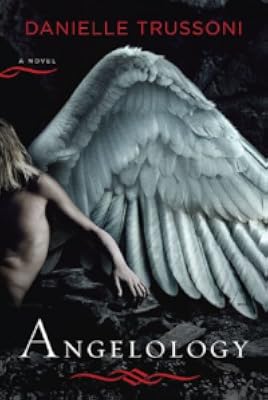
Since the publishers tell you on the blurbs and by virtue of the cover picture itself that the Nephilim exist, it won’t be spoilery to reveal that Evangeline and Vervaine get involved in a life-or-death struggle with these creatures, who are not interested in having their secrets uncovered. In fact, it is the Nephilim, so the angelologists contend, who promulgated atheism, so that people will not suspect the extent to which humans are not, in fact, free of the nefarious intervention of Nephilim into their affairs.
This trope works well enough for most of the book, since there is enough similarity to the real world to make the story seem clever and entertaining. Toward the end though, a few sharks get jumped, in part, one supposes, to spur the reader on to read the next installment.
Discussion: It was interesting to see how Trussoni based the plot on an extremely literal and anthropomorphic interpretation of the Bible. Of course, there are probably more competing interpretations of the Bible than there are actual people in the world. Nevertheless, when you opt for the Vengeful God and Evil Angels version of the Bible, it seems to me that you need to have your characters also account for divergence from metaphysical doctrines such as omnipotence (clearly not a Divine attribute in this series), forgiveness, redemption, and maybe the whole Sermon on the Mount. (Jesus and associated ethics of love and morality generally do not play a role in these two books. The author supplements mostly Old Testament passages with some from the Apocrypha and other non-canonical works, such as the Book of Enoch.)
I do think Trussoni does a nice job with the theological arguments she does tackle, and the thriller aspect of the book is well-done. show less
We quickly get enmeshed in a Dan Brown-sort of thriller, featuring theological mysteries that are derived from angelology, the study of angels and their presence on earth throughout history. We are reminded that the presence on earth of show more “Nephilim,” or half-angels, half-humans, was described at the beginning of the Bible, in Genesis 6:
"The sons of God saw the daughters of men that they were fair; and they took them wives of all which they chose,” and when “they bare children to them, the same became mighty men which were of old, men of renown.”
As the story progresses we learn how the history of the Nephilim became interwoven with the myth of Orpheus, among other myths; all of these stories are purported in the book to have had a basis in fact. As one of the angelologists explains in a clever implied repost to positivists:
"Whereas angels were once the epitome of beauty and goodness, now, in our time, they are irrelevant. Materialism and science have banished them to nonexistence, a sphere as indeterminate as purgatory. It used to be that humanity believed in angels implicitly, intuitively, not with our minds but with our very souls. Now we need proof. We need material, scientific data that will verify without a doubt their reality. Yet what a crisis would occur if the proof existed! What would happen, do you suppose, if the material existence of angels could be verified?”
Since the publishers tell you on the blurbs and by virtue of the cover picture itself that the Nephilim exist, it won’t be spoilery to reveal that Evangeline and Vervaine get involved in a life-or-death struggle with these creatures, who are not interested in having their secrets uncovered. In fact, it is the Nephilim, so the angelologists contend, who promulgated atheism, so that people will not suspect the extent to which humans are not, in fact, free of the nefarious intervention of Nephilim into their affairs.
This trope works well enough for most of the book, since there is enough similarity to the real world to make the story seem clever and entertaining. Toward the end though, a few sharks get jumped, in part, one supposes, to spur the reader on to read the next installment.
Discussion: It was interesting to see how Trussoni based the plot on an extremely literal and anthropomorphic interpretation of the Bible. Of course, there are probably more competing interpretations of the Bible than there are actual people in the world. Nevertheless, when you opt for the Vengeful God and Evil Angels version of the Bible, it seems to me that you need to have your characters also account for divergence from metaphysical doctrines such as omnipotence (clearly not a Divine attribute in this series), forgiveness, redemption, and maybe the whole Sermon on the Mount. (Jesus and associated ethics of love and morality generally do not play a role in these two books. The author supplements mostly Old Testament passages with some from the Apocrypha and other non-canonical works, such as the Book of Enoch.)
I do think Trussoni does a nice job with the theological arguments she does tackle, and the thriller aspect of the book is well-done. show less
I picked up this book based largely upon a laudatory review in the NYT Book Review that concluded that Sensual and intellectual, “Angelology” is a terrifically clever thriller — more Eco than Brown. I am now wondering what book reviewer Susann Cokal read exactly. I'll admit right here that I've never read anything by Dan Brown, but I have read Umberto Eco and Angelology has nothing in common with Eco's complex and highly intelligent novels. I'd be more comfortable comparing this book to thrillers written by Katherine Neville or Kate Mosse, although with reservations.
Is Angelology really so bad? Well, the concept is fantastic; based on three Bible verses (Genesis 6:2-4), Trussoni creates a world in which the fallen angels bore show more children with humans and that these offspring, the Nephilim, supernaturally good-looking, blond, tall and powerful, still exist today. They are, however, very, very evil and seek the utter enslavement of mankind. Also, the central segment of the book, taking place in occupied Paris, is well done, compelling (the Nephilim get along great with the Nazis) and action-packed. The characters here are reasonably fleshed out.
The flaws in the story are most apparent in the modern day story, set at the end of 1999. Here characterization is sacrificed on the altar of cram-packed action and even the action is sometimes quickly summarized so as not to waste time. The good guys are all instantly able to make startling leaps of logic (that are always correct) and to tell the good guys from the bad guys. They are never fooled, not even once. And the bad angels are amazingly incompetent and easy to kill. In one scene, a fierce and gigantic Nephilim is taken down by one unarmed geriatric nun. The characters are also paper-thin. There's the innocent, young and beautiful nun and her love interest, the New York hipster, who despite having to scramble to pay the rent, dresses only in vintage designer clothing and drives an antique car.
There are so many little inconsistencies and unexplained leaps of logic that derail the book. A book can be based on the unbelievable and work, but it must be internally consistent. Either the Nephilim are supernaturally strong and intelligent, allowing them to amass wealth and power or they are a group of easily distracted idiots. The originating idea was good; it's unfortunate that Trussoni didn't spend a little more time on the details. Also, the book doesn't so much end, as make way for book two, in which the hipster and the nun face new perils. show less
Is Angelology really so bad? Well, the concept is fantastic; based on three Bible verses (Genesis 6:2-4), Trussoni creates a world in which the fallen angels bore show more children with humans and that these offspring, the Nephilim, supernaturally good-looking, blond, tall and powerful, still exist today. They are, however, very, very evil and seek the utter enslavement of mankind. Also, the central segment of the book, taking place in occupied Paris, is well done, compelling (the Nephilim get along great with the Nazis) and action-packed. The characters here are reasonably fleshed out.
The flaws in the story are most apparent in the modern day story, set at the end of 1999. Here characterization is sacrificed on the altar of cram-packed action and even the action is sometimes quickly summarized so as not to waste time. The good guys are all instantly able to make startling leaps of logic (that are always correct) and to tell the good guys from the bad guys. They are never fooled, not even once. And the bad angels are amazingly incompetent and easy to kill. In one scene, a fierce and gigantic Nephilim is taken down by one unarmed geriatric nun. The characters are also paper-thin. There's the innocent, young and beautiful nun and her love interest, the New York hipster, who despite having to scramble to pay the rent, dresses only in vintage designer clothing and drives an antique car.
There are so many little inconsistencies and unexplained leaps of logic that derail the book. A book can be based on the unbelievable and work, but it must be internally consistent. Either the Nephilim are supernaturally strong and intelligent, allowing them to amass wealth and power or they are a group of easily distracted idiots. The originating idea was good; it's unfortunate that Trussoni didn't spend a little more time on the details. Also, the book doesn't so much end, as make way for book two, in which the hipster and the nun face new perils. show less
Our young beautiful heroine, is Sister Evangeline. She is a nun, at a convent in upstate New York and one day discovers some correspondence, revealing a few shocking dark secrets, involving her family, a group that calls themselves Angelologists and of course the Angels themselves.
No, these are not our usual chubby-cheeked, harp playing cuties but these are of a more majestic variety. Big, blue-eyed, vermillion-winged beauties, with evil tendencies and bad attitudes. They are called the Nephilim, the off-spring of human and angel pairings.
They have incorporated into society, keeping their identities hidden, patiently waiting for their moment to rise. The Angelologists are there to make sure this doesn’t happen.
Evangeline suddenly show more finds herself caught between these warring factions and the excitement and tension ensue.
The book is structured like [The Historian], with a healthy nod to [[Dan Brown]]
and like those novels, the characterizations suffer under the immense detail. It is still an enjoyable read and I admired the world that Trussoni created. show less
No, these are not our usual chubby-cheeked, harp playing cuties but these are of a more majestic variety. Big, blue-eyed, vermillion-winged beauties, with evil tendencies and bad attitudes. They are called the Nephilim, the off-spring of human and angel pairings.
They have incorporated into society, keeping their identities hidden, patiently waiting for their moment to rise. The Angelologists are there to make sure this doesn’t happen.
Evangeline suddenly show more finds herself caught between these warring factions and the excitement and tension ensue.
The book is structured like [The Historian], with a healthy nod to [[Dan Brown]]
and like those novels, the characterizations suffer under the immense detail. It is still an enjoyable read and I admired the world that Trussoni created. show less
I love an epic read. I live for thrillers. Any story that can keep up at night I would rate as a smashing success.
A nun working in the drafty library of her convent. A dashing reporter trying to finish a thesis no one believes in and a swarm of fallen angels that remind me, well, literally of the tv show Angel.
The fallen angels are living amongst us and have been since the earliest of biblical times. To counter the dark angels a secret society was formed to keep the dark angels in check. I know this sounds like it has the potential of a "dan brown thriller" but it's not. There's something infinitely darker and much more sinister at work in this book.
The fallen angels are catching a virus that is killing off their elite. These angels show more take pride, an unholy amount of pride, in their wings ~ wing span, wing color.....and this virus attacks the very essence of their beings ~ their wings.
When it is discovered that a cure may be known, heaven and hell are hard-pressed to stop these angels from finding the documents they need to save their race.
At the center of this race against time and germ is the young nun living in a convent north of New York City. She's been there since she was a young child, taken there by her father not too long after her mother was killed. The life she's known in the convent has been peaceful, structured. But all is not as it seems for the young nun.
The characters had a disjointed feel at times. The dialogue could have moved the story along in several areas; however, the characters conversations were stilted and contrived. I wanted this book to be so much more than it was. At best it was an entertaining read while at it's worse it was simply a book I was trying to finish. I encouraged the book, talking to it like a child at times because I wanted the epic thriller. I craved the epic thriller. But I did not get it. Not out of this Angelology ~ perhaps the sequel?
I've wondered if Angelology would have been a different book altogether had it been written from a Christian perspective rather than an agnostic or atheist. show less
A nun working in the drafty library of her convent. A dashing reporter trying to finish a thesis no one believes in and a swarm of fallen angels that remind me, well, literally of the tv show Angel.
The fallen angels are living amongst us and have been since the earliest of biblical times. To counter the dark angels a secret society was formed to keep the dark angels in check. I know this sounds like it has the potential of a "dan brown thriller" but it's not. There's something infinitely darker and much more sinister at work in this book.
The fallen angels are catching a virus that is killing off their elite. These angels show more take pride, an unholy amount of pride, in their wings ~ wing span, wing color.....and this virus attacks the very essence of their beings ~ their wings.
When it is discovered that a cure may be known, heaven and hell are hard-pressed to stop these angels from finding the documents they need to save their race.
At the center of this race against time and germ is the young nun living in a convent north of New York City. She's been there since she was a young child, taken there by her father not too long after her mother was killed. The life she's known in the convent has been peaceful, structured. But all is not as it seems for the young nun.
The characters had a disjointed feel at times. The dialogue could have moved the story along in several areas; however, the characters conversations were stilted and contrived. I wanted this book to be so much more than it was. At best it was an entertaining read while at it's worse it was simply a book I was trying to finish. I encouraged the book, talking to it like a child at times because I wanted the epic thriller. I craved the epic thriller. But I did not get it. Not out of this Angelology ~ perhaps the sequel?
I've wondered if Angelology would have been a different book altogether had it been written from a Christian perspective rather than an agnostic or atheist. show less
Despite angels and demons, the book felt curiously bland to me, and apathy neatly sums up basically my entire reaction to the book.
When I read it, I had not yet really read many "urban fantasies" and found the idea of suit-wearing angels strange and unwieldy. Basically my opinion was that if you write fantasy, then write it--you should at least create a hidden realm where your imagination can go wild. I saw "urban fantasy" style novels as a lazy mishmash of our current culture and mystic special hidden powers. I've revised my opinion and greatly enjoy the "hidden society within our own", but I still have issues with supernatural societies where the supernatural seems to have little impact on everyday life.
I'd like to reread it at some show more point, because while at the time, this book felt to me to beggar belief while still remaining too close to reality for me to handle, I'm curious as to how it would strike me now. As one might have guessed from the title, there are angels in the book. The author spends what to me felt like an egregious amount of time describing their wings, which can be, as far as I recall, about thirty feet in length. The wings are simultaneously tangible and intangible. While reading the book, way too much of my brainpower was diverted to skeptical thoughts related to the feasibility and physics of this.
The major selling point for me is always characters. If I find the characters fun, believable, and likable, I'll forgive almost any flaw in logic, reason, and worldbuilding. I felt that this book simply did not have any character that could save it from mediocrity. I found the villain somewhat interesting, analytically, but the protagonists were so dull that I could not rustle up any concern for their well-being.
To me, the characters felt flat, the writing felt choppy, and the narrative didn't seem to flow. It felt like someone transcribing the events of a movie in a "and then he did X" kind of way. Funnily enough, the book apparently was optioned as a movie before it even came out as a book. I guess the producers thought the same thing. While as a story, I felt that the mythology and characters were painfully underdeveloped, I really think the idea can be turned into a great action movie. show less
When I read it, I had not yet really read many "urban fantasies" and found the idea of suit-wearing angels strange and unwieldy. Basically my opinion was that if you write fantasy, then write it--you should at least create a hidden realm where your imagination can go wild. I saw "urban fantasy" style novels as a lazy mishmash of our current culture and mystic special hidden powers. I've revised my opinion and greatly enjoy the "hidden society within our own", but I still have issues with supernatural societies where the supernatural seems to have little impact on everyday life.
I'd like to reread it at some show more point, because while at the time, this book felt to me to beggar belief while still remaining too close to reality for me to handle, I'm curious as to how it would strike me now. As one might have guessed from the title, there are angels in the book. The author spends what to me felt like an egregious amount of time describing their wings, which can be, as far as I recall, about thirty feet in length. The wings are simultaneously tangible and intangible. While reading the book, way too much of my brainpower was diverted to skeptical thoughts related to the feasibility and physics of this.
The major selling point for me is always characters. If I find the characters fun, believable, and likable, I'll forgive almost any flaw in logic, reason, and worldbuilding. I felt that this book simply did not have any character that could save it from mediocrity. I found the villain somewhat interesting, analytically, but the protagonists were so dull that I could not rustle up any concern for their well-being.
To me, the characters felt flat, the writing felt choppy, and the narrative didn't seem to flow. It felt like someone transcribing the events of a movie in a "and then he did X" kind of way. Funnily enough, the book apparently was optioned as a movie before it even came out as a book. I guess the producers thought the same thing. While as a story, I felt that the mythology and characters were painfully underdeveloped, I really think the idea can be turned into a great action movie. show less
Found this book completely delicious. I adore having the Nephilim a subject of a good suspense/thriller + speculative historical fiction combo. I like the notion of angels being treated like just another sci-fi/fictional type creature to weave a story around. And in this case - with the span of biblical accounts and historical arc to draw upon - makes for great speculative/sci-fi type fodder - at least if it's treated as such, which Trussoni does.
As a reformed fundamental Christian - I know when angel fiction goes horribly awry and/or preachy and/or ulterior-motived (I'm looking at you Frank Peretti) - and this is NOT that. This was delightful to read, engaging, loved it.
As a reformed fundamental Christian - I know when angel fiction goes horribly awry and/or preachy and/or ulterior-motived (I'm looking at you Frank Peretti) - and this is NOT that. This was delightful to read, engaging, loved it.
Members
- Recently Added By
Lists

Recommend the 20 best books you've read in the last five years
2,168 works; 606 members
Author Information

13+ Works 3,581 Members
Some Editions
Awards and Honors
Series

Common Knowledge
- Canonical title
- Angelology
- Original title
- Angelology
- Original publication date
- 2010-03-09
- People/Characters
- Sister Evangeline; Percival Grigori; V. A. Verlaine; Otterley Grigori; Sneja Grigori
- Important places
- St. Rose Convent, Milton, New York, USA; New York, New York, USA
- Epigraph
- Page 4
THE FIRST SPHERE
To you this tale refers,
Who seek to lead your mind
Into the upper day,
For he who overcomes should
Turn back his gaze
Toward the Tartarean cave,
Whatever exce... (show all)llence he takes with him
He loses when he looks below.
--Boethius, The Consolation of Philosophy
Pg. 127
THE SECOND SPHERE
Praise him with the sound of the trumpet:
Praise him with the psaltery and harp.
Praise him with the timbrel and dance:
Praise him with stringed instruments and organ... (show all)s.
Praise him upon the loud cymbals:
Praise him upon the high sounding cymbals.
-Psalm I50 - Dedication
- For Angela
- First words
- The angelologists examined the body. It was intact, without decay, the skin as smooth and as white as parchment. The lifeless aquamarine eyes gazed heavenward. Pale curls fell against a high forehead and sculptural shoulders,... (show all) forming a halo of golden hair.
- Quotations
- One of the original branches of theology, angelology is achieved in the person of the angelologist, whose expertise includes both the theoretical study of angelic systems and their prophetic execution through human history... (show all).
- Last words
- (Click to show. Warning: May contain spoilers.)Looking below, to be sure that there was no one to witness her descent, Evangeline climbed up on the granite edge of the tower. The wind lifted her wings, whistling through them, filling them with buoyancy. At such tremendous height, all the world at her feet, a moment of trepidation took hold of her. Flight was new to her, and the fall appeared endless. But as she took a deep breath and stepped off the tower, her heart rising to her throat at the depths before her, she knew that her wings could not fail her. In a sweep of weightlessness, she rose into the currents of icy air.
- Blurbers
- Mosse, Kate; Child, Lincoln; Khoury, Raymond
- Canonical DDC/MDS
- 813.6
- Canonical LCC
- PS3620.R93
Classifications
Statistics
- Members
- 1,996
- Popularity
- 10,543
- Reviews
- 124
- Rating
- (3.28)
- Languages
- 16 — Catalan, Danish, Dutch, English, Estonian, Finnish, French, German, Greek, Italian, Norwegian (Bokmål), Polish, Portuguese, Spanish, Swedish, Turkish
- Media
- Paper, Audiobook, Ebook
- ISBNs
- 56
- ASINs
- 11