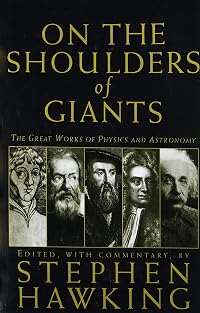
On the Shoulders of Giants: The Great Works of Physics and Astronomy
by Stephen Hawking (Editor)
On This Page
Description
The world-renowned physicist presents a revolutionary look at the momentous discoveries that changed the perception of the world with this first-ever compilation of seven classic works on physics and astronomy. Features landmark writings by some of the world's great thinkers, including Copernicus, Newton, and Kepler. Illustrations.Tags
Recommendations



Member Reviews
(Original Review, 2002)
Back in the day, Einstein opened up my head to what I thought of as the architecture of the way things are, that level of intelligence/information where I clearly understood what reality was and wasn’t despite the limitations of my senses. I'd try to hold onto it but it ultimately faded. I'd feel myself coming closer and closer back to dull reality, each and every time. There's a scene in the film “Lucy” where she's looking at a tree which seems alive, pulsing w/movement and brilliantly coloured light. Ages ago, my friends and I called them jizzles and we'd see them anywhere anything grew (resulting in multiple trips in the woods, old cemeteries, anywhere there was foliage and we couldn't see buildings). We show more live at a gross, aggregated level of existence. The levels of explanation of quantum physics does not change life as we experience it. Pure science would struggle to explain fully everyday events because of their complexities, unlike in laboratory conditions, but somehow we deal with them in actual life.
If you are interested in physics try learning more basic things first (that are also more solidly founded), try learning basic quantum mechanics and special and general relativity. That will already keep you busy for a long time and they are necessary to understand more advanced work anyway. These "I'll teach you most advanced things / I'll teach you what time is without bothering you with any of the basics" most of the time just mislead more than inform - especially if they are this far out and use baity books like this one.
Physics isn't about just making any speculative fancy-sounding claims; it's about testing claims and reproducing observations and thereby gaining confidence in the claims. It isn't automatically "progressive" to make speculative claims that have little physical foundation. Again if you are really interested in physics there's 100 years (more than enough) of modern physics to catch up with, which even students take years to learn. This is solid work that has reached a status that is as close to fact as possible in science.
The more I read this book (and bookmark to go back to later), the more I know I have to learn before beginning to understand. I think it's worth reading it, actually. Also, I spend a lot of time staring off and thinking about what I've just read. The same cannot be said of Hawking’s introductions. What was their purpose? Sell the book? Alas, the publishing industry at play here again. Even Derrida didn't go as far as claiming that the text transcended the whole of material constraints.
5 stars for the original texts; 1 star for the introductions. 3 stars altogether. show less
Back in the day, Einstein opened up my head to what I thought of as the architecture of the way things are, that level of intelligence/information where I clearly understood what reality was and wasn’t despite the limitations of my senses. I'd try to hold onto it but it ultimately faded. I'd feel myself coming closer and closer back to dull reality, each and every time. There's a scene in the film “Lucy” where she's looking at a tree which seems alive, pulsing w/movement and brilliantly coloured light. Ages ago, my friends and I called them jizzles and we'd see them anywhere anything grew (resulting in multiple trips in the woods, old cemeteries, anywhere there was foliage and we couldn't see buildings). We show more live at a gross, aggregated level of existence. The levels of explanation of quantum physics does not change life as we experience it. Pure science would struggle to explain fully everyday events because of their complexities, unlike in laboratory conditions, but somehow we deal with them in actual life.
If you are interested in physics try learning more basic things first (that are also more solidly founded), try learning basic quantum mechanics and special and general relativity. That will already keep you busy for a long time and they are necessary to understand more advanced work anyway. These "I'll teach you most advanced things / I'll teach you what time is without bothering you with any of the basics" most of the time just mislead more than inform - especially if they are this far out and use baity books like this one.
Physics isn't about just making any speculative fancy-sounding claims; it's about testing claims and reproducing observations and thereby gaining confidence in the claims. It isn't automatically "progressive" to make speculative claims that have little physical foundation. Again if you are really interested in physics there's 100 years (more than enough) of modern physics to catch up with, which even students take years to learn. This is solid work that has reached a status that is as close to fact as possible in science.
The more I read this book (and bookmark to go back to later), the more I know I have to learn before beginning to understand. I think it's worth reading it, actually. Also, I spend a lot of time staring off and thinking about what I've just read. The same cannot be said of Hawking’s introductions. What was their purpose? Sell the book? Alas, the publishing industry at play here again. Even Derrida didn't go as far as claiming that the text transcended the whole of material constraints.
5 stars for the original texts; 1 star for the introductions. 3 stars altogether. show less
While this book is an excellent collection of science writings, it also shows how science writing has evolved since the time of Copernicus. Included in each section is a short biography of each writer. Some of the works are rather confusing to me. For instance, Kepler spends most of his time talking about ratios of planetary distances and relating them to music.
Copernicus speaks of his calculations and observations, finding a number of astronomical distances and things. Of course he uses Euclidean geometry throughout, which is something I really need to brush up on.
Galileo uses discourse between some imaginary people to discuss his methods and ideas.
Kepler uses ratios and observations collected by Tycho Brahe. They must have really show more guarded their observations back in the day, though I don't get why...
Newton explains his ideas in terms of Euclidean geometry also, which hinders my understanding, since I have to flip back to find the little drawings.
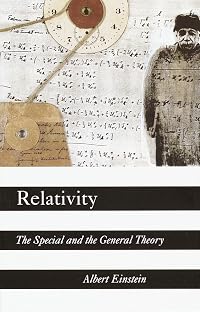
Einstein uses Vector Calculus and simple high school algebra to showcase his ideas, which are quite powerful in this day and age. It is rather amazing that he figured out most of this without experimental data, which only furthered his fame back when he was alive. show less
Copernicus speaks of his calculations and observations, finding a number of astronomical distances and things. Of course he uses Euclidean geometry throughout, which is something I really need to brush up on.
Galileo uses discourse between some imaginary people to discuss his methods and ideas.
Kepler uses ratios and observations collected by Tycho Brahe. They must have really show more guarded their observations back in the day, though I don't get why...
Newton explains his ideas in terms of Euclidean geometry also, which hinders my understanding, since I have to flip back to find the little drawings.
Einstein uses Vector Calculus and simple high school algebra to showcase his ideas, which are quite powerful in this day and age. It is rather amazing that he figured out most of this without experimental data, which only furthered his fame back when he was alive. show less
Exactly what it says on the tin. A quick slice of history followed by a seminal and historic work by the chap you have just learned a little about.
A fascinating flick through but hard work if you want to do more than that.
A fascinating flick through but hard work if you want to do more than that.
Kein populärwissenschaftliches Lesebuch, sondern ein "Hardcore"-Werk mit Originaltexten und Formeln
Edited by Stephen Hawking. The scientific writings of Copernicus, Kepler, Galileao, Newton, and Einstein collected into one book. For the advanced student.
The scientific writings of Copernicus, Keplar, Galileo, Newton, and Einstein, collected into one book.
Copernicus, Galilei, Kepler, Newton, Einstein,
Jan 25, 2012Dutch
Members
- Recently Added By
Author Information

Stephen William Hawking was born in Oxford, England on January 8, 1942. He received a first class honors degree in natural science from Oxford University and a Ph.D. from Cambridge University. He was a theoretical physicist and has held the post of Lucasian Professor of Mathematics at Cambridge University from 1982 until his death. In 1974, he was show more elected a Fellow of the Royal Society, the world's oldest scientific organization. In 1963, he learned he had amyotrophic lateral sclerosis, a neuromuscular wasting disease also known as Lou Gehrig's disease. The disease confined him to a wheelchair and reduced his bodily control to the flexing of a finger and voluntary eye movements, but left his mental faculties untouched. He became a leader in exploring gravity and the properties of black holes. He wrote numerous books including A Brief History of Time: From the Big Bang to Black Holes, Black Holes and Baby Universes, On the Shoulders of Giants, A Briefer History of Time, The Universe in a Nutshell, The Grand Design, and Brief Answers to the Big Questions. In 1982, he was named a commander of the British Empire. A film about his life, The Theory of Everything, was released in 2014 and was based on his first wife Jane Hawking's book Traveling to Infinity: My Life with Stephen. He died on March 14, 2018 at the age of 76. (Bowker Author Biography) show less
All Editions
Some Editions
Awards and Honors
Notable Lists
Series
Belongs to Publisher Series
Work Relationships
Common Knowledge
- Canonical title
- On the Shoulders of Giants: The Great Works of Physics and Astronomy
- Original publication date
- 2002
- People/Characters
- Nicolaus Copernicus; Johannes Kepler; Galileo Galilei; Isaac Newton; Albert Einstein
Classifications
- Genres
- Science & Nature, Nonfiction, General Nonfiction, History
- DDC/MDS
- 520 — Natural sciences & mathematics Astronomy Astronomy
- LCC
- QC6.2 .O5 — Science Physics Physics General
- BISAC
Statistics
- Members
- 1,328
- Popularity
- 18,094
- Reviews
- 7
- Rating
- (4.14)
- Languages
- 7 — Catalan, English, French, German, Portuguese, Slovenian, Spanish
- Media
- Paper
- ISBNs
- 21
- ASINs
- 6