

Nicolaus Copernicus (1473–1543)
Author of On the Revolutions of the Heavenly Spheres
About the Author
Nicolaus Copernicus was born in Torun, Poland, the son of a German mother and Slavic father. Like Tycho Brahe, he was raised by his uncle-the bishop of Ermeland. Copernicus was not trained as a scientist, nor was his job an officially scientific one. He studied mathematics, optics, and medicine at show more the University of Krakow and canon law at the University of Bologna in Italy. Copernicus received a degree from the University of Ferrara in 1506 and returned to Poland when his uncle presented him with the canonry of the cathedral at Frauenberg, East Prussia (now part of Poland). As canon of Frauenberg, Copernicus developed a routine in which he divided his "working" day into thirds. One-third was devoted to religious duties, another third was for providing charity to the sick in need of medical attention, and the final third was devoted to his hobby---the study of astronomy and philosophical meditation. Copernicus's life was devoted to understanding planetary motion. He became famous for proposing that the sun rather than earth was the center of the solar system. A preliminary version of this theory was circulated privately in 1514. However, the first publication of this radical idea, De Revolutionibus Orbium Coelestium (On the Revolutions of the Heavenly Spheres), was not published until 1543, the year of his death. Copernicus's theory finally was accepted nearly 100 years later, when measurements and analyses by Johannes Kepler, Brahe, Galileo, Sir Isaac Newton, and others permitted detailed, quantitative comparisons between predictions of the Copernican model and observation of planetary positions. he acceptance of a heliocentric solar system proposed by Copernicus represents the most fundamental change in our conception of the solar system. Because of Copernicus's leading role in this changing perspective, astronomers refer to this period as the Copernican Revolution. (Bowker Author Biography) show less
Image credit: Portrait by Torun, early 16th Century (Wikimedia Commons)
Works by Nicolaus Copernicus
Three Copernican treatises: the Commentariolus of Copernicus, the Letter against Werner, the Narratio prima of Rheticus (1971) 50 copies
Erster Entwurf seines Weltsystems : sowie eine Auseinandersetzung Johannes Keplers mit Aristoteles über die Bewegung de (1986) 3 copies
No Borderline 1 copy
Monetae Cudendae Ratio 1 copy
Nikolaus Kopernikus zum 400. Todestag am 24. Mai 1943 — Honoree — 1 copy
Associated Works
On the Shoulders of Giants: The Great Works of Physics and Astronomy (2002) — Contributor — 1,327 copies, 7 reviews
Tagged
Common Knowledge
- Canonical name
- Koperník, Mikuláš
- Other names
- Koppernigk, Niclas
Коперник, Николай - Birthdate
- 1473-02-19
- Date of death
- 1543-05-24
- Gender
- male
- Education
- Krakow Academy
University of Bologna
University of Padua (medicine)
University of Ferrara (canon law) - Occupations
- mathematician
astronomer
cleric
canon (of Frombork) - Awards and honors
- A number of things are named for him including craters on both the moon and Mars.
- Short biography
- Copernicus was apparently fluent in several languages but his written communications were mostly in Latin.
He studied law and medicine at Bologna and Padua and received his doctorate of canon law in Ferrara. However, mathematics and astronomy were always a great interest to him and his achievements in the field of observational and mathematical astronomy are the accomplishments for which Copernicus is remembered today. - Nationality
- Poland
- Places of residence
- Royal Prussia, Poland (birth)
Frombork, Poland (on the shore of the Baltic Sea | death)
Torun, Poland (birth)
Krakow, Poland
Bologna, Italy - Burial location
- Cathedral of Frauenburg (probable)
- Associated Place (for map)
- Poland
Members
Reviews
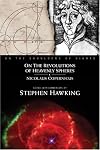
Copernicus writes of the heliocentric theory of the sun. A theory that eventually came to be accepted as fact even throughout all of the controversy. Published on his deathbed, Copernicus never got to see the results of the can of worms he opened.
In any case, there is no real prose, and most of the book is dense mathematical proofs and theorems developed from Euclid's Elements. It really hasn't aged well, but Copernicus and astronomers in general kept fantastic records of calendar dates. The show more reason it hasn't aged well is because of the methods of proof utilized. All of them are proved using diagrams and pure geometry. They don't even have modern terms for mathematical operations yet, so instead of equals and whatnot, you get something like "additosubtraction."
All in all it is a very fascinating read if you are the type of person that would go for this kind of subject. Beyond that, it is really quite dry and mathematical. show less
In any case, there is no real prose, and most of the book is dense mathematical proofs and theorems developed from Euclid's Elements. It really hasn't aged well, but Copernicus and astronomers in general kept fantastic records of calendar dates. The show more reason it hasn't aged well is because of the methods of proof utilized. All of them are proved using diagrams and pure geometry. They don't even have modern terms for mathematical operations yet, so instead of equals and whatnot, you get something like "additosubtraction."
All in all it is a very fascinating read if you are the type of person that would go for this kind of subject. Beyond that, it is really quite dry and mathematical. show less

[On the Revolution of the Heavenly spheres, ] Nicolaus Copernicus.
I did not actually read On the Revolution of the Heavenly spheres in its entirety, because the mathematics would have been way beyond my comprehension, but I did find something called Copernicus Work book edited by Patrick Bruskiewitch which contains a large extract from book one of "On the Revolution of the Spheres" as well as Copernicus "A Commentary on the Hypothesis concerning celestial motion" The work book contains an show more article which introduces Ptolemy's "Almagest" and the concept of the spheres. It also takes the story further with how the study of astronomy developed after the death of Copernicus over 70 years later with Tycho Brae and Galileo's telescope.
Book one of On the Revolution of the Heavenly spheres is perfectly readable and for me added some details that fleshed out my previous understanding of early astronomy. The headings of the sections will give a good idea of the content:
Preface to the revolutionibus with a dedication to the most Holy Lord Pope Paul III;
That the universe is spherical
That the earth is also spherical
How Earth with the water on it forms one sphere
That the motion of the Heavenly bodies is uniform, circular and perpetual or composed of circular motion
Whether circular motion belongs to the earth and concerning its position
Of the vastness of the heavens compared with the size of the earth
Why the ancients believed the earth is at rest like a Centre in the middle of the Universe
The insufficiency of theses arguments and their refutation
Whether more than one motion can be attributed to the earth and of the centre of the universe
Of the Order of the Heavenly bodies
Explanation of the threefold motion of the earth
For anybody who may be interested in the workbook here is the link https://archive.org/stream/CopernicusWorkBook/Copernicus_Book#page/n41/mode/2up show less
I did not actually read On the Revolution of the Heavenly spheres in its entirety, because the mathematics would have been way beyond my comprehension, but I did find something called Copernicus Work book edited by Patrick Bruskiewitch which contains a large extract from book one of "On the Revolution of the Spheres" as well as Copernicus "A Commentary on the Hypothesis concerning celestial motion" The work book contains an show more article which introduces Ptolemy's "Almagest" and the concept of the spheres. It also takes the story further with how the study of astronomy developed after the death of Copernicus over 70 years later with Tycho Brae and Galileo's telescope.
Book one of On the Revolution of the Heavenly spheres is perfectly readable and for me added some details that fleshed out my previous understanding of early astronomy. The headings of the sections will give a good idea of the content:
Preface to the revolutionibus with a dedication to the most Holy Lord Pope Paul III;
That the universe is spherical
That the earth is also spherical
How Earth with the water on it forms one sphere
That the motion of the Heavenly bodies is uniform, circular and perpetual or composed of circular motion
Whether circular motion belongs to the earth and concerning its position
Of the vastness of the heavens compared with the size of the earth
Why the ancients believed the earth is at rest like a Centre in the middle of the Universe
The insufficiency of theses arguments and their refutation
Whether more than one motion can be attributed to the earth and of the centre of the universe
Of the Order of the Heavenly bodies
Explanation of the threefold motion of the earth
For anybody who may be interested in the workbook here is the link https://archive.org/stream/CopernicusWorkBook/Copernicus_Book#page/n41/mode/2up show less
This remarkable work stands as one of the supreme monuments of science. It profoundly influenced, among others, Galileo and Sir Isaac Newton.
De Revolutionibus Orbium Coelestium: Facsimile Reprint of the First Edition of 1543 by Nicolaus Copernicus
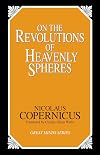
Facsimile of Kepler's copy, with his marginalia
Lists
Western Canon (1)
Awards


You May Also Like


Associated Authors
Statistics
- Works
- 27
- Also by
- 6
- Members
- 636
- Popularity
- #39,628
- Rating
- 3.9
- Reviews
- 7
- ISBNs
- 56
- Languages
- 8
- Favorited
- 4


