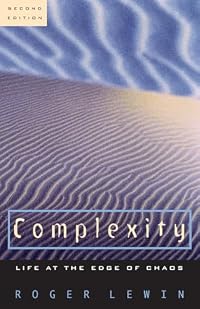
Complexity: Life at the Edge of Chaos
by Roger Lewin
On This Page
Description
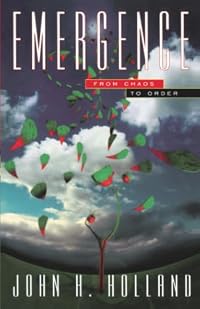
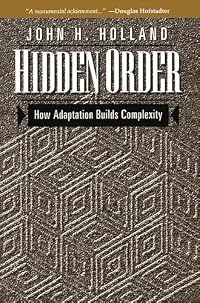
"Put together one of the world's best science writers with one of the universe's most fascinating subjects and you are bound to produce a wonderful book. . . . The subject of complexity is vital and controversial. This book is important and beautifully done."—Stephen Jay Gould "[Complexity] is that curious mix of complication and organization that we find throughout the natural and human worlds: the workings of a cell, the structure of the brain, the behavior of the stock market, the show more shifts of political power. . . . It is time science . . . thinks about meaning as well as counting information. . . . This is the core of the complexity manifesto. Read it, think about it . . . but don't ignore it."—Ian Stewart, Nature This second edition has been brought up to date with an essay entitled "On the Edge in the Business World" and an interview with John Holland, author of Emergence: From Chaos to Order. show lessTags
Recommendations


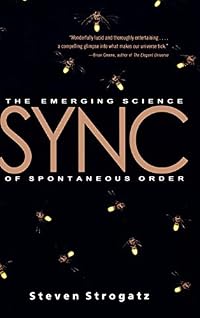

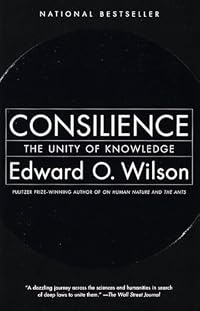
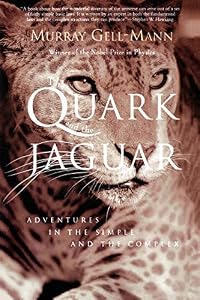
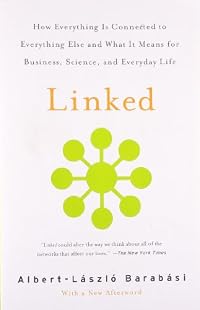
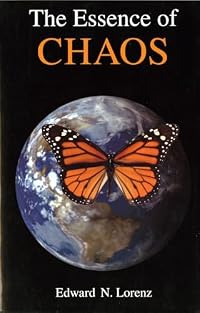






Member Recommendations

Member Reviews
Rather triumphally, the blurb for Roger Lewin's new book describes the author as "arguably the best professional science journalist in the English-speaking world". Times may have moved on since this book's publication in 1993, but it is difficult to credit that claim on the strength of its contents. In Complexity: Life at the Edge of Chaos Roger Lewin fails to do many of the basic things that science reporting really ought to do. Like clearly expounding the theory in the first place.
Lewin starts with a long chapter on the remains of a civilisation at Chaco Canyon, New Mexico. It is designed, I suppose, to exemplify the kernel of complexity theory. In an effort to be entertaining Lewin resorts to New Journalist techniques, recounting the show more hike into the canyon and even pausing to recount an episode of hayfever. This opening passage thus feels decidedly padded, and after ten pages (of a 200 page book) yields as its first dividend: "the phenomenon that may link these disparate worlds [being chemistry, physics, biology, economics and so on], including what propelled Chaco Canyon along its unique history, is called complexity".
Come again?
Lewin thereafter sketches what he means by complexity airily: that "dynamical" systems (can scientists resist elaborating for the sake of it - isn't the word "dynamic"?) will tend to behave, at an abstract level, in predictable ways: that the universe of evolutionary design space is constrained - heavily constrained, even - by architecture of a given ecosystem. At least, that's what I deduce him to be saying because whatever shape the book started out with is quickly lost as Lewin gallops around the leading academics in the evolutionary design space: Richard Dawkins, E. O. Wilson, Daniel Dennett, Stephen Jay Gould, Roger Penrose are among a host of names whose views are canvassed. Given the differences of opinion amongst them - in some cases, animosities run deep - it should be little surprise that the there of complexity Lewin sets out to describe remains elusive.
In the nearly 20 years since its publication there has been much literature about Evolution, but less talk of complexity, and while there are some interesting asides and snippets in this brief book, most of the interesting material in it - game theory, Conway's Game of Life, emergence, evolution and so on, have been covered more comprehensively and more recently by the academics Lewin mentions in this book. show less
Lewin starts with a long chapter on the remains of a civilisation at Chaco Canyon, New Mexico. It is designed, I suppose, to exemplify the kernel of complexity theory. In an effort to be entertaining Lewin resorts to New Journalist techniques, recounting the show more hike into the canyon and even pausing to recount an episode of hayfever. This opening passage thus feels decidedly padded, and after ten pages (of a 200 page book) yields as its first dividend: "the phenomenon that may link these disparate worlds [being chemistry, physics, biology, economics and so on], including what propelled Chaco Canyon along its unique history, is called complexity".
Come again?
Lewin thereafter sketches what he means by complexity airily: that "dynamical" systems (can scientists resist elaborating for the sake of it - isn't the word "dynamic"?) will tend to behave, at an abstract level, in predictable ways: that the universe of evolutionary design space is constrained - heavily constrained, even - by architecture of a given ecosystem. At least, that's what I deduce him to be saying because whatever shape the book started out with is quickly lost as Lewin gallops around the leading academics in the evolutionary design space: Richard Dawkins, E. O. Wilson, Daniel Dennett, Stephen Jay Gould, Roger Penrose are among a host of names whose views are canvassed. Given the differences of opinion amongst them - in some cases, animosities run deep - it should be little surprise that the there of complexity Lewin sets out to describe remains elusive.
In the nearly 20 years since its publication there has been much literature about Evolution, but less talk of complexity, and while there are some interesting asides and snippets in this brief book, most of the interesting material in it - game theory, Conway's Game of Life, emergence, evolution and so on, have been covered more comprehensively and more recently by the academics Lewin mentions in this book. show less
A fairly early book on complexity sciences, shown mostly through conversations between the author and complexity science researchers in a variety of fields. As someone on the verge of getting her PhD in Complexity Sciences in 2012, I found it interesting to see what people in the 1990s thought about the field. I particularly enjoyed reading about the work on patterns of social complexity, which is not an area I know much about. The chapter on consciousness surprised me... I don't know that many complexity scientists are still trying to explain consciousness as an emergent property, but it sort of makes sense to me.
Things I did not enjoy:
- the repetitive nature of some of the interviews, especially the really heavy-handed pointing out show more of connections to early discussion.
- the over-explaining of concepts of mathematics and computer science. I suppose general computer literacy was probably lower in the 90s, but even so this felt a little patronising in places.
- some of the weird asides that didn't have much to do with the theme, e.g. the time he had hayfever, the conversation about some hiker going missing in Dartmoor, and a really weird comment about "urban Jews".
If you want to read about complexity science, there are some much better (and more recent) books out there, e.g. Deep Simplicity by John Gribbin and Sync by Steven Strogatz. show less
Things I did not enjoy:
- the repetitive nature of some of the interviews, especially the really heavy-handed pointing out show more of connections to early discussion.
- the over-explaining of concepts of mathematics and computer science. I suppose general computer literacy was probably lower in the 90s, but even so this felt a little patronising in places.
- some of the weird asides that didn't have much to do with the theme, e.g. the time he had hayfever, the conversation about some hiker going missing in Dartmoor, and a really weird comment about "urban Jews".
If you want to read about complexity science, there are some much better (and more recent) books out there, e.g. Deep Simplicity by John Gribbin and Sync by Steven Strogatz. show less
Interesting. Half-way through it at the moment, and have felt the need to post a review at the end, but I know how often that thought isn't followed up. So, here's an interim to be going on with ...
Lots of flag-waving of Complexity as the next big thing, but yet all these years on and it's not attained any recognition to my mind. I recognise a lot of the names that are popping up, but the two or three who form the backbone of the book aren't among them. (I've yet to check the references at the back of my personal collection of books that would have been impacted by the ideas here.) I think the reason is that ideas are either just wrong, or haven't been attacked by a statistical mathematician. Computer programs that throw up results that show more 'look like a power law' probably do have a best-fit rule, but I'm betting it isn't something so simplistic as a power law. Another thing that grates is the consideration of the Cambrian explosion: first there was uni-cellular life, then multi-cellular life, and then a profusion and a winnowing as larger-scale body-plans proliferated ... and then a long time after came the Cambrian explosion which is only recognisable because of the development of bony structures. The main person that Lewin tracks seems to have made the same mistake as Stephen J. Gould in thinking that the Cambrian explosion is special, whereas it's more likely just a point in the decline of the variety of body plans after an earlier burgeoning which would have been the really interesting stage at which to point a complexity analysis. Simon Conway Morris is mentioned in passing, but doesn't exist in the index - perhaps if his work had been studied a bit more closely then the path to complexity might have been clearer. I'm just at the bit where Gaia is becoming the focus, and I'll be interested to see if the ideas that Dawkins explores in 'The Extended Phenotype' are recognised.
I know I have the advantage of hindsight, but this is really looking like a dead-end (at least in the exploration of biology/evolution) although the field of 'complex systems' does seem to have a life still. Let's see if I have a better opinion when I complete the remaining half of the book.
* * * * *
Finished. I did review my library to see if there was any resonance of these ideas: well, they were mentioned in passing and there was a chapter on it in Concilience, but on the whole they were dismissed as having a wider impact. I found the last chapter interesting because Lewin summed up the investigations he had taken in putting this book together, and came to a conclusion that seemed judicious. My thoughts chimed more with those of Will Provine, also represented in the last chapter, who seemed to see the consideration of the force of Complexity within biology as just wishful thinking (my words). show less
Lots of flag-waving of Complexity as the next big thing, but yet all these years on and it's not attained any recognition to my mind. I recognise a lot of the names that are popping up, but the two or three who form the backbone of the book aren't among them. (I've yet to check the references at the back of my personal collection of books that would have been impacted by the ideas here.) I think the reason is that ideas are either just wrong, or haven't been attacked by a statistical mathematician. Computer programs that throw up results that show more 'look like a power law' probably do have a best-fit rule, but I'm betting it isn't something so simplistic as a power law. Another thing that grates is the consideration of the Cambrian explosion: first there was uni-cellular life, then multi-cellular life, and then a profusion and a winnowing as larger-scale body-plans proliferated ... and then a long time after came the Cambrian explosion which is only recognisable because of the development of bony structures. The main person that Lewin tracks seems to have made the same mistake as Stephen J. Gould in thinking that the Cambrian explosion is special, whereas it's more likely just a point in the decline of the variety of body plans after an earlier burgeoning which would have been the really interesting stage at which to point a complexity analysis. Simon Conway Morris is mentioned in passing, but doesn't exist in the index - perhaps if his work had been studied a bit more closely then the path to complexity might have been clearer. I'm just at the bit where Gaia is becoming the focus, and I'll be interested to see if the ideas that Dawkins explores in 'The Extended Phenotype' are recognised.
I know I have the advantage of hindsight, but this is really looking like a dead-end (at least in the exploration of biology/evolution) although the field of 'complex systems' does seem to have a life still. Let's see if I have a better opinion when I complete the remaining half of the book.
* * * * *
Finished. I did review my library to see if there was any resonance of these ideas: well, they were mentioned in passing and there was a chapter on it in Concilience, but on the whole they were dismissed as having a wider impact. I found the last chapter interesting because Lewin summed up the investigations he had taken in putting this book together, and came to a conclusion that seemed judicious. My thoughts chimed more with those of Will Provine, also represented in the last chapter, who seemed to see the consideration of the force of Complexity within biology as just wishful thinking (my words). show less
Entertaining journalism but not reliable. For example, he is wrong about Langton's parents. Sometimes it seems like he is just making it up.
Great scientific, mathematical, and philosophical journey of chaos, order, and complexity!
Los científicos vienen afirmando desde hace ya varias décadas que la ciencia del siglo XXI será la de los sistemas complejos.
Jan 9, 2021Spanish
Ratings
Members
- Recently Added By
Lists

In Our Time books
4,934 works; 2 members
Author Information

23+ Works 3,679 Members
Roger Lewin is an associate of the Peabody Museum at Harvard University.
Series
Belongs to Publisher Series
Metatemas (41)
Common Knowledge
- Canonical title*
- Complejidad : el caos como generador del orden
- Original title
- Complexity: Life at the Edge of Chaos
- Alternate titles*
- Complejidad : el caos como generador del orden
- Original publication date
- 1992-12
- Dedication
- For Gail
- First words
- The climb was short but steep, more of a scramble really.
- Original language
- English
*Some information comes from Common Knowledge in other languages. Click "Edit" for more information.
Classifications
Statistics
- Members
- 446
- Popularity
- 68,224
- Reviews
- 6
- Rating
- (3.63)
- Languages
- 5 — Dutch, English, French, German, Spanish
- Media
- Paper
- ISBNs
- 11
- ASINs
- 2