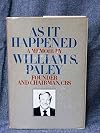
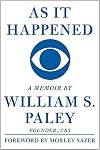
As it happened: A memoir
by William S. Paley
On This Page
Description
As it Happened is a landmark memoir, the first of its kind by a giant of the communications media. It is the intimate and straightforward story of an original, the life and growth of an extraordinary man and the company he built, CBS. In the book, William S. Paley reminisced about his personal life and his life with CBS--from the celebrities of the entertainment world to the business and political leaders of America to the journalistic controversies still in the news. Paley bought CBS when show more it was a small struggling company called United Independent Broadcasting and when he was a young man still in his twenties. Within months he had begun a transformation which shaped CBS into one of the world's greatest communications empires. And still he found time to enjoy the "Roaring Twenties" in Paris, Philadelphia, Los Angeles, and New York. A brilliant and creative businessman dealing for high stakes, Paley foresaw the cultural and informational impact of radio, and later, television. With an uncanny eye for spotting entertainment talent, he "discovered" for radio Bing Crosby, Kate Smith, Will Rogers, Frank Sinatra, and Paul Whiteman; and those he did not discover, he lured to CBS: Jack Benny, Amos and Andy, George Burns, Red Skelton, and a host of others. But this book covers more than radio and television--it is about the tastes and trends of American culture, written by the man who helped to create and refine many of them. William S. Paley was CBS. His life touched virtually every major event of the twentieth century. This is a fascinating and revealing work about a man who perhaps more than any other, brought the great events of our times to us. show lessTags
Recommendations




































Member Reviews
Want an understanding of technology and innovation in the twentieth century? Then read the autobiography William Paley, founder and chairman of CBS, As It Happened: A Memoir. Bill Paley learned the art of business from his father who owned a cigar factory. Still a young man in his twenties, Paley took some of his business windfall and invested the money into radio creating CBS Studios. This is a fascinating history of innovation in America--radio to television to music are all covered from the twenties up to through the seventies. Paley was inventing the business as he went along--and he writes of making quick and early mistakes.
This is a good book to read after Tim Wu's Master of the Switch: The Rise and Fall of Information Empires. show more While Wu's book covers the entire industries and wave and changes of innovation in control, it is then interesting to get Paley's perspective from heading one of the most powerful information empires. You really see through this book how much control Paley did have over media--luckily as he describes in the book he had ideas about fairness and neutrality. Although there are a few times in the book I cringed a bit to realize how much control he had.
During his lifetime a few things that Paley accomplished:
*rise of radio
*rise of television (and he tried to get color tv from the beginning)
*television--mass medium or educational content? and how do you mix both
*WWII--went to Europe and helped `
*major collector of art--picassos, matisse, etc.
*Columbia Records and record club show less
This is a good book to read after Tim Wu's Master of the Switch: The Rise and Fall of Information Empires. show more While Wu's book covers the entire industries and wave and changes of innovation in control, it is then interesting to get Paley's perspective from heading one of the most powerful information empires. You really see through this book how much control Paley did have over media--luckily as he describes in the book he had ideas about fairness and neutrality. Although there are a few times in the book I cringed a bit to realize how much control he had.
During his lifetime a few things that Paley accomplished:
*rise of radio
*rise of television (and he tried to get color tv from the beginning)
*television--mass medium or educational content? and how do you mix both
*WWII--went to Europe and helped `
*major collector of art--picassos, matisse, etc.
*Columbia Records and record club show less
GREAT CONDITION!
Ratings
Members
- Recently Added By
Author Information

2 Works 33 Members
William Paley heard radio for the first time on a crystal set in 1925. He was then 24 and working for his father's prosperous cigar-manufacturing company. The Paley family bought advertising time on the new medium and saw sales of their La Palina cigars increase tremendously as a result. In 1928, Paley became the owner of the struggling Columbia show more radio network. From this humble beginning, he built the Columbia Broadcasting System (CBS), branching out into television in the 1950s. CBS became a central player, first in radio, then in television. For years its chief rival was the National Broadcasting Company (NBC). The American Broadcasting Company (ABC) joined them later. Bill Paley had a consummate feel for both the advertising possibilities of radio and television and the tastes of their audiences. Programming, he said, "must appeal to either the emotions or the self-interest [of the audience member], not merely to his intellect." His approach was hugely successful: CBS attracted enormous audiences, which enabled it to attract big-spending advertisers. While Paley concentrated on developing lowbrow popular programming, his deputy, Frank Stanton, and his star journalist, Edward R. Murrow, developed superior news, educational, and cultural programming, thereby giving CBS an image of class, so that it was called "the Tiffany network." Paley lived the life of a socialite and art collector as well as businessman. He was married several times and was father and stepfather to four children. As he aged and network dominance of broadcasting declined, he lost or ceded (depending on the analysis) control of his empire to Laurence Tisch, chairman of the Loewes Corporation, and CBS went through a period of internal battling and retrenchment. But Paley was a strong leader and left the important legacy of using some of the huge profits of popular programming to support superior news programming. (Bowker Author Biography) show less
Classifications
- Genres
- Nonfiction, Biography & Memoir, Anthropology, Business
- DDC/MDS
- 384.54 — Society, government, & culture Commerce, communications & transportation regulations Communications Broadcasting Radio broadcasting
- LCC
- HE8689.8 .P34 — Social sciences Transportation and communications Transportation and communications Telecommunication industry. Telegraph
Statistics
- Members
- 32
- Popularity
- 882,300
- Reviews
- 2
- Rating
- (3.75)
- Languages
- English
- Media
- Paper, Ebook
- ISBNs
- 2
- ASINs
- 2