On This Page
Description
The wild adventures of Ostap Bender continue in this sequel to The Twelve Chairs. The humorous novel is one of the most prolific pieces of satire about Soviet Union. A secretive Soviet millionaire becomes Ostap's new obsession and target in this volume. The quest to solve this mystery takes us to the depths of chaos in the liberal economic programmes of Soviet Union.Tags
Recommendations















Member Reviews
More adventures with Ostap Bender, the protagonist of The Twelve Chairs and one of the great characters in Russian literature, resurrected here in The Golden Calf.
There is a lightness to this novel as it rollicks through Bender’s adventures, while at the same time satirizing the Soviet Union, religion, and stupidity in all forms. “I have developed very serious differences with the Soviet regime. The regime wants to build socialism, and I don’t,” says Ostap early on in the novel, to explain why he wants to get his hands on enough money to flee to Brazil. The con man comes to know of another con man who has amassed a hidden fortune while living the quiet and humble life of a clerk, and along with his cohorts, sets out to fleece show more him.
Ilf & Petrov write with intelligence, zaniness, and fun, particularly for their time. I loved the manager who has rubber stamps made to speed up how quickly he gets through notes that come across his desk, which start from things like “No objection” and “Make it happen”, progress to “Are they completely crazy?” and “Give me a break”, and finally a very large stamp with an all-purpose form letter. Something for everyone here.
Quotes:
On aspirations:
“Parallel to the big world inhabited by big people and big things, there’s a small world with small people and small things. In the big world, they invented the diesel engine, wrote the novel Dead Souls, built the Dnieper Hydroelectric Station, and flew around the globe. In the small world, they invented the blowout noisemaker, wrote the song Little Bricks, and built Soviet Ambassador-style pants. People in the big world aspire to improve the lives of all humanity. The small world is far from such high-mindedness. Its inhabitants have only one desire – to get by without going hungry.”
On communism:
“’The Soviet regime took everything from me,’ thought the former school district superintendent, ‘rank, medals, respect, bank account. It even took over my thoughts. But there’s one area that’s beyond the Bolshevik’s reach: the dreams given to man by God. Night will bring me peace. In my dreams, I will see something that I’d like to see.’
The very next night, God gave Fyodor Nikitich a terrible dream. He dreamt that he was sitting in an office corridor that was lit by a small kerosene lamp. He sat there with the knowledge that, at any moment, he was to be removed from the board. Suddenly a steel door opened, and his fellow office workers ran out shouting: ‘Khvorobyov needs to carry more weight!’ He wanted to run but couldn’t.
Fyodor Nikitich woke up in the middle of the night. He said a prayer to God, pointing out to Him that an unfortunate error had been made, and that the dream intended for an important person, maybe even a party member, had arrived at the wrong address. He, Khvorobyov, would like to see the Tsar’s ceremonial exit from the Cathedral of the Assumption, for starters.”
And:
“’In Soviet Russia, the only place where a normal person can live is an insane asylum,’ he said, draping himself in a blanket. ‘Everything else is super-bedlam. I cannot live with the Bolsheviks, no sir! I’d rather live here, among common lunatics. At least they aren’t building socialism. Plus, here they feed you, while out there, in bedlam, you need to work. And I have no interest of working for their socialism. Finally, I have my personal freedom here. Freedom of conscience, freedom of speech…’”
On laziness in marriage:
“Lokhankin brushed the crumbs off his beard, threw his wife a cautious, evasive glance, and quieted down on his couch. He really didn’t want to part with Barbara. Despite numerous shortcomings, Barbara had two very important merits: a large white bosom and a steady job. Basilius had never had a job. A job would have interfered with his reflections on the role of the Russian intelligentsia, the social group of which he considered himself a member. As a result, Lokhankin’s prolonged ruminations boiled down to pleasant and familiar themes: ‘Basilius Lokhankin and His Significance,’ ‘Lokhankin and the Tragedy of Russian Liberalism,’ ‘Lokhankin and His Role in the Russian Revolution.’”
On religion:
“The grand strategist didn’t care for Catholic priests. He held an equally negative opinion of rabbis, Dalai Lamas, Orthodox clergy, muezzins, shamans, and other purveyors of religion.
‘I’m into deception and blackmail myself,’ he said. ‘Right now, for example, I’m trying to extract a large amount of money from a certain intransigent individual. But I don’t accompany my questionable activities with choral singing, or the roar of the pipe organ, or silly incantations in Latin or Old Church Slavonic. I generally prefer to operate without incense or astral bells.’” show less
There is a lightness to this novel as it rollicks through Bender’s adventures, while at the same time satirizing the Soviet Union, religion, and stupidity in all forms. “I have developed very serious differences with the Soviet regime. The regime wants to build socialism, and I don’t,” says Ostap early on in the novel, to explain why he wants to get his hands on enough money to flee to Brazil. The con man comes to know of another con man who has amassed a hidden fortune while living the quiet and humble life of a clerk, and along with his cohorts, sets out to fleece show more him.
Ilf & Petrov write with intelligence, zaniness, and fun, particularly for their time. I loved the manager who has rubber stamps made to speed up how quickly he gets through notes that come across his desk, which start from things like “No objection” and “Make it happen”, progress to “Are they completely crazy?” and “Give me a break”, and finally a very large stamp with an all-purpose form letter. Something for everyone here.
Quotes:
On aspirations:
“Parallel to the big world inhabited by big people and big things, there’s a small world with small people and small things. In the big world, they invented the diesel engine, wrote the novel Dead Souls, built the Dnieper Hydroelectric Station, and flew around the globe. In the small world, they invented the blowout noisemaker, wrote the song Little Bricks, and built Soviet Ambassador-style pants. People in the big world aspire to improve the lives of all humanity. The small world is far from such high-mindedness. Its inhabitants have only one desire – to get by without going hungry.”
On communism:
“’The Soviet regime took everything from me,’ thought the former school district superintendent, ‘rank, medals, respect, bank account. It even took over my thoughts. But there’s one area that’s beyond the Bolshevik’s reach: the dreams given to man by God. Night will bring me peace. In my dreams, I will see something that I’d like to see.’
The very next night, God gave Fyodor Nikitich a terrible dream. He dreamt that he was sitting in an office corridor that was lit by a small kerosene lamp. He sat there with the knowledge that, at any moment, he was to be removed from the board. Suddenly a steel door opened, and his fellow office workers ran out shouting: ‘Khvorobyov needs to carry more weight!’ He wanted to run but couldn’t.
Fyodor Nikitich woke up in the middle of the night. He said a prayer to God, pointing out to Him that an unfortunate error had been made, and that the dream intended for an important person, maybe even a party member, had arrived at the wrong address. He, Khvorobyov, would like to see the Tsar’s ceremonial exit from the Cathedral of the Assumption, for starters.”
And:
“’In Soviet Russia, the only place where a normal person can live is an insane asylum,’ he said, draping himself in a blanket. ‘Everything else is super-bedlam. I cannot live with the Bolsheviks, no sir! I’d rather live here, among common lunatics. At least they aren’t building socialism. Plus, here they feed you, while out there, in bedlam, you need to work. And I have no interest of working for their socialism. Finally, I have my personal freedom here. Freedom of conscience, freedom of speech…’”
On laziness in marriage:
“Lokhankin brushed the crumbs off his beard, threw his wife a cautious, evasive glance, and quieted down on his couch. He really didn’t want to part with Barbara. Despite numerous shortcomings, Barbara had two very important merits: a large white bosom and a steady job. Basilius had never had a job. A job would have interfered with his reflections on the role of the Russian intelligentsia, the social group of which he considered himself a member. As a result, Lokhankin’s prolonged ruminations boiled down to pleasant and familiar themes: ‘Basilius Lokhankin and His Significance,’ ‘Lokhankin and the Tragedy of Russian Liberalism,’ ‘Lokhankin and His Role in the Russian Revolution.’”
On religion:
“The grand strategist didn’t care for Catholic priests. He held an equally negative opinion of rabbis, Dalai Lamas, Orthodox clergy, muezzins, shamans, and other purveyors of religion.
‘I’m into deception and blackmail myself,’ he said. ‘Right now, for example, I’m trying to extract a large amount of money from a certain intransigent individual. But I don’t accompany my questionable activities with choral singing, or the roar of the pipe organ, or silly incantations in Latin or Old Church Slavonic. I generally prefer to operate without incense or astral bells.’” show less
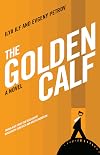
The Golden Calf, a classic Russian novel now available in a new English translation published by Open Letter Books, is an exuberant road trip story, a financial thriller, an examination of the criminal underworld, and a social commentary, all rolled into one package. The story spans the era of Lenin’s New Economic Policy, under which private enterprises coexisted with state entities, to the time of Stalin’s rigid program of collectivization. Set against this backdrop of significant social upheaval, Ostap Bender, facetiously nicknamed the Grand Strategist, devises a plan to swindle an “underground millionaire,” named Koreiko, out of a million rubbles. Bender, along with a colorful band of fellow thieves, tracks Koreiko through show more multiple cities via planes, trains, and automobiles (though Bender’s attempt to board an airplane ultimately fails). In the meantime, Koreiko, who disguises himself as a lowly clerk to avoid detection, hoards his past earnings from dubious deals while “saving himself for capitalism.”
In a brief note from the authors preceding the novel, Ilf and Petrov resolve “to make the novel as funny as possible,” and they have succeeded. Some of the humor is playfully absurd: “It was that time, between five and six in the morning, when … the city is light, clean, and quiet, like a state bank. At moments like this, one feels like crying and wants to believe that yogurt is indeed tastier and healthier than vodka.” Other passages carry more subversive meanings: “The cathedral was enormous. Thorny and sharp, it ripped into the sky like a fish bone. It stuck in your throat.” Throughout, The Golden Calf wears its political and social messages lightly, never forgetting that a good story is more entertaining (and more likely to escape censorship) than a political statement.
Some of The Golden Calf’s masterfully constructed set pieces have little connection to the novel’s primary action, and, when necessary to keep momentum high, Ilf and Petrov have no qualms about glossing over the finer details holding the plot together. While resulting in a somewhat chaotic narrative, this unapologetic disregard for relevance and order contributes to The Golden Calf’s undeniable charm. Wouldn’t you rather read about the escape of one of Bender’s inept colleagues from the clutches of two spell-casting priests than about how Bender managed to collect the necessary details about Koreiko’s past exploits? I certainly would. For a hilarious and utterly unique reading experience, pick up a copy of The Golden Calf. Then, sit back, relax, and enjoy the ride.
This review also appears on my blog Literary License. show less
In a brief note from the authors preceding the novel, Ilf and Petrov resolve “to make the novel as funny as possible,” and they have succeeded. Some of the humor is playfully absurd: “It was that time, between five and six in the morning, when … the city is light, clean, and quiet, like a state bank. At moments like this, one feels like crying and wants to believe that yogurt is indeed tastier and healthier than vodka.” Other passages carry more subversive meanings: “The cathedral was enormous. Thorny and sharp, it ripped into the sky like a fish bone. It stuck in your throat.” Throughout, The Golden Calf wears its political and social messages lightly, never forgetting that a good story is more entertaining (and more likely to escape censorship) than a political statement.
Some of The Golden Calf’s masterfully constructed set pieces have little connection to the novel’s primary action, and, when necessary to keep momentum high, Ilf and Petrov have no qualms about glossing over the finer details holding the plot together. While resulting in a somewhat chaotic narrative, this unapologetic disregard for relevance and order contributes to The Golden Calf’s undeniable charm. Wouldn’t you rather read about the escape of one of Bender’s inept colleagues from the clutches of two spell-casting priests than about how Bender managed to collect the necessary details about Koreiko’s past exploits? I certainly would. For a hilarious and utterly unique reading experience, pick up a copy of The Golden Calf. Then, sit back, relax, and enjoy the ride.
This review also appears on my blog Literary License. show less
Satire at its finest, laugh out loud humor, madcap adventure and a real eye opener on the illusion that things actually change over time.
Even funnier than Twelve Chairs, I think. A few special favorite moments:
- Lokhankin's hunger strike and his wife Barbara's response ("Eat, you nasty man! Eat, you slave-master!")
- All Bender's takedowns of Panikovsky
- Panikovsky pretending to be a blind man (Homer, Milton, and Panikovsky...oh yeah.)
- chapter titles: Gas Is Yours, Ideas Ours
- Bureau for the Collection of Horns and Hoofs. Vice President for Hoofs. ...This is hysterical.
Basically, there were quite a few lols.
You know, I really wish thatBender had succeeded in the end , though I get that it couldn't happen.
- Lokhankin's hunger strike and his wife Barbara's response ("Eat, you nasty man! Eat, you slave-master!")
- All Bender's takedowns of Panikovsky
- Panikovsky pretending to be a blind man (Homer, Milton, and Panikovsky...oh yeah.)
- chapter titles: Gas Is Yours, Ideas Ours
- Bureau for the Collection of Horns and Hoofs. Vice President for Hoofs. ...This is hysterical.
Basically, there were quite a few lols.
You know, I really wish that
I suspect that my rating of this book had something to do with my mood at the time of reading it. It's a madcap comedy, where a group of Misfits steal money from a man who stole money from others. Sometimes they steal from communities. I just didn't find much to admire in this theme. DNF
Cartea este o satiră spumoasă și incisivă despre lăcomie, corupție și absurditățile vieții sovietice interbelice, urmărind aventurile inegalabilului escroc Ostap Bender în încercarea sa de a da lovitura vieții.
📖 Despre autori
a) Ilia Ilf (1897–1937) și Evgheni Petrov (1903–1942) au fost doi scriitori și jurnaliști sovietici care au format un celebru cuplu literar.
b) Sunt cunoscuți pentru satira lor plină de umor, ironie și observație socială, cu accente de comedie absurdă.
c) Cele două mari romane ale lor – Douăsprezece scaune și Vițelul de aur – au devenit clasice ale literaturii ruse și universale.
📚 Despre volum
a) Publicat în 1931, romanul este continuarea directă a Douăsprezece scaune.
b) show more Personajul central, Ostap Bender, carismaticul „mare combinator”, pornește într-o nouă aventură, visând să devină milionar într-o societate unde capitalismul fusese teoretic abolit.
c) Romanul îmbină satira socială, umorul grotesc și aventura picarescă.
d) Este presărat cu replici memorabile și situații absurde, care au intrat în cultura populară.
🔎 Teme principale
a) Corupția și birocrația în societatea sovietică.
b) Contradicțiile sistemului comunist: sărăcia generală coexistă cu visul îmbogățirii rapide.
c) Tipologia escrocului inteligent și seducător ca simbol al adaptabilității.
d) Satira socială ca mijloc de critică a absurdității vieții cotidiene.
⚖️ Semnificație
a) Romanul este considerat una dintre cele mai importante opere satirice din literatura rusă a secolului XX.
b) Personajul Ostap Bender a devenit un arhetip literar și cultural, simbol al șmecheriei și ingeniozității.
c) Cartea dezvăluie, prin umor, tensiunile și ipocriziile unui regim politic rigid.
d) Continuă să fie actuală prin felul în care ridiculizează goana după bani și naivitatea colectivă. show less
📖 Despre autori
a) Ilia Ilf (1897–1937) și Evgheni Petrov (1903–1942) au fost doi scriitori și jurnaliști sovietici care au format un celebru cuplu literar.
b) Sunt cunoscuți pentru satira lor plină de umor, ironie și observație socială, cu accente de comedie absurdă.
c) Cele două mari romane ale lor – Douăsprezece scaune și Vițelul de aur – au devenit clasice ale literaturii ruse și universale.
📚 Despre volum
a) Publicat în 1931, romanul este continuarea directă a Douăsprezece scaune.
b) show more Personajul central, Ostap Bender, carismaticul „mare combinator”, pornește într-o nouă aventură, visând să devină milionar într-o societate unde capitalismul fusese teoretic abolit.
c) Romanul îmbină satira socială, umorul grotesc și aventura picarescă.
d) Este presărat cu replici memorabile și situații absurde, care au intrat în cultura populară.
🔎 Teme principale
a) Corupția și birocrația în societatea sovietică.
b) Contradicțiile sistemului comunist: sărăcia generală coexistă cu visul îmbogățirii rapide.
c) Tipologia escrocului inteligent și seducător ca simbol al adaptabilității.
d) Satira socială ca mijloc de critică a absurdității vieții cotidiene.
⚖️ Semnificație
a) Romanul este considerat una dintre cele mai importante opere satirice din literatura rusă a secolului XX.
b) Personajul Ostap Bender a devenit un arhetip literar și cultural, simbol al șmecheriei și ingeniozității.
c) Cartea dezvăluie, prin umor, tensiunile și ipocriziile unui regim politic rigid.
d) Continuă să fie actuală prin felul în care ridiculizează goana după bani și naivitatea colectivă. show less
It is surprising that I didn't note this one previously. This wa spurchased in Chicago a few years back and read on a snowy afternoon. It is a terrific farce. This certainly was peril of sorts, gevent the hot water Shostakovich found himself in for chord changes.
Members
- Recently Added By
Lists

Russian Literature
184 works; 35 members
Author Information

72+ Works 1,638 Members
The famous collection of Ilf and Petrov created the inimitable rogue and confidence man, Ostap Bender, whose adventures, with their frequent satiric thrusts at Soviet life, have become classics of Russian comic literature. In the first novel, The Twelve Chairs (1928), Bender searches for a hoard of jewels concealed in a set of dining-room chairs. show more In the second, The Little Golden Calf (1931), set in the Soviet Union under the first Five-Year Plan, Bender tries hard but fails to become a millionaire. A six-month car trip in 1935--36 through the United States resulted in a witty travelogue. The collaboration was broken by Ilf's untimely death from tuberculosis. Petrov was killed in a plane crash while working as a war correspondent. (Bowker Author Biography) show less

17+ Works 1,687 Members
Some Editions
Awards and Honors
Awards
Notable Lists
Bulgarian Big Read (54)
Series

Belongs to Publisher Series
Die Andere Bibliothek (340)
Work Relationships
Common Knowledge
- Canonical title
- The Golden Calf
- Original title
- Золотой телёнок; Zolotoj telenok
- Alternate titles*
- Het gouden kalf : roman in drie delen
- Original publication date
- 1931
- People/Characters
- Ostap Bender
- Important places*
- Rio de Janeiro, Brazilië
- Original language
- Russian
*Some information comes from Common Knowledge in other languages. Click "Edit" for more information.
Classifications
- Genres
- Fiction and Literature, General Fiction
- DDC/MDS
- 891.73 — Literature & rhetoric Asian Literature East Indo-European and Celtic literatures Russian and East Slavic languages Russian fiction
- LCC
- PG3476 .I44 .Z313 — Language and Literature Slavic languages and literatures. Baltic languages. Albanian language Slavic. Baltic. Albanian Russian literature Individual authors and works 1917-1960
- BISAC
Statistics
- Members
- 399
- Popularity
- 77,749
- Reviews
- 10
- Rating
- (4.19)
- Languages
- 15 — Czech, Dutch, English, Estonian, French, German, Hungarian, Italian, Lithuanian, Romanian, Russian, Croatian, Slovak, Spanish, Swedish
- Media
- Paper, Audiobook, Ebook
- ISBNs
- 50
- ASINs
- 7